

Nanomedicine Emerges as the New Frontier in Pharmaceutical Innovation
Precision medicine has been the most prominent concept in recent years. Across all aspects of healthcare, from diagnosis and treatment to prognosis, efforts are being made to identify appropriate approaches to realize precision medicine. Specifically, in the drug development process, precision therapy is reflected not only in the precise targeting of targeted drugs but also in the precise delivery methods enabled by novel biologics. Currently, nanomedicines utilizing nanomaterials as carriers are emerging as a new focus in the pharmaceutical industry, reshaping traditional drug development paradigms.
Nanomedicines: Drugs Delivered by Nanoscale Materials
Nanomedicine can be broadly defined as the application of nanoscale materials to improve human health. This includes the development of applications for early medical diagnosis and prevention, as well as improvements in the diagnosis, treatment, and follow-up care of many life-threatening diseases, including cancer, cardiovascular disease, diabetes, HIV/AIDS, Alzheimer’s disease, Parkinson’s disease, and various inflammatory and infectious diseases.
Nanomaterials, with sizes ranging from 1 to 100 nm, are comparable in dimension to fundamental biological materials such as DNA, yet possess a significantly increased surface area. Their applications span drug and gene delivery to biomedical imaging.
Nanomedicines possess characteristics such as small particle size, large specific surface area, high surface reactivity, numerous active centers, and strong adsorption capacity. Utilizing nanomaterials as drug carriers can enhance drug absorption and utilization, achieve efficient targeted delivery, prolong the elimination half-life of drugs, and reduce harmful side effects on normal tissues.
Formulations for the development of nanomedicine particles include polymeric nanoparticles, micelles, liposomes, dendrimers, metallic nanoparticles, and solid lipid nanoparticles. In 1995, researchers announced the first liposome-based nanodrug, doxorubicin, for tumor treatment. To date, owing to rapid scientific advancements, approximately 50 nanoparticle-based drugs have been developed.
The interactions between nanomedicines and biological environments (at the molecular, cellular, organ, and other levels) are based on a series of complex reactions between nanoparticles and biological media. Each biological environment is unique; therefore, the particle size, shape, arrangement, surface charge distribution, and surface chemistry of nanoparticles become key factors determining the efficiency of the reaction between nanomedicines and their surrounding media.
Nanomedicines are primarily influenced by three factors: biodistribution characteristics, cellular uptake rate, and the mechanisms of final clearance from tissues. The size of a drug determines how it is cleared from the body. Particles smaller than 10 nm are cleared by the kidneys, whereas particles larger than 10 nm are eliminated via the liver and the mononuclear phagocyte system.
A BCC Research report released this September stated that sales of nanostructure applications in the life sciences sector (such as nanoparticles, nanospheres, nanocapsules, and quantum dots) are expected to continue growing over the next five years. The global market for nanostructure applications in life sciences reached $17.8 billion in 2019 and is projected to reach $33.8 billion by 2024, with a compound annual growth rate (CAGR) of 13.7% anticipated over the five-year period.
Gold Nanoparticles (GNPs): Dual-Function Drug Carriers and Therapeutic Agents
Nanocarriers possess the ability to enhance the enhanced permeability and retention (EPR) effect in tumor tissues. Furthermore, nanomedicines offer the following advantages: co-delivery of multiple drugs to achieve synergistic therapeutic effects; targeted delivery of specific agents to tumor cells and the tumor microenvironment; simultaneous visualization of therapeutic efficacy based on novel imaging technologies; prolonged drug circulation time; controlled drug release; and optimization of treatment regimens to improve patient compliance.
It is worth noting that many widely used traditional chemotherapeutic agents, such as taxanes and doxorubicin, are associated with significant adverse effects and can induce drug-resistant mutations in various tumors, posing new challenges for cancer treatment. However, numerous existing studies have demonstrated the potential of nanomedicines to overcome these issues.
A particularly active area of nanomedicine research is the design of functionalized gold nanoparticles as versatile agents for biomedical imaging and drug delivery. Gold nanoparticles are renowned for their strong optical activity in the visible to near-infrared (NIR) wavelengths and are being actively investigated as contrast agents for optical imaging modalities. In particular, the NIR spectrum between 750 and 1300 nm provides a “biological window” for optical penetration through tissue, as hemoglobin, biological pigments, and water attenuate other wavelengths.
A new wave of research on gold nanoparticles has been driven in part by advances in the scalable synthesis of anisotropic gold particles. For example, gold nanorods (GNRs) with lengths well below 100 nm can now be fabricated, and their strong absorption in the near-infrared (NIR) region (spanning visible to near-infrared light) can significantly expand the capabilities of medical optical imaging modalities such as optical coherence tomography (OCT) and photoacoustic tomography (PAT).
However, gold nanoparticles are not merely passive imaging agents and carriers: most of the photons they absorb are converted into heat, generating a pronounced photothermal effect. At high gold nanoparticle concentrations and high laser powers, these photothermal effects can induce mild hyperthermia or, under lower-power irradiation, lead to ablation of nearby cells and tissues, thereby enhancing therapeutic efficacy through more subtle mechanisms. These effects have inspired new concepts in nanomedicine, where photothermal therapy is combined with diagnostic imaging or drug delivery, giving rise to novel combination therapies.
Delivery Systems Combining Nanomedicines with Microfluidics Design May Bring New Changes to the Industry
Despite the promising prospects of nanomedicine, its clinical and commercial outputs have been quite limited compared to the investments made in this field over the past 30–40 years. Challenges such as formulation synthesis issues, lack of scalable manufacturing methods, limited characterization techniques, and stringent regulatory requirements have all contributed to these constrained outcomes.
Developing multi-component nanomedicines at clinical scale presents a primary challenge in meeting the escalating demands for production volume and batch-to-batch consistency. Although nanomedicines have made significant strides in the preclinical stage, achieving effective clinical performance remains the most critical issue. For instance, scaling up drug delivery from murine doses (e.g., 20 grams) to human-weight-level doses involves synthesis procedures encompassing multiple typical theranostic steps (such as sonication, centrifugation, sterilization, and lyophilization). These processes are labor-intensive and may lead to consistency issues at large scales.
In R&D laboratories, synthesis processes can be easily optimized and replicated; however, to date, there are no industrial-scale manufacturing protocols available for theranostic nanostructures with multiple components that ensure good reproducibility. Furthermore, it is crucial to understand the in vivo degradation and excretion of multi-component drug delivery systems and nanostructures. These factors remain unclear and must be thoroughly elucidated before such systems can receive FDA approval for commercial medical applications.
Over the past decade, researchers have proposed that microfluidics may have the potential to address these challenges and transform the landscape of drug research and development, with government agencies now also supporting such efforts.
It is well known that the pharmaceutical industry is slow to update and adapt to new changes and technologies. However, with the continuous advancement of microfluidics technology, it may be possible in the future to resolve the issue of inconsistent efficacy of nanomedicines from laboratory to clinical settings, thereby enabling large-scale commercialization of nanomedicine products. Furthermore, advances in enabling technologies such as microfluidics and 3D printing may help the nanomedicine industry achieve low-cost, standardized fluidic devices in the future, opening up possibilities for new applications in personalized medicine, drug manufacturing, and wearable technology.
Undoubtedly, nanomedicine holds the potential to deliver improved healthcare outcomes. By 2025, the nanomedicine market is projected to reach $350.8 billion. According to another report by Market Research Engine, Europe’s drug delivery market will amount to $536 billion by 2024. The current economic incentives for diagnostic nanomedicine approaches are likely to serve as a crucial step in advancing nanomedicine into clinical diagnosis and treatment.
Nanomedicine Companies Leveraging Metal Nanomaterials as Their Core Technological Platform
Cytimmune Sciences: Patented Colloidal Gold Nanotechnology for Targeted Tumor Drug Delivery
CytImmune, founded in 1988, has evolved from a successful diagnostics company into a clinical-stage nanomedicine company with a core focus on the discovery, development, and commercialization of tumor-targeted therapies. The company is developing a portfolio of multifunctional therapeutic agents that combine established anticancer drugs with its proprietary colloidal gold tumor-targeting nanotechnology.
CytImmune is a global leader in the field of nanomedicine, holding more than 60 issued and pending patents for colloidal gold nanotechnology in the United States, the European Union, Japan, and Canada. CYT-6091, a pancreatic cancer therapeutic developed based on its Aurimune nanomedicine platform, has completed Phase I clinical trials.
CytImmune Sciences currently has two main drugs under development:
Aurmine (CYT6091): The first-generation Aurimune platform nanotherapy, CYT-6091, delivers gold nanoparticles conjugated with TNF molecules to tumors to disrupt their vasculature, enabling subsequent chemotherapy to penetrate the tumor and kill cancer cells within. In a successful Phase I clinical trial, CYT-6091 safely administered toxic yet highly effective doses of the anticancer agent TNF to patients; the dosage levels were three times the previously established maximum tolerated dose. Tissue samples collected 24 hours after CYT-6091 administration demonstrated that the nanodrug had accumulated within tumor tissue rather than in surrounding healthy tissue.
The Phase II clinical trial will treat pancreatic cancer patients in accordance with second-line treatment standards. Additional details regarding the Phase II trial will be published on the official website.
AuriTol (CYT2100): A second-generation Aurimune platform nanomedicine, CYT-2100 carries paclitaxel in addition to gold nanoparticles conjugated with TNF molecules. Aurimune is currently the only nanotechnology capable of simultaneously delivering biologics (TNF) and the small-molecule therapeutic paclitaxel via the same nanoparticles.
Nano Probes: Gold Nanoparticle Labels for Medical Imaging and Microscopic Observation
NanoProbes was founded in 1990 by Dr. James F. Hainfeld, together with his former colleagues from Brookhaven National Laboratory. NanoProbes has developed high-sensitivity detection reagents and technologies for detecting biomolecules. Its 1.4 nm gold nanoparticle probes have been cited in more than 250 published articles.
Nano probes’ unique gold labeling technology employs chemically cross-linked metal clusters and nanoparticles as tags. These tags can be attached to any molecule with reactive groups for detection and localization, such as proteins, peptides, oligonucleotides, small molecules, and lipids. The unique FluoroNanogold probes combine Nanogold and fluorescein into a single probe, enabling sample imaging via fluorescence and electron microscopy.
New probes can be designed based on any fragment of naturally occurring biomolecules, with labeling sites positioned away from the binding site to avoid interference with binding. In traditional immunogold probes, colloidal gold particles are adsorbed onto antibodies and proteins via electrostatic interactions. In contrast, the gold labels in nano-probes are uncharged molecules that are cross-linked to specific sites on biomolecules. This provides their probes with a range and versatility not offered by colloidal gold.
Nanoprobes has developed new technologies that extend the use of gold labels for sensitive and rapid medical diagnostics, and also provides a range of auxiliary reagents for chemical amplification, staining, and imaging. They have also pioneered new applications for metal clusters and nanoparticles as components in novel materials, sensors, and data storage media.
Nanobiotix: Enhancing Radiotherapy Efficacy with Nanoparticles
Nanobiotix, founded in 2003, is a leading late-stage clinical nanomedicine company (France). The company introduces nanophysics into core cellular applications, pioneering highly effective universal solutions that significantly improve patient outcomes.
Nanobiotix’s proprietary NanoXray technology is designed to enhance the efficacy of radiotherapy for millions of cancer patients. Furthermore, the company’s immuno-oncology program has the potential to introduce novel advancements to cancer immunotherapy.
Nanobiotix secured a €14 million loan from the European Investment Bank in March this year to fund the research and development of NBTXR3, a crystalline nanoparticle designed to enhance the efficacy of radiotherapy for head and neck cancers. The nanoparticles are injected into tumor cells, where they interact with X-rays to maximize the therapeutic effect of radiation treatment and reduce preoperative tumor burden.
Other Widely Watched Lipid-Based Nanomedicines
AmBisome: The World's First Marketed Liposomal Formulation
AmBisome, developed by NeXstar Pharmaceuticals in the United States, is the world’s first marketed liposomal formulation and was later acquired by Gilead Sciences. It was first launched in Europe in 1990 and subsequently introduced to the U.S. market in 1997. The product is a lyophilized formulation indicated for the treatment of severe systemic fungal infections, such as visceral leishmaniasis, candidiasis, and coccidioidomycosis, as well as for invasive systemic infections caused by Aspergillus and Candida species.
Ambisome has a particle size of approximately 100 nm. It achieves stable drug encapsulation through the interaction between the negatively charged phospholipid DSPG and the positively charged mycosamine moiety in the amphotericin B structure; therefore, the active pharmaceutical ingredient (API), amphotericin B, is located within the phospholipid bilayer membrane. Cholesterol in the formulation interacts with the drug molecules via hydrophobic interactions.
Bind Therapeutics: Developing Targeted Drugs Containing Docetaxel
BIND Therapeutics (NASDAQ: BIND) is a biotechnology company founded in 2006, with the majority of its assets acquired by Pfizer in 2016. Its lead investigational nanomedicine, BIND-014, is designed to evade the immune system, reach disease sites, selectively accumulate in diseased tissues and cells, and then release the encapsulated drug at a controlled rate. The platform is protected by 16 U.S. patents and 50 U.S. patent applications.
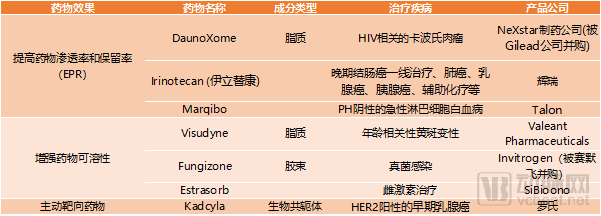
Other Marketed Nanomedicines
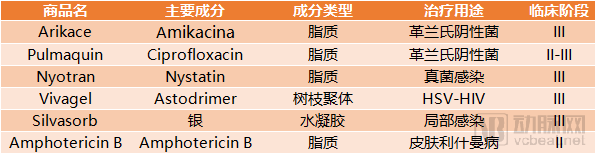
Antibacterial Nanomedicines That Have Entered Clinical Trials
Compiled by: Zhang Xian
Editors: Liu Zongyu, Hao Han
References:
[1]ScienceDirect Medical Nanotechnology
[2]Cornelia Vasile,Polymeric Nanomaterials in Nanotherapeutics,2019.
[3]Sema Çalış, ... Yılmaz Çapan, in Nanocarriers for Drug Delivery, 2019
[4]Adam Bohr, ... Henrik Jensen, in Microfluidics for Pharmaceutical Applications, 2019
[5]SudhakarC.K. , ... Sanjay Jain, in Nanotechnology Applications for Tissue Engineering,2015