

PreCar Liver Cancer Early Screening Project Announces Breakthrough Prospective Results at CSCO 2019: Detection Up to 6–12 Months Ahead of Current Gold Standard
At the 2019 Chinese Society of Clinical Oncology (CSCO) Annual Meeting, Professor Hou Jinlin from Nanfang Hospital, Southern Medical University, presented on behalf of the project team significant advances achieved by the PreCar project (Prospective suRveillance for very Early hepatoCellular cARcinoma), a nationwide, multicenter, prospective cohort study involving 10,000 participants aimed at screening for biomarkers for the ultra-early warning of hepatocellular carcinoma. The project identified patients with ultra-early-stage hepatocellular carcinoma 6–12 months earlier than the current diagnostic gold standard. The incidence rate of hepatocellular carcinoma among the screened population was enriched more than 13-fold compared to the overall incidence rate observed in patients who completed follow-up, demonstrating superior performance in early warning and screening. The five-year survival rate for these patients is expected to increase by more than fivefold, along with a significantly higher chance of cure.
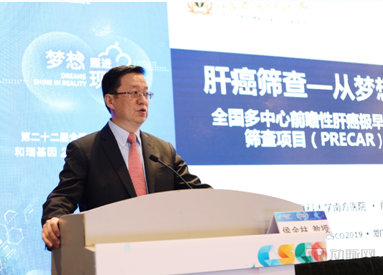
Professor Hou Jinlin, Nanfang Hospital of Guangzhou
In this prospective clinical study, among the first batch of 55 individuals identified by the PreCar model as being at extremely high risk for hepatocellular carcinoma (HCC), eight were diagnosed with new-onset early-stage tumors during the subsequent six-month follow-up period. This represents a more than 13-fold enrichment in cancer incidence compared to the overall conversion rate observed in patients who completed the follow-up. Notably, the tumor sizes in these patients ranged from 0.8 to 2.5 cm, all classified as early-stage HCC (Stage 0 + Stage A), with approximately 75% falling into the very early stage (Stage 0).
Patients with early-stage hepatocellular carcinoma (HCC) identified through routine clinical diagnosis—defined as a single tumor <3 cm, corresponding to stage 0 and stage A—typically account for less than 20% of cases, with stage 0 comprising less than 10%. According to relevant literature, the 5-year survival rate for patients diagnosed at an early stage is 50%–70%, whereas the overall 5-year survival rate for those with advanced HCC is only 10%–19%. This indicates that among individuals diagnosed with HCC, those screened by PreCar exhibit a more than five-fold improvement in 5-year survival.
Academician Wang Hongyang, Director of the National Center for Liver Cancer and one of the principal investigators of the PreCar project, stated that this is the first time prospective data have demonstrated the potential for ultra-early warning of liver cancer through a simple peripheral blood-based test. This approach can identify individuals at extremely high risk and patients with very early-stage liver cancer 6–12 months earlier than existing conventional diagnostic methods. This will undoubtedly significantly enhance the prevention and control of liver cancer in China and worldwide.
PreCar is a prospective clinical project for early screening of liver cancer, jointly led by Academician Wang Hongyang from the National Center for Liver Cancer/Shanghai Eastern Hepatobiliary Surgery Hospital, Professor Hou Jinlin from Nanfang Hospital in Guangzhou, and Berry Oncology, with the participation of nearly twenty clinical centers across China. Officially launched in April 2018, the project is based on an independently developed classification model for liver cancer patients. The preliminary results and the phased findings announced this time are at the forefront of similar studies both domestically and internationally, marking a significant milestone in the research on early screening and diagnosis of liver cancer in China and globally.
The project plans to enroll 10,000–15,000 patients. As of press time, the project team has enrolled approximately 4,000 participants in the prospective cohort (patients with liver cirrhosis), and some of the earlier-enrolled patients have reached the third follow-up visit (with follow-ups conducted every six months).
Based on publicly available information both domestically and internationally, PreCar is the largest and most rapidly advancing clinical research project for early hepatocellular carcinoma screening among similar studies worldwide. It is also the only such project to have released prospective study data to date, and stands out as the most promising initiative led by Chinese researchers in terms of performance metrics within the field of early cancer screening and diagnosis.
Among the approximately 4,000 patients with liver cirrhosis already enrolled, the PreCar classification model initially identified 55 patients at high risk for hepatocellular carcinoma (HCC). During a 6-month follow-up period, early-stage tumors were detected in 8 of these 55 high-risk patients through clinical diagnostic methods (routine testing plus contrast-enhanced CT or MRI). The tumor sizes ranged from 0.8 to 2.5 cm, and all cases were classified as stage 0/A according to the Barcelona Clinic Liver Cancer (BCLC) staging system.
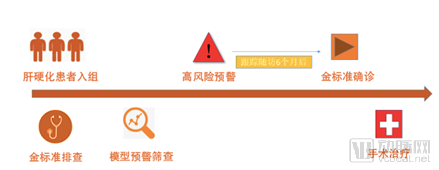
The prediction model advanced the detection of liver cancer by 6–12 months compared to the time of diagnosis using the gold standard.
“This is something that current clinical detection technologies cannot achieve,” stated Academician Wang Hongyang. At present, most molecular diagnostic “early screening” studies disclosed by institutions are primarily aimed at improving or enhancing the performance of existing diagnostic criteria, with the time points in these studies synchronized with those of tumor confirmation by the gold standard. In this prospective cohort study, the prediction model advanced the detection of liver cancer by 6–12 months compared to the time of gold-standard diagnosis, achieving true prospective early screening and marking a first-of-its-kind breakthrough among similar projects worldwide.
The smooth advancement of the PreCar project will greatly aid in addressing the challenges of liver cancer diagnosis and treatment in China, with particular promise for making significant contributions to reducing the incidence and mortality rates of liver cancer nationwide. Academician Wang Hongyang stated, “The PreCar project has already achieved excellent interim results, marking significant progress in the differential diagnosis between liver cirrhosis and liver cancer. Furthermore, we have identified some cases of very early-stage liver cancer, offering greater hope for effective treatment or even cure for these patients.”
For liver cancer, the PreCar model has established a foundational general-purpose technology platform and an AI analysis framework through its unique multi-omics integration-based early screening technology. According to previous trial results, in studies comparing liver cancer patients with healthy individuals, the model achieved a specificity of 99%, a sensitivity of 100%, and an AUC > 99.9%; in studies comparing liver cancer patients with those with liver cirrhosis, it achieved a specificity of 96%, a sensitivity of 93%, and an AUC > 99.8%. These findings demonstrate that the PreCar model’s ability to distinguish between tumor cases and high-risk populations has reached a globally leading level among similar studies, laying a solid foundation for subsequent prospective cohort studies aimed at predicting individuals at extremely high risk for liver cancer.
Globally, numerous cancer early screening studies have been initiated by institutions and companies. Based on publicly available research findings, PreCar’s technological capabilities rank among the world’s leading positions, whether in retrospective or prospective trials.
According to Dr. Zhou Daixing, a director at Berry Oncology, the company has been dedicated to applying genetic testing technologies to clinical oncology diagnostics. The pathway of “underlying technology development – retrospective modeling – prospective validation – industrialization” is essential for achieving the commercialization of early cancer screening. The experience gained from the PreCar project will also provide valuable references for clinical research on other cancer types. Starting with liver cancer, Berry Oncology is now accelerating its expansion into multi-cancer early screening.
Currently, the PreCar project has advanced to the prospective study phase and achieved significant breakthrough results. Previously, at the 2018 CSCO Annual Meeting, Berry Oncology announced the preliminary trial results of the project. In March this year, the project successfully developed an NGS-based classification model for liver cirrhosis and liver cancer. Moving forward, the project team will accelerate product translation while maintaining its technological leadership.
It was revealed that the project team would complete the full enrollment of patients with liver cirrhosis by the end of 2019. According to the overall plan, aligned with the progress of China’s National Major Science and Technology Project during the 13th Five-Year Plan period, the team aims to commercialize its early-screening test kit by 2021.