

Nanomaterial-Assisted Mass Spectrometry Significantly Enhances Accuracy of Colorectal Cancer Diagnosis: Zhongshan Hospital Presents Breakthrough at CSCO 2019
From September 18 to 22, 2019, the 22nd National Clinical Oncology Conference and the 2019 CSCO Annual Academic Meeting were held at the Xiamen International Conference & Exhibition Center. As the largest gathering in the field of clinical oncology in China, CSCO 2019, themed “Innovative Precision Research, Exploring Smart Healthcare,” provided a diversified platform for continuing education and academic exchange.
On the 21st, the academic paper titled “Application of Nanomaterial-Assisted Laser Desorption/Ionization Technology in the Diagnosis of Colorectal Cancer” (hereinafter referred to as “this study”), co-authored by Zhongshan Hospital Fudan University (the primary institution), the National Engineering Research Center for Biomaterials at Sichuan University, and Shenzhen Tailai Biotechnology Co., Ltd., was published. VCBeat promptly interviewed Dr. Yu Yiyi, an oncologist from the Department of Medical Oncology at Zhongshan Hospital Fudan University and the first author of this study.
Colorectal cancer (CRC) is the third most prevalent major disease in China. In clinical practice, the serum tumor antigen markers most commonly used for CRC screening, diagnosis, and prognosis monitoring are CEA and CA19-9. However, due to the low sensitivity and poor specificity of CEA and CA19-9 assays, many CRC patients cannot be detected at an early stage. Dr. Yu pointed out that if colorectal cancer is detected early, the five-year survival rate exceeds 90%. Therefore, there is an urgent need to develop highly accurate and sensitive non-invasive methods for the early diagnosis of colorectal cancer, which was the original motivation behind our team’s research.
Colorectal cancer (CRC) is increasingly recognized as a metabolic disorder, making the analysis of serum metabolites crucial for elucidating alterations in cancer-related biological information. This study applies a novel laser desorption/ionization (LDI) technology to the screening and diagnosis of CRC. By leveraging nanomaterials and machine learning, this approach overcomes the limitations of conventional detection methods, offering high fidelity and reproducibility, thereby providing a more reliable clinical strategy for CRC diagnosis.
According to Dr. Yu Yiyi, this study was initiated in 2017. Over the past two years, the Department of Medical Oncology at Zhongshan Hospital, in collaboration with Shenzhen Tailai Biotechnology Co., Ltd., has collectively gathered data from 238 colorectal cancer patients and 203 healthy controls, established an in-hospital LDI platform, and validated its functionality for CRC screening.
In the clinical trial cohort, 109 out of 232 colorectal cancer (CRC) patients who underwent CEA testing were CEA-negative (46.98%), and 146 out of 230 CRC patients who underwent CA19-9 testing were CA19-9-negative (63.48%). Experimental results demonstrated that this method achieved an average sensitivity of 96% and a specificity exceeding 98% in CRC detection, with LDI capable of identifying nearly all CRC patients who tested negative for both markers.
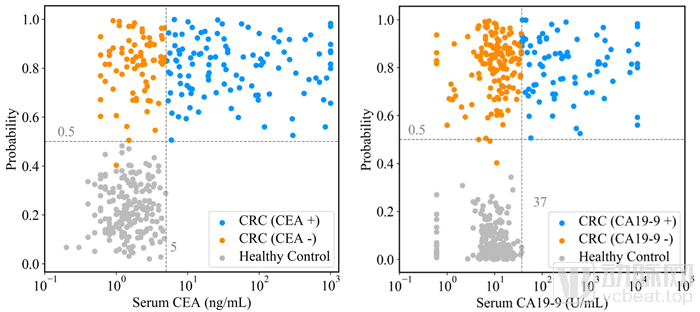
In other words, the LDI method demonstrates significantly superior sensitivity in detecting colorectal cancer (CRC) compared to CEA and CA19-9 assays: among 232 CRC patients, only one case (0.43%) was misclassified as a healthy control. In contrast, CEA and CA19-9 measurements fail to effectively distinguish between CRC-negative and CRC-positive populations. Therefore, this approach holds greater diagnostic significance.
Dr. Yu believes that this study has established a low-cost, high-throughput method requiring only trace amounts of serum, which accurately identifies CRC patients and healthy controls, making it a promising technique for clinical research and applications in colorectal cancer.
VCBeat interviewed Dr. Zhang Hua, co-author of the study and a researcher at the National Engineering Research Center for Biomaterials at Sichuan University, on-site at the CSCO conference. He stated that the research findings offer an alternative to traditional methylation and gene sequencing methods for colorectal cancer (CRC) screening, with lower costs and shorter turnaround times while maintaining comparable accuracy and sensitivity. “The acceptance of our research by CSCO demonstrates the feasibility of applying this technology in CRC screening and diagnosis.”
Dr. Zhong Sheng, Vice President of Biomedical Research and Development at Tailai Bioscience, also pointed out that it will take another 3–5 years to complete larger-scale effectiveness validation before the research findings can be translated into products certified as Class III medical devices and widely deployed in hospitals across China. “Nevertheless, our clinical studies conducted with Zhongshan Hospital have demonstrated that the matrix-assisted laser desorption/ionization time-of-flight (MALDI-TOF) mass spectrometry technology employed by Tailai offers higher sensitivity and specificity than conventional methods. Its cost and turnaround-time advantages provide a new solution for population-wide early screening of colorectal cancer among the general healthy population.”
It is understood that Tailing Biotechnology has promoted this colorectal cancer detection method through Laboratory Developed Tests (LDTs) via research collaborations with several hospitals across multiple regions in China. The continuous accumulation of real-world cases has validated that MALDI-TOF technology maintains high accuracy across diverse populations in multi-center settings.
Currently, apart from invasive colonoscopy, the innovative solutions in China’s colorectal cancer early screening market mainly include fecal exfoliated cell analysis and microbiome testing. Among these, microbiome-based screening has not yet been widely adopted. Fecal exfoliated cell screening encompasses three technological approaches: protein biomarker detection, gene mutation detection, and DNA methylation detection. Several relatively mature products have emerged and achieved rapid market penetration.
The MALDI-TOF platform selected by Taili Bio adopts a different technological approach, establishing differentiated advantages in cost and turnaround time while ensuring sensitivity and specificity. Dr. Zhong Sheng pointed out that the domestic market for early colorectal cancer (CRC) screening is still in its nascent stage. Given CRC’s prolonged disease course and the rapid increase in incidence with age, there is a clear demand for early screening. This will likely give rise to a substantial CRC screening market in the future, where products based on diverse technological pathways will collectively provide support.
Furthermore, leveraging the flexible scalability of the MALDI-TOF platform, Taili Bio’s LDT cancer screening product, AnAnPan, is actually a pan-cancer screening solution. By optimizing nanomaterials, it enables rapid detection through the analysis of a combination of 432 metabolic biomarkers. It currently covers more than 14 types of tumors with the highest incidence and mortality rates in China. With a specificity exceeding 98%, the sensitivity for detecting most of these tumors surpasses 92%.