

Ministry of Civil Affairs Issues Implementation Opinions on Expanding Elderly Care Service Supply and Promoting Consumption
VCBeat (WeChat: vcbeat) reported that on September 23, with the approval of the State Council, the Ministry of Civil Affairs issued the “Implementation Opinions on Further Expanding the Supply of Elderly Care Services and Promoting Consumption in Elderly Care Services,” proposing to comprehensively optimize the effective supply of elderly care services, invigorate the market for senior products, and cultivate new formats of elderly care service consumption.
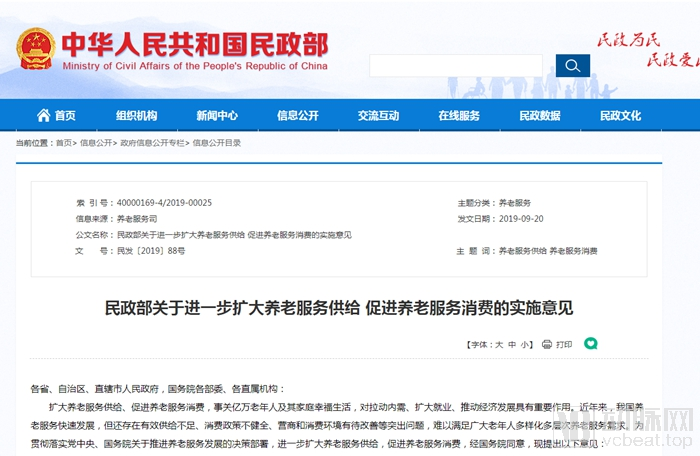
The full text of the policy is as follows:
I. Comprehensively Optimize the Effective Supply of Elderly Care Services
(1) Vigorously develop elderly care services in urban communities.
Relying on community-based elderly care service facilities, comprehensive community elderly care service institutions with functions such as full-time residential care, day care, home-based services, and guidance for subordinate entities shall be established at the sub-district level. Embedded elderly care service institutions or day care centers shall be established at the community level to provide seniors with services including daily living assistance, meal and mobility support, emergency rescue, and emotional comfort. Social forces shall be actively guided to participate extensively in community elderly care services, supporting the cultivation of a batch of comprehensive, specialized, chain-operated, and branded community elderly care service institutions, and ensuring their reasonable returns and sustainable development. Where conditions permit, localities may vigorously develop urgently needed services for the elderly—such as meal assistance, bathing assistance, emergency aid, medical assistance, mobility support, and cleaning services—through methods like government purchase of services, utilizing models such as senior canteens and home-based services. By 2022, efforts shall be made to ensure that every sub-district has at least one comprehensive community elderly care service institution; townships with suitable conditions shall also actively establish such institutions, achieving a coverage rate of over 90% for community day care facilities. Funds invested at all levels into communities shall be utilized in a coordinated manner, optimizing the expenditure structure of fiscal support for the development of elderly care services, with a greater proportion of relevant funds directed toward supporting community elderly care services. (The Ministry of Civil Affairs, the National Development and Reform Commission, the Ministry of Finance, and the Ministry of Housing and Urban-Rural Development shall be responsible according to their respective duties; local people's governments at all levels shall be responsible.)
(2) Actively cultivate home-based elderly care services.
Elderly care institutions and community-based elderly service providers shall support home-based care by extending professional services into households, offering in-home assistance such as daily living care, housekeeping, and emotional support to seniors aging at home, thereby strengthening and enhancing home-based elderly care. A comprehensive home visitation system shall be established, supporting and guiding grassroots organizations and social organizations—through measures such as purchasing services—to prioritize visitation and assistance for elderly individuals facing special difficulties, including those living alone, empty-nesters, left-behind seniors, persons with disabilities, and members of families affected by special family planning policies. Pilot programs for “home care beds” shall be explored, with improvements to relevant standards and regulations covering services, management, and technology, as well as policies for construction and operation; standardized service protocols and contract templates for in-home care shall be refined to ensure that seniors aging at home receive continuous, stable, and professional elderly care services. Where conditions permit, local governments may purchase services to provide skills training for family caregivers of disabled elderly persons, promote knowledge of home-based nursing, and enhance family caregiving capabilities. (The Ministry of Civil Affairs, the National Development and Reform Commission, and the Ministry of Finance shall be responsible according to their respective duties; local people’s governments at all levels shall be responsible for implementation.)
(3) Promote the improvement of quality and efficiency in institutional elderly care services.
Focusing on the rigid demand for long-term care services for the advanced-age elderly and those with disabilities or dementia, priority support shall be given to the development of elderly care institutions that meet basic elderly care service needs and serve the advanced-age elderly and those with disabilities or dementia, continuously enhancing their care capabilities. Where conditions permit, support shall be provided for establishing care institutions specifically addressing the specialized care needs of the elderly with dementia. Further deepen the reform of public elderly care institutions, uphold their public-welfare nature, increase the proportion of nursing-type beds, clarify construction standards for such beds, and prioritize providing residential care services for individuals in extreme poverty, economically disadvantaged elderly with disabilities or dementia, and elderly from families affected by special family planning policies. Explore diverse operational models, guide social forces to establish elderly care institutions targeting middle- and high-income households in accordance with market demands, and build a comprehensive, multi-level, and three-dimensional elderly care service system to meet diversified, convenient, and personalized service needs. By 2022, the proportion of nursing-type beds in elderly care institutions shall be no less than 50%. (The Ministry of Civil Affairs, the National Development and Reform Commission, and the Ministry of Finance shall be responsible according to their respective duties.)
(4) Effectively expand elderly care services in rural areas.
Implement renovation and upgrading projects for care service facilities for individuals in extreme poverty (nursing homes), ensuring that all major safety hazards identified in these facilities during the national special campaign on improving the quality of nursing home services are fully rectified by the end of 2020. By the end of 2022, each county shall establish at least one county-level care service facility for individuals in extreme poverty (nursing home) specializing in professional care for rural elderly persons with disabilities and impairments. Promote the addition of day-care and home-based services in eligible care service facilities for individuals in extreme poverty (nursing homes), thereby facilitating a tiered upgrade of rural elderly care consumption. Vigorously develop mutual-aid elderly care services, and operate rural happiness homes and large-scale elderly care compounds through social donations, self-funding by the elderly, and mutual assistance among villagers to achieve sustainable development. Incorporate the construction of rural elderly care service facilities as a key component of the Rural Revitalization Strategy, prioritize it for budgetary investment, and intensify efforts to build rural elderly care institutions and mutual-aid service facilities to meet the substantial demand for elderly care services in rural areas. (The Ministry of Civil Affairs, the National Development and Reform Commission, and the Ministry of Finance shall be responsible according to their respective duties; local people's governments at all levels shall be responsible.)
II. Prosper the Market for Elderly Care Products
(5) Innovate the supply of high-quality elderly care products.
Implement demonstration projects for technology-enabled elderly care, support the deep integration, application, and promotion of emerging technologies such as new materials, artificial intelligence, and virtual reality in the field of elderly care services, and support the research and development of products such as exoskeleton robots, caregiving and rehabilitation robots, and virtual reality rehabilitation training equipment, thereby creating a batch of highly intelligent, high-tech, and high-quality rehabilitative assistive devices for the elderly. Encourage and support enterprises in researching, developing, and manufacturing smart elderly care devices, including wearable and portable monitoring equipment and home-based elderly care monitoring systems, as well as daily necessities, food, health supplements, and clothing suitable for the elderly. Launch initiatives to improve the quality of elderly care products, employing measures such as risk monitoring, quality analysis, and standard-setting to enhance product quality. (The National Development and Reform Commission, the Ministry of Science and Technology, the Ministry of Industry and Information Technology, the Ministry of Commerce, the Ministry of Civil Affairs, and the State Administration for Market Regulation shall be responsible according to their respective duties.)
(6) Stimulate the consumption potential of elderly care products.
Encourage localities with the necessary conditions to study the gradual inclusion of eligible basic therapeutic rehabilitation assistive devices into the coverage of basic medical insurance payments in accordance with regulations, and provide subsidies for the provision of basic rehabilitation assistive devices to disabled elderly individuals among urban and rural residents in extreme poverty, registered poor households, and families receiving subsistence allowances. Support commercial insurance companies in innovating product design by including the provision of rehabilitation assistive devices urgently needed by the elderly within the scope of insurance coverage. Promote the entry of elderly care products into industrial parks, exhibitions, shopping malls, institutions, communities, and households. Launch “Respect and Care for the Elderly” Shopping Festivals, encouraging major e-commerce platforms and retail enterprises to conduct “Respect and Care for the Elderly” shopping promotions during the Double Ninth Festival. Through online-offline integration, centrally showcase and sell elderly care products to build brand recognition and stimulate a consumption boom, thereby igniting consumer enthusiasm and leading trends in elderly care product consumption. (The Ministry of Civil Affairs, the National Development and Reform Commission, the Ministry of Finance, the Ministry of Commerce, the National Healthcare Security Administration, the China Disabled Persons’ Federation, and the China Banking and Insurance Regulatory Commission shall be responsible according to their respective duties.)
III. Strengthen Support and Safeguards for Elderly Care Service Consumption
(7) Strengthen the construction of community-based elderly care service facilities.
Implement an action plan for the construction of community-based elderly care service facilities, provide guidance, supervision, and inspection on the supply guarantee of elderly care service facilities in all regions, ensure that newly built residential communities are equipped with supporting elderly care service facilities, and adopt measures such as government repurchase, leasing, and renovation to supplement elderly care facilities in old residential communities according to local conditions, while simultaneously carrying out fire safety facility renovations, effectively addressing the serious shortage of venues and facilities for community-based elderly care services, and ensuring that the compliance rate of supporting facilities reaches 100% by 2022. Relevant departments must earnestly fulfill their regulatory responsibilities to ensure that elderly care service facilities are used for community-based elderly care services after being handed over to property owners. Improve standards and requirements for the construction of supporting facilities for community-based elderly care, and establish mechanisms and measures for supervision and implementation. Implement special actions for city-enterprise collaboration in inclusive elderly care, strengthen the construction of community-based elderly care service facilities, support the construction of facilities for elderly care institutions with outstanding professional capabilities and integrated medical and elderly care services, and continuously expand the effective supply of inclusive community-based elderly care services. (The Ministry of Natural Resources, the Ministry of Housing and Urban-Rural Development, the National Development and Reform Commission, the Ministry of Civil Affairs, and the National Health Commission shall be responsible according to their respective duties; local people's governments at all levels shall be responsible.)
(8) Promote age-friendly renovations for homes and communities.
In the renovation of old residential communities in urban and town areas, respect residents’ wishes and coordinate the age-friendly retrofitting of facilities. Measures such as barrier-free accessibility improvements, fire safety upgrades, context-specific additions of recreational spaces and facilities, and installation of elevators where feasible shall be implemented to provide a safe, comfortable, and convenient community environment for older adults. Through industrial guidance and homeowner crowdfunding, among other approaches, encourage households with older members to carry out age-friendly renovations of their homes and furnishings based on the seniors’ physical conditions, needs for rehabilitative assistive devices, and living environments. Local governments with sufficient capacity may provide appropriate subsidies. By the end of 2020, in conjunction with efforts to win the battle against poverty, localities are encouraged to adopt measures such as government subsidies to provide the most urgently needed age-friendly renovations for households with advanced-age, disabled, or functionally impaired older adults who are included in programs for extreme poverty assistance or registered in the poverty-alleviation database. (The Ministry of Housing and Urban-Rural Development, the Ministry of Finance, the Ministry of Civil Affairs, the National Health Commission, and the China Disabled Persons’ Federation shall be responsible according to their respective duties; local people’s governments at all levels shall be responsible.)
(9) Build a high-quality, professional workforce for elderly care services.
Organize the formulation of vocational skill level standards and syllabi for elderly care workers, develop vocational training textbooks and training packages, and establish demonstration sites for the training and development of elderly care workers. Incorporate fire safety into the core curriculum for the training of elderly care workers; all elderly care workers must undergo fire safety training before assuming their posts and possess fire safety skills. Localities should prioritize elderly care services in school-enterprise cooperation within vocational education and support eligible elderly care institutions in establishing vocational colleges specializing in elderly care services. Priority will be given to including eligible industry-education integration and school-enterprise cooperation projects in elderly care services within the scope of central budgetary investment support. Recruit rural migrant workers and urban residents with employment difficulties to engage in elderly care services, thereby broadening the sources of professional personnel. Guide localities to incorporate the training of elderly care workers as a key component of the "Action Plan for Vocational Skills Enhancement (2019–2021)," with required funds disbursed from the unemployment insurance fund allocated for supporting vocational skills enhancement initiatives in accordance with regulations. Establish a national information and credit management system for elderly care workers. Implement actions to train and enhance the capabilities of personnel in elderly care services, ensuring that by the end of 2022, 10,000 nursing home directors, 2 million elderly care workers, and 100,000 full-time and part-time geriatric social workers are trained, thereby substantially improving the sustainable development capacity of elderly care services. (The Ministry of Human Resources and Social Security, the Ministry of Education, the Ministry of Finance, the National Development and Reform Commission, the Ministry of Civil Affairs, and the Ministry of Emergency Management shall be responsible according to their respective duties; local people's governments at all levels shall be responsible.)
IV. Cultivating New Business Formats for Elderly Care Service Consumption
(10) Implement the “Elderly Care Services + Industry” initiative.
Support the integrated development of elderly care services with industries such as culture, tourism, catering, sports, domestic services, education, wellness, health, finance, and real estate; innovate and enrich new models and formats of the elderly care service industry; and expand emerging consumption sectors including sojourn-based elderly care, cultural elderly care, health-oriented elderly care, and wellness-focused elderly care. Encourage localities with favorable conditions to establish industrial parks for elderly products. Broaden funding channels for the development of the elderly care service industry; localities with favorable conditions may explore the establishment of special funds for the development of the elderly care service industry, guiding state-owned capital, social capital, and other investors to participate extensively in the development of elderly care services. Launch initiatives to designate demonstration counties (cities, districts) for the elderly care service industry, effectively leveraging their demonstrative and leading roles to promote the in-depth development of the “Elderly Care Services + Industries” model. (The National Development and Reform Commission, Ministry of Finance, Ministry of Civil Affairs, National Health Commission, Ministry of Commerce, Ministry of Culture and Tourism, General Administration of Sport of China, Ministry of Education, China Banking and Insurance Regulatory Commission, and Ministry of Housing and Urban-Rural Development shall be responsible according to their respective duties.)
(11) Develop a new model of “Internet + Elderly Care” services.
Accelerate the deep integration of the Internet with elderly care services, pool online and offline resources, and precisely match demand with supply. Provide elderly people with convenient, nearby “à la carte” elderly care services, innovate service models, foster new service formats, improve service experiences, and better drive consumption in the elderly care sector. Guide qualified elderly care institutions to leverage modern information technologies—such as the Internet, the Internet of Things (IoT), cloud computing, big data, and smart elderly care devices—to develop a variety of “Internet+” applications, build a multi-tiered smart elderly care service system, and create new business formats and models for elderly care services. (The National Development and Reform Commission, the Ministry of Civil Affairs, and the Ministry of Industry and Information Technology shall be responsible according to their respective duties.)
V. Enhancing the Consumption and Payment Capacity of the Elderly
(12) Leverage the protective role of commercial insurance.
Vigorously develop commercial pension insurance, enhance the level of protection, and effectively improve the comprehensive consumption payment capacity of the elderly. Support commercial insurance institutions in developing group critical illness insurance, medical insurance, long-term care insurance, and other products; encourage party and government organs, enterprises, public institutions, and social organizations to guide their employees to actively participate in insurance, thereby continuously improving current consumption capacity and effectively addressing concerns about old-age security. Encourage commercial insurance institutions to develop insurance products tailored to the characteristics of the elderly, such as accidental injury insurance and travel insurance for seniors, providing multi-channel protection for the elderly. Encourage elderly care service institutions to purchase liability insurance for elderly care service institutions, employer’s liability insurance, and other related products; encourage elderly care service personnel to purchase professional liability insurance, accidental injury insurance, and other related products, effectively dispersing operational risks through insurance mechanisms. (The China Banking and Insurance Regulatory Commission and the Ministry of Civil Affairs shall be responsible according to their respective duties.)
(13) Promote the establishment of a long-term care security system that integrates insurance, welfare, and assistance.
Expand pilot programs for the long-term care insurance system, encourage the development of commercial long-term care insurance products, establish and improve a multi-tiered protection system, and meet diverse care needs. Strengthen the organic integration between the long-term care insurance system and the long-term care service system. Actively guide and leverage the beneficial supplementary roles of social assistance, social welfare, charitable endeavors, and commercial insurance to address care service needs at different levels. Integrate allowances for the advanced elderly and nursing subsidies to centrally subsidize long-term care expenses for economically disadvantaged elderly individuals who are advanced in age or disabled. (The Ministry of Civil Affairs, the National Healthcare Security Administration, the National Development and Reform Commission, the Ministry of Finance, and the China Banking and Insurance Regulatory Commission shall be responsible according to their respective duties; local people's governments at all levels shall be responsible.)
(14) Effectively reduce the cost of elderly care services.
Further implement preferential tax policies for elderly care institutions and community-based elderly care service providers, ensuring the full implementation of policies on the reduction or exemption of relevant administrative and institutional fees, as well as preferential residential pricing for water, electricity, gas, and heating. Increase financial support, include elderly care services in the guidance catalog for government procurement of services, formulate provincial-level standards for government procurement of elderly care services, and allocate central fiscal subsidy funds to guide and support local governments in purchasing elderly care services. Localities may adopt measures such as service procurement, construction subsidies, and operational subsidies to promote the provision of community elderly care facilities at low or no cost for community elderly care services, thereby effectively reducing the costs and prices of community elderly care services. (The National Development and Reform Commission, the Ministry of Finance, the State Taxation Administration, and the Ministry of Civil Affairs shall be responsible according to their respective duties; local people's governments at all levels shall be responsible.)
VI. Optimize the Business and Consumer Environment for Elderly Care Services
(15) Optimize the Business Environment for Elderly Care Services
Comprehensively establish an open, competitive, fair, and orderly market for elderly care services, relax market access requirements for elderly care services, and support the participation of non-governmental forces in providing such services. Effectively break down industry monopolies and local protectionism, and review and abolish regulations and practices in elderly care services that hinder the formation of a unified national market and fair competition. Relying on the National Credit Information Sharing Platform, the National Enterprise Credit Information Publicity System, and other mechanisms, accelerate the development of a social credit system in the field of elderly care services, strengthen credit-based supervision and information disclosure, improve corporate credit records and personnel archive databases in the elderly care sector, continuously enhance regulatory capabilities and standards, further standardize market order, and optimize the business environment. (The Ministry of Civil Affairs, the National Development and Reform Commission, and the State Administration for Market Regulation shall be responsible according to their respective duties.)
(16) Improve the consumption environment for elderly care services.
Strengthen market supervision of elderly care service consumption, conduct monitoring of elderly care service quality, intensify joint law enforcement efforts, ensure smooth channels for consumer feedback, and strictly investigate and punish acts that infringe upon the personal and property rights and interests of the elderly, thereby effectively safeguarding their legitimate rights and interests. Extensively carry out publicity and education campaigns to help the elderly recognize and prevent fraud, enhancing their awareness and ability to resist fraudulent activities. Establish a cross-industry, cross-sector, and cross-departmental joint disciplinary system to penalize entities with breach-of-credit records in the elderly care service sector in accordance with laws and regulations. Improve the post-consumption evaluation system for elderly care products and services. Strengthen publicity and guidance, advocate for a shift in concepts regarding elderly care, reasonably guide market consumption expectations, further unleash societal demand for elderly care services, and actively foster a favorable social atmosphere conducive to promoting elderly care service consumption. (The Ministry of Civil Affairs, the National Development and Reform Commission, the State Administration for Market Regulation, the Ministry of Public Security, and the National Radio and Television Administration shall be responsible according to their respective duties.)
(XVII) Strengthen quality and safety management in elderly care services. Enhance comprehensive oversight of elderly care institutions, and establish and improve service standards and evaluation systems for such institutions.
Continue to carry out special campaigns for improving the service quality of nursing homes, implement projects to ensure that private elderly care institutions meet fire safety standards, vigorously promote the rectification of safety and quality hazards, focus on addressing prominent issues affecting the service quality of nursing homes, cultivate a service culture characterized by “safety, integrity, and excellence,” and enable older adults to live with peace of mind, tranquility, and comfort. (The Ministry of Civil Affairs, the Ministry of Emergency Management, and the State Administration for Market Regulation shall be responsible according to their respective duties.)
The Inter-Ministerial Joint Conference on Elderly Care Services shall fully leverage its role in comprehensive guidance and overall coordination, promote inter-departmental collaboration, and systematically address prominent issues encountered in expanding the supply of elderly care services and stimulating consumption in this sector. All relevant departments must strengthen organizational leadership, increase support efforts, meticulously implement policy breakdowns item by item, and ensure that all measures are effectively implemented and yield results. All regions shall include expanding the supply of elderly care services and promoting elderly care service consumption as key items on their work agendas. In particular, developing community-based elderly care services and strengthening the construction of community elderly care service facilities should be prioritized as vital livelihood projects to address the challenges of elderly care in large cities. Regions shall refine policy measures and ensure proper policy alignment based on local conditions, guaranteeing that all tasks are thoroughly implemented. (All regions and departments shall be responsible according to their respective duties.)
Source: Ministry of Civil Affairs websitehttp://xxgk.mca.gov.cn:8081/n1360/160822.html