

GE Healthcare Launches Edison Intelligence Platform with 140+ Smart Modules to Accelerate AI-Driven Medical Solutions
Shanghai, recently—At the GE Healthcare Digital Ecosystem Forum, GE Healthcare officially launched the Edison Intelligence Platform (referred to as the “Edison Platform”) in China. Meanwhile, GE Healthcare announced that it had signed strategic cooperation memoranda with five local software development enterprises—Shukun Technology, Yizhun Intelligent, Yitu, Tuma Shenwei, and Ande Medical Intelligence—to jointly develop digital healthcare applications based on the Edison Platform.
This strategic collaboration will leverage the Edison platform, integrating both parties’ products through edge computing and cloud technologies, and developing applications using the platform’s functional modules and system services to jointly build the Edison ecosystem.
Amit Phadnis, Global Chief Digital Innovation Officer at GE Healthcare, stated, “The healthcare process generates vast amounts of data, including diagnostic imaging, digital health records, monitoring information, and clinical research data. Typically, such data is difficult to integrate and leverage, making it challenging to derive clinical value that benefits patients. We believe that fully leveraging these data through digital technologies will significantly enhance healthcare efficiency and accelerate the advent of an intelligently connected healthcare era. However, enhancing this data aggregation capability requires functional modules specifically designed for healthcare, including AI, advanced visualization, workflow optimization, and high-performance medical equipment. This is precisely why we are launching the Edison platform in China. By harnessing these digital technologies, GE Healthcare aims to gain timely insights into evolving trends, truly improve patient outcomes, reduce waste and inefficiencies, optimize costs, and prevent major medical adverse events.”
Dai Ying, Chief Innovation Officer of GE Healthcare China, added, “I am thrilled that GE Healthcare has entered into strategic cooperation agreements with five leading Chinese digital health developers. Our strategic partners all possess highly mature software products and have established a strong foundation for collaboration with GE Healthcare. The Edison ecosystem we are jointly building with our partners represents a significant step in GE Healthcare’s digital transformation. We hope to leverage this platform, technology, and services to create a healthier and more efficient digital health ecosystem, thereby advancing further toward the goal of precision medicine.”
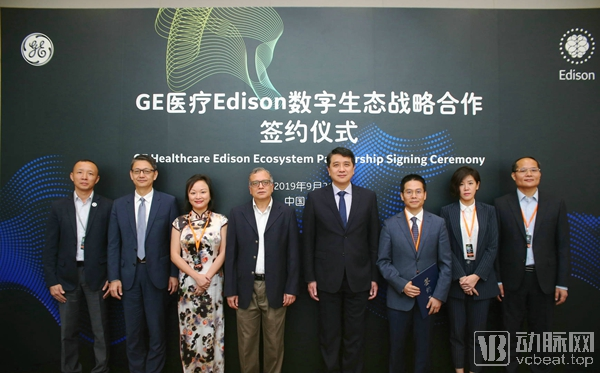
GE Healthcare Signs Strategic Cooperation Memorandums with Five Local Software Development Firms (Photo Provided by Interviewee)
Understanding the Edison platform requires remembering just three key concepts: “integration,” “development,” and “upgrading.” In Dai Ying’s view, data is the gold and oil of our era. The role of the Edison platform is to integrate medical data and apply it more efficiently in the development process. It then connects the resulting AI applications with medical devices and performs real-time upgrades on these devices, transforming them into truly intelligent terminals.
The Edison platform is a digital health intelligence platform created by GE Healthcare, designed to enhance physician efficiency, increase patient throughput, and improve healthcare accessibility. As one of the most comprehensive and integrated digital platforms in the healthcare sector, the Edison platform employs an extensive suite of specialized medical development modules, enabling GE Healthcare developers and their strategic partners to rapidly design, develop, manage, secure, and distribute advanced applications, services, and AI algorithms.
Furthermore, it integrates and assimilates diverse datasets from global business units, suppliers, healthcare networks, and life science ecosystems. It provides users with a unified application selection interface, supports centralized lifecycle management and access to applications either on-premises or in the cloud, and offers operational guidelines deployable on medical devices, thereby effectively avoiding resource waste caused by application silos and redundant development.
In fact, as early as November 2018, the Edison platform was launched in North America, primarily for use by internal data application developers at GE Healthcare and select strategic partners.
Amit Phadnis stated, “Since the launch of the Edison platform in North America, GE Healthcare has collaborated with various healthcare institutions across the United States, gathering extensive feedback through the continuous process of identifying and resolving issues.”
First, data integration represents a major challenge for healthcare institutions. In response, GE HealthCare has developed a clinical data integration platform, creating an ecosystem capable of integrating data from all healthcare institutions, thereby addressing the issue of fragmented and dispersed data that hinders integration across hospitals and other medical facilities.
Second, GE Healthcare found that users of the Edison platform hoped to leverage functional module components to help them rapidly develop required applications. To this end, GE Healthcare offers more than 140 different intelligent functional module components on the Edison platform, enabling users to quickly complete product development.
Third, while integrating applications into healthcare institutions, it is essential not to disrupt physicians’ established workflows and practices. GE Healthcare embeds AI algorithms directly into medical devices and seamlessly integrates the Edison platform into clinicians’ workflows.
After a period of development and refinement, the Edison platform has been reporting frequent successes.
Several months ago, GE Healthcare’s embedded ultrasound system received FDA approval. Empowered by AI technology, the system enables physicians to directly visualize fetal position and morphology during prenatal ultrasound examinations, while also facilitating assessments of the fetal heart and brain, including quantification of cardiac blood flow. This advancement not only enhances physicians’ workflow efficiency but also significantly improves diagnostic accuracy.
On September 12, GE Healthcare’s Critical Care Suite (an AI solution for pneumothorax prediction in the ICU) also received FDA approval, becoming the first artificial intelligence algorithm embedded by GE into mobile X-ray equipment. Developed by GE Healthcare and the University of California, San Francisco, based on GE Healthcare’s Edison platform, this solution is designed for the clinical detection of pneumothorax, pneumoperitoneum, and malpositioned lines. The solution can automatically flag critical cases, assisting physicians in patient triage and prioritizing patients with suspected pneumothorax. This significantly reduces image interpretation time for doctors while improving diagnostic accuracy and helping to prevent delays in treatment.
Currently, GE Healthcare has launched multiple digital health applications developed on the Edison platform, including Asset Performance Management (APM) and its Radiology Command Center solution, the LOGIQ E20 dual-engine ultrasound system, CT Intelligent Subscription, the Imaging Protocol and Sequence Management Platform (IPM), and the Mural Critical Care Command Center. These solutions help healthcare institutions worldwide enhance diagnostic, therapeutic, and operational efficiency.
Why Has GE Healthcare Chosen This Moment to Open Up to Chinese Enterprises?
Dai Ying stated that GE Healthcare’s goal in opening up the Edison platform in China is to deliver value to the Chinese healthcare industry. To facilitate the effective implementation of the Edison platform in China, GE Healthcare conducted extensive preliminary validation work and performed an in-depth analysis of the similarities and differences between the Chinese and U.S. markets, as well as the development direction of the Edison platform in China.
Although GE Healthcare’s technological development is synchronized in both the Chinese and U.S. markets, the challenges it faces in each are not identical. In the United States, improving efficiency and productivity is an urgent priority. Why does the U.S. place particular emphasis on enhancing productivity? There are three main reasons: First, the time span from diagnosis to treatment is relatively long for patients, necessitating the use of AI and big data technologies to improve efficiency; second, U.S. healthcare institutions face significant reimbursement pressures, and from a financial performance perspective, they need digital technologies to optimize operational capabilities; third, innovative approaches are leveraged by healthcare institutions to attract talent and patients.
The challenge facing the Chinese market is how to enable more people to receive diagnosis and treatment more rapidly. How can diagnostic and therapeutic services be leveraged to extend medical care to a broader population? This is where AI and digital technologies become particularly critical.
Dai Ying stated that, recognizing the many differences between the Chinese market and other markets, GE Healthcare has established a “comprehensive localization” strategy. By partnering with local enterprises and talent, gaining firsthand insights into China’s practical challenges, analyzing real-world issues, and understanding local pain points, GE Healthcare aims to better develop products tailored to the domestic industry. “Only in this way can we unlock the maximum value of the Edison platform.”
In China and around the world, GE HealthCare now offers a range of applications for various clinical scenarios, such as the RCC Radiology Command Center, Cloud Imaging, and the Mural Critical Care Command Center. These solutions are helping to enhance efficiency, increase patient throughput, and improve healthcare accessibility.
“‘Rooted in China, Serving China’ is GE HealthCare’s development philosophy. This philosophy has clearly become a major advantage of the Edison platform,” explained Amit Phadnis. Data privacy is a critical concern in the healthcare industry. Generally, there are two approaches to data processing: one involves establishing a centralized data engine and feeding data into it; the other involves deploying the platform locally, bringing the platform and applications closer to the data to serve local needs. It is evident that GE HealthCare has adopted the latter approach, enabling data to be processed locally through AI algorithms to serve local markets.
At this Digital Forum, GE Healthcare signed strategic cooperation memorandums with five local enterprises. When discussing how to select partners, Dai Ying stated that GE Healthcare always adheres to the principle of leveraging each party’s respective expertise. “We are a large team in which every member has their own responsibilities, obligations, and areas of expertise, complementing one another. The five companies featured today are just the beginning. Of course, the success of our entire ecosystem will be tested by the market, and the true measure of our collaborative success lies in whether we can genuinely help the market and hospitals address practical challenges.”
Contributing to precision medicine in China’s healthcare industry and building a comprehensive ecosystem that connects the upstream and downstream segments of the industry constitute GE Healthcare’s overall strategic vision for digital health. The upstream segment refers to the patient experience from the moment they enter the hospital, while the downstream segment pertains to the validity and processing efficiency of medical images following scanning and diagnosis. Amit Phadnis stated, “The Edison platform can effectively establish integrated information and data sharing across multiple departments, thereby enhancing clinical workflows and overall hospital efficiency.”
Dai Ying concretizes this vision into two aspects: labor productivity and clinical outcomes. Clinical outcomes encompass the accuracy of diagnosis and treatment, reduction in mortality rates among critically ill patients, and improved accessibility to healthcare. However, improving these components still faces significant challenges.
Large hospitals face challenges in labor productivity, while small hospitals struggle with capacity enhancement. In fact, the entire patient journey—from entering the hospital for consultation to diagnosis and treatment by physicians—is fraught with challenges. Yet, challenges present opportunities. Dai Ying stated, “We will make precision medicine our ultimate deliverable. By leveraging cutting-edge technologies, relying on a robust local team, and collaborating closely with Chinese domestic enterprises, we will maximize the effectiveness of our ecosystem.”