

Novogene Hosts CSCO 2019 Satellite Symposium on Precision Oncology: Advancing Lung Cancer Management and Real-World NGS Platform Implementation
Novogene
Gene Technology Products and Services Provider
At the CSCO academic conference on oncology diagnosis and treatment, Novogene hosted the molecular pathology satellite symposium themed “Ultimate Speed, Uncompromising Precision” on September 21. Professor Lin Dongmei from Peking University Cancer Hospital and Professor Ren Shengxiang from Shanghai Pulmonary Hospital served as the conference chairs. Professor Zhang Yan from West China Hospital of Sichuan University, Professor Sun Haibo from Henan Cancer Hospital, and Professor Ma Jie delivered outstanding special reports. The symposium discussed the latest advances in lung cancer diagnosis and treatment, the real-world operational status of NGS testing platforms, and future development trends. Numerous experts and scholars in the field of oncology diagnosis and treatment attended the event, with all 600 seats in the venue fully occupied.
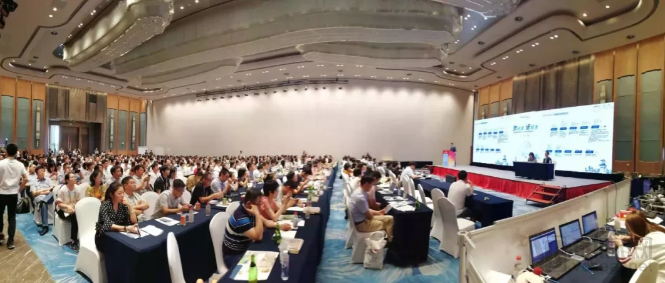
Novogene CSCO Satellite Symposium on Molecular Pathology in Oncology Held
At the outset of the conference, opening remarks were delivered by Professor Lin Dongmei from Peking University Cancer Hospital and Professor Ren Shengxiang from Shanghai Pulmonary Hospital. Professor Lin noted that with the deepening of clinical research on tumors, particularly lung cancer, an increasing number of tumor-related medications or pharmacogenomic markers have demonstrated strong correlations with clinical treatment outcomes. Next-generation sequencing (NGS) technology has shown distinct advantages by meeting the need for more refined detection of genetic loci. Professor Ren pointed out that since the approval of the first batch of multi-gene NGS test kits for lung cancer in 2018, several approved kits have been introduced into clinical practice, making compliant precision oncology diagnostics a reality. In future developments, the clinical application of multi-gene NGS testing in oncology is expected to become increasingly mature.
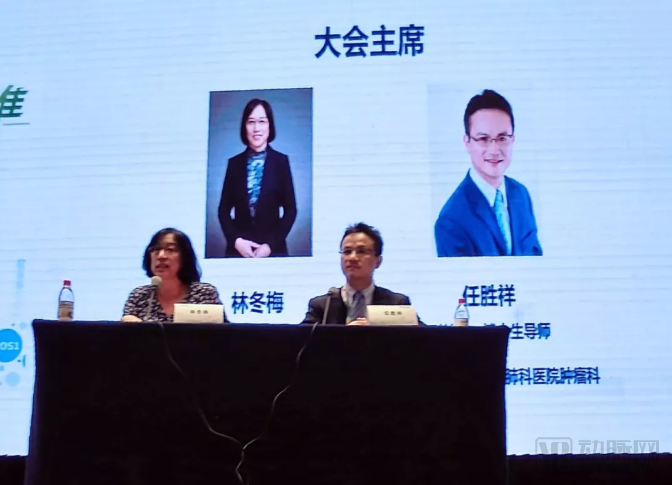
Prof. Lin Dongmei and Prof. Ren Shengxiang delivered the opening remarks.
Professor Zhang Yan from West China Hospital of Sichuan University delivered a special report titled “Latest Advances in Targeted Therapy for Lung Cancer.” Professor Zhang noted that as new therapeutic targets in oncology are progressively developed and the NCCN Guidelines are updated with increasing frequency, the accelerated approval of novel targeted agents underscores the rapid advancement of precision diagnosis and treatment in lung cancer. While presenting multiple new developments in targeted therapy for lung cancer from the World Conference on Lung Cancer (WCLC), Professor Zhang emphasized that with the growing number of approved targeted drugs and the confirmation that an increasing number of rare genetic alterations are closely linked to tumorigenesis and progression, the diagnosis and management of lung cancer are moving toward greater refinement. In light of the expanding array of available targeted therapies, selecting first-line treatment regimens for lung cancer patients has emerged as a new challenge. Professor Zhang pointed out that next-generation sequencing (NGS) offers significant advantages over PCR-based methods, such as higher sensitivity and more comprehensive detection, while also providing valuable clinical data, thereby highlighting the critical role of NGS testing in targeted cancer therapy.
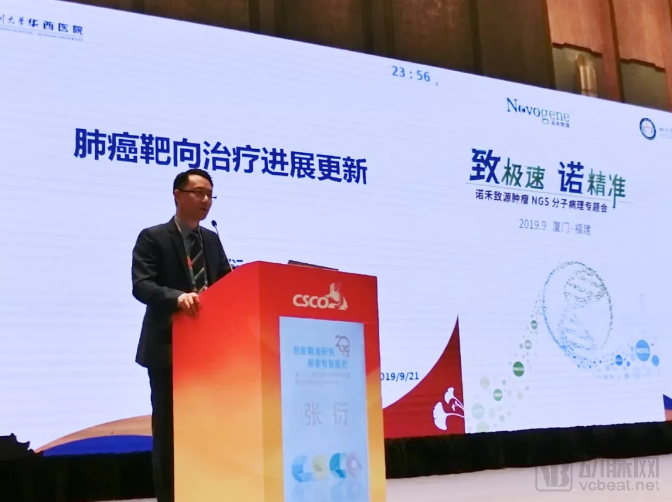
Professor Zhang Yan Delivers a Report on “New Advances in Targeted Therapy for Lung Cancer”
Professor Sun Haibo from Henan Cancer Hospital delivered a keynote presentation titled “Reflections on Perioperative Genetic Testing in NSCLC.” He pointed out that the concept of “neoadjuvant therapy” has been frequently discussed over the past two years. At the 2019 ASCO Annual Meeting, four studies on perioperative treatment for non-small cell lung cancer (NSCLC) were selected for oral presentations, signaling growing clinical emphasis on precision medicine in the perioperative setting. Next-generation sequencing (NGS)-based multi-gene testing also plays a crucial role in selecting targeted therapies during this period. Professor Sun noted that with the conduct of trials related to adjuvant targeted therapy (e.g., ADJUVANT, EVAN), adjuvant immunotherapy (e.g., NCT02273375, IMpower010), neoadjuvant targeted therapy (e.g., ChiCTR1800016948), and neoadjuvant immunotherapy (e.g., CheckMate 159, NEOSTAR), perioperative treatment has become increasingly essential, and the supportive role of NGS testing in perioperative management is becoming ever more prominent.
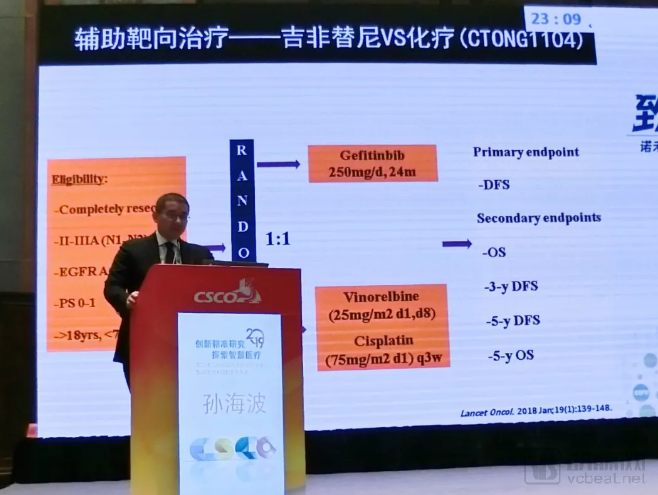
Professor Sun Haibo Delivers a Report on “Considerations for Perioperative Genetic Testing in NSCLC”
Finally, Professor Ma Jie from Henan Cancer Hospital presented real-world in-hospital NGS testing data under the title “Interpretation of Real-World In-Hospital NGS Testing Data.” He showcased the performance of Novogene’s multi-gene NGS test kit for tumors in real-world clinical settings. Professor Ma first shared data from hundreds of lung cancer cases, including mutation detection rates, drug-matching detection rates, pathological subtype distributions, and driver gene profiling. These findings demonstrated that multi-gene NGS testing for tumors can be effectively implemented and operated within hospitals, while also highlighting that Novogene’s molecular pathology product portfolio truly serves clinical practice with stable operational efficiency and an exceptionally rapid turnaround time for reports.
Meanwhile, Professor Ma Jie also shared the experience of Henan Cancer Hospital in implementing its NGS program and outlined its future prospects. He pointed out that testing quality and turnaround time are fundamental requirements for in-house NGS testing. As a participating institution in the “Ultra Speed” initiative aimed at achieving extreme report turnaround times, Henan Cancer Hospital has successfully realized the goal of rapidly issuing multi-gene NGS reports for cancer patients, thereby delivering premium testing services to clinical patients. The introduction of automated workstations and the further development of an integrated lung cancer diagnosis and treatment model within the hospital will be the next objectives for its in-house NGS testing program.
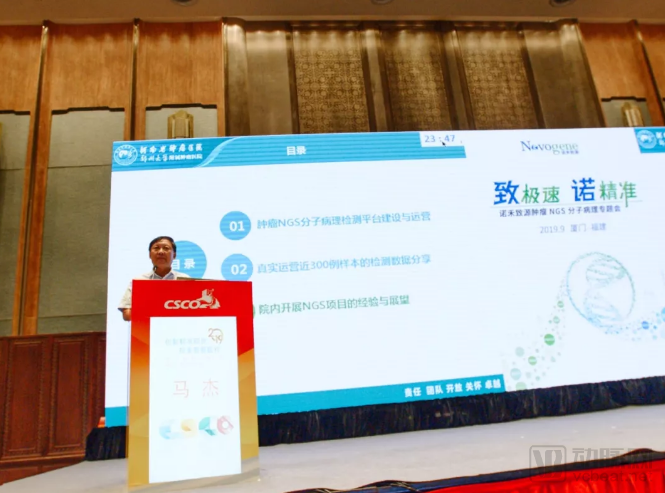
Professor Ma Jie Delivers a Report on “Interpretation of Real-World NGS Testing Data in Hospital Settings”
At the conclusion of the conference, Professor Ren Shengxiang summarized the proceedings, noting that with the increasingly widespread application of next-generation sequencing (NGS) in oncology testing, the future market will inevitably become more standardized. With Professor Ren’s concluding remarks, Novogene’s 2019 CSCO Special Session on Molecular Pathology, themed “Speed and Precision,” came to a successful close.
Novogene’s “Human EGFR, KRAS, BRAF, PIK3CA, ALK, and ROS1 Gene Mutation Detection Kit” was approved for market launch in August 2018. Consequently, Novogene offers a fully approved end-to-end product portfolio that includes NGS sequencers, nucleic acid extraction reagents, NGS sequencing reagents, and automated reporting software, ensuring that tumor NGS testing projects are conducted legally and compliantly within hospitals. Leveraging the high-throughput DA8600 sequencing platform, this kit capitalizes on advantages such as low input requirements for library preparation, high tolerance for nucleic acid quality, and short run times, enabling the entire tumor NGS testing workflow—from nucleic acid extraction to report generation—to be completed in just four days.
Based on the performance over the past year, Novogene’s NGS multi-gene testing product portfolio has been successfully implemented in hospitals, serving both clinical practice and patients. As one of the first companies in China to apply for registration of NSCLC multi-gene testing kits, Novogene remains committed to providing hospitals with fully compliant, practically implementable tumor NGS molecular pathology diagnostic solutions. This effort aims to benefit patients while promoting the standardized application of clinical NGS products.