

Huang Huang of Jiurucheng Group Outlines Four Core Competencies Driving China's Elder Care Industry
On June 17 this year, after 121 rounds of intense bidding, Jiuru City Group won the auction for a 15.2715-mu plot of land designated for social welfare purposes in the Wuhou New Town area of Wuhou District, Chengdu. The plot has a floor area ratio (FAR) of 2.5, with the final transaction price reaching RMB 7.55 million per mu, representing a premium rate of 136%.
“Spending so much money to acquire this plot of land demonstrates, on the one hand, the financial strength of Jiuru City Group and, on the other, its confidence in the Chengdu market,” explained Huang Huang, General Manager of the Southern Jiangsu Regional Company of Jiuru City Group, on September 21 at the 3rd China (Sichuan) International Elderly Care Service and Industry Expo (hereinafter referred to as the “Sichuan International Elderly Care Development Forum”).
The three-day Sichuan International Elderly Care Development Forum (September 20–22) brought together a group of practitioners who shared their hands-on experience in institutional practice and operations, providing valuable insights for industry professionals.
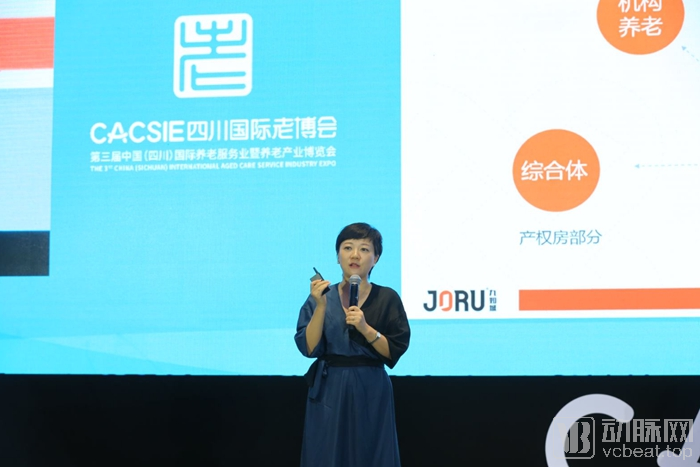
Huang Huang, General Manager of the Southern Jiangsu Regional Company of Jiuru City Group (Image source: Provided by the organizer)
What constitutes the core competitiveness of institutional elderly care? How can such competitiveness be strengthened and upgraded? For chain-operated enterprises, how should an elderly care system be built? To address these questions, VCBeat (WeChat ID: vcbeat) has compiled a transcript of Huang Huang’s speech titled “Upgrading Competitiveness in Institutional Elderly Care and Building an Elderly Care System” for our readers.
When first entering the industry, entrepreneurs must first clarify what type of elderly care services they intend to provide. After a basic classification, elderly care can be broadly categorized into five types: integrated complexes, institutional care, community-based care, home-based care, and sojourn (travel-based) elderly care. Each of these five categories includes further subtypes; for instance, institutional care encompasses Continuing Care Retirement Communities (CCRCs), nursing homes, skilled nursing facilities, and sojourn care institutions. Among these, CCRCs are further divided into sales-based and non-sales-based models...
For professionals in the elderly care industry, the first step is to clearly identify their core competencies. They should ask themselves several questions: “What is our focus in elderly care? What are we capable of delivering? What does our team excel at?” Secondly, it is essential to define the target service recipients. The payers for these services fall into three categories. The first is the seniors themselves, who should be further segmented by age and income level. The second is the seniors’ children, for whom purchasing such services is a rigid demand. The third, and currently indispensable, payer is the government.
The government plays a crucial role, prioritizing not only economic benefits but, more importantly, social benefits. For instance, if an enterprise intends to establish elderly care services in a particular region, it must first study local government policies and understand governmental needs so as to provide services accordingly.
The competitiveness of the elderly care industry is categorized into four dimensions: brand competitiveness, operational differentiation, government policy advantages, and strategic competitiveness.
Strategic Competitiveness
Elderly care enterprises never serve individual seniors in isolation; rather, they serve the families behind them. Whether an elderly person with essential care needs enters a nursing home is akin to a family’s decision on whether to send their child abroad for study—it requires the consensus of all family members before admission can proceed.
Therefore, when undertaking the operation of publicly built, privately operated nursing homes, Jiuru City Group fully integrates the resources of retired community party secretaries. These retired secretaries possess strong capabilities in resolving practical family issues and have an in-depth understanding of community dynamics. They are well aware of the diverse needs of the elderly residents, enabling them to provide targeted and tailored services.
Brand Competitiveness
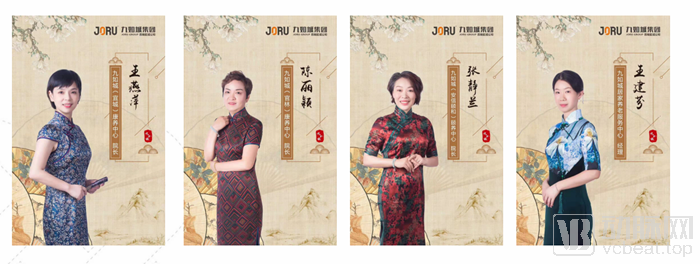
Selected Directors of Jiuru City Group’s Southern Jiangsu Region (Image source: Provided by the company)
Among the projects taken over by Jiuru City Group, some were formerly traditional nursing homes. Due to issues inherent in the conventional elderly care system, these facilities often suffered from low occupancy rates. To boost occupancy, Jiuru City Group rebranded these institutions, promoting its philosophy, objectives, and corporate image to the public through advertising and other channels.
For nursing homes, two things can cause them to “lose everything overnight.” The first is compensation: when an elderly resident suffers an incident, falls, or passes away, and the family files a lawsuit, the nursing home is liable for damages. The second is severe damage to its brand reputation.
For instance, a news report recently emerged in China about an elderly person dying from being restrained at a nursing home. Understandably, such news can severely damage a company’s brand once it surfaces. Therefore, companies must implement strict oversight and focus more on preventive measures. For example, before applying medical restraints, they should obtain medical certification from hospitals and informed consent forms from family members. This way, in the event of a public relations crisis, the company can promptly present documented evidence to protect its reputation.
Operational Competitiveness
The nursing homes developed by Jiuru City Group feature three distinctive operational characteristics. The first is the absence of primary pressure ulcers (bedsores). When training caregiving staff, Jiuru City Group’s trainers require them to keep three key questions in mind: First, did the elderly resident sleep well yesterday? How long did they sleep, and what was the quality of their sleep? Second, has there been any change in the resident’s body temperature? Third, how well did the resident eat, and how much did they consume?
Secondly, there are specialized post-stroke care and dementia care services, as well as the development of elderly care products (with nurses and caregivers at the core). Lastly, there are social work-led activities. For seniors residing in institutional care, beyond nursing support, they also require social engagement. Jiuru City Group organizes a diverse range of social work activities to enrich the leisure lives of the elderly.
Government Policy Competitiveness
The government’s target population is divided into those requiring basic social safety net support and the general public; groups with high-end needs are not a primary focus. Therefore, the core priority for the government is to ensure quality care for elderly individuals in urban areas who are covered under the “Five Guarantees” program, as well as for the general elderly population.
Furthermore, the government’s primary responsibilities lie in managing, supervising, evaluating, and promoting industry development. Enterprises should carry out corresponding elderly care services with government assistance and support. Additionally, there is a critical need for operational capabilities, including assessment, training, and policy forecasting competencies.
What will the elderly care industry look like in the next 5 to 10 years? And what will it look like in the next 10 to 15 years?
Building an elderly care system requires enhancing strategic competitiveness. Over the next ten to fifteen years, as the first wave of the middle class ages, the elderly care industry will usher in a period of robust growth. As the sector gains momentum, enterprises must also upgrade their strategies through brand building, digitalization, and mergers and acquisitions.
In the realm of elderly care systems, Jiuru City Group has observed during its operations that governmental needs are not focused on addressing isolated issues, but rather on implementing comprehensive solutions for all elderly care challenges within a region. Consequently, Jiuru City Group has proposed a four-tier elderly care system: The first tier consists of integrated elderly care complexes, serving as the pillars and support structure of the elderly care service system; the second tier comprises urban comprehensive nursing homes, forming the core service content of the system; the third tier includes community-based day care centers, acting as an extension of institutional services and hubs for home-based care; and the fourth tier encompasses home-based elderly care services, representing the terminal and foundational level of elderly care provision.
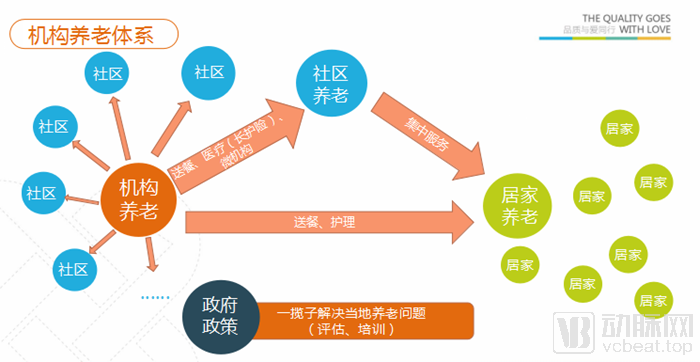
Jiuru City Group’s Institutional Elderly Care System (Source: Provided by the Enterprise)
In the vision of Jiuru City Group, one integrated complex is designed to serve 10 nursing homes; these 10 nursing homes, in turn, support 100 day-care centers; and these 100 day-care centers provide home-based care services to 50,000 elderly individuals. This hierarchical model connects communities within a region, enabling centralized service delivery that not only reduces costs but also facilitates social interaction and recreational activities for the elderly.