

Junshi Biosciences Files for STAR Market IPO with RMB 2.7 Billion Fundraising Plan
Junshi Biosciences
Innovative Drug Developer
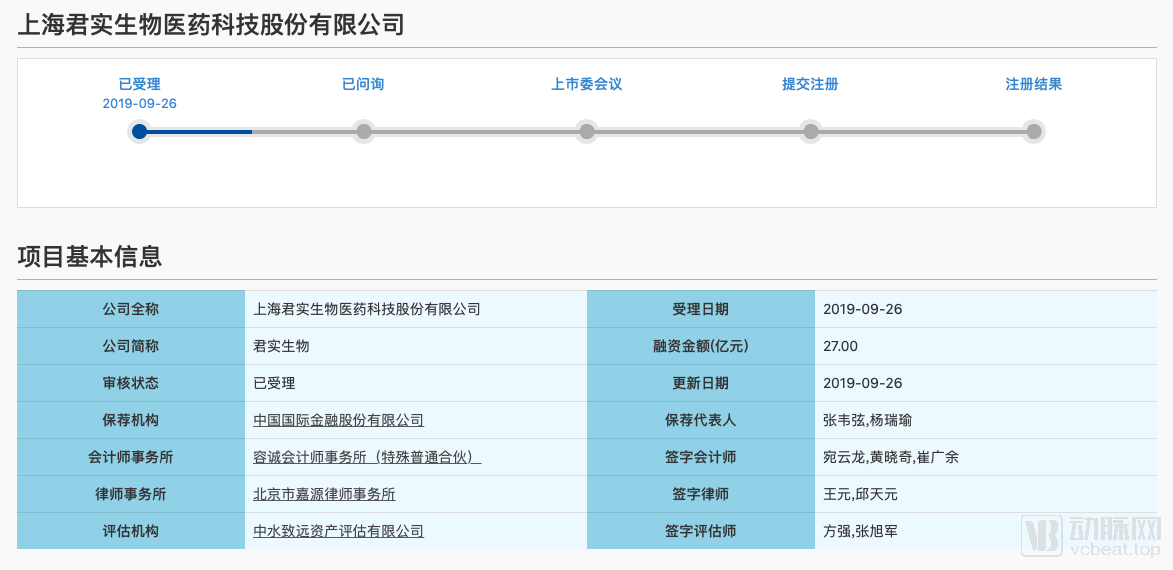
VCBeat (WeChat ID: vcbeat) has learned that, according to the disclosure on the official website of the STAR Market of the Shanghai Stock Exchange on September 26, the STAR Market listing application of Shanghai Junshi Biosciences Co., Ltd. (“Junshi Biosciences”) has been accepted. The company plans to raise RMB 2.7 billion on the STAR Market, with CICC as the lead underwriter and Guotai Junan Securities and Haitong Securities as joint underwriters.
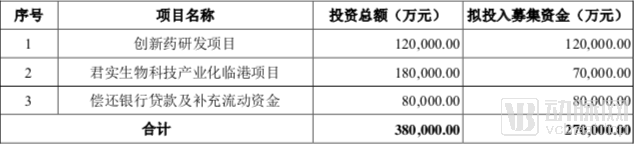
The funds raised in this offering will be used for the research and development of innovative drugs, the construction of the industrialization project in Lingang, and debt repayment. The specific allocation of funds is shown in the figure below.
Junshi Biosciences Operational Data (Source: Junshi Biosciences Prospectus)
On September 24, Junshi Biosciences-B (01877.HK) announced its application for listing A-shares on the STAR Market of the Shanghai Stock Exchange and the suspension of trading in its domestic shares on the National Equities Exchange and Quotations.
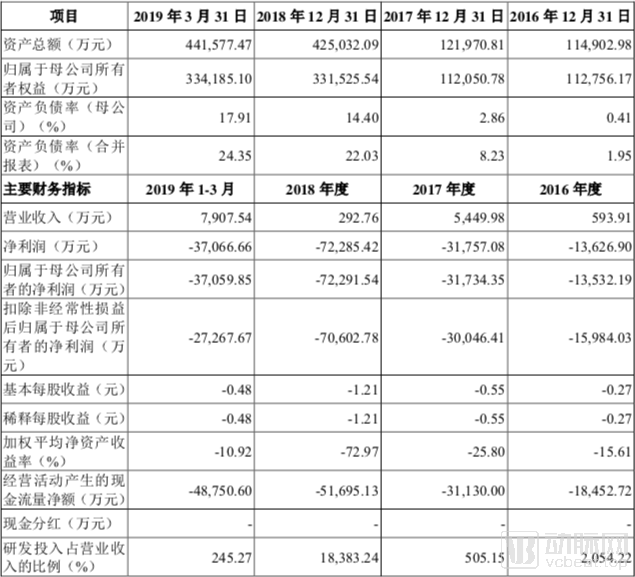
Junshi Biosciences Operational Data (Data sourced from Junshi Biosciences' prospectus)
About Junshi Biosciences
The Company is an innovation-driven biopharmaceutical company with end-to-end capabilities spanning innovative drug discovery, global clinical research and development, large-scale manufacturing, and commercialization. Guided by its mission to provide patients with more effective and affordable treatment options, the Company boasts exceptional capabilities in innovative drug discovery, robust biotechnology R&D expertise, large-scale production capacity, and a rapidly expanding pipeline of highly promising drug candidates with significant market potential.
R&D and innovation capabilities have always been regarded by the Company as its core competitiveness. From 2016 to 2018, the Company’s R&D expenditures were RMB 122.0013 million, RMB 275.3034 million, and RMB 538.1828 million, respectively, representing a compound annual growth rate (CAGR) of 110.03%. Leveraging its strong talent pool and continuous capital investment, the Company has established a globally integrated R&D process and set up laboratories in the United States. Furthermore, the Company has independently developed and established a comprehensive technical system covering the entire lifecycle of protein therapeutics, from early-stage R&D to industrialization.
Leveraging its independently established drug development technology platform, the company pursues source innovation to develop first-in-class or best-in-class therapies. It has successfully developed a portfolio of innovative biologics, including JS001, JS002, JS004, and UBP1213; a biosimilar, UBP1211; and small-molecule products, including JS101, thereby building a robust pipeline of investigational candidates.
Among them, the core product, toripalimab monoclonal antibody injection (brand name: Tuoyi), received conditional marketing approval from the National Medical Products Administration (NMPA) on December 17, 2018. It is the first domestically produced PD-1 monoclonal antibody injection approved for marketing in China, indicated for the treatment of locally advanced or metastatic melanoma after failure of prior standard therapy.
Toripalimab issued its first prescription on February 26, 2019, and as of March 31, 2019, its sales revenue had reached RMB 78.1175 million. In addition to the first approved indication, the Company is conducting multiple clinical trials to expand the indications for toripalimab. As of the date of this prospectus, the Company is conducting or will soon initiate more than 20 clinical trials for toripalimab, including 11 pivotal registration trials. These Phase I, Phase II, and Phase III clinical trials are being carried out in collaboration with numerous clinical trial centers in China, covering multiple indications such as lung cancer, liver cancer, urothelial carcinoma, esophageal cancer, and nasopharyngeal carcinoma. Concurrently, Phase I clinical trials are being conducted in the United States.
Junshi Biosciences is the first Chinese company to obtain IND approval from the NMPA for anti-PCSK9 monoclonal antibody and anti-BLyS monoclonal antibody. The company also applied to the U.S. FDA and obtained clinical trial approval for the world’s first anti-BTLA monoclonal antibody injection.
In addition to its independently developed products, the Company has further expanded its product pipeline through technology transfers and collaborations. In terms of collaborative R&D, the Company acquired a 50% equity interest in the CDK inhibitor (JS104) and the PI3K-α inhibitor (JS105) from Runjia Pharmaceuticals; obtained the existing R&D achievements and subsequent technical support for the Huao Taian vedotin biosimilar (JS501); and secured a license from Anwita for the development and commercialization of an innovative IL-21 fusion protein (JS014) in the Greater China region.
As the product pipeline continues to expand and exploration of combination drug therapies deepens, the company’s innovation scope will extend to the development of a broader range of therapeutics, including small-molecule drugs and antibody-drug conjugates (ADCs), as well as the pursuit of next-generation innovative treatments for cancer and autoimmune diseases.
Recently, Junshi Biosciences announced that data from its Phase II studies of toripalimab (brand name: Tuoyi), an anti-PD-1 monoclonal antibody independently developed by the company, for two indications—bladder urothelial carcinoma and non-small cell lung cancer—were presented at the 22nd National Clinical Oncology Conference and the 2019 CSCO Annual Academic Meeting. The studies achieved impressive interim results. This marks another exciting advancement in Junshi Biosciences’ multi-tumor type development strategy.