

Tencent Youtu Lab Achieves Global Leadership in AI-Powered Scoliosis Assessment, Winning 1st Place at MICCAI AASCE Challenge 2019
Recently, Tencent Youtu Lab’s medical AI has achieved another breakthrough. The fully automated scoliosis estimation method, a medical AI system developed by Tencent Youtu, stood out among more than 200 teams and secured first place in the 2019 MICCAI AASCE Challenge, achieving precision at an internationally leading level. The competition attracted 257 registered teams from around the world, with 79 teams submitting final results.
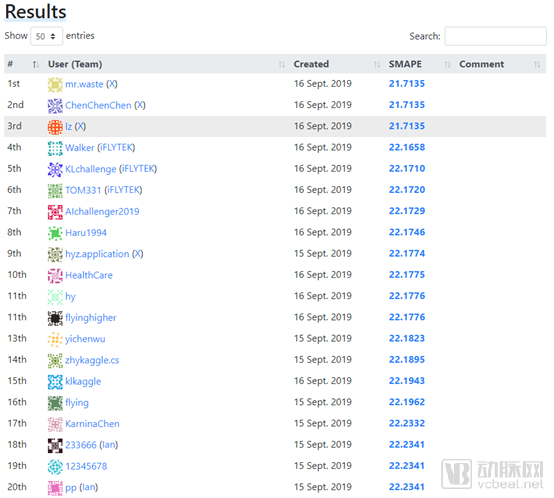
Screenshot of the AASCE Competition Rankings (Due to space constraints, only the top 20 are shown)
Accurate automated quantitative assessment of spinal curvature is a critical task in the clinical evaluation and treatment planning for adolescent idiopathic scoliosis (AIS). Currently, manual measurement of the Cobb angle, based on AIS clinical evaluation criteria, suffers from drawbacks such as being time-consuming and unreliable. Therefore, developing precise methods for automated estimation of spinal curvature and error correction for anteroposterior spinal X-ray images has become a significant challenge in the field of medical AI.
Currently, the more mature technical approaches in the industry include segmentation methods based on hand-crafted filters and automatic estimation methods based on machine learning. The former employs mathematical models such as active contour models, custom filter models, and charged particle models to localize vertebral bodies, thereby obtaining the Cobb angle for scoliosis assessment. However, this approach requires precise vertebral localization and feature engineering, and suffers from drawbacks such as high computational cost and poor generalizability. In recent years, with the advancement of artificial intelligence, the industry has increasingly explored machine learning-based methods for the automatic estimation of scoliosis, including support vector regression, random forest regression, and convolutional neural networks.
The automated scoliosis estimation method proposed by Tencent Youtu Lab leverages AI technology as a computer-aided diagnostic tool to enhance the accuracy and efficiency of assessing adolescent idiopathic scoliosis.
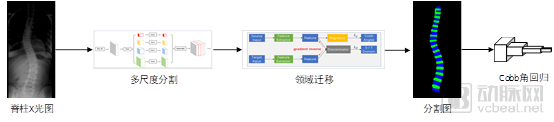
Logic Solutions
For anteroposterior spinal X-rays, the system first employs multi-scale segmentation technology to segment the spine, obtaining segmentation masks for the vertebral bodies and intervertebral disc spaces. The segmentation results are then used as input for the second step, Cobb angle regression. The initial segmentation step serves two purposes: 1. To visually exclude errors caused by anomalous regions outside the spinal area (such as human error and motion artifacts); 2. To reduce the dimensionality of the original image, transforming the complex X-ray input into a binary map containing only the spinal region.
To address the challenge of varying distributions in multi-center imaging data, this system employs a domain adaptation approach that enables the network to disregard differences across source domains while maintaining segmentation accuracy. The segmentation results are then used as input for a deep convolutional neural network to regress the Cobb angle. Finally, a multi-model fusion strategy is applied to further enhance the robustness of the system.
In the future, this system can be applied to computer-aided diagnosis and treatment planning for Adolescent Idiopathic Scoliosis (AIS), improving the accuracy and speed with which physicians assess scoliosis severity, thereby generating economic and social value. Additionally, the system can serve as a tool for early symptom detection, providing a critical basis for physicians in formulating treatment strategies.
From AI-powered triage to AI-assisted early cancer screening, the application of AI technology in the healthcare industry is no longer unfamiliar. Leveraging cutting-edge computer vision technologies, Tencent Youtu Lab has been continuously exploring applications in the field of medical AI. In addition to setting two new records and achieving world-first rankings in liver segmentation and liver tumor segmentation at the global Medical Imaging Challenge LiTS, the lab recently broke the world record in the SegTHOR Challenge 2019, a global competition for multi-organ segmentation in chest CT scans.
As technological R&D continues to deepen, Tencent Youtu has also been consistently exporting its medical AI capabilities through “Tencent Miying,” Tencent’s first medical imaging product. Currently, it supports screening for cervical cancer, lung cancer, ophthalmic diseases, and other conditions, and has been deployed in more than 100 top-tier Grade 3A hospitals across China. This has not only reduced physicians’ workload but also played a significant role in improving diagnostic accuracy and efficiency.