

Top 10 Initiatives for China's Health Industry in the Next Three Years: Action Plan Released by 21 Ministries
VCBeat (WeChat ID: vcbeat) – On September 29, the official website of the National Development and Reform Commission (NDRC) released the Action Outline for Promoting High-Quality Development of the Health Industry (2019–2022). The Outline was jointly formulated by the NDRC, the Ministry of Education, the Ministry of Science and Technology, the Ministry of Industry and Information Technology, the Ministry of Civil Affairs, the Ministry of Finance, the Ministry of Human Resources and Social Security, the Ministry of Natural Resources, the Ministry of Ecology and Environment, the Ministry of Housing and Urban-Rural Development, the Ministry of Commerce, the Ministry of Culture and Tourism, the National Health Commission, the People’s Bank of China, the State Taxation Administration, the State Administration for Market Regulation, the General Administration of Sport, the National Healthcare Security Administration, the China Banking and Insurance Regulatory Commission, the National Administration of Traditional Chinese Medicine, and the National Medical Products Administration.
The Outline proposes that by 2022, a health industry system with rich connotations and a rational structure will be basically established; the coverage of high-quality medical and health resources will be further expanded; the integration and synergy of the health industry will be further enhanced; the technological competitiveness of the health industry will be further improved; the quantity and quality of talent will reach a higher level; and several health industry clusters with strong influence will be formed, thereby laying a solid foundation for the health industry to become an important pillar of the national economy.
The Outline will implement 10 major projects focusing on key areas and critical links, comprising 33 specific work items closely related to various sub-sectors of the health industry. These include supporting the expansion of high-quality private healthcare services, accelerating the development of pharmaceutical e-commerce, applying big data in health and medical care, and increasing the supply of innovative health insurance products.
VCBeat has summarized the main content of the "Outline" as follows:
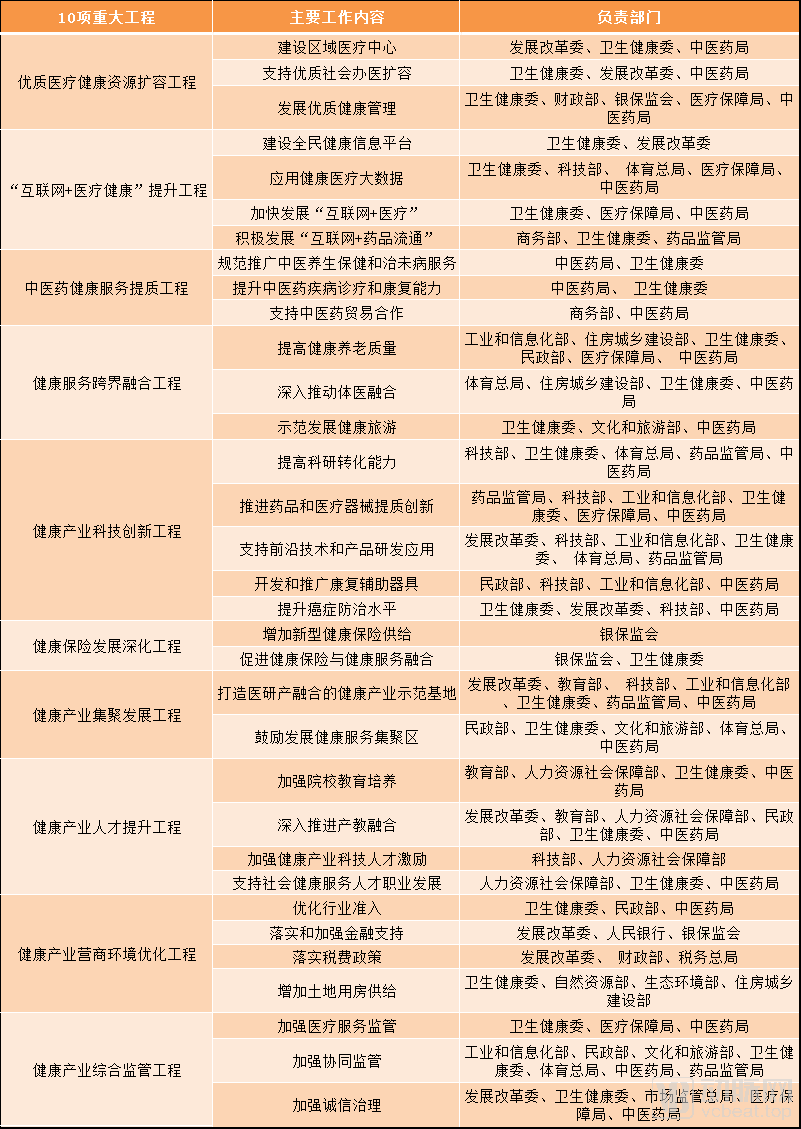 Source: Official website of the National Development and Reform Commission; graphic by VCBeat
I. Project for Expanding High-Quality Medical and Health Resources
Establish Regional Medical Centers.Leveraging existing medical institutions, establish a number of high-level clinical diagnosis and treatment centers, high-standard clinical research and innovation platforms, and high-caliber talent training bases across China. Enhance the capacity for diagnosing and treating complex and critical diseases within regions, gradually meeting the public’s demand for accessible, high-quality medical services, and strive to ensure effective treatment of key conditions such as cancer, cardiovascular and cerebrovascular diseases, respiratory diseases, pediatric disorders, and trauma within regions. Promote the decentralization of high-quality medical resources, advance the establishment of communities of responsibility, interest, service, and management between high-level hospitals and primary care institutions, form specialized medical alliances, and improve the quality of primary healthcare management and services. (The National Development and Reform Commission, the National Health Commission, and the National Administration of Traditional Chinese Medicine are responsible; the first-listed department is the lead agency, as applies below.)
Support the expansion of high-quality private healthcare services.Support high-level private hospitals that meet the requirements in establishing medical practices across regions, extending services to the grassroots level, and achieving branded and group-based development. Further leverage the advantages of flexible mechanisms and close proximity to the public inherent in socially operated medical institutions, and support social forces in establishing institutions for general practice, specialized care, traditional Chinese medicine, third-party medical technology services, rehabilitation, nursing, and palliative care, so as to foster coordinated development with public hospitals. Launch pilot programs for clinic reforms, streamline access procedures for clinics, improve basic standards for clinics, implement a filing-based management system for pilot clinics, and encourage physicians to establish clinics on either a full-time or part-time basis. (Responsibility lies with the National Health Commission, the National Development and Reform Commission, and the National Administration of Traditional Chinese Medicine.)
Develop high-quality health management.Leverage family doctor contract services as a key instrument for popularizing health management, increase the supply of standardized health management services, and prioritize health examinations, health risk assessments, health counseling, and health intervention services for high-risk groups with chronic diseases and occupational diseases. Improve mechanisms for government procurement of services and performance evaluation. Strengthen the development and application of intelligent and informatized platforms for family doctor contract services, fully integrate them with residents’ electronic health records and electronic medical records, and gradually incorporate broader health data. On the basis of providing basic service packages through contracts, encourage non-governmental entities to offer differentiated and customized health management service packages according to the public’s health management needs and ability to pay, and explore commercial health insurance as a financing or cooperation channel. (Responsible entities: National Health Commission, Ministry of Finance, China Banking and Insurance Regulatory Commission, National Healthcare Security Administration, National Administration of Traditional Chinese Medicine)
II. “Internet + Healthcare” Enhancement Project
Build a national health information platform.Orderly advance the construction of provincial-level integrated regional population health information platforms, and gradually connect various medical and health institutions and health data resources to the platforms to achieve interconnectivity. Establish standards for platform data resources and interoperability exchange services, with a focus on promoting the standardization of electronic health records (EHRs) and electronic medical records (EMRs), progressively enabling continuous documentation and information exchange, and enhancing the level of regional health information sharing. (The National Health Commission and the National Development and Reform Commission shall be responsible respectively.)
Application of Health and Medical Big Data.Establish a national health and medical data resource catalog system, build foundational databases centered on residents’ electronic health records (EHRs) and electronic medical records (EMRs), strengthen integration with national physical fitness assessments, health examinations, and other external data sources, and progressively achieve big data management of health information covering the entire population across the full life cycle. Establish and improve policies for information sharing, data security, and privacy protection, as well as emergency safeguard mechanisms for health and medical big data. Promote secure sharing of health and medical big data, and deepen its applications in medical research, education and training, clinical diagnosis and treatment, product development, industry governance, and health insurance payment. Develop intelligent traditional Chinese medicine (TCM) auxiliary diagnostic and treatment systems. (Responsible entities: National Health Commission, Ministry of Science and Technology, General Administration of Sport of China, National Healthcare Security Administration, National Administration of Traditional Chinese Medicine)
Accelerate the development of “Internet + Healthcare”.Support the independent establishment of internet hospitals based on physical medical institutions, regulate the conduct of online diagnosis and treatment activities, improve the accessibility of high-quality medical services, actively develop online health consultation and health management services, and promote the integration of online and offline services. With high-level hospitals as the core, accelerate the establishment of telemedicine networks and platforms, increase the coverage of remote consultations, remote imaging, and remote pathology services for grassroots, remote, and underdeveloped areas, and improve relevant payment mechanisms. Relying on "Internet Plus," implement the Action Plan for Further Improving Medical Services, focusing on enhancing the patient experience, applying internet and IoT technologies to optimize hospital service processes, fully realizing time-slot appointment-based diagnosis and treatment, mutual recognition of laboratory and imaging results within regions, and gradually promoting services such as intelligent triage, queue-free (or reduced-queue) waiting and medication pickup, mobile payment and settlement, automatic push of test results, and smart traditional Chinese medicine pharmacies. (Responsibility lies with the National Health Commission, the National Healthcare Security Administration, and the National Administration of Traditional Chinese Medicine.)
Actively develop “Internet + pharmaceutical distribution”.Establish cooperative platforms for pharmaceutical distribution enterprises, medical institutions, and e-commerce companies; promote the application of information technologies such as cloud computing, big data, mobile internet, and the Internet of Things (IoT) in pharmaceutical distribution to streamline distribution tiers, optimize distribution networks, and enhance the symmetry and transparency of supply and demand information. Establish channels for the interconnectivity and real-time sharing of online diagnosis and prescription information with retail drug consumption data, and support third-party delivery services for prescription medications ordered online. Accelerate the development of pharmaceutical e-commerce and provide patients with services such as “online ordering and in-store pickup” and “online ordering and home delivery.” (Responsible entities: Ministry of Commerce, National Health Commission, and National Medical Products Administration)
III. Quality Improvement Project for Traditional Chinese Medicine Health Services
Standardize the promotion of TCM health preservation and healthcare, as well as “preventive treatment of disease” services.Formulate policy measures to promote the standardized development of Traditional Chinese Medicine (TCM) health preservation and wellness services, strengthen development guidance and industry supervision, improve the operational compliance of TCM health preservation and wellness institutions, standardize service content, and enhance the professional competence of practitioners. Establish and improve norms and standards for common TCM health preservation and wellness services. Encourage TCM medical institutions to provide technical support to TCM health preservation and wellness institutions, and support TCM physicians in providing services at such institutions in accordance with regulations. Promote services such as health status identification and assessment, consultation and guidance, and health interventions that are guided by scientific TCM theories and managed by qualified professionals. Support TCM medical institutions in developing “preventive treatment of disease” services, encourage primary healthcare institutions to provide such services, include TCM preventive treatment service packages in family doctor contracted services, and gradually ensure that every family doctor contracted service team includes a physician or village doctor capable of providing TCM services. (Responsibility: National Administration of Traditional Chinese Medicine, National Health Commission)
Enhance the capacity for diagnosis, treatment, and rehabilitation using Traditional Chinese Medicine.Focus on enhancing the diagnosis and treatment capabilities for major, complex, and chronic diseases by organizing efforts to explore traditional Chinese medicine (TCM) prescriptions. Concentrate superior resources to develop TCM prevention and treatment technologies, conduct new drug research and development, and promote collaborative clinical breakthroughs in integrated traditional Chinese and Western medicine. Support TCM research institutions, medical facilities, and enterprises in collaborating to translate TCM research outcomes into practical applications, accelerating the commercialization of TCM health management products and diagnostic and therapeutic equipment. Establish a database of traditional TCM knowledge, along with a protected list and protection systems. Support the development of rehabilitation hospitals and departments with distinctive TCM features, and promote the development and application of modern TCM rehabilitation technologies. (Responsible agencies: National Administration of Traditional Chinese Medicine, National Health Commission)
Support trade cooperation in traditional Chinese medicine.Support social forces in establishing TCM service trade institutions, consolidate traditional service trade advantages in TCM healthcare and medical care, education and training, and develop “Internet + TCM trade”. Encourage capable and reputable enterprises to build transnational marketing networks for TCM in countries along the “Belt and Road” through new establishment, mergers and acquisitions, leasing, and joint investment, and to establish logistics and distribution centers and economic alliances for TCM products. Actively promote the development of TCM service trade and product trade through multilateral and bilateral economic and trade negotiations and cooperation mechanisms. (Responsible entities: Ministry of Commerce, National Administration of Traditional Chinese Medicine)
IV. Cross-Sector Integration Project for Health Services
Improve the Quality of Healthy Aging.Promote the extension of healthy aging services to rural areas, communities, and households; prioritize the coverage of elderly individuals in family doctor contract services; and establish incentive mechanisms for village doctors to participate in healthy aging services. Focus on enhancing long-term care service capacity by increasing the number of rehabilitation, nursing, and elderly care institutions with long-term care capabilities through appropriate hospital transformations, capacity building in elderly care institutions, and guiding social investment, thereby raising the proportion of long-term care personnel and beds. Develop skills training services for family caregivers to strengthen household long-term care capabilities. Pilot and promote long-term care insurance, and improve industry standards and institutional mechanisms, including criteria for assessing long-term care needs, service scope, service standards, and quality evaluation. Encourage traditional Chinese medicine (TCM) practitioners to provide TCM health consultation and conditioning services in elderly care institutions. Support social forces in establishing a batch of demonstration bases for integrated medical and elderly care services featuring TCM characteristics. Advance pilot demonstrations of smart healthy aging services, build information-sharing platforms for integrated medical and elderly care, and strengthen the promotion of smart healthy aging technologies. Strengthen standardized management of integrated medical and elderly care services. (The Ministry of Industry and Information Technology, the Ministry of Housing and Urban-Rural Development, the National Health Commission, the Ministry of Civil Affairs, the National Healthcare Security Administration, and the National Administration of Traditional Chinese Medicine shall be responsible respectively.)
Deepen the integration of sports and medicine.Establish, improve, and apply a library of exercise prescriptions. Support social forces in establishing a large number of sports-medicine integrated health management institutions centered on scientific fitness, and promote sports-medicine integrated services aimed at chronic disease prevention, exercise rehabilitation, and health promotion. Promote traditional exercises such as Tai Chi and Baduanjin to enrich and develop Traditional Chinese Medicine (TCM)-based sports-medicine integrated services. Further encourage and guide social participation in the development of the fitness and leisure industry. Formulate and implement development plans with a focus on outdoor sports, supporting the growth of fitness and leisure projects that drive consumption. Improve the infrastructure network for fitness and leisure activities. (Responsible entities: General Administration of Sport, Ministry of Housing and Urban-Rural Development, National Health Commission, National Administration of Traditional Chinese Medicine)
Demonstrate the development of health tourism.Strengthen the development of health tourism demonstration bases. Advance the construction of national Traditional Chinese Medicine (TCM) health tourism demonstration zones (bases). Establish a number of high-end medical parks focused primarily on physical examinations and disease treatment, and improve support policies aligned with international medical standards. Develop and promote a range of health tourism routes and products with strong experiential value and broad participation, including TCM, rehabilitation and convalescence, and leisure wellness. Enhance health tourism cooperation with countries along the Belt and Road Initiative and neighboring nations, and implement international (border) medical service projects. (The National Health Commission, the Ministry of Culture and Tourism, and the National Administration of Traditional Chinese Medicine shall be responsible respectively.)
V. Health Industry Technological Innovation Project
Enhance the capability for translating scientific research into practical applications.Effectively organize and implement the National Science and Technology Major Projects and the National Key R&D Programs, and proactively plan public scientific and technological activities that support the development of the health industry, including basic frontier research, social welfare initiatives, and research on major common key technologies. Advance the construction of major national infrastructure for translational medicine. Promote the establishment of National Clinical Medical Research Centers to form a collaborative research network covering the entire country; strengthen evaluations of how these centers organize collaboration among medical institutions, research institutes, and enterprises, and facilitate the transfer and commercialization of achievements, while enhancing the application of evaluation results. Launch pilot reforms of the science and technology system in the health sector. Achieve and promote reform experiences in areas such as the restructuring of research institutes, open sharing of scientific and technological resources, transfer, commercialization, and promotion of achievements, and scientific and technological evaluation mechanisms. Conduct in-depth scientific research on exercise promoting health and promote the industrial application of research findings. (The Ministry of Science and Technology, the National Health Commission, the General Administration of Sport of China, the National Medical Products Administration, and the National Administration of Traditional Chinese Medicine shall be responsible respectively.)
Promote quality improvement and innovation in pharmaceuticals and medical devices.Priority review and approval shall be granted to new drugs urgently needed for clinical use and drugs for rare diseases. The review model for drug clinical trials shall be reformed by transitioning from an explicit approval system to a tacit approval system upon expiration of the statutory review period, thereby improving the efficiency of clinical trial application reviews. Simplified registration and approval procedures shall be promoted for traditional Chinese medicine (TCM) compound preparations derived from ancient classic prescriptions. Consistency evaluation of the quality and efficacy of generic drugs shall be continuously advanced, with improvements to the technical review standards and guideline systems for generics; lists of encouraged generic varieties shall be published to guide enterprises in rational research, development, and submission. Registration applications for innovative medical devices that hold core technology invention patents and demonstrate significant clinical value shall be included in the scope of special review and approval and given priority handling. Medical device standards shall be revised to increase the adoption rate of international standards for medical devices. The demonstration and application of innovative high-performance medical devices shall be further promoted, with intensified efforts in dissemination and adoption. (The National Medical Products Administration, the Ministry of Science and Technology, the Ministry of Industry and Information Technology, the National Health Commission, the National Healthcare Security Administration, and the National Administration of Traditional Chinese Medicine shall be respectively responsible.)
Supports the application of cutting-edge technologies and product research and development.Leverage inter-departmental synergy to enhance the continuity and coordination of policies concerning research project initiation, clinical trials, market access, and regulation. Accelerate the research and translation of key technologies such as next-generation gene sequencing, tumor immunotherapy, stem cells and regenerative medicine, and big data analytics in biomedicine. Promote the application of precision solutions and decision support systems for early screening and individualized treatment of major diseases. Accelerate the application of artificial intelligence (AI) technologies in assisted interpretation of medical imaging, clinical auxiliary diagnosis, and multi-dimensional medical data analysis. Facilitate the entry of eligible AI products into clinical trials, actively explore the use of AI-assisted technologies to improve diagnosis and treatment quality in areas with scarce medical resources and at primary healthcare institutions, and promote the implementation of tiered diagnosis and treatment. Support enterprises in promoting intelligent electronic products for health management and fitness that utilize wearable, portable, and non-contact methods for health information collection. (The National Development and Reform Commission, the Ministry of Science and Technology, the Ministry of Industry and Information Technology, the National Health Commission, the General Administration of Sport of China, and the National Medical Products Administration shall be respectively responsible.)
Develop and promote rehabilitation assistive devices.Integrate rehabilitation assistive devices into policy measures supporting the construction of elderly care service facilities, advance community-based rental pilots for such devices, and improve promotion efficiency while reducing usage costs. Launch national comprehensive innovation pilots for the rehabilitation assistive device industry, supporting pilot regions in fostering industrial clustering, building service networks, innovating government-industry-academia-research-application collaboration models, and promoting the integrated development of business formats. Support enterprises in developing rehabilitation assistive devices for elderly care and nursing, functional compensation, and rehabilitation training, as well as intelligent rehabilitation assistive devices incorporating new technologies such as flexible control, multi-source information fusion, motion information decoding, and external environment perception, and strengthen their promotion and application. Accelerate the development of traditional Chinese medicine (TCM)-based rehabilitation assistive devices. (Responsibility: Ministry of Civil Affairs, Ministry of Science and Technology, Ministry of Industry and Information Technology, National Administration of Traditional Chinese Medicine)
Enhance the Level of Cancer Prevention and Control.Improve cancer prevention and control mechanisms and service systems, and strengthen the capacity building of the National Cancer Center and the National Clinical Research Center for Malignant Tumors. Support research on comprehensive cancer prevention and control technologies suited to China’s national conditions, population characteristics, and regional features, and develop and promote standardized diagnosis and treatment guidelines. Conduct research and implement science and technology programs aimed at conquering cancer. Support medical institutions and enterprises in collaborating on the research and development of traditional Chinese medicine (TCM) technologies and the translation and application of their achievements in areas such as early cancer prevention, coordinated radiotherapy and chemotherapy, cancer pain management, and rehabilitation. (Responsibility: National Health Commission, National Development and Reform Commission, Ministry of Science and Technology, National Administration of Traditional Chinese Medicine)
VI. Health Insurance Development Deepening Project
Increase the supply of new types of health insurance.Further guide health insurance companies to develop medical insurance products that cover special-needs medical care, cutting-edge medical technologies, innovative drugs, the application of high-end medical devices, as well as interventional services such as disease risk assessment, disease prevention, and physical fitness. Formulate policies to further support the development of commercial long-term care insurance and caregiving services. Accelerate the market access approval of medical malpractice liability insurance products suitable for multi-institutional practice, and encourage doctors, medical associations, and other stakeholders to participate in the development of such insurance products. (The China Banking and Insurance Regulatory Commission is responsible.)
Promote the integration of health insurance and health services.Support health insurance companies in launching managed care pilots, and establish health management organizations that cover the entire service chain—including health insurance, health management, medical services, and long-term care. This aims to drive transformation in service models, encourage individuals to assume responsibility for their health, improve the efficiency of insurance fund utilization, and enhance the ability to control and constrain medical expenses. Build a high-level platform to facilitate collaboration between public hospitals (including their special-needs medical services) and health insurance companies, thereby promoting designated partnerships between healthcare providers and insurers. Support health insurance companies in delivering internet-based insurance services and developing health data management businesses to enhance refined management capabilities. (Responsibility: China Banking and Insurance Regulatory Commission, National Health Commission)
VII. Project for the Clustered Development of the Health Industry
Build a demonstration base for the health industry that integrates medical care, research, and production.Select a number of cities or regions with abundant teaching and research resources, strong clinical capabilities, and robust industrial strength. Based on high-level hospitals, gather high-end resources in medical services, medical education, medical research, pharmaceutical and medical device R&D, and review and inspection. Improve comprehensive policies for the coordinated development of medicine, research, and industry tailored to the health industry’s characteristics, strengthen the construction of public service platforms, and accelerate the development of high-end health industry clusters featuring first-class talent, clinical care, innovation, and industry. Support the creation of demonstration bases for integrated health industries combining medicine, research, and production, leveraging the advantages of regional leading institutions. (Responsible entities: National Development and Reform Commission, Ministry of Education, Ministry of Science and Technology, Ministry of Industry and Information Technology, National Health Commission, National Medical Products Administration, National Administration of Traditional Chinese Medicine)
Encourage the development of health service clusters.Establish a classified guidance mechanism for the agglomeration of services such as health tourism, healthy aging, fitness and leisure, and traditional Chinese medicine. Adhere to market orientation, introduce social capital, and gather elements such as brands, talent, and capital to accelerate the creation of specialized health service clusters with clear development orientations, closely integrated services, highly concentrated resources, and coordinated supporting policies. (The Ministry of Civil Affairs, the National Health Commission, the Ministry of Culture and Tourism, the General Administration of Sport, and the National Administration of Traditional Chinese Medicine shall be responsible respectively.)
VIII. Health Industry Talent Enhancement Project
Strengthen the education and training provided by academic institutions.Develop a guidance catalog of disciplines for talent development in the health industry, adjust and optimize the disciplinary structure of medical education, and strengthen the training of personnel in high-demand fields. Leveraging universities designated as “Double First-Class” institutions in medicine, accelerate the cultivation of high-caliber research-oriented talents in basic medicine, pharmacy, medical devices, new medical materials, and medical informatics. Enhance collaboration between medical practice and education, and further implement the Excellent Physician Education and Training Program. Promote competency-oriented reforms in medical education and teaching, strengthening students’ knowledge and skills across the entire continuum of health services, including prevention, diagnosis and treatment, health preservation and wellness, and rehabilitation. Expand the scale of talent training in disciplines such as general practice, geriatrics, geriatric nursing, rehabilitation therapy, and traditional Chinese medicine (TCM) wellness. Strengthen vocational education in health, guide social capital to establish vocational colleges (including technical schools) related to the health industry, support the addition of majors and courses in health services, and expand enrollment for junior secondary school graduates into integrated secondary–higher vocational education programs in fields such as nursing and elderly care. (The Ministry of Education, the Ministry of Human Resources and Social Security, the National Health Commission, and the National Administration of Traditional Chinese Medicine shall each be responsible for their respective areas.)
Deepen the integration of industry and education.Support the development of industry-education integration training bases for cultivating practical technical and skilled personnel in the health industry. Guide enterprises and schools to collaborate in establishing vocational training institutions, practice bases, and business incubation centers for health services, strengthening talent training oriented toward health needs and market applications. Expand the supply of professionals in elderly care, public nutrition, maternal and infant care, therapeutic massage, rehabilitation therapy, health management, and fitness instruction. Improve the mechanism for occupational skill appraisal in health-related services. Refine the training, assessment systems, and evaluation standards for medical auxiliary technical personnel. (The National Development and Reform Commission, the Ministry of Education, the Ministry of Human Resources and Social Security, the Ministry of Civil Affairs, the National Health Commission, and the National Administration of Traditional Chinese Medicine shall be respectively responsible.)
Strengthen Incentives for Scientific and Technological Talent in the Health Industry.Develop a roster of high-level talent for scientific and technological innovation in the health industry, provide prioritized support through relevant science and technology talent programs, and encourage local governments to provide complementary living and working conveniences for urgently needed high-level talent. Guide health industry enterprises and research institutions to establish evaluation criteria for scientific and technological talent oriented toward knowledge contribution and value contribution. Strengthen the implementation of policies related to scientific and technological innovation and entrepreneurship, transformation of scientific and technological achievements, distribution of intellectual property rights income, and reform of the personnel management system. Increase incentives for core personnel through mechanisms such as equity participation via intellectual property rights, intangible assets, and technological elements. (The Ministry of Science and Technology and the Ministry of Human Resources and Social Security shall be responsible respectively.)
Support the career development of professionals in social health services.Comprehensively consider societal demand for health service talent, and increase the allocation of quotas for medical research projects and high-level training programs to privately operated health service institutions. Professional technical personnel in privately operated medical institutions shall participate in professional title evaluations on an equal footing with their counterparts in public medical institutions. Industry organizations and personnel from privately operated medical institutions shall be included in senior professional title evaluation committees and medical institution accreditation committees established at the societal level, accounting for a certain proportion. Consolidate the regional registration system for physicians, and gradually explore and promote the regional registration system for nurses. Effectively safeguard the legitimate rights of medical personnel to engage in multi-institutional practice during non-working hours at their primary practicing institutions. Expand career development opportunities for caregiving service personnel. (The Ministry of Human Resources and Social Security, the National Health Commission, and the National Administration of Traditional Chinese Medicine shall each be responsible.)
IX. Project to Optimize the Business Environment for the Health Industry
Optimize industry market access.Promote the implementation of the “integration of two certificates into one” for the approval of establishment and practice registration of eligible medical institutions. Improve the approval workflow for medical institutions by implementing a “single-window acceptance, one-time notification, and one-stop approval” mechanism, shorten the approval timelines for the establishment of medical institutions, practice registration, and the practice registration of physicians and nurses, accelerate the integration and interconnection of different business information systems, and promote the verification of required materials through online access. Effectively implement the filing management system for traditional Chinese medicine clinics, infirmaries, and nursing stations established within elderly care institutions. (The National Health Commission, the Ministry of Civil Affairs, and the National Administration of Traditional Chinese Medicine shall be responsible respectively.)
Implement and strengthen financial support.Support equity financing, intra-industry mergers and acquisitions, and the issuance of debt financing instruments for eligible health industry enterprises. Encourage financial institutions to provide market-based service support for the export of health products and services, as well as for cross-border mergers and acquisitions by health industry enterprises. (The National Development and Reform Commission, the People’s Bank of China, and the China Banking and Insurance Regulatory Commission shall be respectively responsible.)
Implement tax and fee policies.Implement effectively the preferential tax policies, reductions and exemptions of administrative and institutional fees, and pricing policies applicable to health service institutions as stipulated. Electricity, gas, and heating prices for sports venues and other fitness facilities shall not exceed those for general industrial and commercial users. Sports venues shall enjoy preferential policies on property tax and urban land use tax in accordance with regulations. (The National Development and Reform Commission, the Ministry of Finance, and the State Taxation Administration are respectively responsible.)
Increase the supply of land and housing.Standardize the supply of land for the health industry through agreement-based transfers, and promote methods such as long-term leasing, leasing before transfer, combined leasing and transfer, and flexible-term transfers to increase the supply of land for medical and health purposes. For land supplied via transfer, land premiums may be paid in installments as stipulated in the contract. Encourage the inclusion of health service facilities in the supply of new commercial land, based on assessments of regional health and other plans; improve standards and requirements for supporting community health service facilities; and establish mechanisms and measures for supervision and implementation. Encourage cities to make rational use of existing land reserves and explore approaches such as transformation and redevelopment, subdivision and transfer of surplus land, and government land banking to revitalize land resources and construct premises required by the health industry. Support non-governmental entities in utilizing marginal plots and abandoned factories to build sports venues and facilities. Where market entities repurpose idle commercial, office, or industrial properties for establishing medical institutions without changing the primary land user or planning conditions, they may implement a five-year transitional policy allowing continued land use according to the original purpose and rights type, except where the original paid land use contract or administrative allocation decision explicitly prohibits changes in land use or stipulates that the government shall reclaim land use rights upon any change in use. During the five-year transitional period, procedures for changing land and property purposes and types of rights may be temporarily waived. Health, natural resources, ecological environment, housing and urban-rural development, and other relevant functional departments shall jointly take effective measures in accordance with laws and regulations to establish and improve management systems that ensure safety while facilitating reasonable operations. (The National Health Commission, the Ministry of Natural Resources, the Ministry of Ecology and Environment, and the Ministry of Housing and Urban-Rural Development are respectively responsible.)
X. Comprehensive Supervision Project for the Health Industry
Strengthen the Supervision of Medical Services.Strengthen the comprehensive performance assessment of public medical institutions, improve incentive and constraint mechanisms, curb unreasonable growth in medical expenses, enhance supervision over the professional conduct of healthcare practitioners, establish accessible information channels for the public to inquire about and access practitioners’ credential and practice information, and intensify efforts to prevent unlicensed medical practice. Step up the construction of professional ethics and conduct in the healthcare industry, and implement the system for evaluating the medical ethics of healthcare personnel. Strengthen oversight and control over the profit margins of for-profit medical institutions, and disclose service prices and other relevant information in accordance with the law. Launch special campaigns to address violations and fraudulent activities involving medical insurance funds, and terminate designated provider agreements with institutions found guilty of fraud. Fully roll out intelligent monitoring systems for medical insurance, explore effective approaches to extend medical insurance supervision to cover the clinical practices of healthcare providers, and curb unreasonable growth in medical expenses. (The National Health Commission, the National Healthcare Security Administration, and the National Administration of Traditional Chinese Medicine shall be respectively responsible.)
Strengthen collaborative regulation.Research and establish an inclusive, effective, and prudential regulatory system adapted to the development of new technologies, new products, new business formats, and new models in the health industry, promoting a transition from fragmented, multi-headed regulation to comprehensive and collaborative oversight. Priority should be given to improving regulation of cross-sector integration involving elderly care, tourism, the internet, fitness and leisure, and medical healthcare. The departments responsible for each integrated business format shall reasonably define regulatory boundaries based on the characteristics of the format and establish inter-departmental coordination mechanisms. Strengthen drug safety supervision to effectively safeguard public medication safety. Enhance the construction of ethical review mechanisms for clinical research and increase the costs associated with violations of ethical norms. (The Ministry of Industry and Information Technology, the Ministry of Civil Affairs, the Ministry of Culture and Tourism, the National Health Commission, the General Administration of Sport of China, the National Administration of Traditional Chinese Medicine, and the National Medical Products Administration shall be respectively responsible.)
Strengthen integrity governance.Integrate information on administrative licensing, administrative penalties, and sampling inspection results in the healthcare, pharmaceutical, and medical device industries into the National Credit Information Sharing Platform. Information involving enterprises shall be pushed to the National Enterprise Credit Information Publicity System and disclosed in accordance with the law. Establish a blacklist system for the healthcare and pharmaceutical distribution industries in accordance with laws and regulations. Conduct in-depth special campaigns to address serious dishonest acts, such as unlicensed medical practice and insurance fraud through deception, and continuously intensify efforts to crack down on false and illegal pharmaceutical advertisements. Establish a point-based system for recording improper professional conduct by healthcare institutions and medical personnel, and improve the credit record database for the healthcare industry based on practice access registration and records of improper professional conduct. (The National Development and Reform Commission, the National Health Commission, the State Administration for Market Regulation, the National Healthcare Security Administration, and the National Administration of Traditional Chinese Medicine shall be respectively responsible.)
Source: National Development and Reform Commission