Hepatitis B Functional Cure Enters the Value Realization Era: Technological Breakthroughs, Pipeline Dynamics, and Commercial Prospects

GSK
Pharmaceutical R&D Manufacturer
ART.
01
Epidemiology and Clinical Needs:
The Existing Gap Lays the Foundation for Value Realization
Key Points: Significant achievements in prevention, the diagnosis and treatment gap for the adult population constitutes the core market, and the limitations of traditional therapies provide room for the value realization of curative drugs.
The Prevention and Control of Hepatitis B Has Been Implemented in“Prevention End”Achieve Milestone Success——Full-course HepB vaccination coverage rate in Chinese newborns reached99.6%,1-4Years old childrenHBsAgPrevalence drops to0.3%, close toWHO 2030Annual prevention and control targets. However, the treatment gap in the adult stock market still constitutes a major public health challenge.
Globally, the number of people with chronic hepatitis B exceeds2.54100 million, Africa (prevalence)8.1%) and the Western Pacific Region (prevalence6.2%) as high-burden areas, hepatitis B-related liver cancer accounts for56%, which is the core cause of death in liver diseases. Focusing on China, according toPolaris Observatory 2024Yearly update data,2022In ChinaHBVThe number of infected people has reached7974Ten thousand people, of which those meeting the "Guidelines for the Prevention and Treatment of Chronic Hepatitis B (2022Chronic hepatitis B patients with treatment indications according to the "Year Edition)"2300Ten thousand, while the diagnosis rate is only22%, Treatment Rate Only15%, Ultra80%Patients who have not been diagnosed or have not received standardized treatment face the risk of disease progression, creating a significant gap in clinical demand.
Traditional nucleos(t)ide analogues (NAs, such asETV、TDF/TAF) By inhibitingHBVPolymerase achieves viral replication inhibition; long-term medication can control the condition but cannot eliminate covalently closed circular DNA within hepatocytes.DNA(cccDNA)——This viral replication“Ultimate Template”, resulting in the patient requiring lifelong medication, and there are still2%-4%/The risk of liver cirrhosis and liver cancer occurring over the years. This“Control Rather Than Cure”The clinical limitations, promoting functional cure (defined as: after the end of treatment≥24Week, SerumHBsAgContinuous clearance, with or without resistance-HBsPositive conversion,HBV DNAContinuously below the detection limit, no need for continued antiviral treatment) has become the core R&D objective,“Inhibit virus replication+ReduceHBsAg+Activate Host Immunity”The triple synergistic strategy has become the technical path of industry consensus.
ART.
02
Core Technology Route:
Break Through Barriers to Support Value Realization and Implementation
Key Points: Nucleic acid drugs have the highest commercial certainty, with multiple complementary routes breaking through technical bottlenecks, providing core support for value realization.
The Core Logic of Functional Cure for Hepatitis B“Triple Synergy”——Inhibit virus replication, reduceHBsAg(Lifting immunosuppression) and activating host immunity, four major technological pathways have formed a research and development boom around this goal, each with its own breakthroughs.
1. Nucleic Acid Drugs: The Core Pillar of Rapid Antigen Reduction
Nucleic acid drugs with potent reductionHBsAgThe ability to become a core pillar of functional cure, and also the technology route with the fastest clinical progress and the highest commercial certainty currently. The core advantage lies in the rapid removal of immunosuppression, creating conditions for subsequent immune activation.
Antisense oligonucleotide (ASO) Class Drug RepresentativeGSK bepirovirsen Adopting a unique chemical structure design, through2′-MOE Modification to enhance stability and targeting. Its mechanism of action is unique, on the one hand through specific bindingHBV mRNA Exert spatial hindrance effects to inhibit viral protein translation, and on the other hand, act as an immunostimulant to activate.TLR8 Pathway, achieving 'direct antiviral+ The dual mechanism of 'immune activation' can be achieved without the combination of interferon.HBsAg A sharp decline. ItsⅢPhase Clinical Trial (B-Well 1/2) Using a randomized, double-blind, placebo-controlled design, nucleos(t)ide analogs (NUC) Previously treated and baselineHBsAg≤3000 IU/ml TheCHB Patient, the primary endpoint was after the end of treatment24 Zhou's functional cure. The results showed,bepirovirsenThe functional cure rate in the group receiving combined standard therapy was significantly better than that in the placebo group, with baselineHBsAg≤1000 IU/ml The subgroup efficacy was better (approximately15%-20%). In terms of safety, the main manifestations are injection site reactions and flu-like symptoms, which are generally controllable, consistent with previous experiences.ⅡThe data is consistent with the expected results.
Small InterferenceRNA(siRNA) Rely onGalNAc Liver-targeted delivery technology, precisely binding to the asialoglycoprotein receptor on the surface of hepatocytes (ASGPR), enabling subcutaneous injection, every4 Week 1 Convenient administration with excellent tolerance. The core mechanism is throughRNA Pathway DegradationHBV Pre-genomicRNA(pgRNA) andmRNA`, thereby effectively inhibiting`HBsAg Expression. Among the core varieties,VIR-2218(Vir/AlnylamJoint R&D) is proceeding throughⅢExploratory Joint TrialPEG-IFNαTo improve the durable response rate;GSK3228836(OriginalJNJ-3989, now belongs toGSK All) focus on combination regimens with capsid inhibitors; in China,siRNA Ribo Biotech, its core productRBD1016Has also entered the clinical development stage, closely following the international forefront.
2. Targeted Drugs for the Viral Life Cycle: The Key Power of Oral Synergy
Capsid Inhibitors (CpAM) as the representative, through interferenceHBV Nucleocapsid assembly, blocking viral replication andcccDNAForming from the beginning, some drugs also possess certainHBsAg Reducing ability. Due to its convenient oral administration and good safety profile, it has become a core partner in combination therapy regimens.
Chinese pharmaceutical companies have formed differentiated competition in this field, focusing on the advantages of oral administration and breaking through the compliance pain points of injectable drugs. GSKGST-HG141(Nerixizumab)For efficient capsid assembly modulators (CpAM), acting onHBVCore protein assembly process. IIPhase clinical data show that the combinationNA Treatment 24 Week, High-Dose GroupHBV RNA(pgRNA) Inhibition rate exceeds80%,HBsAg Decrease from baseline ≥1 log10 IU/ml The proportion of patients reached35%, significantly superior to monotherapy. CurrentlyⅢMore than half of the Phase clinical trials have been enrolled, focusing on treatment.CHBThe population is expected to become the first domestically produced capsid inhibitor approved in China.
Dongyang Light DrugMorphothiamine Mesylate (GLS4)As a novel capsid inhibitor, it functions by interfering with nucleocapsid assembly and maturation. It was one of the earlier agents proven in China to significantly inhibitHBsAg An orally administered small molecule drug, itsⅢFinal ExamTest Exploration & NA The all-oral combination regimen aims to improve patient compliance and fill the clinical gap."
3. Immunomodulators: Immune-Activating“Booster”
The core role is to breakCHBThe patient's immune tolerance status, recoveryTCell,BCell PairHBVThe ability to recognize and kill infected liver cells is often used as an "efficacy-enhancing module" in combination therapies. Specific sub-directions include:
Immune Checkpoint Inhibitors (PD-1/PD-L1、LAG-3):By blocking immune suppression pathways, reversingT Cell depletion. The representative regimen is nivolumab (developed by Bristol-Myers Squibb) combined withPEG-IFNα(ⅡPhase trial shows improvementHBsAg Clearance);GSKPreviously Promoted LAG-3 InhibitorGSK3359609 UnitedASO The program has been terminated due to the中期 efficacy not meeting expectations.ⅡPhase Clinical.
Therapeutic vaccine:InductionHBV Specific immune response, representative varietiesGS-4774(Gilead Sciences developed, recombinant protein vaccine) combinationNA And PEG-IFNα,ⅡThe data show that it can improve the durable response rate;
TLRAgonist:Activation of Innate Immune Pathways (TLR7/8/9), enhancing antiviral immunity. Due to the limited efficacy of monotherapy, this class of drugs (such as Gilead once developedGS-9620") Focus more on the exploration of combined applications."
4. cccDNATargeted Drugs: The Future Direction of Ultimate Cure
These drugs are designed to eliminate or silence at the root cause.cccDNA, achieving 'root"Except for 'sexual cure', which is the ultimate direction for future research and development, but still in the early stage. The core technical barriers are concentrated on delivery efficiency and safety."
①Gene Editing Technology: CRISPR-Cas9, Base Editing (Multiple institutions globally, such as Editas Medicine、Intellia Therapeutics All have layouts) can precisely cut hepatocytescccDNA Or integrated typeHBV DNAAmong them, base editing technology has attracted much attention because it can avoid genome instability caused by double-strand breaks and significantly reduce off-target risks. However, the core challenge remains the efficiency of liver-targeted delivery (which needs to precisely reach the nuclei of hepatocytes). The mainstream strategy currently is throughAdeno-Associated Virus (AAV) Vector optimization delivery, related projects are mostly inPre-ⅠPeriod /ⅠPhase Clinical;
②Epigenetic Regulators:By inhibiting histone deacetylase (HDAC), Bromodomain-containing protein (BET), etc., damage cccDNA Nucleosome structure, thereby silencing viral gene transcription. Representative drugs ACY-241(Conset Bio Concert Pharmaceuticals Research and Development,HDAC Inhibitors) are being explored in combination regimens with other drugs; notably,GSKOf BET Inhibitor GSK525762 Due to comprehensive considerations of efficacy and safety, clinical development has been terminated. The current focus of research and development for this class of drugs is on achieving complete clearance through combination therapy, which cannot be achieved with a single drug.cccDNA "Limitations."
ART.
03
Analysis of Benchmark Drugs:
Core Products Lead the Way in Value Realization Process
Key Points:AllNucleic acid drugs take the lead in defining the cure standard with their first-mover advantage, while pharmaceutical companies in China have taken a different approach by adopting an all-oral combination regimen to address the challenge of patient compliance."Injection"Compared with domestically produced"Oral"Dual-driven acceleration for the realization of value in the functional cure of hepatitis B.
1. World's First Candidate Drug:GSK bepirovirsen
GSK bepirovirsen(ASO Class)——The Global Functional Cure Track"Pioneer", itsⅢThe data from this period has established a core reference standard for the industry. This drug uses the previous 12Weekly 2 Times, After 12 Weekly 1 Subcutaneous injection regimen,6 Months of limited treatment, trial coverage 29 National Super 1800 Nucleos(t)ide analog-treated patients, excluding decompensated cirrhosis population, core endpoints focus"After the treatment ends" 24 "Functional cure sustained over weeks." The advantage lies in the dual mechanism of action (targeted degradationHBV mRNA + ActivationTLR8 Pathway), can be achieved without relying on interferonHBsAg Clear, suitable for those who cannot tolerate interferon; the drawback lies in the baseline.HBsAg>3000 IU/ml Efficacy in the population is limited (cure rate <5%), and there are adverse reactions such as injection site reactions and flu-like symptoms. The drug has now received Breakthrough Therapy Designation in China and the United States.FDA Fast Track Designation, Program2026 Year Q1 Submit NDA, if approved smoothly in the second half of the year, peak sales are expected to reach 27Hundreds of millions of dollars. Its pricing strategy (expected course of treatment costs tens of thousands of dollars) and medical insurance access negotiation results will directly affect the commercialization path of subsequent similar drugs.
2. China-produced Oral Benchmark: GSK's Dual Pipeline Layout
GSK (GST-HG131+GST-HG141)——The Benchmark of China-Produced Oral Combination Regimen, Through"Peak Climbing Plan"Build“HBsAg Inhibitor + Capsid Inhibitor"The all-oral combination, which has been included in the National Science and Technology Major Project. Among them,GST-HG131(Independently developed by GSK) is the world's first to announceⅡOral Phase Clinical DataHBsAg Inhibitor, acts onHBV S Protein Translation Phase, IIThe data for the period shows that administration 12 Zhou Ke Shi 76.5% Patient's HBsAg Decrease to 100 IU/ml The following (Note: This data is based on the baseline HBsAg Lower population), has been included in the national breakthrough treatment category;GST-HG141(Nerexinib) as a core capsid inhibitor, focuses on viral replication inhibition. The combination of the twoⅡThe trial period shows that it can be achieved."Reduce Antigen" + "Suppressive Action"Synergistic effect,HBsAgThe clearance rate has significantly improved compared to monotherapy, with the potential to address the adherence challenges of injectable drugs and set a benchmark for China-produced curative solutions. Progress is currently being accelerated.ⅢPhase clinical trials, striving for differentiated competitive advantage.
ART.
04
Global R&D Pipeline:
Multi-track Layout Accelerates the Rhythm of Value Realization
Key Points:2026-2028The year is a critical window period for commercialization, combination therapy becomes mainstream, and early pipeline layout realizes long-term value potential.
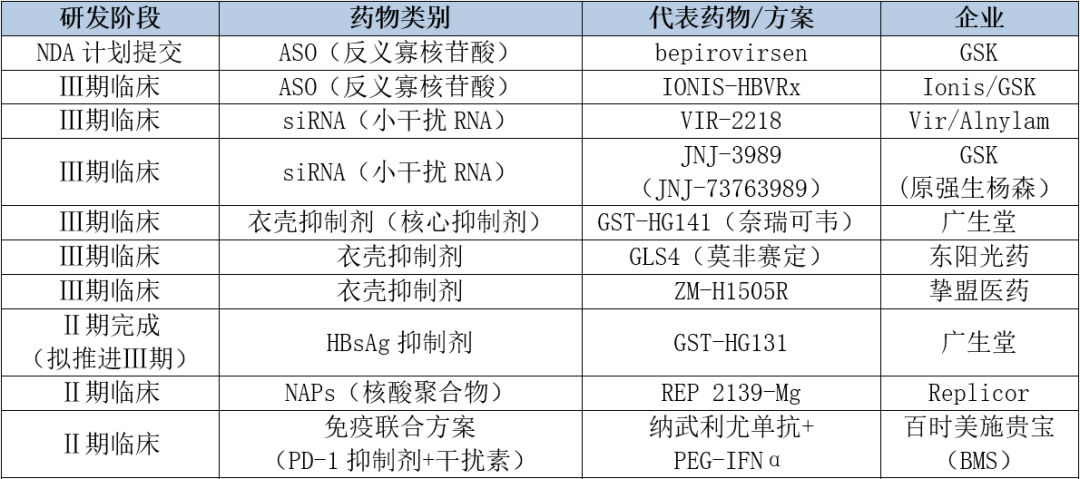
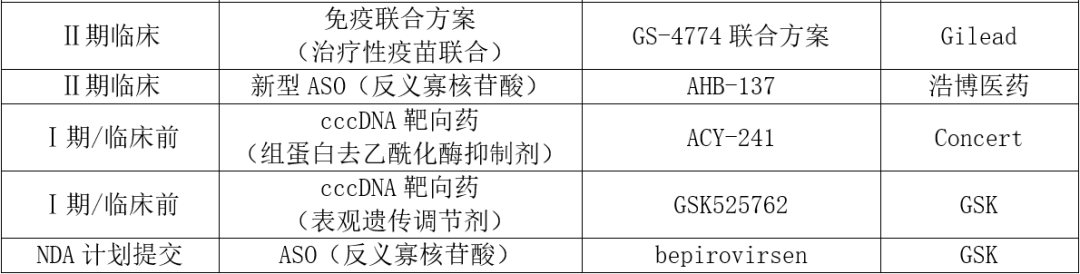
The Current Global Pipeline for Functional Cure of Hepatitis B Shows“Foreign Investment Takes the Lead, Domestic Production Catches Up”Pattern, combination therapy as the core R&D direction, key players focusASO、siRNA, the three major tracks of capsid inhibitors. The pace of pipeline advancement directly determines the speed of track value realization and market share allocation. The following is a summary of core products at each stage and competitive analysis:
1.ⅢPhase One: Foreign Investment Sprinting for IPOs, Domestic Production Accelerating Validation
ⅢDrugs at or above Phase ___ are mainly foreign-funded nucleic acid drugs (ASO/siRNA) and domestically produced oral small molecules (capsid inhibitors, etc.). Foreign investment includesbepirovirsen(ASO) as a representative, it has taken the lead in rushing to market. Its single drug can achieve functional cure for some patients, setting an example for the industry. “Advantaged Population (Low HBsAg)+ Limited Course of Treatment” The benchmark, but it also exposed the shortcomings of efficacy dependence on baseline levels and injection compliance; followed closely by siRNA Drug (such as VIR-2218、JNJ-3989) By virtue of GalNAc Delivery technology demonstrates potent antigen reduction capabilities and is being evaluated in combination with immunomodulators (such as PEG-IFNα) In Ⅲ Exploring higher cure rates. Meanwhile, domestically produced companies are taking a different path, such as GSK (GST-HG131/HG141), Dongyang Light Drug (GLS4) etc. as representatives, focusing on “Capsid Inhibitor+ HBsAg Inhibitor” The all-oral combination regimen, which aims to address the compliance pain points of injectable drugs through a differentiated route of administration, is currently being accelerated. Ⅲ Clinical trials to verify its curative potential in the real world.
2. ⅡPhase Clinical: Potential Candidate Reserve Value Realization Increment
・Nucleic Acid Polymer (NAPs):REP 2139-Mg(Canada Replicor Company R&D, combined with a low dose PEG-IFNα And background nucleos(t)ide analogues “COMBO” Solution, demonstrating a high level in clinical trials HBsAg Clearance);
・Immunomodulators:PD-1 Inhibitors (such as Nivolumab, Toripalimab) CombinedPEG-IFNα Plan, and GS-4774(Gilead Sciences) Therapeutic Vaccine Combination Regimen;
・Domestically Produced Innovative Drugs:Haobo Medicine AHB-137(Novel non-conjugated ASO,II Positive Phase Clinical Data, Significant Reduction Achieved HBsAg Level).
3. Early-stage R&D: Positioning for the Ultimate Cure, Unlocking Long-term Value Realization Potential
Early R&D withcccDNA Targeted drugs at the core, focusing on the ultimate cure goal. Although there is still a long way to go before commercialization, it provides important technical reserves for the realization of the track's long-term value. The current core technical barriers are mainly concentrated in delivery efficiency and safety. Gene editing technology (such as CRISPR‑Cas9, Base editing, multiple institutions globally including Editas Medicine、Intellia Therapeutics All have layouts) can precisely cut hepatocytes within cccDNA Or integrated HBV DNA, but the efficiency of liver-targeted delivery (especially the ability to enter the nucleus of hepatocytes) remains a key challenge. Multiple institutions are working on this through lipid nanoparticles (LNP), Adeno-Associated Virus (AAV) carriers and other methods to continuously optimize the delivery system. Epigenetic regulators (such as HDAC Inhibitor,BET Inhibitor) by modification cccDNA Relevant histone structures to silence viral transcription,ACY‑241(Conset Bio / Concert Pharmaceuticals R&D),GSK525762(GSK Products such as R&D are exploring combination regimens with nucleic acid drugs, which are expected to break through the efficacy bottleneck of single drugs and further amplify the value of the field.
ART.
05
Conclusion: The Validation Period of Track Value
Core Judgment
2026Will Become the Track for Functional Cure of Hepatitis B in [Year]“The First Year of Commercialization”,GSK bepirovsenThe listing process, pricing strategy, and market access outcomes will set the competitive tone for the track, while also pushing subsequent products to focus on differentiated populations (such as high...HBsAg, patients with liver cirrhosis) and the development of combination regimens. The current field still has clear limitations: existing drugs for baselineHBsAg>3000 IU/ml, The cure rate of patients with compensated cirrhosis is still lower than10%, The response rate in immunotolerant populations is insufficient, and the optimal combination and dosing schedule for combination therapy have yet to be determined. These represent key areas for future research and development.
For pharmaceutical practitioners, three core areas need to be prioritized: First, on the commercialization front, tracking the market entry pace of foreign nucleic acid drugs and domestically produced oral capsid inhibitors, updates on national reimbursement negotiations, and differentiated market positioning (such as focusing on grassroots markets in China and targeting high-payment-capacity markets overseas); Second, on the clinical research and development front, concentrating on exploring combination therapy approaches (e.g.,ASO+Capsid Inhibitor+PD-1Triple combination of inhibitors), biomarkers (such asHBsAgDecline rate, immune cell subsets) have predictive value for efficacy, which will determine the future clinical drug use landscape; third is the technological breakthrough side, focusing oncccDNATargeted drug delivery systems (such asLNP、AAVThe liver-targeting efficiency and safety data, the maturity of its technology will open a new chapter in hepatitis B“Radical Cure”The new track. Overall, the track for functional cure of hepatitis B is transitioning from“R&D-Driven”Turn to“Value Realization Driven”, clinical demand and commercial potential will continue to be unleashed, and the competitive landscape of the industry is expected to evolve in the future.3-5Became clear year by year.


Heavyweight Review! Full Inventory of China CDE Drug Submissions in 2025
Dongyang Guangya Pharmaceuticals' New Type 1 Diabetes Drug Approved for Marketing
Four Arrows Released! The Small Nucleic Acid Drug Track "Stirs Up a Storm"
Heavyweight Review! Full Inventory of China CDE Drug Submissions in 2025
Dongyang Guangya Pharmaceuticals' New Type 1 Diabetes Drug Approved for Marketing
Four Arrows Released! The Small Nucleic Acid Drug Track "Stirs Up a Storm"
Heavyweight Review! Full Inventory of China CDE Drug Submissions in 2025
Dongyang Guangya Pharmaceuticals' New Type 1 Diabetes Drug Approved for Marketing
Four Arrows Released! The Small Nucleic Acid Drug Track "Stirs Up a Storm"
Heavyweight Review! Full Inventory of China CDE Drug Submissions in 2025
Dongyang Guangya Pharmaceuticals' New Type 1 Diabetes Drug Approved for Marketing
Four Arrows Released! The Small Nucleic Acid Drug Track "Stirs Up a Storm"
Heavyweight Review! Full Inventory of China CDE Drug Submissions in 2025
Dongyang Guangya Pharmaceuticals' New Type 1 Diabetes Drug Approved for Marketing
Four Arrows Released! The Small Nucleic Acid Drug Track "Stirs Up a Storm"