

National Health Commission at the Helm: 328 Major Policies Enacted and Seven Key Areas Transformed Within 18 Months of Establishment
"Steering the Ship Across the Vast Ocean Depends on the Helmsman."
For China’s arduous path of healthcare reform, each step forward has largely depended on policy breakthroughs.
It has been a year and a half since the National Health Commission was officially established. Over the past 18 months, what actions has the NHC taken? In which areas has it driven reforms? And what is the overarching strategic direction under its leadership?
We reviewed 328 policy documents issued since the establishment of the National Health Commission, aiming to identify its key priorities.
According to data from the official website of the National Health Commission, since its establishment, the Commission has issued a total of 328 policy documents, focusing on seven major areas including informatization construction, drug management, and internet-based healthcare.(Note: The research sample for this article was sourced from the “Home > Information > Information Disclosure” section of the official website of the National Health Commission of China, covering the period from March 27, 2018, to October 9, 2019.)
In March 2018, the State Council launched a major institutional reform. The National Health Commission (NHC), along with 24 other entities, was newly established under the State Council’s restructuring plan. On March 27, the NHC officially commenced operations at the former compound of the National Health and Family Planning Commission, with people eagerly posing for photos in front of the new signage.
In addition to capturing people’s smiles, the camera also recorded a moment such as this:
China’s Healthcare Reform Sets Sail Once Again.
In 2018, the healthcare industry underwent significant changes.
On February 28, the Third Plenary Session of the 19th Central Committee of the Communist Party of China adopted the Plan for Deepening the Reform of Party and State Institutions. In the healthcare sector, the National Health Commission and the National Healthcare Security Administration were newly established.
The National Healthcare Security Administration is primarily responsible for controlling healthcare costs, supervising and managing medical insurance funds, and advancing informatization. In contrast, the National Health Commission’s mandate encompasses nearly the entire healthcare sector, serving as the de facto helmsman of China’s healthcare reforms. It is tasked with formulating national health policies, coordinating and promoting the deepening of healthcare system reforms, organizing the establishment of the national essential medicines system, overseeing public health, medical services, and health emergency response, managing family planning administration and services, and developing policy measures to address population aging and integrate medical care with elderly care.
The establishment of the National Healthcare Security Administration and the National Health Commission carries public expectations for the coordinated reform of medical insurance, healthcare services, and pharmaceuticals.
This round of the State Council’s institutional reform plan redefines the relationship among the government, society, and the market, and clarifies the boundaries of governmental authority. It represents an active exploration in advancing the modernization of China’s national governance system and governance capacity. There are two specific operational principles: The first is the principle explicitly stated in the Decision of the Third Plenary Session, which advocates that “in principle, matters of the same category should be coordinated by a single department, and each task should be overseen by one department, so as to avoid fragmented policymaking, unclear responsibilities, and mutual shirking or buck-passing.”
The second principle is not explicitly stated in words; however, the clearly defined responsibilities of various institutions in the plan do not assign ministries the duty of formulating reform plans or leading reforms. With regard to reforms within their respective industries, where mentioned, the phrasing used is “coordinate and advance” or “integrate and advance.”
This means that the current institutional reform plan is committed to addressing the previous drawback whereby individual departments independently designed and led their own sectoral and systemic reforms. Instead, it empowers an authoritative body, transcending departmental interests, to design the reform blueprint and lead its implementation.
On March 19, the Seventh Plenary Session of the First Session of the 13th National People's Congress decided, through voting, to appoint Ma Xiaowei as the Director of the National Health Commission. Ma Xiaowei studied at China Medical University and has held various prominent positions, including Vice President of China Medical University, Director of the Liaoning Provincial Department of Health, Vice Minister of Health, and Deputy Director of the National Health and Family Planning Commission. His career record is truly remarkable.
On March 27, the National Health Commission was officially inaugurated as a ministry-level agency, with 23 subordinate departments including the Bureau of Medical Administration and Hospital Management, the Department of System Reform, and the Department of Primary Healthcare.
The photo of the unveiling ceremony of the National Health Commission once went viral, as if people had already sensed that a major shift in the industry was about to unfold.
In terms of the impact of policies issued, the National Health Commission appears far more measured compared to the bold and sweeping reforms undertaken by the National Healthcare Security Administration in the realm of medical insurance.
If the treatment plan prescribed by the National Healthcare Security Administration to the healthcare industry is invasive surgery, then the treatment plan prescribed by the National Health Commission is chronic disease management.
Over the past year and a half, the National Health Commission has issued a total of 328 policy documents. A review of these policies reveals that not all of them bring about direct, transformative changes to the industry. Instead, most resemble seemingly casual moves on a board; yet, in the grand strategy of healthcare reform, they are indispensable.
To some extent, the National Health Commission resembles a seasoned chess player, strategizing behind the scenes to secure victory a decade down the line.
From an industry perspective, this article will review the key initiatives of the National Health Commission, using six-month intervals as phases.
Phase I (March 2018–September 2018): Establishing industry standards, specifications, and informatization as the overarching direction
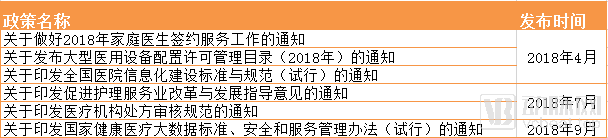
(Important policies issued by the National Health Commission during this period)
On the second day of its official operations, the National Health Commission issued four announcements concerning health industry standards, including the “Announcement on the Release of Seven Health Industry Standards Such as ‘Diagnosis of Hepatitis C’” and the “Announcement on the Release of Two Recommended Health Industry Standards Such as ‘Screening for Overweight and Obesity in School-Age Children and Adolescents.’” Both the mandatory and recommended health industry standards mentioned in the announcements will come into effect on August 1, 2018.
In early April, the National Health Commission ignited its “first major initiative,” directly targeting the configuration management of large-scale medical equipment. The issuance of the Notice on the Catalogue for Licensing Management of Large-Scale Medical Equipment Configuration (2018) sent shockwaves through the industry. This document officially released the latest 2018 edition of the catalogues for Class A and Class B large-scale medical equipment, establishing regulatory standards for the licensed configuration of such devices.
The Class A management catalog in the “Catalog” has been reduced from 12 items to 5, with the price threshold for large medical equipment subject to Class A management upon initial configuration adjusted upward from RMB 5 million to above RMB 30 million. The Class B management catalog has been expanded from 5 items to 7, covering large medical equipment priced between RMB 10 million and RMB 30 million upon initial configuration.
The “Notice on Further Promoting the Construction of Information Systems in Medical Institutions with Electronic Medical Records at the Core,” released in September, has had a significant impact on the industry. The document addresses core issues such as hospital grading and compliance, drawing considerable attention from hospitals at all levels.
Over the past six months, the National Health Commission has issued a total of 152 policy documents, primarily focusing on establishing industry norms and standards. Significant policy releases were made in key areas such as family doctor services, internet-based healthcare, health nursing, and electronic medical records.
Phase II (October 2018–March 2019): Decentralization of Medical Resources and Smart Services as Key Priorities
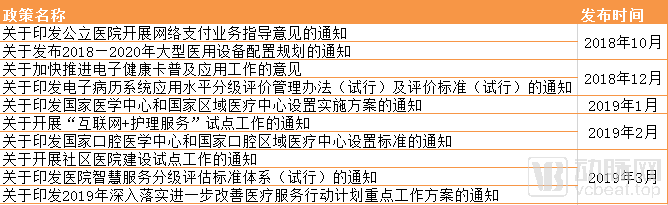
(Important policies issued by the National Health Commission during this period)
On the last day of October 2018, the National Health Commission issued the Assessment Indicators for the Action Plan to Further Improve Medical Services (2018–2020). The plan was released in two versions, tailored respectively for medical institutions and for health administrative departments. Both versions include requirements for informatization.
In the version for medical institutions, there are 12 first-level indicators and 39 second-level indicators, with a total score of 100 points. In the version for health administrative departments, there are 6 first-level indicators and 15 second-level indicators, with a total score of 50 points. With the introduction of this policy, the informatization construction of healthcare reform has been quantified for the first time.
In 2019, the National Health Commission continued to make strategic moves at a measured pace. Several policies introduced at the beginning of the year included commendations for blood collection teams and a call for proposals to establish national food safety standards.
In March this year, the General Office of the National Health Commission issued the “Notice on Launching Pilot Programs for Community Hospital Construction,” designating 20 provinces and municipalities—including Hainan Province, Chongqing Municipality, Sichuan Province, Yunnan Province, Shaanxi Province, and Gansu Province—as pilot areas. Implementing pilot programs for community hospital construction is a powerful lever to enhance primary healthcare service capacity, a significant measure to advance the development of a tiered diagnosis and treatment system, and an excellent pathway to promote the establishment of a high-quality and efficient healthcare service system.
Subsequently, the National Health Commission (NHC) set the tone for the development direction of smart hospitals. On March 18, the NHC issued the “Notice on Printing and Distributing the ‘Graded Evaluation Standard System for Hospital Smart Services (Trial)’.” In accordance with the basic service content that should be covered in the pre-diagnosis, during-diagnosis, and post-diagnosis stages for patients, and taking into account hospital informatization construction and the internet environment, the NHC established five categories comprising a total of 17 evaluation items.
Over the past six months, the National Health Commission has issued a total of 116 policies, releasing landmark documents in areas such as drug administration, clinical practice guidelines, and smart healthcare.
Phase III (April 2019–September 2019): The “Healthy China” Blueprint Takes Center Stage
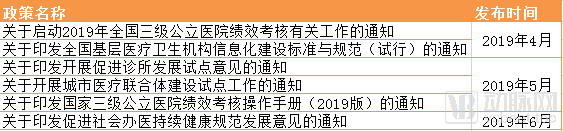
(Important policies issued by the National Health Commission during this period)
On July 15, the State Council Information Office held a regular policy briefing to introduce the “Opinions on Implementing the Healthy China Action” and the “Notice on Issuing the Implementation Organization and Assessment Plan for the Healthy China Action,” both issued on the same day. These two landmark documents were formulated under the leadership of the National Health Commission.
Yu Xuejun, Deputy Director of the National Health Commission, attended the press conference and provided an interpretation of the policy. He stated that the implementation of the Healthy China Initiative should revolve around four key aspects: in terms of positioning, shifting from a disease-centered approach to a health-centered one; in terms of strategy, moving from focusing on “treating existing diseases” to emphasizing “preventive care”; in terms of stakeholders, transitioning from reliance solely on the health system to fostering broad societal collaboration; and in terms of action, striving to shift from mere publicity and advocacy to nationwide participation and individual action.
Later that month, the National Health Commission also issued the “Notice on Printing and Distributing the Grading Assessment Standard System for Hospital Smart Services (Trial),” deciding to carry out the 2019 grading assessment of hospital smart services in secondary-level and above hospitals that apply information systems to provide smart services, and setting forth clear requirements for the grading assessment standards and methodologies for smart hospitals. At that time, whether a hospital is “smart” or not would become part of its performance evaluation.
On September 3, the National Health Commission issued the "Notice on Printing and Distributing Work Measures to Leverage Nationwide Health Informatics for Reducing Burdens on Primary-Level Healthcare Institutions." The document revealed that over 200 existing information systems of the National Health Commission would be streamlined and integrated, with a catalog of information systems to be published. Primary-level healthcare institutions may refuse to submit data for any system not included in this catalog. For reports required directly or through third-party agencies from primary-level institutions, those not incorporated into the national health statistical survey system will, in principle, no longer be mandatory, ensuring a reduction of at least 30% in the number of required reports.
Over the past six months, the National Health Commission has issued a total of 59 policies, releasing landmark documents in areas such as privately operated healthcare, medical consortium development, and performance assessment of public hospitals.
As of now, the latest policy issued by the National Health Commission is the “Notice on Issuing the First Batch of Encouraged Generic Drug List,” released on October 9. The list includes 33 drugs, most of which are concentrated in the fields of oncology and hereditary rare diseases.
Over the past year and a half, the healthcare industry has undergone significant changes.
A review of the 328 policy documents issued over the past year and a half reveals that the policies of the National Health Commission are primarily designed to provide national-level guidance for disease prevention and health promotion across society over the next decade or more, with the goal of achieving a “Healthy China 2030” as an imperative milestone.
Beyond the immediate short-term effects, we have identified seven sectors significantly influenced by National Health Commission policies from an industry perspective. In the medium to long term, these seven sectors are undergoing or are poised for substantial transformation.
1. Development of Industry Standards and Work Specifications
Mature standards and operational specifications are critical to any industry, and this is especially true for the healthcare sector, which is directly concerned with human life and health.
Since the establishment of the National Health Commission, hundreds of policy documents have been issued involving the formulation of industry standards and work specifications. From service standards for maternal and child health construction, diagnostic criteria for hepatitis C, to food safety standards, the policies of the National Health Commission are comprehensive in scope.
In July 2018, the National Health Commission, together with two other departments, jointly formulated the "Specifications for Prescription Review in Medical Institutions," which stipulated the basic requirements, review basis and procedures, review content, quality management of reviews, and training for prescription review. In September, at a press conference held by the National Health Commission, it was announced that the newly revised "Administrative Measures for the Clinical Application of Medical Technologies" had been deliberated and approved, and would come into effect on November 1, 2018.
Establishing mature industry standards and operational norms is no easy feat; it is a process that requires time to accumulate. However, as an increasing number of industry standards are introduced, providing clear guidelines for stakeholders, the sector will become increasingly standardized.
2. Family Physician
In April last year, the General Office of the National Health Commission issued a document on family doctor contract services, making specific arrangements for the goals and content of such services. The document mentioned encouraging social forces to participate in contract services, determining contract fees, and meeting residents' multi-level and diversified health service needs.
In terms of performance assessment, localities shall establish an evaluation mechanism for family doctor contract services, incorporate it into the comprehensive performance appraisal system for primary healthcare institutions, conduct regular assessments, and link the assessment results to the total performance-based wage pool of primary healthcare institutions and the compensation of their principal leaders.
From this point onward, family doctor contracting has become a key component in the implementation of the national tiered diagnosis and treatment policy, with the focus of family doctor contracting shifting from "quantity" to "quality."
However, given the current situation, this field still faces challenges such as heavy workloads for family doctor services, poor contract fulfillment quality, low physician motivation, difficulties in supervision and assessment, and data silos.
According to data from VCBeat·VBInsight, the potential market size for family doctor service consumption in 2020 was approximately RMB 170 billion, highlighting the promising prospects of this sector. Pain points signify commercial opportunities.
3. Primary Care
The amount of water a bucket can hold depends on its shortest stave; likewise, the quality of a service system is determined by its weakest link.
The primary healthcare market is the main battleground of China’s healthcare sector, characterized by a large population base and extremely strong demand for medical services. Meanwhile, primary healthcare facilities suffer from weak capabilities, inadequate infrastructure, and a shortage of high-quality medical service provision. Due to various factors such as technology, talent, and funding, there have been persistent challenges in effectively implementing initiatives aimed at strengthening primary healthcare capacity.
On August 9 and 10, 2018, the National Health Commission consecutively issued the “Notice on Printing and Distributing the Work Plan for Comprehensive Performance Assessment of Medical Consortia (Trial)” and the “Notice on Further Advancing Key Tasks Related to the Construction of a Tiered Diagnosis and Treatment System,” providing detailed arrangements for the development of medical consortia from the perspectives of performance assessment and the establishment of a tiered diagnosis and treatment system, respectively.
In late October, the National Health Commission issued the “Work Plan for Comprehensively Enhancing the Comprehensive Capabilities of County-Level Hospitals (2018–2020),” which set forth the development goal that by 2020, 500 county hospitals (including some in impoverished counties) and county traditional Chinese medicine (TCM) hospitals should respectively meet the service capability requirements for “Grade III general hospitals” and “Grade III TCM hospitals.” The plan also aims to ensure that 90% of county hospitals and county TCM hospitals nationwide reach the basic standards for medical service capabilities.
4. Healthcare Information Technology Infrastructure Development
Data has long been hailed as the “crude oil” of the information age.
Like the National Healthcare Security Administration, breaking down data silos and advancing industry-wide informatization are also key priorities for the National Health Commission.
Establishing electronic health records (EHRs) for residents is a key initiative of the National Health Commission (NHC). In June 2018, the NHC, in conjunction with the Ministry of Finance and the National Administration of Traditional Chinese Medicine, jointly issued the “Notice on Doing a Good Job in the 2018 National Basic Public Health Services Projects.” The notice emphasized the need to effectively leverage EHRs as a foundational support and convenient service tool in basic public health services and health management. It called for advancing the opening of EHRs to individuals, based on the level of grassroots informatization and EHR development in various regions as well as the actual needs of residents for health services, thereby facilitating public access to their own health information and encouraging active participation in self-health management.
The following month, the National Health Commission once again released a landmark document on healthcare informatization. The document proposed that by 2020, tertiary hospitals should achieve interoperability and sharing of internal medical service information; medical institutions that pass professional medical quality control assessments at the provincial or prefecture-level city levels shall implement mutual recognition of examination and test results within their respective administrative regions. It also aimed to realize an “all-in-one card” system for medical visits within prefecture-level city areas, enabling patients to use their electronic health cards for registration, consultations, examinations, tests, and information inquiries at any medical institution.
In September this year, the National Health Commission of China cleaned up and consolidated more than 200 existing information systems, released a catalog of information systems, and strengthened unified data collection and standardized management.
5. Internet Healthcare
Since the dawn of the “Year One of Mobile Health” in 2014, internet healthcare has remained the sector with the highest concentration of innovative enterprises. Policy developments often determine the fate of companies in this field.
In September 2018, the release of three landmark documents sent shockwaves through the sector. The National Health Commission, in conjunction with the National Administration of Traditional Chinese Medicine, unveiled the foundational rules for “Internet + Healthcare” services by issuing the Interim Measures for the Administration of Internet-Based Diagnosis and Treatment, the Interim Measures for the Administration of Internet Hospitals, and the Interim Specifications for the Management of Telemedicine Services.
The document categorizes “Internet + Healthcare Services” into three types based on the users involved and the service delivery models.
The first category is telemedicine, in which medical institutions conduct remote consultations and remote diagnoses using their own registered medical personnel through information technologies such as the Internet. The second category is online diagnosis and treatment activities, in which medical institutions use their own registered medical personnel to directly provide patients with follow-up visits for certain common and chronic diseases, as well as family doctor contract services, via internet technologies. The third category is internet hospitals, including those operating under a secondary name of a physical medical institution, as well as independently established internet hospitals affiliated with physical medical institutions.
Three landmark documents not only clarify the definitions and scope of internet-based diagnosis and treatment and telemedicine services, but also stipulate the basic requirements for internet hospitals and their personnel, and identify the entities bearing legal liability.
The issuance of these three documents marks the National Health Commission’s strengthened access control and supervision over new business models in internet-based medical services, striving to create a policy environment conducive to their healthy development.
6. Health Care
Nursing care serves individuals throughout the entire life course, from birth to death, playing a vital role in the acute, chronic, and palliative care phases of illness. It holds significant importance for advancing the Healthy China initiative and promoting the development of the health service industry.
In July 2018, the National Health Commission, together with 10 other departments including the National Development and Reform Commission, jointly issued the "Guiding Opinions on Promoting the Reform and Development of the Nursing Service Industry." The document proposed achieving substantial growth in the nursing workforce and a more rational supply of nursing services. It also revealed that the goal for the reform and development of China's nursing industry was to have the total number of registered nurses exceed 4.45 million by 2020.
In the past, nursing care was primarily delivered within healthcare institutions, with a focus on patient-centered and clinically oriented services. As China enters an aging society, the focus of nursing services is now shifting toward community-based and socially integrated care.
Nursing care is increasingly extending into communities and homes, providing services to the entire population—including the elderly, pregnant and postpartum women, newborns, and those requiring maternal and child health care. It also offers rehabilitative nursing for individuals with disabilities, along with professional caregiving, health management, psychological support, rehabilitation promotion, and palliative care for all.
This September, the National Health Commission held a special press conference to introduce the development of China’s nursing industry over the 70 years since the founding of the People’s Republic of China. By the end of 2018, the total number of registered nurses exceeded 4 million, accounting for nearly 50% of health professional and technical personnel. Nurses with an associate degree or higher accounted for nearly 70%, whereas in the past, the nursing workforce was predominantly composed of those with secondary vocational education.
7. Drug Management
"Drug price regulation and pharmaceutical management are important goals of deepening healthcare reform, as well as a major issue concerning public welfare."
In April 2018, the National Health Commission held a press conference at China-Japan Friendship Hospital, providing its first official response to widely discussed topics such as the entry points for “Internet + Healthcare” and drug price management.
At the press conference, the National Health Commission explicitly expressed its support for exploring the sharing of information between medical institution prescriptions and retail drug sales, as well as piloting the release of out-of-hospital prescriptions and third-party delivery services, thereby integrating the entire process of online consultation, prescription issuance, and home delivery of medications. These measures indicate that long-awaited market explorations into online prescriptions and drug delivery by internet hospitals are set to be formally liberalized.
In November last year, the National Health Commission issued the “Notice on Ensuring the Availability and Rational Use of 17 Cancer Drugs Included in the National Medical Insurance Negotiations,” stipulating that hospitals shall not impede the supply guarantee and rational use of negotiated drugs by citing reasons such as overall cost controls for medical expenses, overall cost controls for medical insurance expenditures, drug-to-total-revenue ratios, or restrictions on the number of drug varieties.
At a press conference held in April this year, the National Health Commission reviewed its work over the past year in this area: special negotiations were conducted for the inclusion of anti-cancer drugs in the national medical insurance program, with 17 new anti-cancer drugs added to the reimbursement list, resulting in an average price reduction of 56.7%; provincial-level specialized procurement of anti-cancer drugs was carried out, leading to price reductions for a total of 1,714 drug products, with an average decrease of 10%.
Over the past four decades of reform and opening-up, most industries have undergone profound transformations; however, the healthcare industry remains one of the few sectors where underlying concepts and institutional frameworks have seen little substantial change.
The National Health Commission bears the mission of deepening national healthcare reform. In the year and a half since its establishment, the National Health Commission has neither hesitated nor acted rashly, achieving a solid start.
However, as healthcare reform enters uncharted waters, the vision of a "Healthy China" remains elusive, seeming both near and far.
Ten years remain until 2030.
A Decade: Neither Too Long Nor Too Short.
What Will China Look Like in Ten Years?