

JunLian Healthcare Global Drug Pipeline Update – Issue 24
Sep 30, 2019 16:17
CST Updated
16:17

Legend Capital
Early-stage venture capital and growth-stage private equity investment institutions

This week, there were 9 new drug data entries, including 6 for oncology, 2 for inflammation, and 1 for metabolism.
❖ Amgen’s bispecific antibody Blincyto had its patient enrollment prematurely terminated in a Phase III trial for first-relapse ALL due to superior efficacy. Launched in the US in 2014, Blincyto can simultaneously bind CD3 and CD19 and was regarded as a revolutionary therapy at the time. However, hampered by its short half-life, it has failed to become a blockbuster drug despite continuous new developments over the past five years, with sales reaching approximately $230 million in 2018. The domestic bispecific antibody sector in China has also seen vigorous growth in the past three years, but no successful interim data have been reported so far. The complexity of antibody manufacturing processes and the control of half-life are likely the main constraining factors.
❖ In the world’s first head-to-head Phase 3 study in ulcerative colitis, Takeda’s Entyvio decisively outperformed Humira. The field of inflammatory bowel disease (IBD) has long lacked effective treatment options. Although Remicade and Humira demonstrate moderate efficacy, more than 40% of patients fail to respond, highlighting a substantial unmet medical need. In addition to Entyvio, AbbVie and Gilead’s JAK1 inhibitor is in the late stages of Phase 3 trials, with final data expected to be released by the end of 2019. Although the JAK1 inhibitor was not evaluated in a direct head-to-head trial against Humira (possibly due to concerns about Humira’s robust efficacy), its approval would still provide IBD patients with a more convenient oral treatment option.
Roche’s Anti-PD-L1 Monoclonal Antibody Tecentriq as First-Line Monotherapy for NSCLC,
Improving Overall Survival in Patients with High PD-L1 Expression
Roche’s Tecentriq, an anti-PD-L1 monoclonal antibody, has been approved for use in combination with chemotherapy and Avastin as a first-line treatment for patients with non-squamous NSCLC. At ESMO 2019, Roche presented clinical results of Tecentriq as a monotherapy for the first-line treatment of patients with NSCLC.
Tecentriq is an anti-PD-L1 monoclonal antibody.
A randomized, open-label, phase 3 study involving a total of 572 patients. The objective was to evaluate the efficacy and safety of Tecentriq versus cisplatin or carboplatin plus pemetrexed or gemcitabine (chemotherapy) as first-line treatment for patients with advanced non-small cell lung cancer (NSCLC) who do not harbor ALK or EGFR gene mutations.
Trial results demonstrated that Tecentriq met the primary endpoint in the interim analysis, improving overall survival (OS) by 7.1 months in patients with high PD-L1 expression compared with chemotherapy.
The Medicines Company’s Cholesterol-Lowering RNAi Therapy Inclisiran Achieves Further Success,
Met Both Phase 3 Clinical Trial Endpoints
The Medicines Company announced that its RNAi therapy for lowering cholesterol, Inclisiran, met all primary and secondary endpoints in Phase 3 trials for the treatment of heterozygous familial hypercholesterolemia (HeFH) and atherosclerotic cardiovascular disease (ASCVD).
Inclisiran is an RNAi therapy targeting PCSK9, designed with a GalNAc delivery system, and is the first RNAi therapy capable of lowering LDL-C.
Randomized, double-blind, placebo-controlled Phase 3 clinical trials were conducted in 482 patients with heterozygous familial hypercholesterolemia (HeFH) and elevated LDL-C levels (ORION-9 trial) and 1,561 patients with atherosclerotic cardiovascular disease (ASCVD) and elevated LDL-C levels (ORION-10 trial).
In the ORION-9 trial, patients’ LDL-C levels were significantly reduced from baseline. The results observed in the ORION-10 trial demonstrated the excellent efficacy, tolerability, and safety of inclisiran.
Janssen’s Erleada in combination with androgen deprivation therapy,
Reducing the Risk of Death in Patients with Non-Metastatic Castration-Resistant Prostate Cancer
Janssen Announces Latest Results on Survival Benefits of Erleada Combined with Androgen Deprivation Therapy (ADT) for Non-Metastatic Castration-Resistant Prostate Cancer (nmCRPC)
Erleada (Apalutamide) is a next-generation androgen receptor inhibitor.
An interim analysis of the long-term results from the Phase 3 SPARTAN clinical trial.
Erleada, in combination with ADT, reduced the risk of death by 25% in patients with nmCRPC compared to ADT alone. At a median follow-up of 41 months, the 4-year overall survival (OS) rate was 72.1% in the Erleada group versus 64.7% in the control group.
Amgen's bispecific antibody demonstrates significantly superior efficacy compared to chemotherapy,
Phase 3 Trial Terminated Early
Amgen announced that patient enrollment in two Phase 3 trials of Blincyto (blinatumomab), a bispecific antibody developed by the company for pediatric patients with high-risk B-cell acute lymphoblastic leukemia (ALL) in first relapse, was terminated early due to its significantly superior efficacy compared with the chemotherapy control group.
Blincyto is the first approved bispecific T-cell engager (BiTE) that binds to the CD19 antigen expressed on the surface of B cells at one end and to the CD3 receptor on the surface of T cells at the other.
In the open-label, randomized, global Phase 3 trial designated as 20120215, pediatric patients with high-risk first-relapse B-cell acute lymphoblastic leukemia (ALL) received treatment with Blincyto or standard consolidation chemotherapy. The primary endpoint of the trial was event-free survival.
Blincyto met the primary endpoint of the trial. Based on the recommendation of the independent Data Monitoring Committee (DMC), Amgen prematurely terminated patient enrollment in this trial, while subsequent follow-up will continue in accordance with the trial protocol.
Mechanism of Action of Blincyto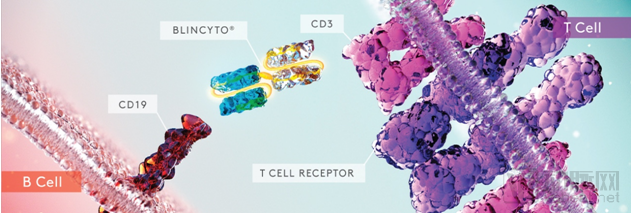
Data source: Amgen
Tecentriq in combination with Avastin,
Improving Remission Rates in Patients with Hepatocellular Carcinoma
At ESMO 2019, Roche announced the results of a Phase 1b clinical trial evaluating the combination therapy of Avastin and Tecentriq for hepatocellular carcinoma. This regimen had already received Breakthrough Therapy Designation from the U.S. FDA in July 2018 for the treatment of advanced or metastatic hepatocellular carcinoma.
Avastin is an antibody targeting vascular endothelial growth factor (VEGF). It interferes with tumor blood supply by directly binding to VEGF, thereby inhibiting tumor growth and metastasis.
The Phase 1b clinical study named GO30140 is divided into two parts: a non-randomized trial and a randomized trial.
Results from the non-randomized patient cohort showed an objective response rate (ORR) of 36% with Tecentriq plus Avastin combination therapy at a median follow-up of 12.4 months, including a complete response (CR) rate of 12%. Results from the randomized trial component demonstrated that Tecentriq combined with Avastin reduced the risk of disease progression or death by 45% compared with Tecentriq monotherapy.
Intercept Pharmaceuticals Announces Submission of NDA to FDA for Obeticholic Acid in the Treatment of Liver Fibrosis Caused by Nonalcoholic Steatohepatitis
Intercept Pharmaceuticals Announces Submission of New Drug Application (NDA) to the FDA for Obeticholic Acid in the Treatment of Liver Fibrosis Caused by Nonalcoholic Steatohepatitis (NASH)
Obeticholic acid is currently the only drug to have reached the primary endpoint in a pivotal Phase III trial for the treatment of NASH, and it is also the only new NASH therapy to have received FDA Breakthrough Therapy designation.
Based on data from the pivotal, randomized, double-blind, placebo-controlled, Phase III REGENERATE study, which enrolled 750 patients with NASH and liver fibrosis, treatment was administered for 72 weeks (18 months).
Interim Analysis: At Month 18, the proportion of patients in the obeticholic acid (OCA) 25 mg once-daily group who achieved at least a one-stage improvement in liver fibrosis without worsening of nonalcoholic steatohepatitis (NASH) was significantly higher than that in the placebo group (23.1% vs. 11.9%, p=0.0002). At Month 18, the proportions of patients with histological improvement in NASH (reduction in hepatic steatosis) without worsening of fibrosis were higher in both the 10 mg and 25 mg treatment groups compared with the placebo group, but these differences were not statistically significant.
The first head-to-head biologic study in the field of UC,
Takeda's Entyvio Outperforms Humira
Takeda Pharmaceutical Announces Further Results from the Phase III VARSITY Trial (NCT02497469) of Entyvio (vedolizumab) for Ulcerative Colitis (UC) Published in The New England Journal of Medicine.
Entyvio is a gut-selective biologic agent whose active pharmaceutical ingredient is vedolizumab, a humanized monoclonal antibody that specifically antagonizes α4β7 integrin.
VARSITY is a randomized, double-blind, double-dummy, multicenter, active-controlled, Phase IIIb study designed to evaluate the efficacy and safety of intravenous (IV) Entyvio versus subcutaneous (SC) Humira over one year (52 weeks) in patients with moderately to severely active ulcerative colitis (UC).
The study met its primary endpoint, with the Entyvio group demonstrating superiority over the Humira group in clinical remission rates at Week 52 (31.3% vs. 22.5%, p=0.006). Exploratory analyses showed that at Week 52, Entyvio achieved higher clinical remission rates than Humira in both the anti-TNFα-naïve subgroup (34.2% vs. 24.3%) and the anti-TNFα-experienced subgroup (20.3% vs. 16.0%).
VARSITY Study - Comparison of UC Clinical Remission Outcomes
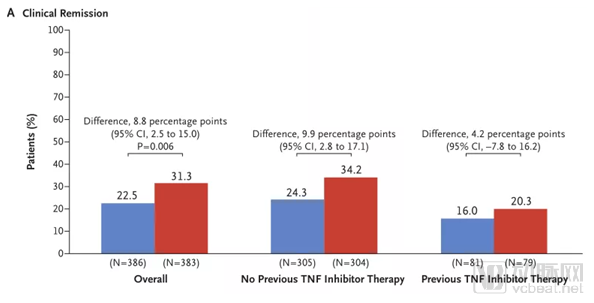
Note: Red indicates vedolizumab, and blue indicates adalimumab.
Source: The New England Journal of Medicine
Zai Lab’s Optune for the Treatment of Glioblastoma Has Been Accepted by the CMDE
Zai Lab announced in September 2018 that it had obtained the rights to Optune from Novocure in China (includingHong Kong, Macao, and Taiwan)Regionexclusive commercial license, responsible for the development and market launch of Optune in the aforementioned regions.
The mechanism of Optune is based on Tumor Treating Fields (TTFields), which generate a low-intensity, intermediate-frequency (200 kHz) alternating electric field within the tumor. This field exerts physical forces on charged cellular components, disrupting mitosis in tumor cells, thereby inducing apoptosis and inhibiting tumor growth.
An international Phase III study conducted in patients with newly diagnosed glioblastoma, compared with temozolomide monotherapy.
Compared with temozolomide monotherapy, Optune plus temozolomide extended the median overall survival from 16 months to 20.9 months, more than doubling the 5-year survival rate (5% vs. 13%). In patients with high adherence who wore Optune for more than 22 hours per day, the 5-year survival rate increased to 29.3%.
Bayer’s Tumor-Agnostic Drug Larotrectinib Approved by the EU
Bayer recently announced that the European Union has granted marketing authorization for the precision oncology drug larotrectinib. The drug is indicated for the treatment of adult and pediatric patients with solid tumors harboring neurotrophic receptor tyrosine kinase (NTRK) gene fusions, which are locally advanced, metastatic, unresectable, or have shown poor response to surgery, and for whom no satisfactory alternative treatment options exist.
Larotrectinib is the first oral TRK inhibitor.
Pooled analysis of clinical trial data from 102 patients (93 patients from the primary analysis population and an additional 9 patients with primary CNS tumors), including Phase I clinical trials in adult patients, the Phase II NAVIGATE trial in adult and adolescent patients, and the pediatric Phase I/II SCOUT trial.
Results in the primary analysis population (n=93) showed an objective response rate (ORR) of 72% (95% CI: 62, 81), including a complete response (CR) rate of 16% and a partial response (PR) rate of 55%.
❖ 2019: Breakthrough Progress in Immunotherapy for MSS Colorectal Cancer. Breakthrough 1: Nivolumab plus regorafenib achieved a 36% objective response rate in patients with advanced MSS-type colorectal cancer and gastric cancer receiving third-line or later treatment. Breakthrough 2: PD-1 monoclonal antibody combined with CTLA-4 monoclonal antibody and radiotherapy achieved a 15% objective response rate in MSS-type patients receiving third-line or later treatment. Breakthrough 3: Durvalumab (PD-L1 monoclonal antibody) combined with tremelimumab (CTLA-4 monoclonal antibody) in patients with advanced colorectal cancer receiving third-line or later treatment showed more significant benefits in the population with high tumor mutational burden (TMB). Breakthrough 4: Sequential treatment with preoperative chemoradiotherapy followed by PD-1 inhibition in patients with MSS-type colorectal cancer achieved a pathological complete response (pCR) rate of 30%.
❖ Data from the TWILIGHT phase IV independent study of AstraZeneca’s anticoagulant Brilinta show that, among high-risk patients who have undergone percutaneous coronary intervention and completed three months of dual antiplatelet therapy, continuing treatment for 12 months with Brilinta monotherapy reduced the risk of clinically relevant bleeding compared with Brilinta plus low-dose aspirin, without increasing the composite risk of major adverse cardiovascular events.
❖ Jazz Pharmaceuticals’ investigational drug JZP-258 met the primary and key secondary endpoints in a Phase 3 trial for the treatment of excessive daytime sleepiness in adults with narcolepsy. Compared with the placebo group, patients treated with JZP-258 showed statistically significant improvements in the weekly frequency of cataplexy attacks and changes in Epworth Sleepiness Scale scores.
❖ vTv Therapeutics’ adjunctive therapy for type 1 diabetes, the liver-selective glucokinase activator TTP399, demonstrated in newly added data from Part 1 of the Phase 2 SimpliciT1 trial that TTP399 increased time in range, reduced time spent in hyperglycemia, and decreased both hypoglycemic events and insulin dosage.
❖ Zealand Pharma Announces Positive Results from Phase III Pediatric Clinical Study of Dasiglucagon for Severe Hypoglycemia in Diabetes; Median Time to Glucose Recovery Was 10 Minutes in the Dasiglucagon Group, Outperforming the Placebo Group