

2019 Nobel Prize in Physiology or Medicine Awarded to Three Scientists for Discovering How Cells Sense and Adapt to Oxygen Availability
At 5:30 p.m. Beijing Time on October 7, the 2019 Nobel Prize in Physiology or Medicine was announced.
William G. Kaelin, Jr., of Harvard Medical School’s Dana-Farber Cancer Institute; Peter J. Ratcliffe, of the University of Oxford and the Francis Crick Institute; and Gregg L. Semenza, of Johns Hopkins University School of Medicine in the United States, were honored for their contributions to understanding the mechanisms by which cells sense and adapt to changes in oxygen levels.
They will receive gold medals, certificates, and share a prize of 9 million Swedish kronor (approximately RMB 6.47 million).
This Nobel Prize win was not unexpected; previously, in 2016,The three individuals have previously received the Lasker Basic Medical Research Award, which is second only to the Nobel Prize in the field of medicine.
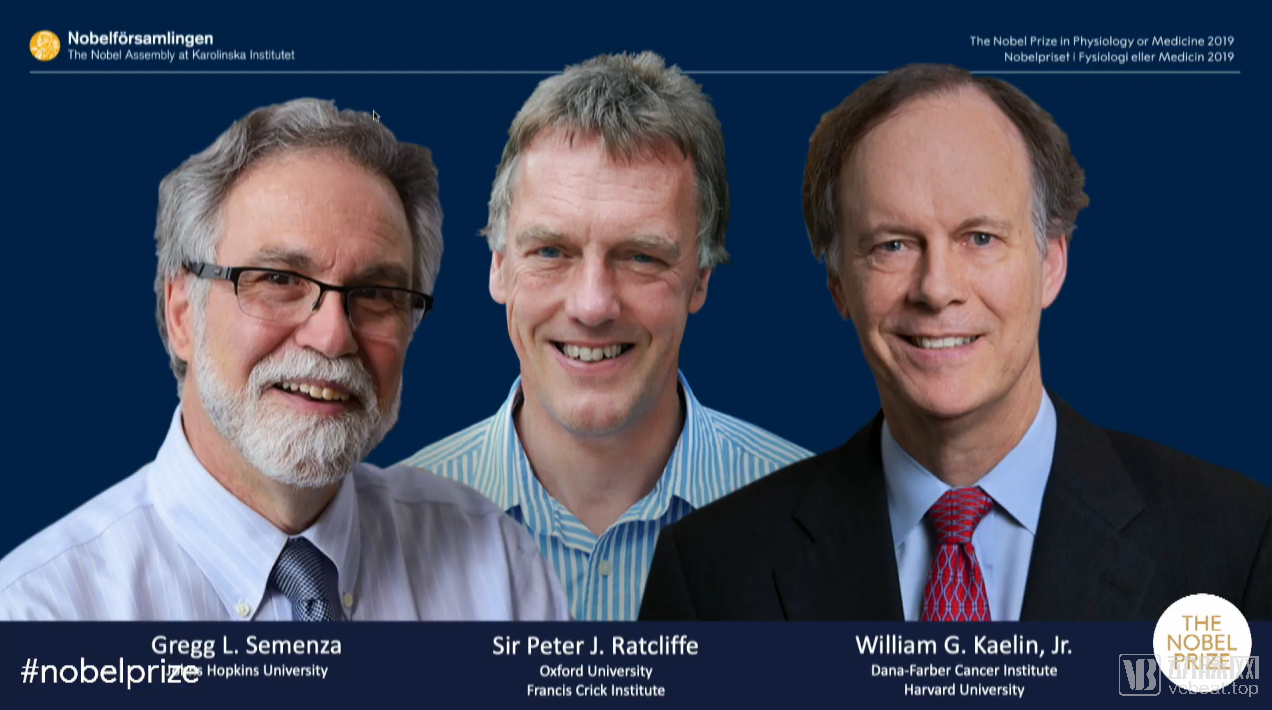
(Live video screenshot)
The signaling system by which organisms sense oxygen concentration is a fundamental function of life. Three scientists elucidated the basic principles underlying how human and most animal cells sense oxygen levels at the molecular level, revealing key signaling mechanisms and paving the way for new clinical treatments for various diseases, including anemia, cardiovascular diseases, macular degeneration, and cancer.
Oxygen serves as the electron acceptor in numerous biochemical metabolic pathways. Scientific research into oxygen sensing and the regulation of oxygen homeostasis began with the study of erythropoietin (EPO). Under conditions of oxygen deficiency, the kidneys secrete EPO to stimulate the bone marrow to produce new red blood cells. For instance, when we engage in activities at high altitudes, hypoxia triggers changes in human metabolism, leading to the formation of new blood vessels and the production of new red blood cells. The work of these scientists focused on identifying the gene expression underlying this physiological response. They discovered that the “switch” for this response is a protein known as Hypoxia-inducible factors (HIF), whose functions extend far beyond that of a simple switch.
In the early 1990s, Semenza and Ratcliffe began investigating how hypoxia induces erythropoietin (EPO) production. They identified a transcriptional enhancer factor, hypoxia-inducible factor (HIF), which not only responds to changes in oxygen concentration but also regulates EPO expression levels. They demonstrated that inserting its DNA fragment adjacent to a gene renders that gene inducible under hypoxic conditions. In 1995, Semenza and his postdoctoral fellow, Guang Wang, purified HIF-1 and discovered that it comprises two protein subunits: HIF-1α and HIF-1β. They further confirmed that HIF-1 mediates the body’s adaptive responses to hypoxia through erythropoiesis and angiogenesis.
Subsequently, Semenza and Ratcliffe further expanded the repertoire of genes known to be induced under hypoxic conditions. They discovered that, in addition to EPO, HIF-1 can bind to and activate numerous other genes in mammalian cells involved in processes such as metabolic regulation, angiogenesis, embryonic development, immunity, and tumorigenesis.
Furthermore, they observed that the levels of HIF-1 dropped sharply when cells were shifted to high-oxygen conditions, and that this factor could activate target genes only under hypoxic conditions.
On November 27, 1895, the renowned Swedish chemist and inventor of dynamite, Alfred Bernhard Nobel, signed his last will and testament, allocating the largest portion of his estate to establish a series of awards known as the Nobel Prizes. The Nobel Prizes are awarded in six categories: Physics, Chemistry, Physiology or Medicine, Literature, Peace, and Economic Sciences.
As of 2019, the Nobel Prize in Physiology or Medicine has been awarded 110 times, with 39 awards granted to individual scientists. A total of 12 female scientists have received this honor.
In 2015, pharmaceutical scientist Tu Youyou became the first Chinese scientist to win the award for her contributions to artemisinin.