

Jiezi Bio: Pioneering Microfluidic POCT Multiplex Testing with Ambient-Stable Solid-Phase Reagents to Empower Chronic Disease Management in Primary Care
According to EvaluateMedTech, among the top ten sectors in the healthcare industry, in vitro diagnostics (IVD) ranks first with $48.4 billion in revenue, maintaining an annual growth rate of over 5.6%. IVD is projected to retain its leading position by 2022. In China, although the IVD market started later, it has developed rapidly, with a compound annual growth rate exceeding 15%. The global IVD market is expected to reach $74.65 billion by 2020, with China becoming the world’s largest IVD market.
Point-of-Care Testing (POCT) is a niche segment of the in vitro diagnostics (IVD) industry. The global POCT market has maintained a compound annual growth rate (CAGR) of 8%. In contrast, China’s POCT market has achieved a CAGR exceeding 20% in recent years, with its market size projected to surpass US$2 billion in 2020.
In China, the POCT industry has experienced rapid growth, with JIEZLAB emerging as a leading player in this field. Its co-founder, Zhang Yi, specialized in biomedicine during his academic years and conducted research on tumor pathogenesis and diagnosis at the University of British Columbia in Canada. After graduation, Zhang Yi dedicated his career to drug R&D, serving as R&D Director at Sanofi, France’s largest pharmaceutical company.

JIEZLAB Founder Zhang Yi
A series of initiatives centered on biomedical R&D have given Zhang Yi a deeper understanding of the industrialization of biomedicine. Meanwhile, her husband’s founding of an in vitro diagnostics (IVD) company has subtly influenced her entrepreneurial direction. Point-of-care testing (POCT), the fastest-growing segment within IVD, holds vast potential for future development in China. However, commonly used IVD technologies—such as chromatography and fluorescent lateral flow assays—fail to meet POCT requirements in terms of detection accuracy. Furthermore, Zhang Yi’s recognition of current challenges, including the low coverage of POCT products in the chronic disease monitoring market, became the key that unlocked her exploratory journey.
Prior to founding his company, Zhang Yi made two separate trips to Europe’s leading microfluidics research institutes for in-depth study, collaborating with experts to explore how the technical characteristics of microfluidics could be applied to the biomedical and pharmaceutical fields. This laid a solid technological foundation for JIEZLAB to apply microfluidics technology to the point-of-care testing (POCT) sector.
Microfluidics is a novel interdisciplinary field that involves the control, manipulation, and detection of complex fluids at the microscale. It has emerged from advancements in microelectronics, micromechanics, bioengineering, and nanotechnology. Zhang Yi stated, “Microfluidic technology is widely used in industrial sectors abroad and, given its technical characteristics, is equally applicable to the point-of-care testing (POCT) industry.”
Leveraging microfluidic technology, JIEZLAB has developed a centrifugal microfluidic detection platform. Capitalizing on the advantages of microfluidics, this platform enables automated sample separation, quantification, and mixing driven by centrifugal force, achieving full automation from sample loading to result reporting.
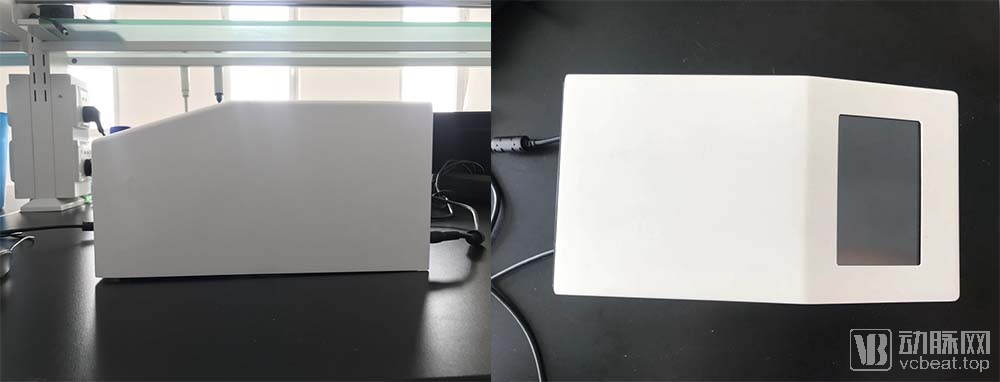
Centrifugal Microfluidic Detection Prototype (Image provided by the company)
JIEZLAB’s centrifugal microfluidic detection prototype (as shown in the figure above) weighs no more than 5 kg, with a cross-sectional area comparable to that of a notebook. The front of the instrument features a drawer-like compartment for holding the detection disc, which has a diameter of 12 cm and is suitable for testing scenarios involving 1 to 3 samples. Users employ the dedicated detection disc by applying a blood sample to the designated loading area; once the disc is inserted into the instrument, test results can be viewed on the display screen at the top of the device in approximately 12 minutes.
Currently, JIEZLAB’s centrifugal microfluidic testing platform can be divided into a biochemical testing platform and an immunoassay testing platform. The biochemical testing products are primarily oriented toward chronic disease monitoring, with a focus on the primary healthcare market. Their most distinctive feature is that the testing discs can be transported at ambient temperature. A domestically pioneered invention patent for reagent immobilization enables the distribution of biochemical testing discs to primary healthcare institutions without cold-chain logistics, thereby reducing transportation costs and ensuring product quality. This provides core competitiveness for delivering products to dispersed primary healthcare institutions and for expanding into overseas markets.
China’s chronic disease monitoring market is vast. Epidemiological data show that the prevalence of chronic kidney disease (CKD) among Chinese adults is as high as 10.8%, affecting approximately 119.5 million people, yet the awareness rate stands at only 12.5%. The number of individuals with cardiovascular disease in China has been increasing year by year, with current estimates exceeding 290 million. Early and timely monitoring and detection of chronic diseases play a crucial role in subsequent clinical intervention. Convenient and rapid monitoring technologies are key to enhancing patients’ understanding of disease progression and their adherence to regular monitoring as prescribed. JIEZLAB’s product portfolio covers a comprehensive range of indicators for diabetes, cardiovascular disease, renal function impairment, and liver function monitoring. Its user-friendly testing devices, ambient-temperature transportation, and flexible test disk configurations (serving 1–3 individuals per disk) facilitate chronic disease monitoring at the primary care level, significantly improving the coverage of chronic disease monitoring and patient adherence, thereby enhancing the efficiency of chronic disease management. Improving chronic disease management not only boosts individual health outcomes but also reduces medical insurance expenditures, yielding substantial socioeconomic benefits.
Another highlight of JIEZLAB’s centrifugal microfluidic biochemical testing platform is its ability to simultaneously perform dry immunoturbidimetric assays for the detection of special proteins. Researchers first allow antigens and antibodies to bind, forming immune complexes, and then calculate the concentration of specific antigens by measuring the turbidity of the reaction solution, thereby achieving quantitative detection of special proteins. This single platform can conduct both traditional biochemical tests and immunoturbidimetric assays for special proteins, significantly expanding its testing menu and creating new revenue streams for conventional biochemical platforms.
In addition to its centrifugal microfluidic biochemical testing platform, JIEZLAB has also established a centrifugal microfluidic immunoassay platform. This platform primarily targets the market for detecting infectious agents and cardiac markers, making it suitable not only for primary healthcare institutions but also for point-of-care, emergency, and other specialized settings in large hospitals.
The immunoassay platform employs time-resolved fluorescence and patented microcolumn technology, significantly enhancing detection sensitivity while enabling multiplexed testing; even nearly 20 assays can be performed simultaneously on the platform. Zhang Yi revealed that with advancements in JIEZLAB’s manufacturing processes, the immunoassay platform will ultimately achieve the simultaneous detection of dozens of immune markers on a single test disc.
Currently, JIEZLAB is preparing the registration applications for its first batch of biochemical and immunoassay products, with completion expected by the end of the year. Meanwhile, major pharmaceutical companies are seeking to capture the primary healthcare market for chronic disease monitoring and have initiated strategic collaborations with JIEZLAB to secure product distribution rights in specific regions.
At this stage, JIEZLAB will initiate a new round of financing, primarily to support the continuous R&D, regulatory filings, and procurement of production equipment for its pipeline products, as well as commercial promotion activities leading up to the market launch of its first batch of registered products. As of the end of September 2019, JIEZLAB had filed five patent applications and repeatedly secured top-three finishes in provincial and municipal competitions. Committed to independent and innovative R&D, JIEZLAB continues to increase its scientific research investment and will consistently roll out POCT products with core competitiveness.
Currently, JIEZLAB is seeking a new round of financing. Interested parties please contact VCBeat’s financing assistant, Xiao Yun: DongMai_Investent