

Genovate Biotech Advances Multi-Drug Liposome Technology for Hematologic Malignancies with GP-L02 Candidate
After years of leading innovation project initiation and research at major domestic pharmaceutical companies, Feng Hao, founder of Jingnuoze Biotech, remarked that their work at the time was akin to a lookout stationed high on a large ship, scanning the horizon to identify where land (opportunities) or icebergs (risks) might lie. During that period, Feng Hao’s primary focus was on mining and collecting information on new drugs developed overseas.
Feng Hao graduated with a degree in clinical medicine. Although he was aware of many “short, flat, and fast” projects during the early stages of his entrepreneurial journey, he firmly believed that venturing into sectors crowded with companies and characterized by low barriers to imitation would inevitably result in limited survival space and intense competitive pressure for his company in the future. Feng Hao stated that Jingnuoze Biotechnology should focus on projects with high technological barriers, as such initiatives are better suited to the survival and development of startup companies.
Jingnuoze Biotech is a biopharmaceutical company focused on innovative R&D in oncology therapeutics. Its core technology is multi-drug liposome technology, which empowers traditional chemotherapy by enhancing the efficacy and safety of first-line chemotherapeutic agents.
When asked why he chose to start a business in this field, Feng Hao replied, “There is a significant unmet need in the oncology space. Although the medical community has seen vigorous development in targeted therapy and immunotherapy for cancer, it is undeniable that chemotherapy remains the first-line treatment for most tumors today. Chemotherapy has many well-recognized drawbacks, including high toxicity, low efficacy, and considerable patient suffering (leading to poor medication adherence). Addressing these challenges is precisely what Jingnuoze Biotech is dedicated to achieving.”
When it comes to Jingnuoze Biotechnology’s core technology, “Multi-Drug Liposome Technology,” it was innovatively developed based on the existing “liposome” technology. Liposomes can be vividly understood as hollow spherical particles capable of effectively encapsulating various water-soluble molecules of different sizes and dissociation constants. By controlling the drug loading capacity and release rate of liposomes, it is possible to reduce drug side effects while ensuring therapeutic efficacy. Additionally, modifying the surface of liposomes can enhance their targeting ability, thereby controlling the distribution and duration of action of drugs within the body.
This technology aligns with Feng Hao’s original entrepreneurial intent—to select technical fields with high barriers to entry. “The most direct way to assess the height of a technological barrier is to examine the number of generic drugs on the market after a new drug utilizing that technology has been launched,” Feng Hao stated bluntly. “Generic versions of complex injectables such as liposomes are few and far between. The first amphotericin B liposome, launched in 1990, has yet to be successfully replicated by generics in the European and American markets. Doxorubicin liposome, which hit the market in 1995, did not see its generic counterpart launched in the United States until 18 years later, illustrating just how high the barriers to liposome technology are.”
Currently, the most common clinical approach for tumor treatment is combination therapy using multiple chemotherapeutic agents. This is precisely where Jingnuoze Biotechnology’s multi-drug liposome technology excels. As drug carriers, liposomes can enhance drug absorption and utilization, enable efficient targeted delivery, effectively prolong the drug’s half-life, and reduce toxic side effects on normal tissues.
Unlike traditional combination chemotherapy for tumors, Jingnuoze Biotechnology’s multi-drug liposome technology alters the in vivo distribution and half-life of co-administered drugs, promoting a more uniform drug distribution throughout the body. This approach improves drug metabolic behavior, enhances the synergistic effects of combination chemotherapy, addresses the limitations of existing methods, and ultimately improves therapeutic efficacy.
Feng Hao explained, “The ‘microspheres’ of multi-drug liposome technology can be vividly understood as artificially manufactured ‘cells’ containing multiple therapeutic agents. When conventional drugs directly reach cells, they mostly trigger cellular resistance mechanisms. In contrast, our cellular microspheres are engulfed entirely by the cells upon contact, thereby delivering anticancer drugs into the cells and preventing their efflux.”
Based on this principle, Jingnuoze Biotechnology has developed several multi-drug liposome projects targeting tumors. The most advanced among them is GP-L02, a project for the treatment of acute myeloid leukemia (AML), which has completed laboratory studies and animal proof-of-concept efficacy testing. Feng Hao disclosed to VCBeat that their animal trials yielded highly promising results: the survival time of mice increased to 120 days after three doses, compared to a one-month survival period in the control group, indicating that GP-L02 significantly improved the condition of AML-afflicted mice.
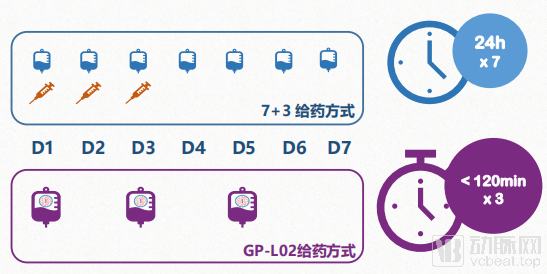
Schematic Diagram of Dosing Optimization for GP-L02
In addition to significantly enhancing drug efficacy, GP-L02 reduces the distress experienced by tumor patients during chemotherapy administration by optimizing drug delivery methods, while also alleviating the workload of physicians. However, Feng Hao emphasized that the core highlight of Jingnuoze Biotechnology’s combination therapy lies in its ability to improve therapeutic efficacy, thereby increasing patient survival rates while reducing medication dosages.
In addition to GP-L02, Jingnuoze Biopharma has GP-L03 for solid tumors and GP-M01 for multiple tumor types in its R&D pipeline; both are currently in the early stages of candidate product design. The company will prioritize GP-L02 in the near term, advancing it into clinical trials.
Regarding the company’s future, Jingnuoze Biotech will build on its independent R&D capabilities to advance projects into clinical trials, and may subsequently seek collaborations with large pharmaceutical companies. Jingnuoze Biotech completed its angel financing round in 2017 and has now launched a new funding round, aiming to raise RMB 30 million to support the preclinical development of innovative projects and initiate R&D on several new initiatives.
Currently, Jingnuoze Biotechnology is seeking a new round of financing. Interested parties are invited to contact Xiaoyun, the VCBeat Financing Assistant: DongMai_Investent