

JunLian Healthcare Global Drug Pipeline Newsletter – Issue 25
Oct 08, 2019 18:00
CST Updated
18:00

❖September 27–October 1, ESMO was held in Barcelona, Spain. This year’s ESMO Congress was exceptionally vibrant, with multiple innovative therapies achieving breakthrough progress in cancer treatment. This weekly report will review the many highlights of the conference.
❖This year’s ESMO featured numerous advancements, but the standout star was undoubtedly olaparib, with results from eight studies presented. Breakthroughs were achieved across four tumor types—ovarian, prostate, breast, and pancreatic cancers—even demonstrating the potential for chemotherapy-free regimens. Currently, there are four PARP inhibitors approved globally. Many research institutions believe that while all PARP inhibitors significantly prolong progression-free survival (PFS) and chemotherapy-free intervals with comparable efficacy, there are substantial differences in their safety profiles. Overall, olaparib exhibits lower off-target toxicity and minimal bone marrow distribution. The incidence of grade 3 or higher adverse events and the rate of treatment discontinuation due to adverse events are relatively lower. Therefore, although definitive head-to-head trials are not yet available, olaparib may emerge as the best-in-class agent due to its superior safety profile.
❖The results of the FLAURA study on osimertinib have finally been released, cementing its position as the leading EGFR TKI. Previously, osimertinib gained approval worldwide for first-line treatment of NSCLC based on a PFS of 18.9 months. At this conference, the median OS was reported as 38.6 months, significantly higher than the 31.8 months observed in the control group (first-generation TKIs), thereby rightfully earning its crown. However, the devil lies in the details. Among the 347 Asian patients, osimertinib showed no benefit, with standard therapy proving equally effective as first-line osimertinib. Therefore, although osimertinib is also used as a first-line treatment in China, this detail may pose obstacles to its inclusion in national medical insurance coverage for first-line therapy.
AstraZeneca and Merck’s jointly developed Lynparza doubles radiographic progression-free survival (rPFS) in metastatic mCRPC
AstraZeneca and MSD Announce at ESMO Conference That Lynparza, Developed in Collaboration, Further Expands Its Indications, Doubling Radiological Progression-Free Survival (rPFS) in Patients with Metastatic Castration-Resistant Prostate Cancer (mCRPC).
Lynparza is a PARP inhibitor.
In the Phase 3 PROFOUND clinical trial, Lynparza was evaluated in patients with metastatic castration-resistant prostate cancer (mCRPC) harboring BRCA1 and ATM gene mutations.
In the PROfound trial, rPFS reached 7.4 months, compared with 3.6 months in the chemotherapy-treated control group. Lynparza reduced the risk of disease progression or death by 66%.
Lynparza’s Performance in the Profound Clinical Trial
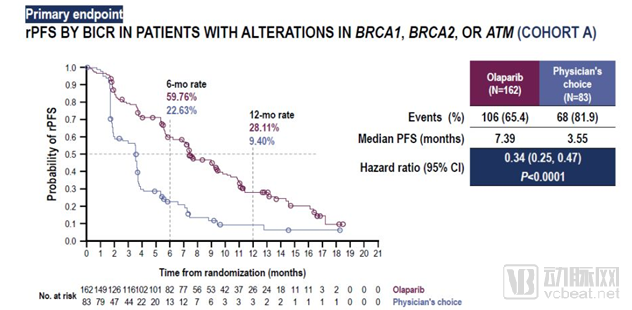
Data source: AstraZeneca
Novartis’ Kisqali, in Combination with Endocrine Therapy, Demonstrates Efficacy in Reducing Mortality Risk in Two Breast Cancer Patient Populations
Novartis announced that Kisqali, in combination with endocrine therapy, reduces the risk of death by 28% in postmenopausal patients. This makes it the second patient population to demonstrate a mortality benefit, following the previously reported results at the ASCO Annual Meeting for premenopausal patients with HR-positive, HER2-negative breast cancer.
Kisqali is a CDK4/6 inhibitor.
Study on the long-term efficacy in postmenopausal patients.
The phase 3 clinical trial results of MONALEESA-3 demonstrated that Kisqali, in combination with endocrine therapy, reduced the risk of death by 28%.
Lilly's Verzenio significantly extends overall survival (OS) in patients with HR-positive, HER2-negative advanced breast cancer who have received prior endocrine therapy.
Eli Lilly Announces That Its CDK4/6 Inhibitor Verzenio (abemaciclib) Significantly Extends Overall Survival in Patients with HR-Positive, HER2-Negative Advanced or Metastatic Breast Cancer Who Have Previously Received Endocrine Therapy
Verzenio (abemaciclib) is a CDK4/6 inhibitor.
In the Phase 3 MONARCH 2 clinical trial, a controlled study was conducted in patients with HR-positive, HER2-negative advanced or metastatic breast cancer who had previously received endocrine therapy.
Patients receiving Verzenio in combination with fulvestrant achieved an overall survival (OS) of 46.7 months, compared to 37.3 months for those receiving fulvestrant alone.
Merck’s PD-1 Inhibitor Keytruda Achieves Breakthrough in the Treatment of Triple-Negative Breast Cancer (TNBC)
Merck’s Blockbuster PD-1 Inhibitor Keytruda Achieves Breakthrough in Treating Triple-Negative Breast Cancer (TNBC). When Used in Combination with Chemotherapy as Neoadjuvant Therapy, Keytruda Significantly Improves Pathological Complete Response (pCR) Rates in Patients with Early-Stage TNBC (pCR Is Defined as the Absence of Invasive Cancer in Resected Breast Tissue and Lymph Nodes).
Keytruda is a PD-1 inhibitor.
Treating patients with early-stage triple-negative breast cancer (TNBC).
The pCR rate was 64.8% in patients receiving the combination of Keytruda and chemotherapy, compared with 51.2% in the chemotherapy control group.
AstraZeneca’s Tagrisso (osimertinib) delivers a statistically significant and clinically meaningful improvement in overall survival (OS) for patients
AstraZeneca Announces Long-Term Efficacy Results of Tagrisso (Osimertinib), a Third-Generation EGFR Tyrosine Kinase Inhibitor (TKI), as First-Line Treatment for NSCLC Patients with EGFR Gene Mutations
Tagrisso is a third-generation EGFR tyrosine kinase inhibitor (TKI).
A controlled trial was conducted against first-generation EGFR TKIs (gefitinib or erlotinib), with progression-free survival (PFS) as the primary endpoint and overall survival (OS) as the secondary endpoint.
Compared with previous-generation EGFR TKIs, osimertinib provided a statistically significant and clinically meaningful improvement in overall survival (OS). The median OS was 38.6 months in the osimertinib group versus 31.8 months in the active comparator group.
Roche’s Tecentriq Poised to Become First-Line Monotherapy for NSCLC Patients Without EGFR and ALK Mutations, Following Keytruda
Roche’s PD-L1 inhibitor, Tecentriq, has also demonstrated significant efficacy as a first-line therapy in patients with PD-L1-high non-small cell lung cancer (NSCLC).
Keytruda is a PD-1 inhibitor.
Enrollment of NSCLC patients with high PD-L1 expression for a controlled trial against the chemotherapy group.
Compared with chemotherapy, Tecentriq improved patient OS by 7.1 months. The median OS was 20.2 months in the Tecentriq group versus 13.1 months in the chemotherapy group (HR=0.595). Meanwhile, in patients with moderate PD-L1 expression, Tecentriq also improved OS by 3.3 months.
Efficacy of Tecentriq in NSCLC Patients with High PD-L1 Expression
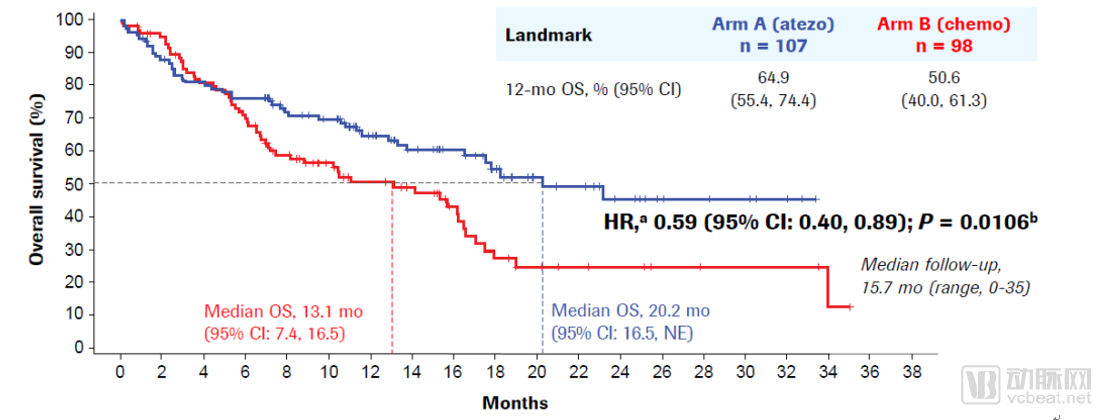
Data source: Roche
Bristol Myers Squibb’s Opdivo + ipilimumab met the independent co-primary endpoints of the study as first-line treatment for advanced non-small cell lung cancer
Bristol Myers Squibb’s Opdivo, in combination with low-dose ipilimumab, met the study’s independent co-primary endpoint of overall survival (OS) in patients with PD-L1 expression ≥1%. This is the first and only clinical trial to demonstrate that dual immunotherapy, as a first-line treatment for non-small cell lung cancer, provides a significant survival benefit compared with chemotherapy.
Opdivo, abbreviated as O drug, is a PD-1 inhibitor; ipilimumab is a CTLA-4 antibody.
To evaluate the efficacy of Opdivo combined with low-dose ipilimumab as first-line treatment for patients with advanced non-small cell lung cancer (NSCLC), with overall survival (OS) in patients with PD-L1 ≥1% serving as one of the independent co-primary endpoints.
Study results showed that, compared with chemotherapy, the combination therapy provided a significant overall survival benefit in patients with PD-L1 ≥ 1% [HR 0.79].
Amgen Announces New Data from Phase 1 Study of KRAS-Targeted Drug AMG 510
At this year’s ESMO Congress, Amgen presented new data from its ongoing Phase 1 study of the KRAS-targeted therapy AMG 510. The study evaluated the safety and efficacy of AMG 510 in patients with previously treated KRAS G12C–mutated solid tumors, including those with colorectal cancer, appendiceal cancer, and non-small cell lung cancer (NSCLC).
AMG510 is a KRAS-targeted drug.
Thirteen NSCLC patients were enrolled at a dose of 960 mg.
Seven patients (54%) achieved partial response, and six patients (46%) achieved stable disease, resulting in a disease control rate of 100%.
ARIAD Pharmaceuticals’ Brigatinib Makes a Dark-Horse Debut, Offering a Safety Net for Various TKI Resistances with an Efficacy Rate of Up to 34.9%
The UVEA-Brig real-world study is a retrospective study, and its findings were presented at the ESMO Congress.
Brigatinib (布加替尼, Alunbrig) is a second-generation ALK-TKI inhibitor targeting ALK fusions and ROS1 rearrangements.
This study enrolled a total of 50 patients with ALK-positive metastatic non-small cell lung cancer (mNSCLC), including adults with brain lesions, from the EAP program (International Expanded Access Program), who had experienced disease progression after prior treatment with multiple tyrosine kinase inhibitors (TKIs). Among them, 34% of patients had received ≥3 lines of drug therapy; prior treatments included crizotinib in 84%, ceritinib in 46%, alectinib in 10%, and lorlatinib in 8%.
With a median follow-up of 6 months, 36 patients discontinued brigatinib, and 43 patients were evaluable for efficacy. The results showed an objective response rate (ORR) of 34.9% and a disease control rate (DCR) of 81.4%. Among these, 1 patient (2.3%) achieved complete response (CR); 14 patients (32.6%) achieved partial response (PR); and 20 patients (46.5%) had stable disease (SD). The median duration of response (DoR) was 9.7 (range: 0.7–23.4) months, the median progression-free survival (PFS) was 5.7 (95% CI: 6.2–9.9) months, and the median overall survival (OS) was 10.2 (95% CI: 8.6–12.6) months.
Incyte’s Novel FGFR Inhibitor Pemigatinib Achieves 36% ORR in Later-Line Treatment of Cholangiocarcinoma
Incyte Announces Latest Data from Phase II Clinical Trial — FIGHT-202. This study aims to evaluate the efficacy of its selective fibroblast growth factor receptor (FGFR) inhibitor, pemigatinib (INCB54828), in patients with advanced/metastatic or unresectable cholangiocarcinoma who have experienced at least one prior treatment failure.
Pemigatinib is a novel FGFR-targeted drug.
In the Phase II FIGHT-202 study, patients with advanced cholangiocarcinoma who had received ≥1 prior line of therapy were enrolled and divided into three cohorts: Cohort A (FGFR2 fusions/rearrangements), Cohort B (other FGFR mutations), and Cohort C (non-FGFR mutations), all treated with pemigatinib.
The efficacy of 145 patients was analyzed, with Cohort A demonstrating the best outcomes. The overall objective response rate (ORR) was 40%, comprising 19 patients (40%) with partial response and 21 patients (45%) with stable disease (SD). The overall disease control rate (DCR) was 85% (40/47). Furthermore, the median progression-free survival (PFS) was 9.2 months, and the median overall survival (OS) was 15.8 months.
❖GRAIL announced the latest clinical trial results of its multi-cancer blood test at ESMO. The trial data demonstrated that the company’s multi-cancer blood test can detect signals for more than 20 types of cancer with a specificity of 99.4% (equivalent to a false positive rate of 0.6%). Roche announced the results of its first clinical trial using liquid biopsy to stratify patients and guide treatment selection.
❖CTONG 1509 Study: “A+T” Regimen Poised to Redefine First-Line Standard of Care for EGFR-Mutated NSCLC. The addition of A (bevacizumab) delays resistance to T (erlotinib) and prolongs progression-free survival (PFS). Preclinical studies have demonstrated synergistic antitumor effects with the combination of EGFR-TKIs and bevacizumab, a synergy that has been corroborated by multiple global clinical trials.
❖ TMB Levels Influence Survival Outcomes with Pembrolizumab Monotherapy in NSCLC. In the KEYNOTE-010 trial, which compared pembrolizumab monotherapy versus chemotherapy in previously treated PD-L1-positive NSCLC patients, a significant difference in median overall survival (OS) was observed between the pembrolizumab and chemotherapy groups when tissue TMB (tTMB) was ≥175 mutations/exome (14.1 months vs. 7.6 months); no significant difference was found between the two groups when tTMB was <175 mutations/exome (9.3 months vs. 7.2 months).
❖ The triplet regimen of abemaciclib, trastuzumab, and fulvestrant has surpassed traditional chemotherapy regimens, successfully ushering in a chemotherapy-free era. MonarcHER is a Phase II clinical trial comparing the CDK4/6 inhibitor abemaciclib plus trastuzumab and fulvestrant versus trastuzumab plus standard chemotherapy as third-line treatment for HR+, HER2+ advanced breast cancer. In terms of the primary endpoint, progression-free survival (PFS), the experimental group demonstrated a statistically significant improvement over the traditional trastuzumab plus chemotherapy group, with median PFS values of 8.32 months and 5.69 months, respectively.