

Completion of National Healthcare Security Administration's 15 Coding Standards Set to Transform China's Medical Industry
Editor’s Note: This article is reprinted from CN-Healthcare, with authorization granted to VCBeat for republication.
On October 8, the National Healthcare Security Administration (hereinafter referred to as the NHSA) issued the “Notice on Printing and Distributing the Information Business Coding Rules and Methods for Designated Medical Institutions under Medical Security” on its official website. The notice includes the “Information Business Coding Rules and Methods for 10 Items Including Designated Medical Institutions under Medical Security” and the “Medical Security Fund Settlement List.”
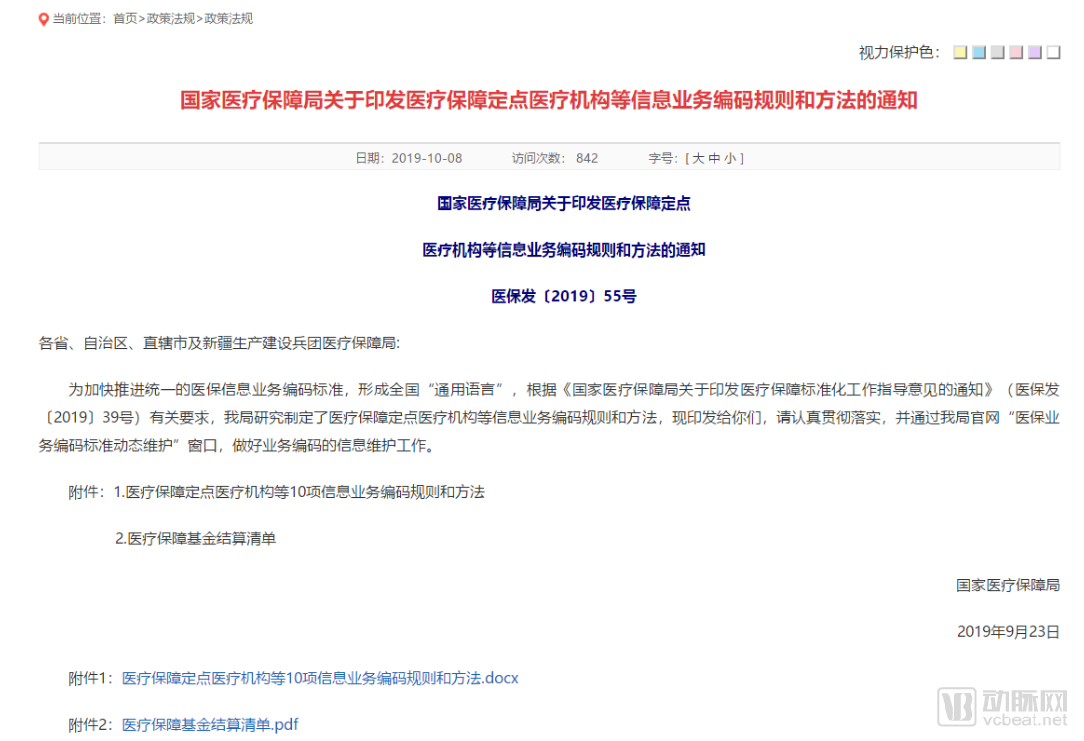 Image source: Screenshot from the official website of the National Healthcare Security Administration
The release of this document marks the full completion of all 15 standard codes for medical insurance information services. Establishing a nationally unified medical insurance information standard and platform represents a critical step forward since the inception of China’s medical insurance system, and, in light of the current healthcare reform landscape, carries profound implications.
On June 27, the National Healthcare Security Administration (NHSA) released the "Notice of the National Healthcare Security Administration on Issuing the Guiding Opinions on Standardization Work for Medical Security" (hereinafter referred to as the "Notice"), launching four sets of business codes—including those for disease diagnoses and surgical procedures—as a priority initiative. This move has attracted widespread attention from various stakeholders within the healthcare sector. Provincial-level medical security administrations, along with relevant pharmaceutical and medical consumable enterprises, have actively participated in the dynamic maintenance of the coding standard database.
After more than three months of exploration, the National Healthcare Security Administration achieved initial success and released its performance results: As of the end of September 2019, pharmaceutical companies had uploaded and maintained 120,459 product information records online; medical device consumable manufacturers had maintained 17,298 registration certificate records and 20 million specification and model records, among which 11.98 million records corresponded to products already in use across various regions.
The 11 coding standards launched by the National Healthcare Security Administration (NHSA), including the Medical Insurance Settlement List, each feature distinct characteristics. For example:- **Medical Insurance Settlement List**: Integrates settlement information into a single form with unified data transmission standards, facilitating medical insurance settlements, supporting DRG reform, and improving the efficiency of medical insurance management.- **Codes for Designated Medical Institutions and Personnel**: Features unique and easily identifiable codes to support public-benefit services throughout the entire process.- **Codes for Medical Insurance System Entities and Staff**: Provides comprehensive coverage of institutions and personnel to serve the public and enhance people’s well-being.- **Medical Insurance Disease Codes**: Ensures full compatibility of coding for more convenient settlements.
As early as in the "Notice," the statement that "China's medical security system has been established and operated for more than 20 years, but a unified standardization system has not yet been formed" was particularly noteworthy. This clearly demonstrates the importance of building a "unified, efficient, compatible, convenient, and secure" medical insurance information platform to enhance China's governance capabilities in medical security.
Yu Changjiang, Executive Dean of the School of Humanities at Peking University Shenzhen Graduate School, has expressed his expectations for the unified medical insurance information platform.
“Over the more than 20 years since the establishment of China’s medical insurance system, many persistent challenges have remained, including issues related to cross-regional medical care, pharmaceutical procurement, varying local medical insurance standards, national pooling of medical insurance funds, as well as personal medical information inquiries and the transfer and continuation of individual medical insurance coverage.” In his view, the inability to formulate and implement many policy regulations stems from the lack of a unified national medical insurance information standard and an integrated information platform.
Experts have stated that the rapid growth of medical expenses, unreasonable medical costs, significant waste of health insurance funds, and even fraud and deception in insurance claims in recent years are also related to the imperfection of information technology construction.
“Many doctor-patient disputes stem from billing issues. Some patients do not understand how hospitals charge, and hospital pricing lacks transparency.” Professor Lo Chung-mau, President of The University of Hong Kong-Shenzhen Hospital, seems to have pinpointed the rationale behind establishing a unified medical insurance information platform. “Implementing bundled payment based on standardized settlement processes, clear disease categorizations, and surgical coding will be crucial to resolving doctor-patient relations. It ensures that patients know the payment standards are uniformly set by the system, rather than being individually determined by each hospital,” emphasized Professor Lo.
Evidently, standardizing medical insurance disease diagnoses, surgical procedures, and medical services will undoubtedly facilitate reforms in medical insurance payment methods. Unified coding for disease diagnoses, surgical procedures, and medical services serves as a critical tool for the collection, statistics, analysis, and payment of condition-related information. Establishing standardized norms promotes reforms in medical insurance payment models, such as Diagnosis-Related Group (DRG) payment, and facilitates cross-regional medical expense settlement, thereby meeting the healthcare needs of the mobile population.
Shi Zihai, Deputy Director of the National Healthcare Security Administration, once stated that only by unifying data coding standards and achieving mutual recognition of data can big data be established at both national and regional levels. This enables big data analytics applications to provide decision-making support for policy formulation in areas such as healthcare financing, benefit coverage, payment systems, centralized procurement of drugs and medical consumables, and fund supervision, thereby promoting precise and scientific management of medical insurance. In particular, it plays a crucial foundational role in reducing drug prices and advancing reforms in the governance of high-value medical consumables.
“The goal of gradually implementing the 15 information business coding standards by 2020” was already stated in the Notice. According to the National Healthcare Security Administration, the next step will involve organizing application testing of these information business codes in selected regions. Through the early adoption and in-depth participation of these pilot regions, the compatibility and applicability of the relevant information business codes and databases in routine healthcare security administration will be validated. This will facilitate further refinement of the coding database, optimization of dynamic maintenance processes, accumulation of experience for nationwide promotion, and the establishment of a “common language” for national healthcare security information services.
Addressing many prominent issues, such as difficulty and high cost in accessing medical care, kickback-driven sales of pharmaceuticals and consumables, and weak supervision of the national health insurance fund, requires a unified national health insurance information standard and platform to oversee and facilitate their resolution.
