

Vir Biotechnology IPO Plunges Nearly 30% Amid High Valuation Concerns; Advances Toward Functional Cure for Hepatitis B

Vir Biotechnology
Developer of Immunological Drugs
Vir Biotechnology, founded in April 2016, is a clinical-stage immunology company based in California, USA, focused on the treatment and prevention of infectious diseases, with a mission to create a world free of infectious diseases. The company’s CEO, George Scangos, formerly served as Chief Executive Officer of Biogen. When he stepped down from Biogen, industry observers closely watched where he would continue his work in the biotechnology sector.
Scangos stated that he was drawn to the “huge medical demand” in the infectious disease market, which led him to join Vir Biotechnology in January 2017. In the early hours of the 12th (Beijing time), Scangos will lead the biopharmaceutical company, which has been established for less than three years, to ring the opening bell on the Nasdaq, marking his return to Wall Street.
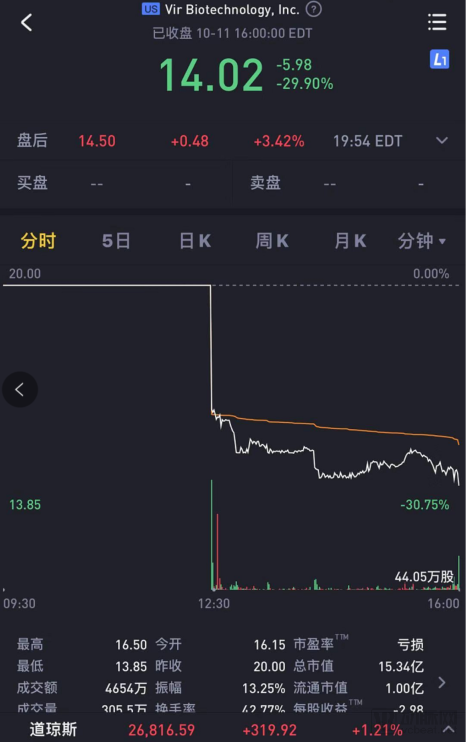
Vir Biotechnology offered 7.1 million shares at an IPO price of $20 per share. However, due to market dissatisfaction with its high valuation, the stock opened directly at $16.50, down 18% from the offering price. The share price continued to decline throughout the day, closing at $14.02, a drop of 29.9%. Vir Biotechnology’s listing marked the worst debut for a U.S. company since May this year and ranked fifth among all IPOs in 2026.
Infectious diseases are among the leading causes of death worldwide, imposing an economic burden of hundreds of billions of dollars annually. “I could not pass up the opportunity to lead Vir. There is a substantial global demand for infectious disease treatments, and effective treatment and prevention of infectious diseases are critically important to public health. The success of new technologies will mean alleviating the suffering of many people,” said George Scangos, CEO of Vir Biotechnology. “We need a company dedicated to pursuing more effective and innovative therapies. Vir Biotechnology is that company, and I am delighted to assume this leadership role.”
Vir Biotechnology was co-founded by Robert Nelsen, founder of the renowned venture capital firm ARCH Venture Partners, and Dr. Klaus Frueh, a senior scientist at Oregon Health & Science University, with angel investment from ARCH Venture Partners. Dr. Klaus Frueh also serves as President and Chief Scientific Officer of TomegaVax, a biotechnology company that was acquired by Vir Biotechnology in September 2016.
Vir Biotechnology combats infectious diseases through novel immunological technologies, employing a multi-pronged, multi-platform approach to leverage these breakthroughs. This includes developing therapies that induce prophylactic and therapeutic immune responses, as well as modulating pathogen-host interactions to address highly infectious viral pathogens. Vir’s research is primarily focused on three areas of infectious diseases: first, chronic infectious diseases, including hepatitis B, tuberculosis, and HIV/AIDS; second, respiratory diseases, including influenza, respiratory syncytial virus (RSV), and human metapneumovirus; and third, hospital-acquired infections.
Four Technology Platforms, Five Pipelines
Through internal development, collaborations, and acquisitions, Vir Biotechnology has established four technology platforms: an antibody platform, a T cell platform, an innate immunity platform, and an siRNA platform. Vir Biotechnology’s approach begins by identifying the limitations of the immune system in combating specific pathogens, the vulnerabilities of those pathogens, and the reasons for the failure of previous approaches. It then leverages robust technologies, which can be used individually or in combination, to generate effective therapies.
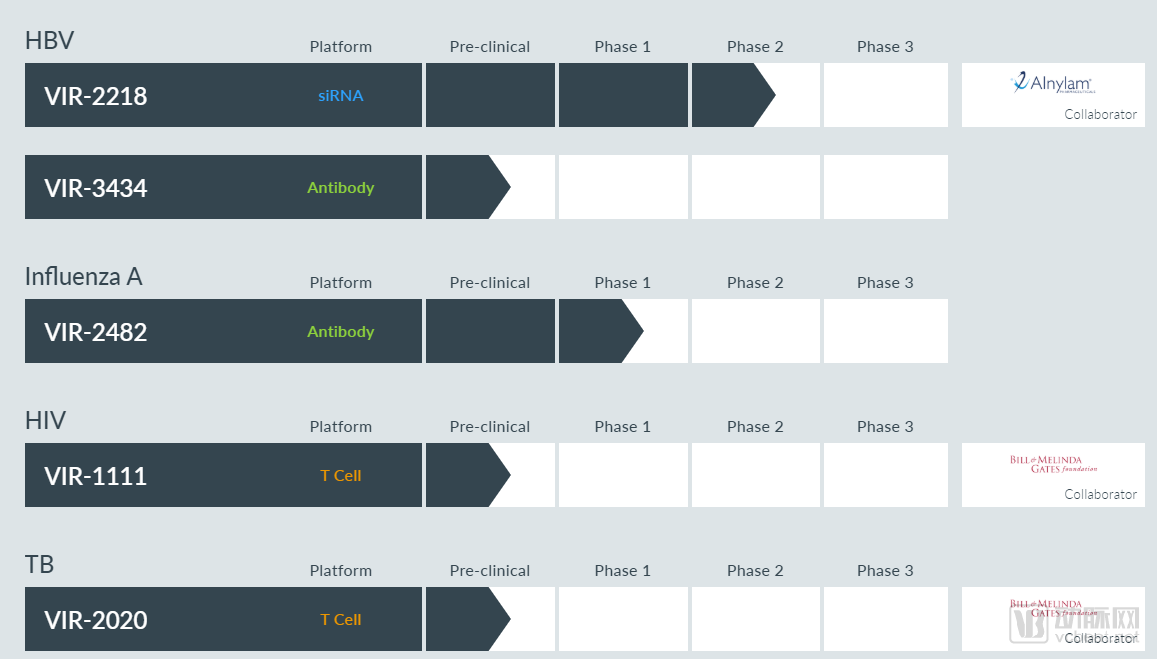
According to Vir Biotechnology’s prospectus, its current R&D pipeline comprises five drug candidates targeting hepatitis B, influenza A, HIV/AIDS, and tuberculosis. The most advanced candidate, VIR-2218, is an siRNA-based therapeutic for hepatitis B virus (HBV) infection and is currently in Phase II clinical trials. Preliminary data indicate a substantial reduction in hepatitis B surface antigen (HBsAg) levels—by approximately 4- to 200-fold—with good tolerability. VIR-2482, a monoclonal antibody for the prevention of influenza A, is currently in Phase I clinical trials.
siRNA drugs are relatively scarce; to date, only ONPATTRO (patisiran), developed by Alnylam, has received FDA approval in 2018. The technology used in Vir Biotechnology’s siRNA platform was licensed through a collaboration agreement with Alnylam, which also granted Vir the global exclusive license for VIR-2218, with milestone payments tied to R&D progress.
Globally, approximately 290 million people suffer from chronic hepatitis B virus (HBV) infection each year, with around 900,000 deaths attributed to related complications. VIR-2218 is a subcutaneously administered siRNA therapeutic targeting HBV, while VIR-3434 is a subcutaneously administered neutralizing monoclonal antibody against HBV. VIR-2218 and VIR-3434 hold promise for achieving a functional cure for hepatitis B, defined as lifelong viral control following a limited course of treatment. Each of these candidate products has the potential to stimulate robust immune responses and also exhibits direct antiviral activity against HBV. Brii Biosciences, a Chinese company, has introduced VIR-2218 into China for clinical development of this therapy.
Vir Biotechnology’s prospectus notes that, in addition to antiviral activity, an effective immune response is required for a functional cure of hepatitis B virus (HBV) infection. Although monotherapy with either of these two drugs may achieve a functional cure in some patients, combination therapy is likely to be adopted for the majority of patients, leveraging synergistic effects by eliminating potentially tolerogenic HBV proteins and stimulating de novo HBV-specific T-cell responses.
VIR-2482 is a monoclonal antibody targeting the hemagglutinin stem for the prevention of influenza A. Clinical trials commenced in August 2019. Preclinical studies demonstrated that VIR-2482 covers all major influenza A virus strains circulating since the 1918 Spanish flu pandemic. With a half-life of five to six months, it provides coverage throughout the entire influenza season.
VIR-1111 is an HCMV-based, subcutaneously administered HIV T-cell vaccine, with an IND submission planned for the first half of 2020, followed by the initiation of Phase I clinical trials. VIR-2020 is an HCMV-based, subcutaneously administered TB T-cell vaccine; preclinical studies have demonstrated that T-cell vaccines based on rhesus cytomegalovirus (RhCMV) can protect non-human primates from tuberculosis infection. An IND submission to initiate clinical trials is expected in 2020.
Vir Biotechnology’s approach utilizes human cytomegalovirus (HCMV) as a vaccine vector to potentially treat and prevent pathogens that are currently beyond the reach of existing vaccine technologies. This is because HCMV can induce potent and durable T-cell responses over a broader spectrum, surpassing those elicited by conventional viral vaccines. Currently, safety and toxicity studies of this technology have been conducted exclusively in animal models using replication-deficient HCMV.
Vir Biotechnology's Financing and Acquisition Information
At its inception, Vir Biotechnology secured $150 million in angel funding on January 6, 2017, led by prominent venture capital firm ARCH Venture Partners and the Bill & Melinda Gates Foundation, with participation from Altitude Life Science Ventures, SoftBank Vision Fund, and Alta Partners in the initial round.
On August 7, 2018, Vir Biotechnology raised $66 million in its Series A financing round.
On January 1, 2019, Vir Biotechnology secured $327.6 million in its Series B financing round, led by SoftBank Vision Fund, with participation from ARCH Venture Partners and Alta Partners. Despite its short history, Vir Biotechnology has raised over $500 million, attracting significant market attention.
ARCH Venture holds the largest equity stake in Vir Biotechnology, at 27%. SoftBank Vision Fund follows as the second-largest shareholder with a 21.2% stake. Founder and CEO George Scangos owns 6.7% of the shares. Board Chair Vicki Sato holds 1.7% of the shares; she has had a long and distinguished career in the biotechnology sector. Scangos’s compensation is significantly lower than what he earned at previous companies. Last year, Scangos’s total compensation amounted to $783,000, whereas Herbert “Skip” Virgin, the Head of R&D from Washington University School of Medicine, received $2.16 million—nearly three times the CEO’s pay.
In September 2016, Vir Biotechnology acquired TomegaVax, whose primary asset was a CMV vector-based vaccine platform for HBV, HIV, and TB.
In August 2017, Vir Biotechnology acquired Humabs BioMed SA, a Swiss company whose proprietary technology enables the rapid isolation and development of antibodies naturally selected by the human immune system. The company is currently dedicated to developing fully human monoclonal antibodies for the treatment of serious infectious diseases.
This acquisition of Humabs has provided Vir with 15 candidate antibodies for infectious diseases, among which those targeting HBV, RSV (respiratory syncytial virus), MPV (human papillomavirus), and Zika virus have entered the preclinical trial stage, while the antibody against Dengue virus is in the engineering stage.
In January 2018, Vir Biotechnology acquired Agenovir, whose primary assets were R&D programs targeting HPV and HBV using CRISPR/Cas9 gene-editing technology.
In February 2018, Vir Biotechnology acquired Statera Health, a cloud-based predictive analytics platform for clinical data.
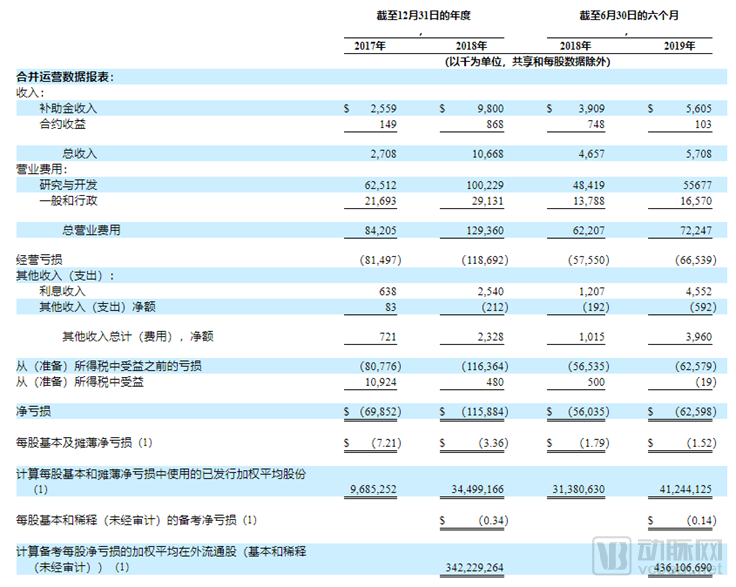
Currently, Vir Biotechnology has no products on the market, so it remains in the R&D investment stage, with the company experiencing significant losses. In 2018, the loss was approximately $110 million, with minimal revenue mainly coming from donations related to AIDS and tuberculosis funds or government agencies, as well as contract income from its Swiss subsidiary Humabs. As of June 30, 2019, the six-month R&D expenses were $55.7 million, and the R&D investment in 2018 was $100 million.
This marks Scangos’ third appearance on Wall Street; after moving from Exelixis to Biogen, he led the company’s IPO in 2000. This time, he is guiding Vir Biotechnology into the public markets.