

Yunweikang Tackles China's Underdiagnosed 'Silent Killer': OSAHS, with Low-Cost Wearable Diagnostic Solution
Looking back on the development trajectory of health wearables, it is evident that these devices are undergoing a refined and specialized evolution from consumer-grade to medical-grade standards. The user base for health wearables has expanded beyond its initial focus on fitness enthusiasts to include professional physicians, positioning them as important tools in precision medicine.
At present, gaining physician acceptance for health wearable devices has become a pressing challenge. VCBeat (WeChat ID: vcbeat) has learned that Chengdu iCareTech Healthcare Co., Ltd. (“Yunweikang”) managed to deploy its wearable products in over 100 hospitals within just six months. By focusing on obstructive sleep apnea-hypopnea syndrome (OSAHS) as an entry point, Yunweikang has transformed its wearable devices into genuine diagnostic tools for physicians.
How Did iCareTech Gain Hospital Recognition? VCBeat Interviewed Liu Jun, Chairman of iCareTech, and Deputy General Manager Pu Yunhai.
The founding team of Chengdu iCareTech Healthcare Co., Ltd. (iCareTech) comprises seasoned veterans from the medical industry. Liu Jun, Chairman of iCareTech, is also a co-founder of Laoken Medical, a well-known comprehensive provider of disinfection and sterilization services in China, established in 1998. iCareTech’s initial technical team hails from GE Healthcare. Other core members of iCareTech have also been deeply rooted in the medical industry for many years, bringing extensive industry experience to the table.
Years of deep engagement in the healthcare industry have determined the Yunweikang team to develop a medical-grade wearable product from the outset. Yunweikang has chosen to first tackle sleep apnea syndrome.
According to the International Classification of Diseases, there are 88 sleep disorders, 65% of which are obstructive sleep apnea-hypopnea syndrome (OSAHS), with snoring being its primary manifestation. Li Taoping, Director of the Sleep Medicine Center at Nanfang Hospital, Southern Medical University, stated in an interview that 90% of snoring cases are attributable to OSAHS.
Many people believe that snoring is a sign of good, deep sleep; in reality, it is an indicator of poor sleep quality and a warning signal for underlying health conditions.
Snoring is common in our daily lives, yet obstructive sleep apnea hypopnea syndrome (OSAHS) remains unfamiliar to many. This actually reflects the extremely low diagnostic rate of OSAHS in China; data show that fewer than 0.1% of sleep-disordered breathing cases are diagnosed.
In 2019, according to a report in The Lancet Respiratory Medicine, a world-leading journal in the field of respiratory medicine, there were over 936 million patients with obstructive sleep apnea worldwide, including 176 million in China.
The 936 million patients represent a nearly tenfold increase over the more than 100 million cases estimated by the World Health Organization in 2007. A high rate of missed diagnoses has made sleep-disordered breathing syndrome an “invisible killer.” Patients with sleep-disordered breathing have a 2–7 times higher risk of being involved in traffic accidents and a 2–3 times higher risk of construction-related accidents compared to healthy individuals.
Sleep Apnea Syndrome not only affects sleep quality but also leads to numerous complications, including hypertension, coronary heart disease, arrhythmia, heart failure, and pulmonary hypertension.
To catch this “invisible killer,” it is first necessary to reduce the screening costs for sleep-disordered breathing.
In the diagnosis of sleep apnea-hypopnea syndrome, polysomnography (PSG) is the recognized gold standard for detecting obstructive sleep apnea (OSA), but its availability is limited.
First, due to the large size and high cost of polysomnography (PSG) equipment, patients generally face long waiting times for scheduled examinations. Furthermore, PSG requires patients to wear more than 20 electrodes while staying overnight in a hospital, monitoring parameters such as electrocardiogram (ECG), electromyogram (EMG), electrooculogram (EOG), and blood oxygen saturation. This approach poses significant inconveniences for patients.
Therefore, it is urgent to identify a screening method that minimizes sleep disturbance for patients, is cost-effective, easy to administer, and suitable for large-scale population screening.
When patients experience sleep apnea syndrome, blood oxygen saturation decreases due to impaired gas exchange in the lungs.
iCareTech’s first-generation product was a blood oxygen monitoring wristband. After years of technological accumulation and R&D investment, iCareTech has launched its third-generation respiratory monitoring solution. iCareTech’s current product offerings consist of an integrated hardware-software system, comprising a coin-sized monitoring terminal and auxiliary diagnostic software.
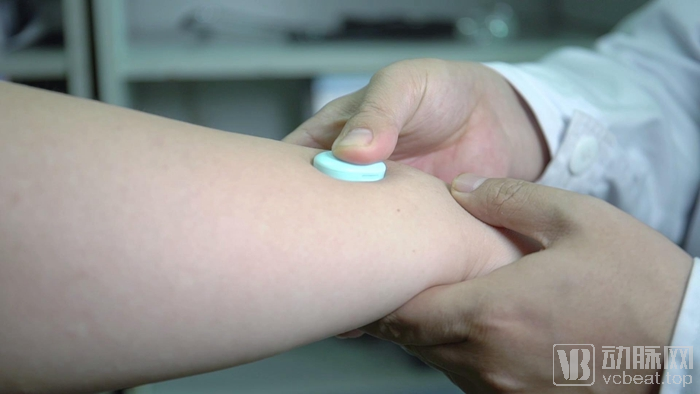
Yunweikang Product Monitoring Terminal
Patients only need to obtain the relevant product at the hospital and attach the compact monitoring terminal to a designated location, such as the wrist, to enable home-based monitoring without requiring an overnight hospital stay. After the patient returns to the hospital to have the monitoring terminal removed, the auxiliary diagnostic software can immediately retrieve the data and provide doctors with diagnostic support recommendations following local or cloud-based analysis.
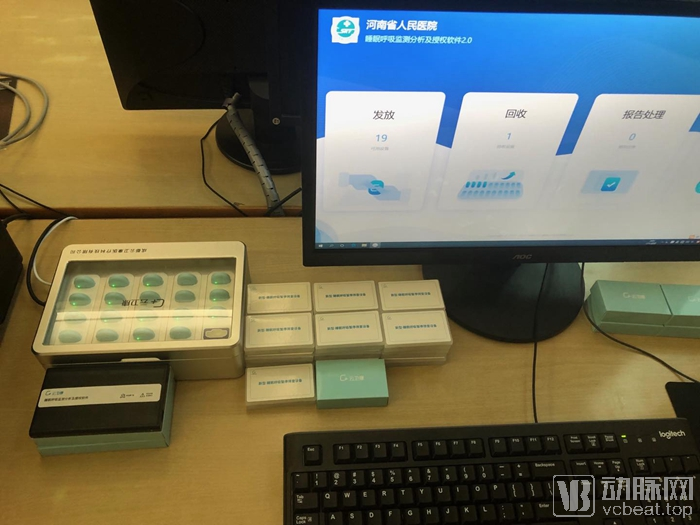
iCareTech Product Portfolio
Liu Jun stated, “Our core technologies are, first, our independently developed reflective vital signs monitoring algorithm, and second, our foundation in medical big data applications. We have conducted extensive clinical research on obstructive sleep apnea (OSA) and have established a solid basis for fundamental research in data analysis and disease matching.”
Pu Yunhai told VCBeat that the current R&D team of iCareTech is divided into three parts, including the basic research team, the clinical application technology team, and the clinical medicine team. The basic research team is responsible for the underlying technology development, converting optoelectronic signals into physiological signals. The clinical application technology team is mainly responsible for data analysis, which is to build disease models.
“Behind Chengdu iCareTech Healthcare Co., Ltd. (Yunweikang) stands a robust team of physicians. These are frontline medical professionals whose resources have been accumulated by Yunweikang during its development. Through continuous industry-academia-research collaborations, Yunweikang provides them with scientific research support and facilitates the translation of their research findings.”
Currently, both the hardware and software products of iCareTech have obtained CFDA certification. Within just six months of market launch, iCareTech’s products have been promoted to over 100 hospitals, with nearly 40 hospitals having either proposed procurement plans or completed purchases and put them into application.
To gain strong recognition from hospitals, the iCareTech team believes the key lies in combining technological innovation with business model innovation.
Pu Yunhai stated, “In fact, people spend one-third of their lives sleeping, making the sleep market substantial. However, traditional diagnostic methods and business models are open to question. The conventional diagnostic approach requires patients to undergo overnight polysomnography in a hospital setting, which hinders large-scale adoption. Meanwhile, hospitals are compelled to purchase expensive, large-scale equipment. This has directly resulted in a lack of commercial drive in the sleep disorder market, affecting both patient education and academic research.”
“iCareTech’s vision is to improve the current state of screening, diagnosis, and treatment for the 176 million patients with sleep-disordered breathing in China. Therefore, we have adopted an innovative business model.”
First, in terms of hardware costs, iCareTech enters hospitals with a low-cost approach, enabling its products and services to be widely deployed across departments such as Otolaryngology, Health Check-up Centers, Neurology, and Sleep Centers, thereby reducing the procurement cost burden for hospital departments. iCareTech’s primary revenue stream comes from licensing fees for analytical reports. Under this model, hospital departments can conduct sleep screening services with exceptional cost-effectiveness, expanding the screened population without being constrained by the number of monitoring devices available.
In addition to traditional clinical departments, the portability and flexibility of iCareTech’s third-generation products have expanded the screening scenarios for sleep apnea syndrome, enabling diagnoses that were previously confined to clinical settings to be performed at health examination centers.
Health checkup centers see higher patient traffic, enabling OSA screening to reach a larger patient population. Furthermore, patients at these centers tend to have greater health awareness and are more receptive to health screening products. Therefore, health checkup centers will also be a key market for expansion by iCareTech.
Second, Chengdu iCareTech Healthcare Co., Ltd. has established long-term partnerships with hospital departments through its licensed analytical software.
Driven by business model innovation, the relationship between Chengdu iCareTech Healthcare Co., Ltd. (iCareTech) and hospital departments is no longer a simple "buyer-seller" transaction but a long-term, in-depth partnership. On one hand, iCareTech provides comprehensive support to hospital departments in conducting operations and academic research; on the other, medical experts share their extensive clinical experience and academic findings with iCareTech. This synergy fosters a truly virtuous cycle.
In 2016, Chengdu iCareTech Healthcare Co., Ltd. (iCareTech) secured RMB 20 million in Series A financing from Kaitai Capital. Currently, iCareTech is undergoing a new round of financing. Pu Yunhai told VCBeat that the proceeds from this round will be primarily used for market expansion and talent acquisition.
Currently, Chengdu iCareTech Healthcare Co., Ltd. is seeking a new round of financing. Interested parties please contact VCBeat’s financing assistant, Xiao Yun: DongMai_Investent