

9th China-U.S. Health Summit: Exploring the Future of Public Health and Healthcare Services in the United States
VCBeat (WeChat ID: vcbeat) has learned that the 9th China-US Health Summit was recently held in Boston. Over the course of two days of intensive agendas, elites from the industry, academia, research, government, and business sectors in both China and the United States gathered together for in-depth and efficient dialogues and exchanges centered on two major themes: innovation and investment/financing in healthcare, and the establishment of a sustainable health system. Among the more than 400 attendees, over 100 were healthcare policy makers, directors of public and private hospitals, representatives from medical teaching and research institutions, and professionals from investment and pharmaceutical companies who traveled specifically from China to participate in the China-US Health Summit.
At the conference, Arlene Bierman, Director of the Center for Evidence and Practice Improvement at the Agency for Healthcare Research and Quality (AHRQ) within the U.S. Department of Health and Human Services; Marc-David Munk, former Chief Medical Officer of CVS MinuteClinic; Christine Lu, Associate Professor and Director of the Center for Precision Medicine in Population Health at Harvard Medical School’s Department of Population Medicine; Joe Kimura, Chief Medical Officer of Atrius Health Community Care Alliance; and Alfred Demaria, Medical Director of the Bureau of Infectious Disease and Laboratory Sciences at the Massachusetts Department of Public Health, jointly explored the future of public health and healthcare services in the United States. VCBeat has compiled their insightful perspectives.
“Regarding issues such as delayed treatment, lack of personalized treatment plans, and overly complex workflows, we discussed solutions including personalized medicine, digital health, and patient-centered care,” stated Arlene Bierman, Director of the Center for Evidence and Practice Improvement at the Agency for Healthcare Research and Quality (AHRQ), in her presentation titled “Challenges Posed by Multiple Chronic Conditions.” She noted that current healthcare models fail to provide effective assistance to patients because there is a disconnect between patient needs and the services delivered.
Arlene Bierman stated, “Among the U.S. population aged 65 and older, there are many individuals with disabilities and chronic diseases, a demographic that is disproportionately represented among low-income groups and women. China faces similar challenges, making effective cross-border sharing of experience essential. China and the United States should work together to explore new pathways.”
The Future of U.S. Public Health and Medical Services: Five Experts Offer Five Perspectives with Implications for China’s Public Health and Medical Services
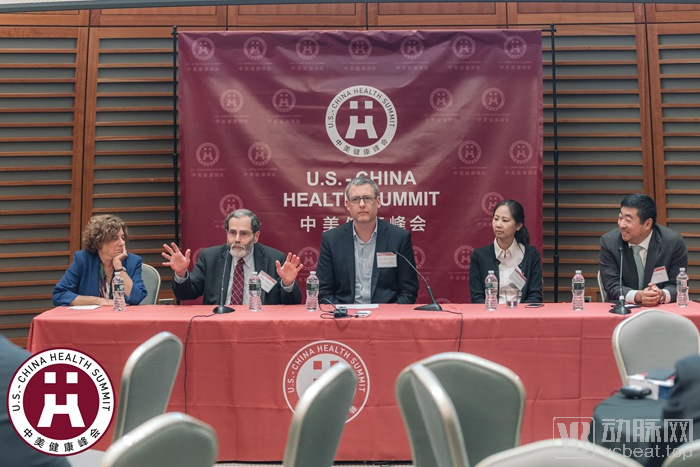
(Forum site; photo provided by the contributor)
Cooperative Learning System
Arlene Bierman recommends that “chronic diseases and their complications, along with mental health conditions, environmental factors, and socioeconomic status, should all be incorporated into evaluation metrics. For patients with multiple chronic conditions, a collaborative learning healthcare system should be established to support them. This system should analyze clinical outcomes in an evidence-based manner and evaluate the results. It should not only provide more data to patients and healthcare providers to facilitate better decision-making but also offer humanistic care to patients. Furthermore, it should serve as a hub connecting family physicians, medical homes, community workers, personalized community caregivers, and government administration.” Additionally, regarding traditional pharmacies, he believes that the potential of pharmacists has not been fully realized, and greater emphasis should be placed on leveraging their expertise and capabilities in the realm of over-the-counter medications.
Patient Self-Management
Joe Kimura, Chief Medical Officer of the Atrius Health community medical alliance, also emphasizes the necessity of establishing a collaborative learning healthcare system. He stated, “A collaborative learning healthcare system is a vital framework for transforming healthcare conditions and structures. Even if the future roadmap remains unclear, proactive experimentation is essential, as the insights generated can significantly impact many related medical fields. Furthermore, in the context of scarce medical resources, such a proactive healthcare system is needed to engage patients in self-management rather than relying solely on physicians—for example, by performing dialysis at home. This presents an opportunity for information technology to enhance the value and quality of primary care by optimizing the supply chain.” Additionally, regarding the challenges of an aging population, he believes that hospital-centric models should provide more cost-effective services. Specifically, leveraging digital health to deliver care to patients’ homes can not only reduce hospitalization rates but also lower costs to one-third of the original amount.
Data Has Value
Alfred DeMaria, Medical Director of the Bureau of Infectious Disease and Laboratory Sciences at the Massachusetts Department of Public Health, believes that the collection and use of medical data are also highly beneficial for public health research. “For the management of epidemics and chronic diseases, the focus is on maintaining health rather than treating illness. On the other hand, public health relies on the collection and utilization of medical data. For example, Harvard developed the Electronic Surveillance Platform (ESP) to support public health research. Previously, hepatitis A testing relied on laboratory-based data collection, whereas this system integrates information from electronic health records to provide relevant data, significantly improving research efficiency. Additionally, the system can automatically generate reports for various conditions, thereby reducing the workload for healthcare providers. The collection and use of data information make public health services more efficient.”
Service Categories
Marc-David Munk, former Chief Medical Officer of CVS MinuteClinic, stated, “In the past, primary care was not a priority, but now new models are beginning to disrupt tradition. For instance, CVS has started having family physicians provide services to patients, a move that offers valuable lessons for China. Previously, the role of family physicians was primarily focused on referrals, whereas they are now authorized to conduct independent clinical diagnoses. Currently, CVS proposes a CPC model, which categorizes services: for example, certain services are better suited for the elderly, younger individuals tend to prefer MinuteClinics, patients with severe conditions go to hospitals, and registered nurses can also address many patient concerns effectively.”
Precision Medicine
Christine Lu: Precision medicine is a growing trend, exemplified by President Obama’s proposal several years ago for personalized diagnostics tailored to different populations. Precision genomic therapy is no longer an unattainable goal. This technology can be applied not only to patients but also to general consumers through genetic sequencing; for instance, prenatal genetic sequencing can diagnose whether a fetus carries recessive genetic disorders. However, the advancement of this technology requires corresponding legal frameworks and improved regulatory models.
Original Author: Chen Yutong
Editor: Zhang Jing