

5G Smartphone Transforms into Microscope: Landing Smart Enables On-Demand Data Collection

Landing Med
Developer of Cervical Cancer Diagnostic Robots
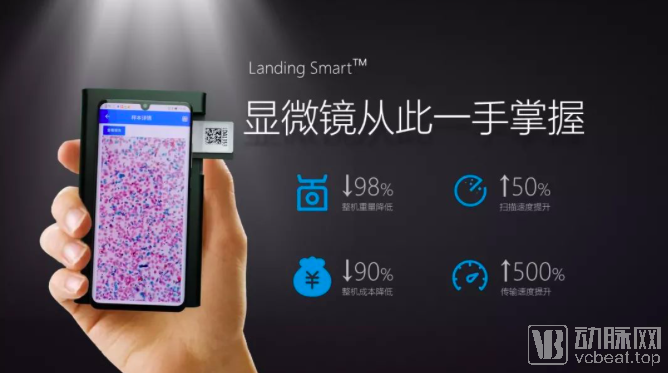
On October 12, at the Symposium on New Technological Achievements in AI-Based Early Cancer Diagnosis held at the Wuhan National Bio-industry Base, the “Landing Smart” smartphone microscope, independently developed by the Landing AI Cytology Diagnostic Research Center of Wuhan University, was officially launched. This technology transforms a 5G-enabled smartphone into a portable, fully automated, high-resolution microscopic image acquisition system. Integrated with 5G networks and an AI-driven big data cloud platform, it enables standardized, intelligent, simplified, and networked acquisition and interpretation of microscopic images.
At the conference, Zhao Baige, Vice Chair of the Foreign Affairs Committee of the 12th National People’s Congress, Chair of the Expert Committee of the Chinese Academy of Social Sciences’ “Belt and Road” International Think Tank, and Chair of the Expert Committee of Lantai International Think Tank, compared the current state of AI in China and the United States. She noted that, for China, the market implementation and application scenarios of AI technology are far more abundant than those in the U.S. Additionally, China’s demographic scale advantage provides an exceptionally rich data resource for the development of AI technology. These two unique strengths make China an ideal market for AI applications. She urged relevant authorities to formulate policies in the following areas to promote the better development of the AI healthcare industry: First, establish a high-level coordination mechanism. Second, strengthen national policy and financial support in areas such as talent development, intellectual property protection, and key scientific and technological research in the field of AI. Third, leverage advantages in application scenarios and data usage. Currently, China leads the U.S. in data utilization within application scenarios; continued support should be provided to leading industries. Fourth, innovate the regulatory approval and pricing environment for AI to lower market entry barriers. Fifth, actively encourage and assist medical AI enterprises in expanding overseas.
At the seminar, a Huawei 5G smartphone equipped with the “Landing Shiba” mobile app component was instantly transformed into a microscope. The demonstrator inserted a cervical cell specimen slide into the component, completing cell scanning and uploading to the cloud platform within three minutes. Upon receiving the digital images of cervical cells via the 5G network, Wuhan Landing’s AI-powered big data cloud platform rapidly performed classification and diagnosis of the cervical cells and generated an inspection report that was sent back in real time. Meanwhile, cytology experts at Tongji Hospital in Wuhan also received the report on their mobile phones and conducted an online review of the cloud-based diagnostic results. A complex cervical cell test, which would typically require a hospital laboratory, was easily completed in a very short period.
What is the significance of this technology? Pang Baochuan, a researcher at the Landing AI Cytopathology Diagnosis Research Center of Wuhan University, offered a vivid analogy: “With such a smartphone, medical personnel effectively carry an advanced cytopathology laboratory with them.”
Pang Baochuan explained that in medical diagnostics, many tests require the use of microscopes. However, traditional microscopes demand trained professionals for operation, cost over 100,000 yuan, are heavy and bulky, and thus inconvenient to carry. They necessitate dedicated laboratories to house these delicate instruments, resulting in high operational costs. After collecting samples, medical personnel must return to the laboratory for analysis, tying doctors to the equipment. In contrast, the “Landing Vision Master” integrates multiple advanced technologies, including artificial intelligence, big data, 5G networks, and robotics. Compared with traditional microscopes, this system significantly reduces both price and weight. A 5G-enabled device costs only a few thousand yuan, is pocket-sized, and can be easily transported even to the most remote areas, delivering immediate results. More importantly, it simplifies operations and lowers the experience threshold required for users.
“Previously, doctors relied on their eyes to identify pathological cells under a microscope and analyzed them based on personal experience. Now, this entire process is handled by an AI-powered big data cloud platform. After completing sample collection, medical personnel can simply scan the sample with a smartphone to obtain test results quickly. This task can be performed by individuals with minimal training, thereby avoiding errors caused by the subjectivity of manual diagnosis,” stated Pang Baochuan. He added that in cases involving diagnostic difficulties, medical experts can conduct real-time reviews and consultations via the cloud platform, allowing patients to receive their test reports on their smartphones at home. “In this way, issues related to the cost and efficiency of traditional microscope usage, as well as dependence on specialized personnel and facilities, have been resolved.”
Liu Juan, a professor at Wuhan University, believes that this technology will have a positive impact on medical diagnosis, particularly in the early screening of tumors. It is reported that the “Landing” AI-powered big data cloud platform for cervical cancer diagnosis, which underpins the “Landing Vision Master” system, has been successfully applied in cervical cancer screening programs across multiple provinces and cities in China. The platform provides screening services to millions of women in both urban and rural areas annually. Practical evidence has demonstrated that using artificial intelligence to replace physicians in diagnosing cancer cells yields higher efficiency and quality than manual methods, and large-scale early screening can effectively reduce cervical cancer mortality rates.
However, this platform currently still relies on traditional microscopes as the front-end interface. After medical personnel collect pathological cell samples, they must still consolidate these samples at a central laboratory for microscopic scanning. In large-scale screening programs, processing a high volume of samples within a short timeframe is undoubtedly an extremely burdensome task. The current combination of 5G-enabled mobile phone microscopes and an AI-powered big data cloud platform allows primary healthcare workers to bypass dependence on centralized laboratories by directly scanning and uploading specimens. This approach is expected to further improve screening efficiency and accuracy, reduce screening costs, and lower the reliance on clinicians’ experience, thereby ushering cervical cancer screening into a new era characterized by lower costs and higher efficiency through 5G and AI-driven big data technologies.
Meanwhile, this technology can also be applied to cytopathological examination and screening for other cancers. In the near future, it may shift tumor diagnosis to an earlier stage, making cancer a disease that can be detected and cured in a timely manner.
It is understood that by standardizing, intelligently automating, simplifying, and networking the acquisition and interpretation of microscopic images, “Landing Vision Master” can be applied in any industry requiring precise diagnosis based on microscopic imaging. In addition to medical applications such as tumor diagnosis, this technology can also be utilized in various fields including biological sciences, agriculture, industry, and teaching and research. It holds significant practical importance for innovating inspection and testing technologies in related industries. The Wuhan National Bio-industry Base will accelerate the translation of this scientific achievement into practical applications.