

Mingyi Zhonghe Completes Over RMB 1 Billion Series B Funding Round to Empower More Than 130,000 Grassroots Medical Institutions
Recently, Mingyi Zhonghe, a company dedicated to building an empowerment service system for “Internet + Primary Healthcare,” announced that it has recently completed a Series B financing round worth over RMB 100 million. The round was led by Sinovation Ventures, a renowned Chinese venture capital firm, with Yijing Capital participating as a co-investor. This financing marks another significant resource infusion for Mingyi Zhonghe, following investments last year from Tonghe Yucheng, Yuanyi Capital, and Fosun Pharma.
Founded in 2015, Mingyi Zhonghe is committed to its mission of “serving the public’s health.” Adhering to the business philosophy of “empowerment, sharing, and restructuring,” and leveraging “Yidebang” as its platform, the company has deeply cultivated the grassroots market for over four years. It provides comprehensive empowerment solutions to primary healthcare institutions, covering medical education, healthcare informatization, health insurance data services, pharmaceutical supply chain, and medical collaboration. Its services have reached 11 provinces (including Shandong, Guangdong, and Hebei), 80 prefecture-level cities, and 130,000 primary clinics and village health rooms, benefiting over 150 million rural residents.
“Primary healthcare institutions serve as the first point of contact and provide continuous care for common, chronic, and frequently occurring diseases among the grassroots population. They form the foundational safety net for public health and constitute the bedrock of China’s healthcare service system. Advancing the implementation of tiered diagnosis and treatment and strengthening primary care are core requirements of China’s medical reforms. Mingyi Zhonghe is the first ‘Internet + Healthcare’ startup to focus its services at the village level,” said Jiang Qiang, founder and chairman of Mingyi Zhonghe. “Approximately 600 million people in China live in rural areas, where daily healthcare services are provided by over a million primary care physicians. For four years, Mingyi Zhonghe has remained deeply rooted in rural areas, serving these most grassroots medical institutions.”
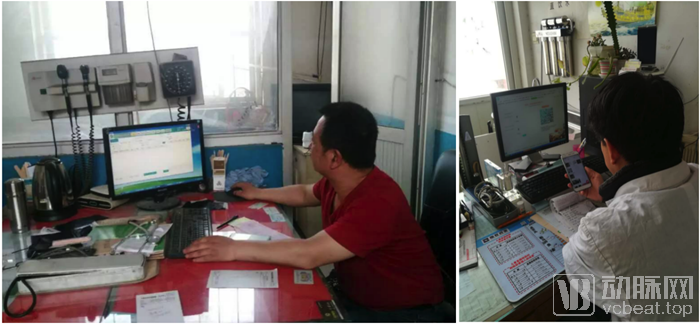
Primary care physicians are using the "Yidebang" SaaS system and app.
The average age of village doctors is around 45, and their educational attainment is generally low. Currently, the hardware infrastructure and network foundations in villages have been relatively well established. However, there is still significant room for development in the “Internet Plus” model for village-level healthcare systems. “Internet Plus” is precisely a powerful tool for channeling frontline medical resources down to the grassroots level. Village doctors demonstrate strong learning abilities and high motivation to learn, yet their current work methods have not been “internet-enabled.” For these “barefoot doctors,” who possess a certain foundational base but lack digital integration, how has Mingyi Zhonghe enabled them to install professional software and adopt mobile apps?
Mingyi Zhonghe’s founder, Jiang Qiang, answers with “running on foot.” No matter how remote the grassroots clinics and village health stations are, Mingyi Zhonghe provides dedicated stewards (shared sales representatives) to offer services. These stewards are what Jiang Qiang refers to as “legs.” Over four years, Mingyi Zhonghe Cloud Pharmacy has recruited more than 2,000 shared sales representatives. It is these thousands of “legs” that have delivered Mingyi Zhonghe’s empowerment services for grassroots healthcare to over 100,000 medical terminals. “According to our internal statistics, our sales representatives cover 210,000 kilometers each month, equivalent to circling the Earth 5.3 times.” Speaking of these “legs,” Jiang Qiang expresses great pride: “This is something many internet companies lack, and it is one of our core competitive advantages.”
It is understood that Mingyi Zhonghe has already established a comprehensive empowerment ecosystem centered on China’s most grassroots medical institutions, with its three core business segments—IT empowerment, pharmaceutical empowerment, and medical empowerment—all operating on track.
Jiang Qiang introduced that Mingyi Zhonghe has made continuous investments in the field of grassroots medical informatization for many years, establishing an integrated information system for primary healthcare institutions that covers HIS, LIS, ERP, CRM, unified medical insurance settlement, and public health services. By empowering these institutions with digital solutions, it helps clinics improve their operational and management efficiency.
Digitalization is not only an intrinsic requirement for the upgrading and transformation of primary healthcare institutions, but also a policy mandate from multiple government bodies—including health authorities, drug regulators, and medical insurance agencies—to strengthen supervision and services at the primary care level. On April 28, 2019, the National Health Commission (NHC) and the National Administration of Traditional Chinese Medicine jointly issued the *Standards and Specifications for Information Technology Construction in Primary Healthcare Institutions Nationwide (Trial)*, which outlined detailed requirements for digital infrastructure in primary care settings. On May 7, 2019, five departments, including the NHC, released the *Guiding Opinions on Launching Pilot Programs to Promote the Development of Clinics*, explicitly calling for enhanced industry oversight and service delivery through digital means. On May 15, 2019, the National Healthcare Security Administration (NHSA) and the Ministry of Finance jointly issued the *Notice on Doing a Good Job in Basic Medical Insurance for Urban and Rural Residents in 2019*, requiring the elimination of personal accounts and a shift toward outpatient pooling by the end of 2020—a move that will inevitably strengthen digital monitoring of primary care medical insurance expenditures. Leveraging years of experience in primary healthcare digitalization, Mingyi Zhonghe is using these policies as leverage to provide local governments with solutions for policy implementation and intelligent regulatory services, building upon its existing systems.
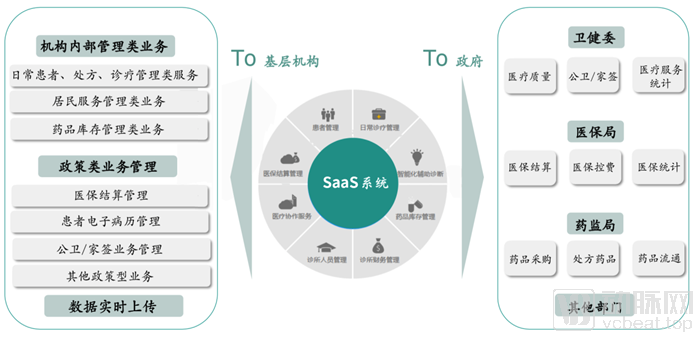
Schematic Diagram of Mingyi Zhonghe’s SaaS System for Primary Healthcare
Currently, Mingyi Zhonghe has established strategic partnerships with institutions such as the National Health Commission’s Institute of Scientific and Technological Information and Guoxin Health. Together, they provide local government authorities in multiple regions, including Qingdao and Lhasa, with information system support for the supervision and management of primary healthcare, pharmaceuticals, and medical insurance. This mature system and service package are currently under negotiation and being implemented in various other regions.
Pharmaceutical empowerment is Mingyi Zhonghe’s second empowerment initiative. In 2017, Mingyi Zhonghe conducted a survey on medication needs among more than 6,000 primary-care clinics, revealing significant problems in the supply of medicines at the grassroots level: shortages were widespread, and overall drug quality issues were prevalent.
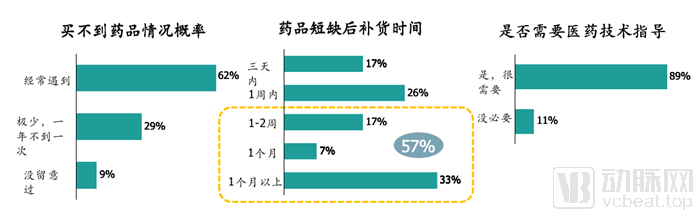
Mingyi Zhonghe’s Survey and Statistical Analysis of Drug Demand Across Nearly 6,000 Primary Healthcare Institutions
In May 2017, the pilot launch of Mingyi Zhonghe Cloud Pharmacy Model 1.0 was officially initiated, marking an initial effort to integrate multiple stakeholders—including pharmaceutical distributors, manufacturers, GSP-compliant warehousing and logistics providers, grassroots terminal outlets, and sales representatives—to deliver centralized and planned pharmaceutical supply services to end customers. After two years of refinement and upgrades, Mingyi Zhonghe Cloud Pharmacy has become increasingly intelligent.
Jiang Qiang believes that “the future of the primary-care pharmaceutical supply chain will feature the coexistence of multiple models, including direct-to-customer sales by manufacturers, direct procurement by end-users, regionally distributed warehousing and distribution (compliant with Good Supply Practice [GSP] standards and leveraging third-party logistics), and O2O promotion (promoting orders, pharmacies, manufacturers, and new knowledge).” Mingyi Zhonghe’s digital supply chain platform has fully digitized product management, demand management, order management, sales personnel management, and marketing management. As data volume grows, the platform’s profiling of users’ medication needs and purchasing habits has become increasingly clear, dynamic, and real-time, laying a solid foundation for enhancing the intelligence, integration, and planning capabilities of primary-care pharmaceutical supply. This further improves the efficiency of drug supply at the primary care level, reduces costs, and facilitates local access to medical care and medications for the public.
Information technology empowerment enhances efficiency in primary healthcare, pharmaceutical empowerment reduces costs, and medical service empowerment increases revenue for grassroots providers. After more than six months of preliminary exploration, Mingyi Zhonghe has recently established a Medical Service Empowerment Business Department and launched its “New Clinic” strategy for primary care. The company plans to help 100,000 grassroots clinics improve their medical standards and service capabilities within one year, leveraging the internet to achieve the goal of “letting data do the running so that patients have to run less.”
With the advancement of internet-based medical AI technologies, primary healthcare institutions need to leverage new technologies, environments, and facilities, while adopting innovative marketing strategies and business models, to further enhance medical standards and expand their integrated service capabilities encompassing medical care, rehabilitation, elderly care, and nursing, thereby building “New Clinics.” Mingyi Zhonghe’s “New Clinic” strategy for primary care focuses on empowering these grassroots medical endpoints through medical project enablement and clinic operational support, facilitating their upgrade and transformation into “New Clinics.”
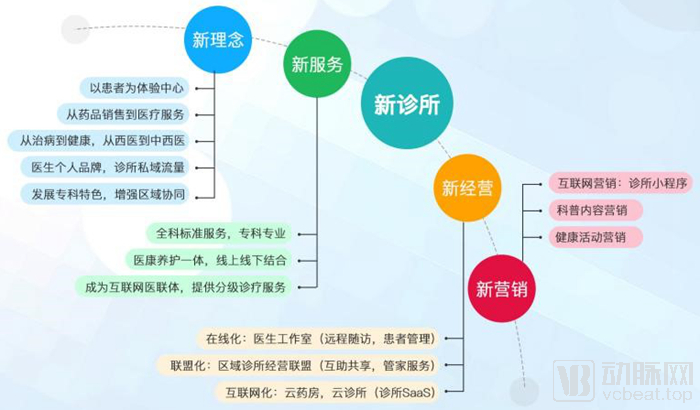
Mingyi Zhonghe’s Strategic Vision for the “New Clinic” at the Primary Care Level
It is understood that, to date, Mingyi Zhonghe has integrated high-quality medical resources in specialized fields focusing on specific diseases and medications, including pain management, gastroenterology, viral diseases, refractory allergies, hepatitis C, and pediatric nutrition, thereby assisting primary healthcare institutions in their transformation and upgrading toward the “New Clinic” model. Among these initiatives, several empowerment services under the “New Clinic” strategy—such as primary care pain management centers, pediatric nutrition management centers, and programs facilitating the transition from Western to Traditional Chinese Medicine—have already been piloted and demonstrated.
To help practitioners at primary care institutions enhance their business acumen and operational capabilities, Mingyi Zhonghe has established regional clinic management alliances on a pilot basis. By upgrading its Clinic Steward services, the company provides alliance members with marketing support—including a clinic CRM mini-program, clinical decision support tools, various business-oriented courses and training, and health education content promotion—thereby strengthening regional collaborative services among alliance members.
According to Jiang Qiang, Mingyi Zhonghe is actively applying for an internet hospital license. Once established, the internet hospital will serve as a platform for collaborating on the decentralization of medical services. By sharing technology, service capabilities, procurement needs, and membership resources, it aims to help partner clinics enhance their diagnostic and treatment capabilities, pharmaceutical care services, and broader public health services.
Commenting on this round of financing, Jiang Qiang stated, “Sinovation Ventures has made deep investments in the internet and artificial intelligence sectors. Attracting shareholders with such a global perspective and resources serves as a strong endorsement of the Mingyi Zhonghe team and its business model.” Jiang believes that this collaboration will facilitate the implementation of the national healthcare strategy to “strengthen primary care,” promoting the decentralization of more high-quality, reliable, and trustworthy medical resources and advanced technologies to better serve the health needs of people at the grassroots level.
Yang Xiaolong, Partner at Sinovation Ventures, stated, “Mingyi Zhonghe has cultivated the primary healthcare market with great dedication, empowering end-users through digitalization and providing service support for the implementation of government policies and intelligent regulation. We highly recognize the efforts made by the Mingyi Zhonghe team to empower grassroots healthcare through internet-based solutions, and we look forward to and are optimistic about the company’s future development.”