

JunLian Healthcare Global New Drug Insights – Issue 26: Key Advances in Oncology, Immunology, Respiratory, and Dermatology Therapeutics
Oct 14, 2019 18:00
CST Updated
18:00

This week, there were 8 new drug data entries, including 2 in respiratory, 2 in dermatology, and 1 each in oncology, immunology, metabolism, and pain.
❖ PD-1 Inhibitors Take Center Stage in China This Week: BMS’s Opdivo Receives NMPA Approval for First-Line Treatment of Head and Neck Squamous Cell Carcinoma, Expanding Its Indications to Seven Cancer Types; Meanwhile, MSD’s Keytruda Is Approved as Monotherapy for First-Line Treatment of Lung Cancer in China, Covering Six Cancer Types. To date, five PD-1 monoclonal antibodies have been approved for marketing in China: Bristol Myers Squibb’s Opdivo, Merck & Co.’s Keytruda, Junshi Biosciences’ Tuoyi, Innovent Biologics’ Tyvyt, and Hengrui Medicine’s AiRuiKa. According to domestic sales data from the first half of 2019, Merck’s Keytruda led the market with sales exceeding RMB 1 billion, while BMS’s Opdivo recorded RMB 430 million, less than half of Keytruda’s revenue. Domestic PD-1 inhibitors also delivered impressive results, with Junshi Biosciences’ Tuoyi achieving RMB 308 million and Innovent Biologics’ Tyvyt reaching RMB 346 million. Hengrui’s AiRuiKa entered the competition in June, and its future performance is highly anticipated.
❖ In the field of immunotherapy, the market share of Humira, the global best-selling drug, has long been a highly coveted prize for pharmaceutical companies, with IL-17A inhibitors emerging as strong competitive alternatives. Novartis’s Cosentyx (secukinumab) and Eli Lilly’s Taltz, as pioneers in the IL-17A inhibitor segment, are engaged in intense competition. In terms of sales, Taltz’s revenue surged to $606.3 million in the first half of 2019, while Cosentyx delivered an even more impressive performance, reaching $1.65 billion during the same period. Regarding indications, Novartis announced last week that Cosentyx had met its primary endpoint in a Phase 3 clinical trial for treating non-radiographic axial spondyloarthritis, potentially marking its fourth approved indication. Given Cosentyx’s strong momentum, it is poised to further erode Humira’s market share in the future.
Novartis’ Cosentyx Meets Phase 3 Clinical Endpoint, Paving the Way for a Fourth Indication
Novartis announced that Cosentyx met another primary endpoint in the Phase 3 PREVENT trial for the treatment of non-radiographic axial spondyloarthritis (nr-axSpA).
Cosentyx is the first fully human biologic agent that directly inhibits IL-17A. IL-17A is a core pathogenic factor involved in inflammation and disease progression in psoriatic arthritis (PsA), ankylosing spondylitis (AS), and psoriasis, playing a pivotal role in their pathogenesis.
A 2-year, randomized, double-blind, placebo-controlled Phase 3 clinical study designed to evaluate the efficacy and safety of Cosentyx in treating patients with nr-axSpA. The primary endpoint of the trial was achieving Assessment of SpondyloArthritis International Society 40 (ASAS40) response.
The latest data announced further demonstrate the long-term efficacy and safety of Cosentyx in the treatment of ankylosing spondylitis (AS), psoriatic arthritis (PsA), and psoriasis.
“Breaking Through” in Diabetic Nephropathy! Janssen’s Canagliflozin Receives FDA Approval
Johnson & Johnson’s Janssen announced that the FDA has approved the sodium-glucose cotransporter 2 (SGLT2) inhibitor canagliflozin to reduce the risk of end-stage renal disease, decline in kidney function, cardiovascular death, and hospitalization due to heart failure in adult patients with diabetic kidney disease and type 2 diabetes.
Canagliflozin is an SGLT2 inhibitor that helps control blood glucose levels in patients with type 2 diabetes by inhibiting the function of SGLT2 expressed in the renal tubules, thereby reducing renal glucose reabsorption and increasing urinary glucose excretion.
A clinical trial specifically designed to assess the impact of SGLT2 inhibitors on renal function. A total of 4,401 patients with type 2 diabetes and stage 2 or 3 chronic kidney disease received treatment.
At a median follow-up of 2.62 years, the risk of the composite endpoint (including doubling of serum creatinine, end-stage kidney disease [ESKD], and renal or cardiovascular death) was reduced by 30% in the canagliflozin group compared with the control group, while the risk of major adverse cardiovascular events (MACE) was reduced by 20% in the canagliflozin group.
First Major Innovation in Acute Migraine Treatment in 20 Years! FDA Approves Eli Lilly’s 5-HT1F Receptor Agonist for Market Launch
Eli Lilly and Company announced that the U.S. FDA has approved Reyvow (lasmiditan) tablets, developed by the company, for marketing as an acute treatment for adult patients with migraine with or without aura. This marks the first new class of drug approved by the FDA for the acute treatment of migraine in more than 20 years.
Reyvow is the first FDA-approved serotonin (5-HT) 1F receptor agonist, representing an innovative oral 5-HT1F receptor agonist. It binds to 5-HT1F receptors with high affinity and does not activate 5-HT1B receptors, thereby avoiding vasoconstrictive effects.
A randomized, double-blind, placebo-controlled Phase 3 clinical trial involving 3,177 patients with a history of migraine.
Compared with the placebo group, the proportion of patients achieving complete headache relief two hours after dosing was significantly higher. Reyvow also significantly alleviated other most bothersome migraine symptoms, namely nausea and photophobia/phonophobia. Favorable outcomes were also observed in the subgroup of patients with an inadequate response to triptans.
Efficacy Results of Ubrelvy at 2 Hours in Phase 3 Clinical Trials
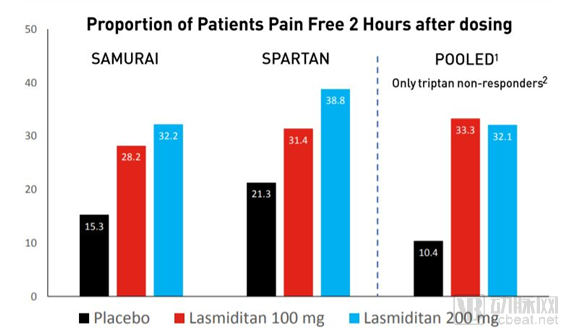
Data Source: 2018 Investment Community Meeting
Good News for Asthma Patients! Novartis’ Innovative Combination Therapy Meets Phase 3 Clinical Endpoints
Novartis announced that QVM149, a combination therapy developed by the company, met the primary clinical endpoint in the Phase III IRIDIUM trial for patients with asthma whose symptoms are poorly controlled.
QVM149 is a once-daily, fixed-dose combination product comprising three active ingredients: the long-acting muscarinic antagonist (LAMA) glycopyrronium bromide, the long-acting β2-agonist (LABA) indacaterol, and the inhaled corticosteroid (ICS) mometasone furoate.
3,092 adult patients with poorly controlled asthma, who had previously been treated with stable medium-to-high doses of long-acting β2-agonist/corticosteroid combinations but whose symptoms remained inadequately controlled, were randomly assigned to receive treatment with one of two different doses of either QVM149 or QMF149.
Compared with the active control group, QVM149 not only significantly improved patients’ lung function but also improved forced expiratory volume in one second (FEV1), thereby achieving the primary endpoint of the trial; however, it failed to meet the key secondary endpoint.
After Two Decades of Anticipation: Innovative Acne Therapy Receives FDA Approval
Galderma Announces U.S. FDA Approval of Aklief (trifarotene) Cream, a Retinoic Acid Receptor Gamma (RARγ) Agonist, for the Treatment of Acne Vulgaris in Patients Aged 9 Years and Older
Aklief is a selective retinoic acid receptor gamma (RARγ) agonist. Preclinical data indicate that Aklief has a longer half-life in keratinocytes but a shorter half-life in hepatocytes, suggesting it may offer an improved safety profile while treating common dermatological conditions.
A 12-week, randomized, double-blind Phase 3 trial with the primary endpoint being the proportion of patients achieving a reduction of at least 2 points from baseline in the Investigator’s Global Assessment (IGA) total score at Week 12, improvement in facial inflammatory lesions, and reduction in non-inflammatory lesion counts.
Aklief ointment can significantly reduce inflammatory lesions in patients within two weeks. The detailed results of these two trials have been published in the Journal of the American Academy of Dermatology.
Positive Phase 3 Results for Eli Lilly’s VEGFR2 Inhibitor as First-Line Treatment for Non-Small Cell Lung Cancer
Eli Lilly announced that its anti-angiogenic monoclonal antibody Cyramza (ramucirumab), in combination with Roche’s tyrosine kinase inhibitor (TKI) Tarceva (erlotinib), achieved positive results in a pivotal Phase 3 trial for the first-line treatment of previously untreated patients with metastatic non-small cell lung cancer (NSCLC) harboring EGFR mutations.
Cyramza, a vascular endothelial growth factor (VEGF) receptor 2 antagonist, is an anti-angiogenic therapy. Cyramza blocks the activation of this signaling pathway by inhibiting the specific binding of VEGF receptor 2 to VEGF-A, VEGF-C, and VEGF-D.
Schematic Diagram of the Mechanism of Action of Cyramza
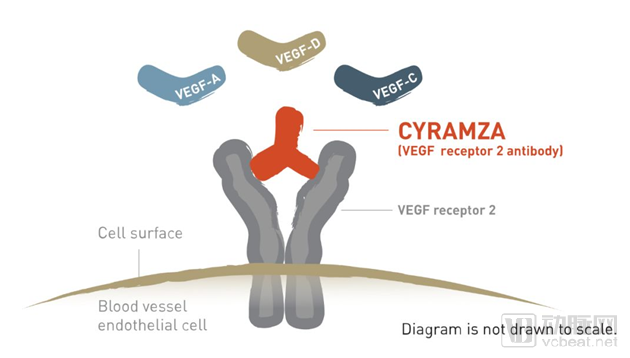
Data Source: Cyramza
A total of 449 patients with metastatic NSCLC harboring EGFR mutations were enrolled in a phase 3 trial, in which they were randomized to receive either Cyramza in combination with erlotinib or placebo plus erlotinib. The primary endpoint was PFS.
Compared with a PFS of 12.4 months in the erlotinib group, the PFS in the combination therapy group was 19.4 months, achieving the trial’s primary endpoint of significantly prolonging PFS.
Innovative Pulmonary Fibrosis Therapy Nintedanib Receives FDA Breakthrough Therapy Designation, Reducing Rate of Lung Function Decline by 57%
Boehringer Ingelheim Announces U.S. FDA Grants Breakthrough Therapy Designation to Its Small-Molecule Tyrosine Kinase Inhibitor Ofev (Nintedanib) for the Treatment of Patients with Chronic Progressive Fibrosing Interstitial Lung Disease (ILD)
Ofev is a small-molecule tyrosine kinase inhibitor that simultaneously blocks three growth factor receptors, including vascular endothelial growth factor receptor, platelet-derived growth factor receptor, and fibroblast growth factor receptor, effectively inhibiting signaling pathways involved in the fibrotic process.
A randomized, double-blind, placebo-controlled Phase 3 clinical trial designed to evaluate the safety, tolerability, and efficacy of Ofev in patients with progressive fibrosing interstitial lung disease.
At Week 52, Ofev reduced the decline in lung function by 57%, as assessed by forced vital capacity (FVC), thereby meeting the primary endpoint of the trial. Furthermore, Ofev slowed disease progression in patients with various progressive fibrosing interstitial lung diseases during the trial.
Superior Efficacy to Standard Therapies: Positive Clinical Results for Novartis’ New Urticaria Drug
Novartis announced that ligelizumab (QGE031), a humanized anti-IgE monoclonal antibody developed by the company, demonstrated superior efficacy compared with Xolair (omalizumab) in a Phase 2b trial in patients with chronic spontaneous urticaria inadequately controlled by H1-antihistamines.
Ligelizumab is a monoclonal antibody targeting immunoglobulin E (IgE) and is currently in clinical development for the treatment of patients with chronic spontaneous urticaria (CSU) who are inadequately controlled by H1-antihistamines.
In a randomized, double-blind, active-controlled Phase 2b clinical trial, 382 patients with chronic spontaneous urticaria (CSU) inadequately controlled by H1-antihistamines were randomized to receive treatment with one of three different doses of ligelizumab or Xolair.
Interim data showed that at Week 12 of treatment, complete resolution of disease symptoms was achieved in 30% (24 mg dose), 44% (72 mg dose), and 40% (240 mg dose) of patients receiving ligelizumab, compared with 26% in the Xolair treatment group.
❖ Novartis Announces FDA Approval of Beovu (brolucizumab) for the Treatment of Wet Age-Related Macular Degeneration (AMD). Beovu is a humanized single-chain antibody variable fragment targeting VEGF, with a significantly smaller molecular weight compared to other VEGF-targeting antibodies. Its dosing interval can extend up to three months, offering convenience and improving the quality of life for patients with wet AMD.
❖ Merck & Co. (MSD)’s innovative nucleoside reverse transcriptase translocation inhibitor (NRTTI) for HIV infection, islatravir (formerly known as MK-8591), has yielded positive results in Phase I clinical trials. The trial data demonstrated that the subcutaneously implanted drug-eluting implant can sustain the long-term release of islatravir, maintaining intracellular drug concentrations above the pharmacokinetic threshold for more than one year. This suggests that the drug could potentially become a once-yearly pre-exposure prophylaxis (PrEP) regimen for HIV prevention.
❖ The U.S. FDA Announces Approval of Clinuvel’s Scenesse (afamelanotide) for Adult Patients with Skin Damage Due to Erythropoietic Protoporphyria, Reducing Skin Pain and Injury Upon Sun Exposure. According to the FDA press release, this is the first therapy approved to increase pain-free sun exposure time for these patients.
❖ Clinical-stage biotechnology company Frequency Therapeutics announced that its investigational candidate drug FX-322, designed to promote hearing restoration, has been granted Fast Track designation by the FDA for the treatment of sensorineuralIn the Phase 2a trial for sensorineural hearing loss (SNHL), the first patient was dosed.
❖ Nature Publishes Breakthrough: U.S. and Japanese Research Teams Successfully Co-Culture Three Interconnected Organoids—Liver, Pancreas, and Bile Ducts—from Induced Pluripotent Stem Cells for the First Time Worldwide. Specifically, researchers started with human skin cells, converted them into primitive stem cells, and then guided and stimulated these stem cells to form two very early cell “spheroids.” Over time, these spheroids merged and developed into organ structures that ultimately gave rise to the digestive tract.