

MIT Technology Review Releases Report: AI Poised to Reshape Asia's Healthcare Landscape
The healthcare sector has long been an ideal scenario for the practical application of AI. On October 14, MIT Technology Review released a report titled “AI in Healthcare: Growth Potential, Capabilities, and the Future of Proactive Health in Asia” (hereinafter referred to as the “Report”), which points out that AI is steadily rising in Asia’s healthcare landscape to address regional needs and challenges. Through interviews with technical industry experts and leading enterprises in the healthcare sectors of various Asian countries, along with research and field visits, the Report assesses the value and prospects of AI applications in healthcare services across the region. Notably, Baidu’s Clinical Decision Support System (CDSS) case at the primary care level was highlighted as a key example for analysis and recommendation due to its extensive deployment and effective utilization.
“The Report” argues that, against the backdrop of a shortage of healthcare human resources, many Asian countries are grappling with strained medical resources. According to World Health Organization estimates, the Asia-Pacific region will need more than 12 million healthcare professionals by 2030, representing an increase of over 70% from current levels. Furthermore, insufficient healthcare spending poses another severe challenge. Excluding developed economies, per capita healthcare expenditure in other Asian countries and regions is less than one-quarter of the Organisation for Economic Co-operation and Development (OECD) average. Meanwhile, AI technology is effectively narrowing the gap in healthcare development across Asia.
On the other hand, healthcare development in Asia is benefiting significantly from the substantial support AI technologies provide to frontline medical personnel, as well as from professional assistance enabled by novel diagnostic and treatment approaches such as “human-computer interaction.” Furthermore, many Asian countries are rapidly advancing AI innovation through public-private partnerships, targeting their respective national healthcare challenges. Whether it is Singapore’s efforts to reduce the prevalence of hyperlipidemia, hyperglycemia, and hypertension among its population; India’s initiatives to lower infant mortality rates; or Japan’s applications addressing aging-related issues, there is both an urgent demand and a vast market for AI applications in the healthcare sector across Asia.
As described in the Report, on one hand, AI has tangibly enhanced the capacity and efficiency of healthcare service delivery in Asia; on the other hand, the region’s substantial demand and market size are driving the rapid development and implementation of AI in healthcare. In recent years, countries around the world have been making strategic investments in artificial intelligence. Indeed, over its more than 60-year history, AI technology has experienced two major cycles of hype and disillusionment, emerging from its latest trough in 2016 with exciting technological breakthroughs and commercial progress.
A Retrospective on the Development of AI in Healthcare: Since the creation of mathematical models for computer-based diagnosis in 1959, which pioneered the field of computer-aided diagnosis, the concept of “Computer Aided Diagnosis” (CAD) was formally proposed in 1966. By around 1968, medical “expert systems” had been successfully developed, adopting architectural components such as knowledge bases and inference engines for the first time, thereby establishing a comprehensive theoretical framework for expert system development. Subsequently, expert systems specifically designed for the healthcare sector continued to evolve; by the 1990s, the knowledge bases of CAD systems contained information on 22,000 diseases and 5,000 symptoms. In the late 1970s, China developed its first proprietary medical expert system, which then rapidly expanded and gained widespread application. In 2006, breakthroughs in neural network-based deep learning algorithms emerged, prompting industry to quickly extend these technological advancements across various sectors, including healthcare. The trend of “AI + Healthcare” has been gaining momentum worldwide for many years, with particularly vigorous growth in Asia in recent times.
Regarding the use of AI to enhance healthcare service delivery capacity in Asia and alleviate the shortage of medical resources, the Report cites Baidu, a Chinese company, as an example, introducing its AI-driven “Clinical Decision Support System” (CDSS). Currently, this system has been deployed in nearly 1,000 medical institutions across 16 provinces, municipalities, and autonomous regions in China, assisting physicians in making clinical diagnostic decisions through standardized diagnostic processes and scientifically recommended treatment plans. Dr. Wang Haifeng, CTO of Baidu, pointed out, “From medical imaging analysis to clinical decision support, from in-hospital diagnosis and treatment process management to out-of-hospital health management, and from empowering physicians to empowering pharmaceutical companies, the application of artificial intelligence in the healthcare sector is becoming increasingly extensive and profound. It helps promote the decentralization of high-quality medical resources, achieve resource sharing, and improve the diagnostic efficiency of primary care physicians as well as the overall level of medical services.”
Furthermore, analysts from MIT Technology Review, as cited in the Report, learned through visits to Baidu and its implementation cases that primary healthcare institutions in China are supposed to serve as the first line of defense for public health. However, due to the relatively limited capabilities of primary care, most patients prefer to seek treatment at tertiary hospitals to receive standardized professional care. This has further exacerbated the “structural imbalance of medical resources in China”: primary hospitals are nearly empty with underutilized medical resources, while tertiary hospitals are overcrowded and operating under long-term excessive load.
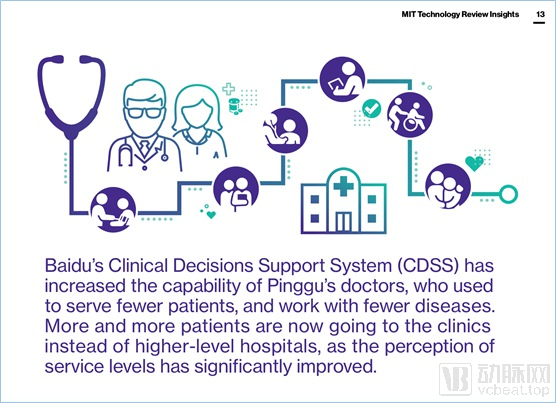
In response to the aforementioned challenges, AI-driven Clinical Decision Support Systems (CDSS) have demonstrated their unique value in many regions across China. The Report features a case study on the implementation of Baidu’s CDSS. Jiao Junfeng, Director of the Information Center at the Health Commission of Pinggu District (located in northeastern Beijing with a population of 460,000), stated that with the assistance of Baidu’s CDSS, local medical institutions have been better able to meet the healthcare needs of the entire administrative region, serving residents across 18 townships. Jiao noted that national policies require primary care providers to handle the diagnosis and treatment of 66 common diseases, which poses certain difficulties for grassroots physicians. Moreover, the limited number of primary care doctors in the area cannot satisfy the growing healthcare demands of residents. Baidu’s CDSS is positioned to enhance the diagnostic and treatment capabilities of primary care hospitals, aligning closely with national requirements. Both share the same goal: enabling primary care facilities to undertake more diagnostic and treatment tasks and better serve the grassroots population. Discussing the outcomes since the deployment of the CDSS, Jiao Junfeng offered high praise. “The system’s accuracy in symptom recognition far exceeds our expectations and has received high acclaim from both doctors and patients. Previously, primary care physicians could treat only a limited range of conditions and saw fewer patients, resulting in relatively limited clinical experience. Since the deployment of the CDSS, physicians’ capabilities have improved, leading to greater public trust in our local doctors. Nowadays, an increasing number of patients seek care at primary care hospitals, rather than bypassing them to go directly to large tertiary hospitals regardless of the severity of their condition, as was common in the past.”

Beijing Pinggu District Community Hospitals Apply Baidu CDSS System to Assist in Diagnosis and Treatment
It is understood that the interpretability of Baidu’s Clinical Decision Support System (CDSS) is built upon medical natural language processing (NLP) and knowledge graph (KG) technologies, both of which are key factors contributing to the ultimate success of the CDSS. In an interview featured in the Report, Huang Yan, General Manager of Baidu Smart Healthcare, stated, “Medical NLP and knowledge graph technologies lay the foundation for Baidu’s AI-driven healthcare initiatives. NLP technology can automatically identify entities and their relationships within electronic medical records and medical literature, integrating them into a medical knowledge graph. This compilation and understanding of medical knowledge is complex and highly structured; achieving it would be difficult without close collaboration between medical experts and artificial intelligence engineers.”
The Report also highlights the importance of preventive diagnostic and treatment strategies in light of AI healthcare development trends in Asia. In the future, the healthcare ecosystem will place greater emphasis on health and well-being, with AI playing a leading role in promoting “proactive health” by identifying early signs of disease and tracking health status. Meanwhile, the healthcare system must remain human-centric. From an ethical perspective, technology must serve as an auxiliary tool for physicians and healthcare professionals. To ensure accountability within the healthcare system, final decision-making authority must remain firmly in human hands. AI developers should ensure that physicians and patients can accurately interpret and understand these technologies, thereby fostering sustained trust and willingness to adopt artificial intelligence in healthcare settings.
The full English version of the latest Asia AI in Healthcare Report released by MIT Technology Review is available on its official website (https://insights.techreview.com/ai-in-health-care/). The complete Chinese version is expected to be released for access and download in late October.
About MIT Technology Review
Founded in 1899 at the Massachusetts Institute of Technology in the United States, it is the world’s oldest and most influential technology and business magazine. Its extensive coverage spans the internet, communications, computer technology, energy, new materials, biomedicine, and business technology, with a particular focus on emerging technologies and their profound impact on commerce and society. It provides cutting-edge news and in-depth analysis of industry trends to over 3 million professionals and business leaders in the technology sector.