NVIDIA and King’s College London Unveil First Privacy-Preserving Federated Learning System for Medical Imaging at MICCAI 2019
NVIDIA
Artificial Intelligence Computing Service Provider
To advance medical research, safeguard data privacy, and improve brain tumor identification outcomes for patients, NVIDIA (NVIDIA) partnered with King’s College London to release the first federated learning system for medical image analysis with privacy-preserving capabilities on October 14, 2019 (federated learning system), marking a breakthrough in the field of AI for healthcare.
This technical paper was released during the MICCAI 2019 conference, which kicked off on October 13 in Shenzhen, China, and is one of the world’s premier medical imaging conferences. Researchers from NVIDIA and King’s College London presented the implementation details of the technology.
Federated Learning (FL) is a learning paradigm that enables developers and enterprises to train centralized deep neural networks (DNNs) using training data distributed across multiple locations. This approach facilitates collaboration among enterprises on shared models without the need to share any clinical data.
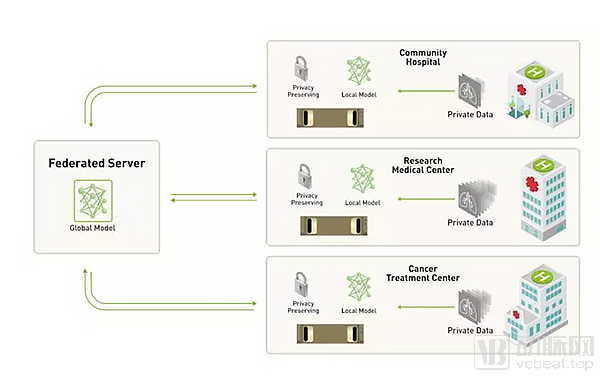
The researchers stated in their paper: “Federated learning enables collaborative and decentralized neural network training without the need to share patient data. Each node is responsible for training its own local model and periodically submitting it to a parameter server. The server continuously accumulates and aggregates these contributions to create a global model, which is then shared with all nodes.”
Researchers explained that although federated learning can ensure a high level of privacy security, data can still be reconstructed through model inversion attacks. To help enhance the security of federated learning, researchers investigated the feasibility of employing the ε-differential privacy framework. This framework provides a formal definition of privacy loss and leverages its robust privacy guarantees to protect patient and institutional data.
The aforementioned breakthrough experiment was conducted using brain tumor segmentation data derived from the BraTS 2018 dataset. The BraTS 2018 dataset contains MRI scans from 285 patients with brain tumors.
This dataset is designed to evaluate federated learning algorithms for multimodal and multi-level segmentation tasks. On the client side, the research team adapted a state-of-the-art training pipeline originally intended for centralized training and integrated it as part of the NVIDIA Clara Train SDK.
In addition, the research team also utilized the NVIDIA V100 Tensor Core GPU for training and inference.
Compared with centralized data systems, the approach provided by federated learning can achieve considerable segmentation performance without sharing institutional data. Furthermore, experimental results demonstrate a natural trade-off between privacy preservation and the quality of the trained model. Moreover, by employing the sparse vector technique, federated learning systems can achieve rigorous privacy protection with only a reasonable and minor impact on model performance.
Deep learning is a powerful technique for automatically extracting knowledge from medical data. Federated learning holds promise for effectively aggregating knowledge locally learned by institutions from their private data, thereby further enhancing the accuracy, robustness, and generalizability of deep models.
This study provides a significant impetus for the deployment of secure federated learning and will broadly advance the progress of data-driven precision medicine.
To learn more about the application of federated learning in medical imaging, please scan the QR code below to register for the online webinar: