

Subtle Medical Secures FDA 510(k) Clearance for SubtleMR, Pioneering AI-Driven 10x Faster High-Quality MRI Scans
Subtle Medical
Medical Imaging Software Developer
Unlike X-rays and CT scans, MRI (Magnetic Resonance Imaging) can provide patients with richer details related to soft tissues. As a trade-off, plain MRI scans typically take fifteen minutes to an hour. Due to such long durations, young children and patients with claustrophobia often experience distress during the examination process.
With this as the starting point, SubtleMR, developed by Silicon Valley-based Subtle Medical (Shentou Medical), is attempting to address the time-consuming nature of MRI examinations. By leveraging artificial intelligence for real-time reconstruction of MRI images, SubtleMR can deliver high-quality diagnostic results in a shorter timeframe, leading to lower examination costs, reduced scan times, and improved image quality.
Recently, the product officially received 510(k) clearance from the U.S. Food and Drug Administration (FDA), becoming the first MRI image enhancement AI solution to gain such certification worldwide. With this milestone, Subtle Medical has become the first China-founded AI medical imaging company to obtain this certification and truly enter the U.S. market.
This is not the first time Subtle Medical has received FDA device clearance. As early as December 2018, SubtlePET, developed by Subtle Medical, already obtained FDA clearance. Currently, SubtlePET is in paid use at multiple U.S. hospitals, where it has quadrupled examination efficiency and become integrated into the standard workflow for clinical PET scans. Michael Brant-Zawadzki, MD, Administrator of Hoag Hospital and Honorary Member of the American College of Radiology, highly affirmed the clinical and workflow value of SubtlePET, stating, “SubtlePET accelerates PET scans by up to fourfold while still delivering medical images of equivalent quality. This is highly effective in improving hospital PET utilization efficiency.”
Today’s MRI products employ similar principles. SubtleMR introduces the latest image enhancement technology into existing medical imaging scanners, optimizing machine-generated MRI images through deep learning algorithms to reduce artifacts, suppress noise, and enhance resolution, thereby improving image quality. Currently, it is undergoing clinical trials at multiple top-tier hospitals and third-party imaging centers in the United States.
MR scans typically require patients to remain still inside the scanner for an extended period. SubtleMR significantly improves image quality and reduces scan time, thereby markedly enhancing imaging outcomes for patients who struggle to maintain prolonged immobility. Artifact-ridden images often necessitate repeat scans, posing a challenging issue for both patients and healthcare providers; SubtleMR helps avoid such unnecessary rescans.
Today, SubtleMR can be seamlessly integrated into existing radiology workflows and is compatible with MRI scanners and PACS systems from all major brands. It enhances image quality in real time during scanning without interrupting or slowing down the medical image acquisition process. This means that SubtleMR can significantly improve the quality of images obtained from short-duration scans.
Why Focus on MRI and PET as R&D Directions? Dr. Gong Enhao, founder of Subtle Medical, stated that imaging examinations such as MRI and PET are both expensive and time-consuming, with 90% of the costs and a significant amount of time attributed to the image acquisition process. Subtle Medical’s technology targets this image acquisition phase, leveraging AI to enhance image quality, enabling healthcare institutions to scan more patients in less time, and potentially further reducing radiation exposure and contrast agent dosage.
Subtle Medical showcased its AI-powered image processing platform at RSNA 2018. Imaging data flows directly from the equipment into Subtle Medical’s system, where it is processed before being sent to PACS workstations for physician use. Ideally, Subtle Medical can currently accelerate MRI and PET imaging processes by 4–10 times using AI technology. In practical applications, MRI scanning can be accelerated an additional 2–4 times beyond existing hardware and software capabilities, while maintaining diagnostic-level accuracy. Numerous tests have demonstrated that the image quality of SubtleMR even surpasses that of standard, slower acquisition protocols. The simultaneous improvement in image quality and efficiency enables a qualitative transformation in scanning and diagnostic workflows within radiology departments.
Furthermore, many rural areas and low-income countries suffer from a shortage of MRI scanners, and the existing equipment is insufficient to serve large populations. This technology effectively upgrades hospitals’ existing MRI systems at a lower cost, enabling them to enhance the speed and quality of MRI scans without the need for costly new purchases. This makes it possible to provide patients with higher-quality and more efficient services.
SubtleGAD, the third product developed by Subtle Medical, has the potential to significantly reduce the dosage of gadolinium-based contrast agents during contrast-enhanced MRI scans. The potential health risks associated with gadolinium contrast agents represent an urgent issue currently facing the global medical imaging industry. This technology from Subtle Medical received a Scientific Achievement Award at RSNA 2018 and recently secured $1.6 million in funding from the U.S. National Institutes of Health (NIH). This 2.5-year fast-track innovation grant will accelerate the research and clinical testing of this product, thereby enhancing the safety of MRI examinations.
Regulatory agencies do not gauge the difficulty of approval based on a device’s profitability; their mandate is to ensure that users have access to devices that are fully safe. Thus, FDA approval is merely the first step in the commercialization of a medical device. For a company, the true measure of a product’s value lies in its ability to deliver value to patients, physicians, and hospitals, as well as to generate profitability for the enterprise. Regulatory approval is only the beginning, not the end goal.
Dr. Gong Nanjie, Head of Subtle Medical’s Asia-Pacific Region, told VCBeat: “We are pursuing a dual-track strategy. The first track follows the conventional route of healthcare institutions, where we leverage our AI products to enhance the quality and efficiency of imaging services, while providing low-cost hardware upgrades to bolster hospitals’ service capabilities. The second track involves collaboration with upstream and downstream partners. Value creation in both areas has already begun.”
Taking the U.S. market as an example, medical resources are relatively advanced, with MRI systems available across healthcare institutions at all levels, and the third-party imaging market is highly mature. Therefore, Subtle Medical has focused its primary efforts on expanding within healthcare institutions.
In China, hospital resources are increasingly concentrated at the top tier. To penetrate this market, Subtle Medical must not only secure partnerships with core regional hospitals but also expand into segments such as health examination centers and third-party imaging centers.
Downstream, Subtle Medical is also exploring collaborations with pharmaceutical manufacturers. Gong Nanjie stated, “As a monitoring tool, medical imaging can function similarly to biomarkers by enabling the observation of tumor cell activity within the human body. During drug development, we can make the measurement of these ‘biomarkers’ more efficient, stable, and cost-effective.” It is understood that Subtle Medical has reached agreements with several leading pharmaceutical companies, which will pay to use Subtle Medical’s technology and products in drug development testing, thereby optimizing the efficiency and quality of imaging analysis in clinical trials.
As for traditional medical device manufacturers, while they may appear to be in direct competition with Subtle Medical on the surface, both parties share aligned development and collaboration goals for hospitals that have already purchased MRI equipment. Subtle Medical is also collaborating with multiple domestic and international device manufacturers to provide service applications for existing machines and technical support for their latest devices.
In addition to its market demand advantages, Subtle Medical selected a strategic entry point for AI adoption to ensure that regulatory approval bottlenecks would not hinder commercialization.
Since Subtle Medical’s AI products are limited to the reconstruction, enhancement, and output of MRI and PET images, and its deep learning algorithms do not involve making diagnoses or providing diagnostic opinions, they can be cleared via the FDA 510(k) pathway.
In contrast, the NMPA (National Medical Products Administration) has adopted a more cautious stance toward AI. Although the key distinction hinges on whether AI is used for auxiliary diagnosis, in practice, most AI software has been classified as Class III devices. Gong Enhao stated that Subtle Medical is actively preparing the relevant application materials to ensure its products comply with the applicable approval processes. For such a novel product category, the safety of AI is paramount.
Nevertheless, this represents a breakthrough for the commercialization of domestically produced AI products. Drawing from the case of Subtle Medical, which has obtained regulatory approval and successfully commercialized its products, we can observe that AI products not classified as auxiliary diagnostic tools are increasingly penetrating the hospital market. It appears to be a sound strategy to outsource the tedious computational tasks previously performed by physicians to more intelligent and automated tools, thereby delegating extensive quantitative and measurement work to these systems for greater efficiency and optimization.
An examination of AI products approved by the FDA over the past two years reveals that computational and early-warning (predictive) products account for the majority of approvals. Some of these products have already achieved significant commercial success.
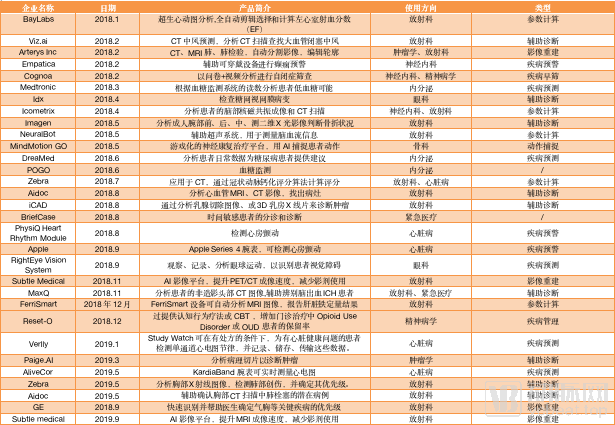
Statistical data reveal that the vast majority of FDA-approved products remain concentrated in radiology and cardiovascular/cerebrovascular specialties. Within radiology, AI-assisted diagnostic products and non-assisted diagnostic products each account for half of the approvals. It is important to note, however, that many products marketed under the “assisted diagnosis” label, such as those from Viz.ai and Imagen, emphasize AI’s “alert” or “warning” capabilities rather than true “diagnostic” functions. To date, IDx-DR, developed by IDx, remains the only AI product with FDA clearance for autonomous diagnosis.
In contrast, AI-based products for image reconstruction and parameter calculation have encountered a much smoother path to commercialization. Many companies listed in the table have adopted a more focused positioning for their AI solutions. For instance, FerriSmart uses AI to automatically analyze MRI images and report quantitative liver iron results. Functionally, this software, which is based on deep learning algorithms, may appear to deviate from the conventional definition of artificial intelligence, yet it proves to be more effective.
The same holds true in China, where numerous AI products not classified as auxiliary diagnostic tools have entered the “Green Channel for Innovative Medical Devices,” potentially allowing them to secure an early advantage in the fierce AI competition.
However, we must not overlook pioneers such as IDx and Aidoc, which specialize in AI-assisted diagnostic solutions. Following IDx’s submission of its application, the FDA has been reevaluating the standardized approval process for AI-based diagnostic assistance products. Perhaps, before the completion of the 510(k) reforms, this regulatory framework will still leave a historical mark on the landscape of AI-assisted diagnostic products.