

MICOT Secures RMB 115 Million in Pre-A Funding and Achieves RMB 220 Million Out-Licensing Deal for Peptide Drug; Files IPO Prospectus

Detong Capital
Private Equity Investment Firm

Micot
Dual functional and multifunctional specific peptide drug developers

Northern Light Venture Capital
Venture Capital Firms
VCBeat has learned that Shaanxi Micot Pharmaceutical Technology Co., Ltd. (hereinafter referred to as “Micot”) has recently successfully completed a Pre-A financing round of RMB 115 million. The round was led by the renowned investment firm Northern Light Venture Capital, with follow-on investments from four institutions, including Tasly Capital Huaxin Fund, Detong Capital, and Shaanxi Investment Growth Fund, marking a strong collaboration between professional institutional investors and industrial capital. The proceeds from this financing will be primarily used to advance clinical studies for multiple candidates in Micot’s pipeline of novel molecular entity drugs based on “bispecific” peptides.
Shaanxi Micot Pharmaceutical Technology Co., Ltd., established in 2007, is a pharmaceutical company rooted in China with a global outlook, dedicated to the research and development of novel molecular entity drugs based on “bispecific” peptides. The team comprises experts and scholars from Xi’an Jiaotong University and Johns Hopkins University. Dr. Yu Weiping, former Vice President of Research at Libang Pharmaceutical, serves as Senior Vice President and Technical Director. Dr. Zhao Zhiyang, former Director at Amgen, serves as Chief Technical Advisor. A Medical Doctor with nearly 20 years of experience working at multiple R&D institutions in the United States serves as Director of Pharmacology and Toxicology, underscoring the company’s robust technical capabilities.
Despite being established for a decade, this financing round marks Micot’s first public fundraising. Over the past ten years, Micot has achieved basic self-sufficiency through project support, collaborative R&D, and out-licensing. In November 2013, Micot partnered with Shandong Buchang Pharmaceuticals to jointly develop MT1001, a cardiovascular and cerebrovascular drug. In March 2014, Micot successfully completed the preclinical transfer of its injectable pregabatin formulation, in a deal valued at RMB 220 million, including RMB 120 million in upfront payments and RMB 100 million in clinical research milestone payments.
Micot’s core technologies focus on the design and formulation of bispecific peptide drugs, particularly those involving dual-target or multi-target peptides. Compared with single peptides, this technology maximizes therapeutic benefits and minimizes side effects by simultaneously activating different signaling mechanisms, while providing a more balanced pharmacokinetic profile.
The peptide drug market is developing rapidly, with an annual growth rate of 20%, which is higher than the average overall level of the pharmaceutical market. The field of peptide drugs has seen the frequent emergence of major products. The single-product sales of liraglutide, dulaglutide, semaglutide, octreotide (Sandostatin), goserelin (Zoladex), liraglutide (Victoza), teriparatide (Forte), and exenatide (Byetta) range from $500 million to $4 billion. The market prospects for peptide drugs are promising. Currently, there are more than 150 peptide drugs undergoing clinical trials worldwide.
Micot’s product pipeline primarily focuses on three major areas: cardiovascular and cerebrovascular diseases, metabolic disorders, and neurological diseases. Leveraging its core competencies, the company has established a robust product portfolio and built several specialized R&D platforms, including a novel molecular entity platform for bispecific peptides, a central nervous system (CNS) drug research platform capable of crossing the blood-brain barrier, and an advanced formulation research platform. To date, three of its drug candidates have been selected for the National “Major New Drug Development” Special Program.
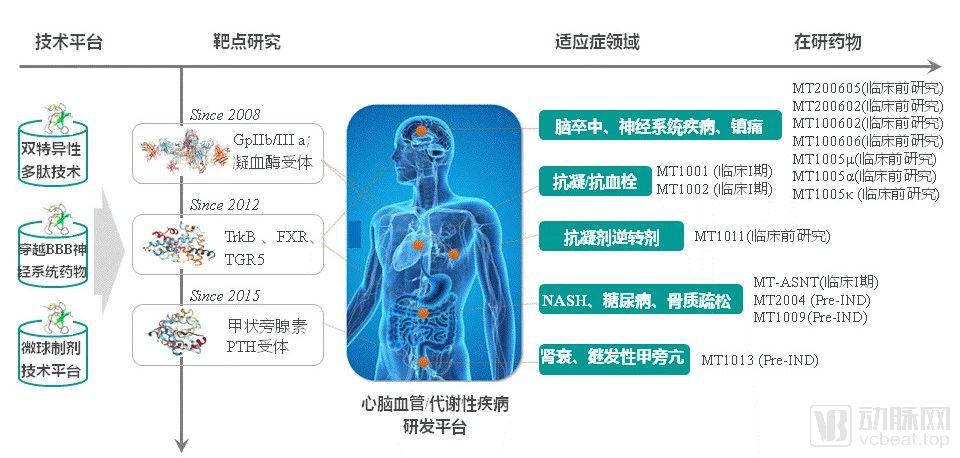
Micot's Partial R&D Product Pipeline Layout
Currently, Micot has multiple bispecific peptide candidates in development. In its core therapeutic area of cardiovascular and cerebrovascular diseases, two products have entered clinical trials. The lead candidate, MT1002, is nearing the completion of its Phase I clinical trial in the United States, with overall favorable results; Micot plans to announce the relevant trial data later this year. Meanwhile, the pharmacokinetic (PK) and pharmacodynamic (PD) data for MT1002, the first bifunctional peptide drug in China, are currently being evaluated in both China and the United States. Another product, MT1001, has also completed its Phase I clinical trial in China.
Leveraging Johns Hopkins University’s strengths in neuroscience, Micot has partnered with the university to conduct early-stage research and development of neurological products. Under this collaboration, Micot primarily provides funding, and all resulting intellectual property rights are exclusively owned by Micot. This collaborative model facilitated the completion of compound target activity screening for two products, MT1006 and MT2006, in 2016.
Micot has not yet expanded into the oncology sector. This decision is driven by two factors: first, the oncology landscape is currently characterized by intense competition and high homogeneity, whereas significant opportunities remain in the cardiovascular and cerebrovascular disease sectors; second, considering the team’s professional expertise, R&D for cardiovascular and cerebrovascular drugs demands a strong background in pathology, an area where Micot’s core team, with its medical expertise, holds a distinct advantage. “Should promising opportunities arise in oncology in the future, we can rapidly enter the market. Our team is fully capable of achieving this,” stated the head of Micot, expressing strong confidence.
Despite having a pipeline of more than a dozen products spanning multiple therapeutic areas, Micot has not faced significant financial pressure. This is primarily attributable to its open development strategy and the clear positioning of its diverse product portfolio. Anticoagulant and antithrombotic drugs in the cardiovascular and cerebrovascular fields constitute Micot’s core products, with independent R&D efforts consistently advancing. In contrast, the company has chosen to license out its renal failure and osteoporosis drug candidates to recoup part of the early-stage development costs. Similarly, neurotherapeutics co-developed with Johns Hopkins University have been licensed out or pursued through external collaborations, generating cash flow through upfront payments and milestone-based compensation.
Micot has established a 40-member R&D team and built a 3,500-square-meter research base in Shaanxi, covering the entire peptide drug development process from peptide production and purification to the manufacturing of sustained-release formulations. This R&D base is sufficient to meet Micot’s current drug supply needs for early-stage clinical trials.
With ample funding secured, Micot aims to fully advance its product pipeline and seek further proof of value before considering any transfer arrangements. In contrast, the prior transfer of Pregabatin was completed before it entered clinical trials. Future pipeline assets are more likely to be considered for transfer only after they have entered the clinical stage.
Micot’s relevant person in charge told us that the company’s biggest current challenge is talent. Although Shaanxi is home to prestigious institutions such as Xi’an Jiaotong University and the Fourth Military Medical University, its talent density still lags behind that of Beijing or the Yangtze River Delta region. Therefore, Micot is also considering expanding toward the coastal areas by establishing R&D centers or production bases.
Regarding this investment, Mr. Deng Feng, Founder of Northern Light Venture Capital, stated that unlike protein antibody macromolecules and small-molecule chemical drugs, the development of innovative peptide-based therapeutics presents significant challenges. Micot is one of the few domestic innovators focused on the development of such peptide-based drugs, with its founding team possessing extensive experience in this field. Northern Light Venture Capital is delighted to participate in this capital increase for Micot, supporting the development of its highly promising product pipeline. We believe this collaboration will accelerate the company’s ability to bring therapies to market, address unmet clinical needs, and benefit more patients.
Regarding the company’s future development, Micot stated, “Supported by the favorable environment for innovative drugs in China, Micot has a promising future. We are delighted to have successfully partnered with renowned investment institutions such as Northern Light Venture Capital. Leveraging this opportunity, we will accelerate product development and innovate global new drugs. It is Micot’s responsibility and mission to address clinical challenges and provide more effective treatment options for patients worldwide.”
About Northern Light Venture Capital
Northern Light Venture Capital was founded by Mr. Deng Feng in 2005. As a venture capital firm committed to “empowering world-class entrepreneurs and nurturing world-class Chinese enterprises,” it currently manages five U.S. dollar funds and five RMB funds, with a long-term focus on investing in high-potential, early-stage, technology-driven companies. To date, Northern Light Venture Capital has invested in over 250 companies across the TMT, advanced technology, and healthcare sectors, including nearly 60 investments in the healthcare sector. These portfolio companies include BGI Genomics, Burning Rock Biotech, Guoke Hengtai, Taimei Medical Technology, Eastern Speech, Zelgen Pharmaceuticals, and Convoy Therapeutics, among others.
About Tasly Capital Huaxin Fund
Tasly Capital, established in 2007, has managed five RMB funds and three USD funds, with cumulative assets under management exceeding RMB 12 billion, through more than a decade of focused investment and M&A activities in the pharmaceutical, healthcare, and broader health industry. As the venture capital fund under Tasly Capital, Huaxin Fund leverages Tasly Capital’s comprehensive health strategy and adheres to a “4D” investment approach encompassing diagnostics, drugs, devices, and digital health. It concentrates its investments on three core therapeutic areas—cardiovascular and cerebrovascular diseases, oncology, and digestive and metabolic disorders—with a particular focus on growth-stage companies. Its portfolio to date includes enterprises such as Zhiyun Health, 3D Medicines, and Yuanxing Gene. Leveraging its strong industrial background, Huaxin Fund aims to fully utilize its capabilities in industry chain integration to empower and add value to its portfolio companies, thereby achieving a win-win outcome of “industry + capital + strategic value creation.”
About Detong Capital
Detong Capital is a private equity investment firm focused on investing in Chinese enterprises. It currently manages multiple RMB-denominated funds with assets under management exceeding RMB 10 billion, primarily targeting investments across various stages in the fields of healthcare, artificial intelligence, consumption segmentation, high-end manufacturing, and next-generation information technology. Detong Capital was among the first investment institutions to establish strategic partnerships with numerous local governments and leading industrial groups. In recent years, it has been repeatedly selected as one of China’s Top Ten Investment Firms, and its managing partners have been frequently recognized as China’s Best Investors. Portfolio companies that have achieved public listings include Huaqi Houpu, Guanghui Auto, Porton Pharma, Aisikai, Kanghui Pharmaceutical, Chipscreen Biosciences, Focus Media, and ChineseAll.
About Shaanxi Investment Growth Fund
Shaanxi Growth Enterprise Guidance Fund Management Co., Ltd. (hereinafter referred to as “Growth Fund”), serving as the private equity investment platform under Shaanxi Investment Group, currently focuses primarily on sectors such as biopharmaceuticals, civil-military integration, and advanced intelligent manufacturing. As a specialized fund under the Shaanxi Investment Growth Fund targeting innovative drugs, Junying Growth Fund’s participation in the investment of Micot demonstrates the high recognition by local Shaanxi venture capital institutions and their strong confidence in the development prospects and market potential of innovative drugs, particularly peptide-based therapeutics. In the future, the company will further strengthen its investment in innovative biopharmaceutical enterprises to support the faster and better development of high-quality companies like Micot.