

TELA Bio Files for IPO to Advance Innovative Biologic-Based Materials for Soft Tissue Repair

TELA Bio
Tissue Repair Material Developer
TELA Bio is a life sciences company that provides tissue repair and reconstruction materials for use in surgical procedures, incorporated in Delaware on April 17, 2012. The company primarily develops and markets innovative tissue repair materials to address unmet needs in soft tissue reconstruction during surgery.
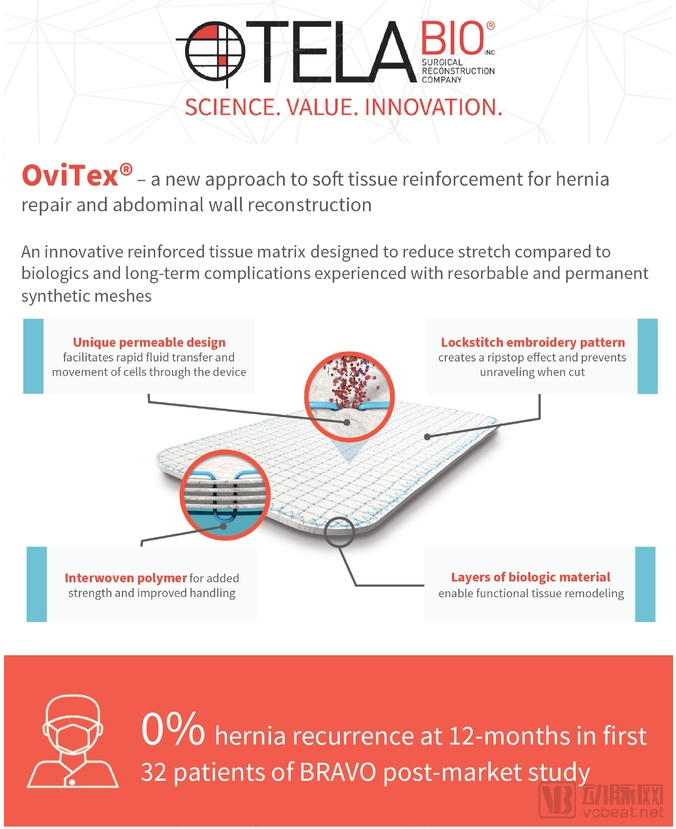
Currently, TELA Bio has launched two innovative repair materials: OviTex and OviTex RBS. OviTex Reinforced Tissue Matrix (OviTex) was co-developed with Aroa Biosurgery and received FDA 510(k) clearance in 2016 (held by Aroa). OviTex utilizes ovine rumen as its biomaterial, offering optimal biomechanical properties and an open collagen structure that facilitates rapid cellular infiltration. In the BRAVO clinical trial, none of the 32 patients experienced ventral hernia recurrence during the one-year follow-up period, indicating favorable outcomes. This product combines the advantages of both biological matrices and polymer materials, while also providing cost benefits.

The table above shows that the recurrence rate was 0 among the first 32 patients who underwent 12 months of follow-up in the BRAVO study.
The second product is OviTex PRS, an enhanced tissue matrix that addresses unmet needs in plastic and reconstructive surgery. In April 2019, OviTex PRS received FDA 510(k) clearance, which is also held by Aroa Biosurgical. It is indicated for soft tissue implantation in procedures requiring soft tissue repair or in plastic and reconstructive surgeries. OviTex RBS integrates multiple layers of biological and synthetic materials using a unique embroidered pattern, allowing fluids and cells to move freely through the structure. This design improves clinical outcomes and reduces overall costs in hernia repair, abdominal wall reconstruction, and plastic and reconstructive surgeries. To date, these two products have been used in over 6,500 patients, with no reports of new complications or reoperations attributable to product issues.
Hernia repair is one of the most common surgical procedures. A hernia occurs when pressure forces an organ, intestine, or fatty tissue to protrude through a hole created by a defect or weak area in the surrounding muscle or connective tissue. In patients who have experienced multiple failed hernia repairs, the anatomy of the abdominal wall is often compromised, requiring surgeons to perform more advanced techniques to restore the abdomen, known as abdominal wall reconstruction.
The vast majority of hernias are repaired surgically. Surgical hernia repair can be performed via open repair or minimally invasive repair, including laparoscopic or robot-assisted techniques. In robot-assisted repair, surgeons benefit from greater instrument flexibility and precision, enabling primary closure of the hernia defect. In recent years, the number of robot-assisted hernia repairs has increased significantly.
In the United States, an estimated 1.2 million hernia repair procedures, including revisions for recurrence, are performed annually. It is estimated that approximately 90% of current hernia repairs utilize some form of reconstructive material to provide long-term support at the repair site, representing a total addressable market of roughly $1.5 billion in the U.S. The OviTex portfolio comprises multiple products indicated for ventral hernia repair and abdominal wall reconstruction, inguinal hernia repair, and hiatal hernia repair, thereby addressing unmet needs in hernia repair and abdominal wall reconstruction.
Plastic surgery primarily addresses issues arising from defects, anomalies, trauma, infection, burns, tumors, or other diseases, utilizing reconstructive and restorative procedures to improve function and capability while repairing human anatomical structures compromised aesthetically or functionally. A growing body of clinical literature supports the use of biomaterials in head and neck surgery, as well as in reconstruction of the chest wall, pelvis, extremities, and breast. It is estimated that the potential market opportunity addressable annually by the OviTex PRS product in the United States is approximately $500 million.
Currently, common materials used in this type of surgery include permanent synthetic materials, biological materials, and absorbable synthetic materials, all of which have certain limitations. TELA Bio’s products are designed with more than 95% biological materials, combining the advantages of both biological and polymer materials while addressing their limitations by interweaving polymer fibers into the biological material layer. OviTex not only facilitates tissue repair but also induces tissue regeneration. It can reduce inflammatory responses, accelerate tissue healing, lower recurrence rates, and simultaneously reduce costs by 40%.
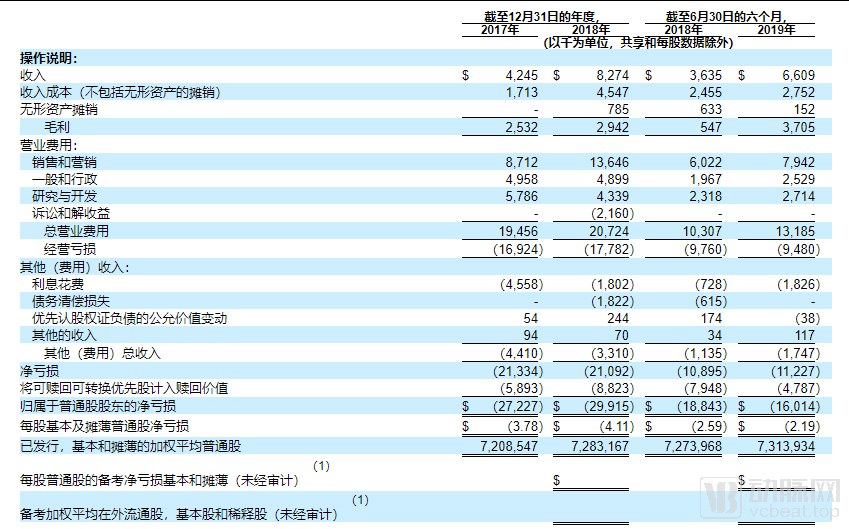
TELA Bio began commercializing its OviTex product in the United States in 2016 and in certain European countries in 2019. Since 2016, nearly all of its revenue has been derived from sales of the OviTex product. Annual revenues for 2017 and 2018 were $4.2 million and $8.3 million, respectively, with a net loss of $21.1 million in 2018. Revenues for the first half of 2018 and the first half of 2019 were $3.6 million and $6.6 million, respectively. In April 2019, Aroa Biosurgery, Ltd., TELA Bio’s exclusive manufacturer, received FDA 510(k) clearance, and limited market launch commenced in May.
According to Crunchbase, TELA Bio has recorded eight financing rounds since 2013, raising a total of $87.3 million. Following this IPO, the proceeds will be used for sales and marketing efforts in the United States to promote product adoption among surgeons, continue clinical validation of product efficacy and safety, and expand the product’s indications for use.