

Market Booms as JST Medical's Bio-Ceramic Bone Graft Material Receives NMPA Approval, Ushering in a Golden Era

Just Medical
Medical Device Research and Development, Production, and Sales
On January 14, 2026, Just Medical's "Bioceramic Bone Repair Material" was officially approved for marketing by the National Medical Products Administration (NMPA). The product actively responds to China's strategic direction regarding the localization and independent innovation of high-end medical devices, and more precisely meets the significant clinical demand for orthopedic regenerative repair materials.It is a key breakthrough in Just Medical's product layout in the field of orthopedic regenerative repair.
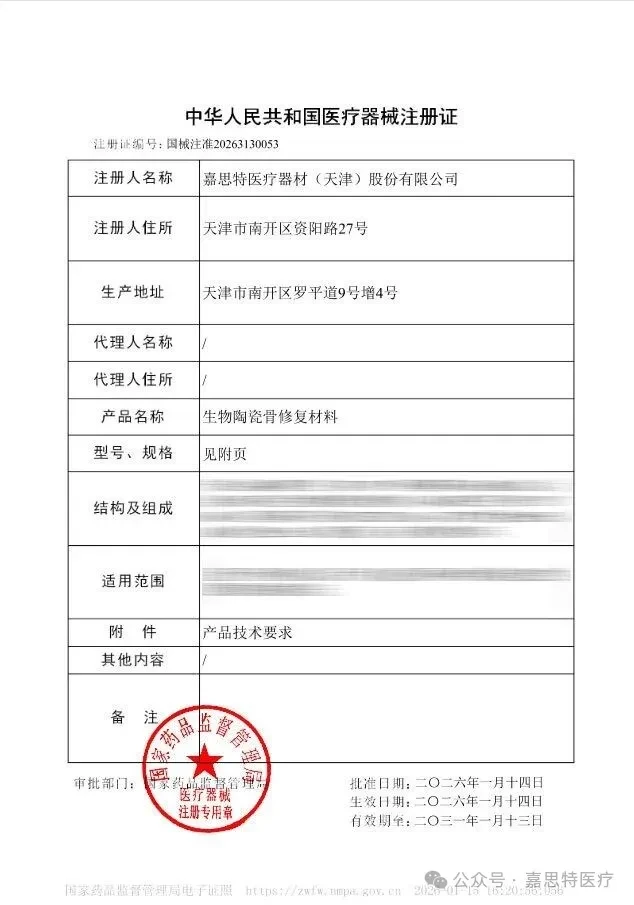
The product is similar to the inorganic components of natural bone and consists of 85% β-tricalcium phosphate (β-TCP).Composed of 15% hydroxyapatite (HA), a mixed biphasic porous bioceramic bone repairComposite material. The product has the following advantageous characteristics:
① Good Biocompatibility:Similar to the inorganic components of natural bone, it has high strength and good biocompatibility.
② Good degradability:Unique product formulation, β-TCP and HA gradient degradation, promotes bone formation.
③ Excellent Bone Filling:Porous structure promotes bone growth.

It is reported that bio-ceramic bone repair materials, as a core branch in the field of biomedical materials, occupy an important position in clinical scenarios such as orthopedic trauma repair, spinal fusion, joint reconstruction, and oral and maxillofacial repair due to their excellent biocompatibility, osteoconductivity, and degradability.
In recent years, driven by multiple factors such as the intensification of population aging, the iterative innovation of medical technology, and policy support, both the global and Chinese markets have shown a high-speed growth trend. Meanwhile, the industry also faces challenges such as technical barriers and cost pressures.
The global bioceramic bone repair materials market is in a rapid growth phase, with technological innovation and demand upgrades serving as the core driving forces. According to industry forecasts, the compound annual growth rate of the global bioactive bone repair materials market (including bioceramics and composites) will exceed10%, and by 2030, the market size will exceed 15 billion US dollars, with bioceramic materials accounting for a core share of 28%-32% due to their mature clinical applications.
In the细分领域, hydroxyapatite (HA), calcium phosphate-based composites, and zirconia ceramics are mainstream products, widely used in trauma repair, joint replacement, and other scenarios. Meanwhile, 3D-printed customized products show the most significant growth, with an expected annual compound growth rate of 19.8%.
The growth rate of China's bioceramic bone repair materials market is significantly higher than the global average, becoming the core engine of global market growth.In 2023, the scale of China's bone repair materials market has reached 6.98 billion yuan, with an annual growth rate of 15.3%. Among this, bioceramic materials account for 38% of the market share, with a scale of approximately 2.65 billion yuan.
Benefiting from a large patient base, the release of primary healthcare demands, and the advancement of localized production, the market size in China is expected to exceed 18 billion yuan by 2030. The market size of the bioceramic materials segment is anticipated to increase to over 7 billion yuan, with an annual compound growth rate of more than 12.4%.
Among them, injectable bone repair materials have achieved a year-on-year increase of 25.6% due to the rising penetration of minimally invasive surgeries, becoming one of the fastest-growing subcategories.
From a global regional perspective, North America and Europe, with their advanced medical infrastructure, high healthcare spending, and high acceptance of innovative technologies, dominate the market, collectively contributing to the global...More than 60% of the market share. The United States, Germany, France, and other countries are the core consumer markets, with leading companies such as Germany's CeramTec and the United States' CoorsTek monopolizing the high-end market through technological advantages. Meanwhile, the Asia-Pacific region is experiencing faster growth, with China, Japan, and India as the core growth poles. Among them, China, due to its large population base and strong policy support, has become the most potential market globally and is expected to maintain an average annual growth rate of around 15% in the next five years.
The market for bioceramic bone repair materials in China exhibits clear regional clustering characteristics, primarily concentrated in three major economic zones. The Yangtze River Delta region, centered around Shanghai and Suzhou, gathers the majority within China.42% of manufacturing enterprises, relying on a complete industrial chain and scientific research resources, have an R&D investment intensity 1.5 times the industry average. By 2025, the regional market size is expected to reach 7.8 billion yuan, accounting for 38.6% of China. The Pearl River Delta region, centered on Shenzhen and Guangzhou, contributes 35% of the output value due to its advantages in large-scale production; companies such as Shenzhen Mindray and Guangzhou Guanhao have annual production capacities exceeding 150 tons. The Beijing-Tianjin-Hebei region, supported by national-level scientific research resources, holds 53% of the patents in the field of bioceramics for orthopedic implants, establishing a leading technological edge. Additionally, central and western regions are showing a tiered development trend, with cities like Chengdu, Wuhan, and Xi’an gradually forming distinctive industrial clusters through industrial fund support, steadily increasing their market share.
Beyond the traditional orthopedic field, bioceramic materials are increasingly penetrating new applications such as oral and maxillofacial repair, neurosurgical scaffolds, and cardiovascular coatings. Among these, the order volume for alveolar bone augmentation materials in cosmetic restoration has increased 215% year-over-year, and the annual number of surgeries for maxillofacial bone defect repair has exceeded 150,000 cases, becoming a new growth highlight.
It should be noted that Chinese enterprises lag behind in high-end technology fields such as 3D printing accuracy (average 50 microns, international leading level 20 microns) and nano-level powder preparation. In areas like high-end dental implants and artificial joint coatings, the market share of imported products exceeds 80%. At the same time, the import ratio of core raw materials such as high-purity alumina reaches 65%, restricting cost control and capacity expansion.
Moreover, the development of bioceramic materials needs to go through multiple stages such as material synthesis, animal experiments, and clinical trials. The R&D cycle for a single Class III medical device product can last 5 to 8 years, with R&D investment accounting for 8%-10% of revenue. The high R&D costs and long transformation cycle create significant barriers for small and medium-sized enterprises.
Global Market Presentation"The pattern of 'European and American leaders dominating, Japanese and Korean enterprises penetrating'." The three giants—Germany's CeramTec, America's CoorsTek, and France's Saint-Gobain—collectively hold over 35% of the market share. Relying on core technologies such as nanoscale powder synthesis and precision sintering, they have established a monopoly in high-end joint replacement and dental implant fields. Switzerland's Straumann’s zirconia ceramic implants boast a clinical 10-year survival rate of 98.7%, while Germany's Zimmer Biomet’s β-tricalcium phosphate composite material can increase bone regeneration speed by 40%, demonstrating significant technological advantages. Japanese and Korean companies penetrate the mid-to-low-end markets through cost-effective strategies, occupying a certain share in Southeast Asia and grassroots markets in China.
Formation of the Domestic Market"The pattern of 'leading enterprises guiding, small and medium-sized enterprises competing with differentiation' has been formed. Leading companies such as Aojing Medical, Guanhao Bio, and Shanghai BioRoad have achieved technological breakthroughs in the fields of mineralized collagen, β-tricalcium phosphate ceramics, and zirconia ceramics. Aojing Medical's mineralized collagen products hold a 63% market share in the field of maxillofacial bone repair, while Shanghai BioRoad’s minimally invasive ceramic rod hip-preserving technology boasts a clinical effectiveness rate of 90.3%, gradually realizing import substitution."
Small and medium-sized enterprises focus on niche areas such as injectable bone cement and basic dental materials, capturing grassroots markets with cost advantages. In the first half of 2024, the industry's total financing exceeded 2.45 billion yuan, with leading capital firms like Sequoia Capital increasing their investments, accelerating industry integration and technology transformation.
It is obvious that the bioceramic bone repair material market is in a golden period of development driven by technological iteration and surging demand. Both the global and Chinese markets will maintain a high growth momentum. Despite challenges such as reliance on core technologies and high R&D costs, market potential continues to be unleashed due to multiple favorable factors including an aging population, technological innovation, and policy support.
In the future, technological innovation capabilities, the progress of localization substitution, and global layout will become the core elements of enterprise competition. Local leading enterprises with core technologies and comprehensive industrial chain layouts are expected to stand out in the industry integration, promoting China's transformation from a major country to a powerful country in bioceramic bone repair materials.
March 24-25, 2026 "The 3rd Orthopedic and Dental Implant Conference"“The 2nd Conference on Biomaterials Applications"Second 3D Printing Technology Application Conference" Grandly Opens in Suzhou,This conference aims to deeply integrate the upstream and downstream resources of the orthopedic and dental industry chain, and build a platform that connects hospitals./Schools, Channels/An efficient对接platform for distributors, suppliers, device manufacturers, OEM enterprises, contract service providers, and related R&D, procurement, and engineering technical personnel.
