

Stago Group: Global Leader in Hemostasis Diagnostics with Over 350 IVD Products and Strategic Expansion Across 110+ Countries

Stago
In Vitro Diagnostics (IVD) Product Development and Manufacturing
Coagulation testing is a niche segment within the in vitro diagnostics (IVD) industry and has emerged as one of the most rapidly growing subsectors in recent years. Primarily encompassing assays related to thrombosis and hemostasis, coagulation testing constitutes a specialized branch of clinical laboratory services.
With the rapid development of the IVD sector, coagulation testing has also surged in prominence. According to estimates by IVD Network, the current size of China’s coagulation market is approximately RMB 3.5 billion, with 90% of the market share dominated by three major players: Werfen (Instrumentation Laboratory), Sysmex, and Stago. Other foreign companies (such as Sekisui Medical from Japan and BE from Germany) and leading domestic manufacturers (including Beijing Succeeder, Mindray Puli Sheng, Sichuan Maccura, and Shanghai Sun Biotech) hold the remaining smaller portion of the market.
There are three primary methods for coagulation testing: the clotting method, the chromogenic substrate method, and the immunoturbidimetric method. These methods are used in conjunction with their respective matching reagents to enable quantitative clinical analysis of indicators such as Prothrombin Time (PT), Activated Partial Thromboplastin Time (APTT), Thrombin Time (TT), Fibrinogen (FIB), D-Dimer (DD), Fibrin(ogen) Degradation Products (FDP), and Antithrombin III (ATIII). The measured indicators correspond to various clinical conditions; by detecting these specific markers in patient plasma, early diagnosis of particular diseases can be achieved.
Currently, the clotting method is the most commonly used coagulation assay, which determines coagulation function by measuring changes in specific properties during plasma clot formation. Based on the observed properties, the clotting method can be further divided into optical and mechanical (magnetic bead) methods. The optical method, also known as turbidimetry, detects changes in turbidity using optical principles, while the magnetic bead method, a type of mechanical measurement, detects changes in viscosity by monitoring the movement of magnetic beads.
Among these, optical coagulation testing is more common, with lower instrument manufacturing costs. In contrast, magnetic bead-based coagulation testing primarily targets the high-end market; it requires smaller sample volumes and less reagent consumption than optical methods, and is unaffected by optical abnormalities in samples or air bubbles during pipetting, thereby significantly reducing reagent usage and improving the accuracy of test results.
Currently, the two industry giants in coagulation testing, Werfen and Sysmex, primarily employ optical methods for coagulation assays. In contrast, Stago mainly utilizes the magnetic bead method for coagulation testing, targeting the high-end testing market. The magnetic bead-based assay is also the company’s flagship IVD platform.
VCBeat (WeChat Official Account: vcbeat) has compiled historical data on Stago, the industry leader in coagulation testing, analyzed its major product lines, and examined its global market presence.
Stago, founded in 1945, is a French multinational private group specializing in thrombosis and hemostasis diagnostics. The group has obtained ISO 13485 and ISO 9001 (2008) certifications and provides advanced coagulation reagents and coagulation analyzers to clinical and research laboratories worldwide. Currently, the group offers more than 350 coagulation products, with 90% of them exported to over 110 countries globally.
In 1985, Stago established its first subsidiary in the United States, marking the beginning of the rapid expansion of its distribution network. Over the past few decades, Stago has set up 15 subsidiaries across China, the United Kingdom, Dubai, Australia, New Zealand, and Canada. Notably, the Group entered the Chinese market for the first time in 2003 by establishing a subsidiary, focusing on the promotion of hemostasis products and reagent projects. It has forged strong ties with domestic academic institutions and gained widespread recognition from academic organizations in the field of hemostasis in China.
In 2011, Stago established its Asian office in Hong Kong; in 2012, the Group set up subsidiaries in Germany, Austria, Spain, Italy, Portugal, Switzerland, Belgium, and the Netherlands; in 2014, it entered the Indian market by establishing a subsidiary in India. Despite its global network of subsidiaries and offices, Stago’s core industrial activities remain concentrated in France, where it strives to identify biomarkers in the fields of IVD and hemostasis to explore potential new products.
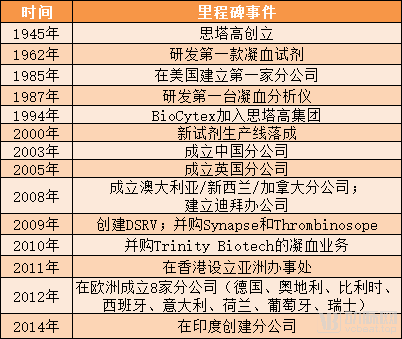
Stago Milestone Chronology (Data collected from the official website)
Identifying new biomarkers is one of Stago’s key innovative approaches. Since its inception, Stago has been dedicated to advancing the frontiers of hemostasis research. More than 20% of its employees belong to the Research and Development (R&D) department, whose primary mission is to develop products or solutions—such as automated analyzers and reagents—that improve the management of hemostasis and thrombosis, thereby meeting the clinical needs of biologists and physicians. Currently, Stago’s R&D investment significantly exceeds the average level of other in vitro diagnostic (IVD) companies in the industry.
Stago also states on its official website: “With the rapid development of biomedical technologies, particularly in the field of biology, only by continuously enhancing our professional expertise and proprietary technical capabilities can we ensure long-term sustainability.” Stago has acquired BioCytex, a company specializing in cellular hemostasis, as well as Thrombinoscope and Synapse, manufacturers of thrombin. These moves clearly indicate that Stago is striving to expand its competencies in hemostasis and continually advance its technologies in this field.
The technological expansion brought about by acquisitions is clearly evident from Stago’s 2017 acquisition case. In 2017, Stago acquired the medical device company HemoSonics, gaining technology and resources in the field of point-of-care testing (POCT). This acquisition also empowered Stago to develop its now-patented Bedside Testing System, which enables physicians to reduce patients’ risk of bleeding in surgical, obstetric, or trauma settings.
The essence of all in vitro coagulation tests is to simulate the in vivo coagulation cascade, with the core application being the “coagulation waterfall” (coagulation system model) and the physiological balance among the three major systems: coagulation, anticoagulation, and fibrinolysis.
Stago offers specific testing parameters for each of the three major systems. For the coagulation system, the primary indicators include PT, APTT, TT, and FIB, as well as specific coagulation factors. For the anticoagulation system, the main tests focus on antithrombin, the protein C system, and tissue factor pathway inhibitor (TFPI). Assessment of the fibrinolytic system primarily covers four components: plasminogen, plasmin, plasmin activators, and plasmin inhibitors.
Different test indicators are associated with different diseases, and abnormalities in specific indicators suggest that the body may have developed specific conditions. For example, a prolonged prothrombin time (PT) indicates that the patient may have disorders such as impaired intestinal reabsorption or liver cirrhosis; a prolonged activated partial thromboplastin time (APTT) suggests that the patient may have consumptive coagulopathy, among other conditions.
To detect specific indicators of the three major systems, basic coagulation analyzers are indispensable. Stago has independently developed several models of coagulation analyzers and has conducted multiple iterations. The coagulation reagents compatible with these analyzers number in the dozens; different coagulation reagents can detect different physiological indicators, and Stago will continue to update its portfolio with new testing reagents.
Typically, a single coagulation analyzer can simultaneously assess the three major coagulation systems. For instance, Stago’s third-generation “STA R Max” coagulation analyzer can measure 22 parameters, including PT, APTT, antithrombin, and the protein C system, and is equipped with nearly 50 test reagents. In addition to automatically performing sample integrity checks, the third-generation STA R Max makes efficient use of patient blood samples. Its unique magnetic bead-based assay delivers reliable results without requiring additional sample volume and is unaffected by optical interference.
In addition, the STA R Max 3rd Generation features a unique VAD (Visual Alarm Device) that displays the analyzer’s operational status. When manual intervention is required, the VAD promptly notifies staff, minimizing analyzer downtime to the greatest extent possible. This facilitates daily laboratory operations and enhances the analyzer’s work efficiency.
In addition to the STA R Max system, Stago’s portfolio includes other coagulation analyzers such as the STA Compact Max, STA Satellite Max, and STart Max systems. Each of these platforms is equipped with dozens of test reagents and capable of performing routine coagulation testing, while offering distinct advantages and features tailored to specific needs.
For example, the STA Compact Max series offers the largest sample capacity among comparable competitors and enables effective STAT management. The STA Satellite Max series was designed specifically for “satellite” laboratories, aiming to meet low-volume testing demands while delivering results comparable to those of large-scale laboratories. The STart Max is a compact semi-automated instrument featuring an upgraded color touchscreen and added functionalities such as patient result archiving. Stago began production of this analyzer series in August of this year.
If products are differentiated by test items, Stago not only performs testing on indicators related to the three major systems—the coagulation system, the anticoagulation system, and the fibrinolytic system—but also covers monitoring of anticoagulant therapy, detection of thrombophilia, and assessment of physiological hemostasis mechanisms, thereby achieving comprehensive coverage of the coagulation testing field across six dimensions.
Stago in China
Stago currently markets two product lines in China: Stago and Emoliz. Emoliz is a new product line launched by the Stago Group in China, successfully introduced to the Chinese market in October 2015, with a focus on serving small and medium-sized laboratories. The Emoliz series primarily comprises three models: the Emo Express fully automated coagulation analyzer, the Emo Smart fully automated coagulation analyzer, and the Emo Step 4 semi-automated coagulation analyzer.
In terms of collaboration, Stago has engaged in close cooperation with Chinese hemostasis academic institutions, including the National Center for Clinical Laboratories (NCCL) under the National Health Commission, the National Conference on Laboratory Medicine and Clinical Practice, and the Hematology Branch of the Chinese Medical Association. The company has also been invited to participate in various academic conferences in the domestic IVD sector, such as the 16th China Association of Clinical Laboratory Practice (CACLP) Expo and the 14th National Conference on Laboratory Medicine.
Stago has divided its Chinese customer base into five nationwide regions, with over 50 regional service engineers stationed in major cities and equipped with regular spare parts inventories to provide users with faster on-site service and quicker fault resolution. Like all other Stago call centers worldwide, the Stago call center in China is equipped with dedicated instruments to simulate issues encountered by users, and more than ten professional hotline service engineers provide 24/7 online guidance year-round.
“While we understand that instruments in use will inevitably experience failures, we strive to delay this occurrence through regular instrument maintenance and frequent daily upkeep, thereby extending maintenance intervals and aiming to provide users with an instrument that ‘never breaks down.’ Furthermore, when a failure does occur, we assist users in restoring instrument operation immediately through online troubleshooting via our hotline, while our regional service engineers provide prompt on-site support to ensure the instrument’s normal functioning,” Stago stated in an interview with Medical Instruments & Reagents.
According to Owler data, Stago’s current annual revenue is approximately $67.9 million, higher than that of its Japanese competitor Sysmex ($3.3 million), but slightly lower than that of its U.S. competitor Werfen ($180 million). Furthermore, Stago is not yet publicly listed and has no publicly disclosed financing data.