

Aesthetic Medical International Holdings Group Limited to List on Nasdaq with $800M Revenue and 21 Clinics
VCBeat (WeChat ID: vcbeat) has learned that Aesthetic Medical International Holdings Group Limited (hereinafter referred to as “Peng’ai Medical”), the overseas holding company of Shenzhen Peng'ai Hospital Investment Management Co., Ltd., recently released its prospectus and is expected to be officially listed on the Nasdaq on October 25, with the stock ticker symbol “AIH”.
Peng'ai Medical plans to issue 2.5 million American Depositary Shares (ADS) in this IPO, with a price range of $11–$13 per ADS. Each ADS represents three ordinary shares, with total proceeds expected to be between $27.5 million and $32.5 million. Cantor Fitzgerald, Haitong International, and Prime Capital are serving as joint bookrunners for this IPO.
The proceeds from this IPO will be primarily used for strategic acquisitions of additional medical aesthetics centers, upgrading existing facilities, redeeming convertible notes, and other general corporate purposes.
According to the prospectus, between 2011 and 2018, Peng’ai Medical received investments from Andafu Capital, IDG, and Shanghai Chuangrui Investment (SCI) in succession.
According to Frost & Sullivan, the medical aesthetics market in China grew at a compound annual growth rate (CAGR) of 23.6%, from RMB 52.1 billion in 2014 to RMB 121.7 billion in 2018, and is expected to reach RMB 360.1 billion by 2023, representing a CAGR of 24.2% from 2018 to 2023.
The compound annual growth rate (CAGR) of China’s private medical aesthetics market was 25.5%, growing from RMB 40 billion in 2014 to RMB 99.3 billion in 2018, and is projected to reach RMB 316.6 billion by 2023, with a CAGR of 26.1% from 2018 to 2023.
China's medical aesthetics industry has a history of nearly 30 years, evolving from traditional, single-procedure surgeries into a diverse market offering treatments for various conditions and minimally invasive cosmetic procedures with demonstrated efficacy.
Compared with mature overseas markets such as those in Europe and the United States, China’s medical aesthetics market remains a rapidly growing incremental market. Younger demographics, particularly those born in the 1990s and 1995s, have emerged as a new pool of potential consumers. Their consumption habits are driving traditional large-scale medical aesthetics institutions to undertake reforms, leveraging innovations in services, products, and technology to meet the aesthetic enhancement needs of the younger generation.
Across the medical aesthetics sector, the proportion of asset securitization remains exceptionally low. Why was Peng’ai Medical able to list on Nasdaq ahead of its peers, overcome challenges related to chain operations, expansion, technology, and safety, and stand out in the fiercely competitive medical aesthetics services market? Its development model and trajectory can be gleaned from its prospectus.
Overview and Revenue Model
The prospectus shows that Peng’ai Medical was established in 1997 and is currently a leading medical aesthetics service provider in China. The group currently operates 21 medical aesthetics centers, 19 of which are wholly owned or majority-controlled, spanning 15 cities across mainland China, Hong Kong, and Singapore. As of June 30, 2019, Peng’ai Medical Aesthetics had 567 medical staff members, including 203 doctors.
With over 20 years of clinical experience, Peng'ai Medical provides one-stop medical aesthetic services, including:
1. Surgical aesthetic medical treatments, such as ophthalmic surgery, rhinoplasty, breast augmentation, and liposuction;
2. Non-surgical medical aesthetic treatments, including minimally invasive therapies and energy-based devices (EBD), such as laser, ultrasound, and ultraviolet therapies;
3. Other medical aesthetic services, such as cosmetic dentistry and general medical services.
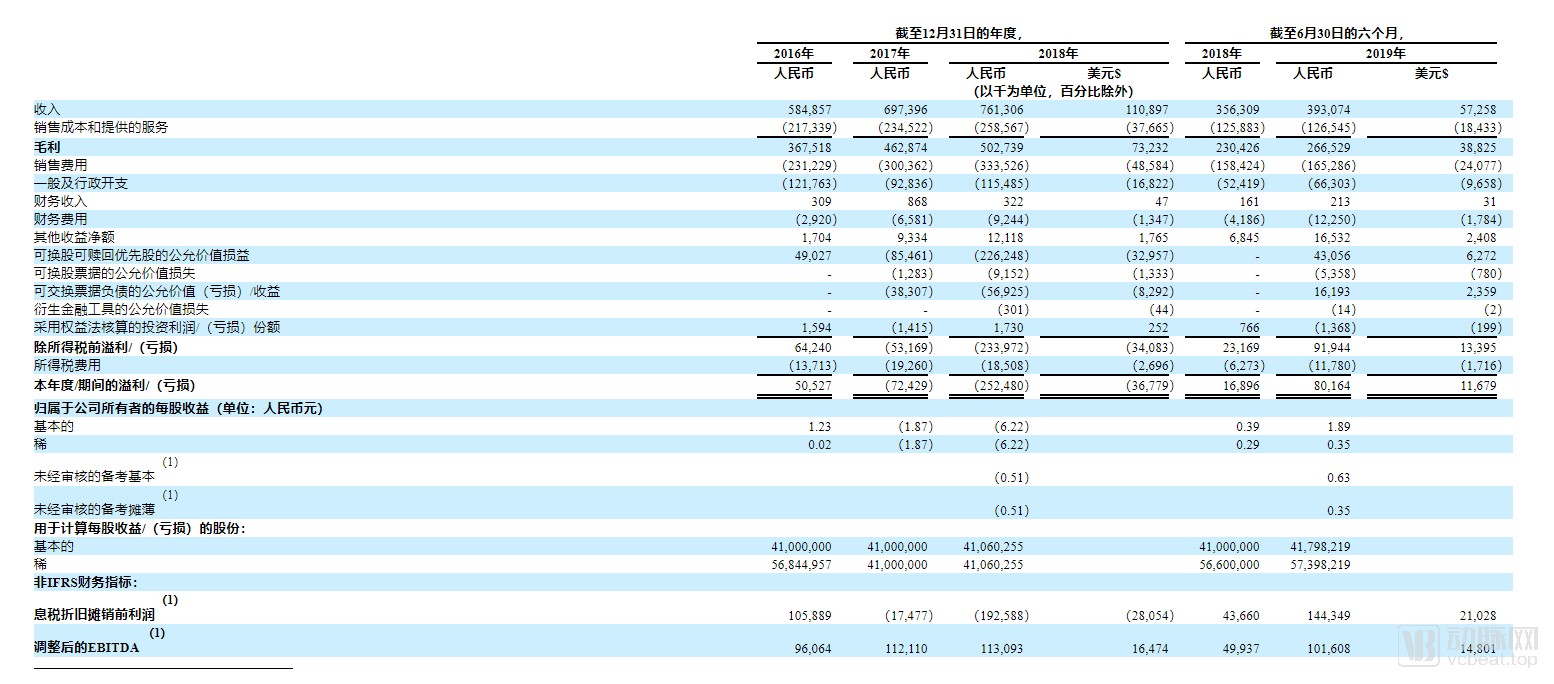
In terms of revenue structure and profitability model, non-surgical medical aesthetics is the largest source of income, derived from self-paying patients not covered by health insurance. It accounted for 51.0%, 47.5%, and 49.1% of total revenue in 2016, 2017, and 2018, respectively. In the first half of 2019, surgical medical aesthetics, non-surgical medical aesthetics, and other medical aesthetic services contributed 40.1%, 51.2%, and 8.7% to total revenue, respectively.
 Peng'ai Medical Revenue Overview
In terms of average revenue per customer, the medical aesthetics industry features high gross margins alongside substantial sales expenses; in the first half of 2019, the gross profit margin for non-surgical medical aesthetic treatment services reached 72.4%.
Peng’ai Medical’s revenues in 2016, 2017, and 2018 were RMB 585 million, RMB 697 million, and RMB 761 million, respectively, with revenue for the first half of this year reaching RMB 393 million. In 2016, the group reported a profit of RMB 50.53 million, whereas it incurred losses of RMB 72.43 million and RMB 253 million in 2017 and 2018, respectively. From 2016 to 2018, its adjusted EBITDA (earnings before interest, taxes, depreciation, and amortization) amounted to RMB 96.06 million, RMB 112.1 million, and RMB 113.1 million, respectively. In the first half of this year, the group’s profit stood at RMB 80.2 million, representing a year-on-year increase of 374%.
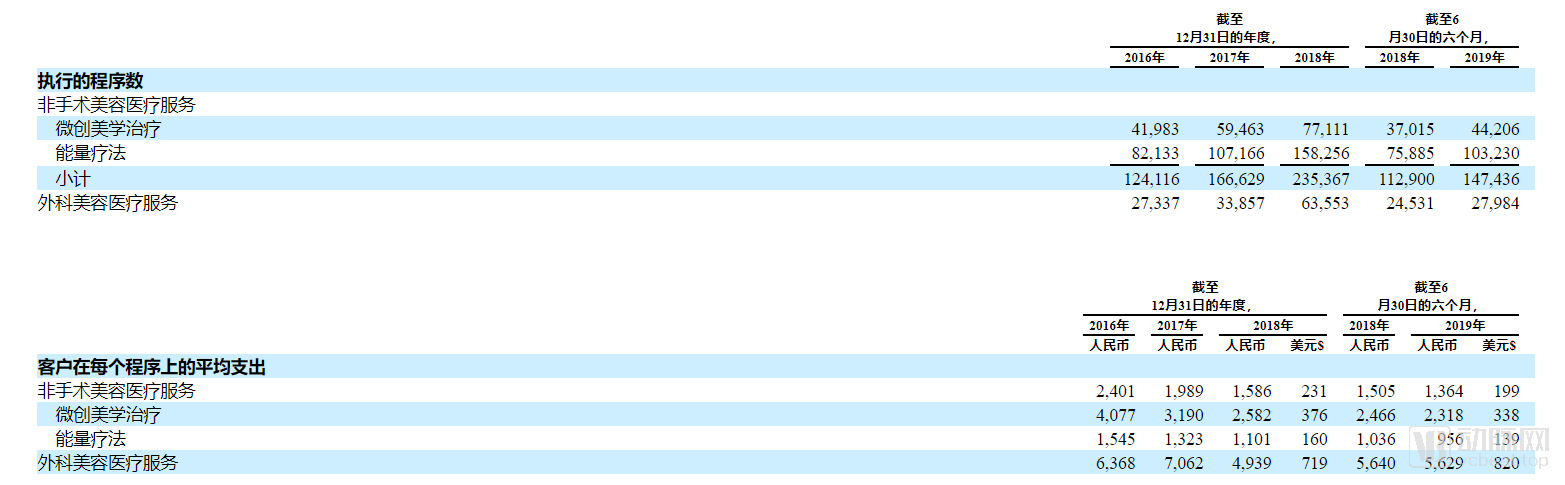
Specifically, regarding operational data, the active customer base (those who received at least one medical aesthetic service per year) totaled 108,291, 128,892, and 178,657 in 2016, 2017, and 2018, respectively. In the first half of 2019, Peng’ai Medical performed 147,436 non-surgical and 27,984 surgical medical aesthetic procedures, with average revenue per customer of RMB 1,364 and RMB 5,629, respectively.
Peng'ai Medical: Average Revenue Per User (ARPU) and Number of Patients Served
In the first half of 2019, 100,048 individuals received medical aesthetic services, compared to 85,635 during the same period in 2018. Among these over 100,000 individuals, returning customers (active clients who had previously undergone at least one medical aesthetic procedure) accounted for 52.8%, slightly lower than the 54.1% recorded in the same period of 2018.
Citing data from Frost & Sullivan, the prospectus stated that Peng’ai Medical ranked as the third-largest private medical aesthetics service provider in China by revenue in 2018.
Chain Layout, Deepening Presence in the South China Market
Medical aesthetics is one of the most market-driven segments within consumer healthcare. The medical aesthetics services market is projected to achieve robust growth globally and in China over the next five years.
As one of the fastest-growing markets globally, China ranked second in the world in terms of market size in 2017. However, the penetration rate of China’s medical aesthetics services market remains extremely low. According to Frost & Sullivan, in 2017, there were an average of 11.7 medical aesthetic treatments per 1,000 people in China, compared with 80.4, 50.1, 43.6, and 27.0 per 1,000 people in South Korea, the United States, Brazil, and Japan, respectively. Therefore, the market holds immense growth potential, driven by the following factors:
1. The market demand for medical aesthetic services is increasing day by day;
2. Younger customers are increasing their spending on minimally invasive therapies, while middle-aged and elderly customers are adopting anti-aging therapies and products at an increasingly earlier age;
3. Increase in residents' disposable income;
4. Surgical medical technologies are gradually maturing, with relatively low risks;
5. Continuous increase in investment in the medical aesthetics service industry;
6. Enhanced customer awareness and convenient access to medical aesthetic treatments.
However, information asymmetry and high marketing costs have led to a characteristic pattern in China’s medical aesthetics industry of high gross profit margins but low net profit margins. As the market faces an opportunity for transformation, achieving a sustainable expansion model has become a critical challenge for every medical aesthetics group.
Throughout its development, Peng’ai Medical has been committed to expanding its chain network, with a particular focus on strategically positioning core “flagship” stores. Building upon a highly standardized management and operational framework across its central network, the company replicates and scales this model to establish a “1+N” layout in each city and region. For Peng’ai Medical, this strategy entails deepening its market presence in South China.
Typically, flagship hospitals account for the majority of revenue, are staffed with the most experienced physicians, and provide safe, high-quality services. Moreover, developing flagship medical institutions not only enhances brand awareness in surrounding areas but also enables referral services for complex or premium cases from smaller treatment centers within the chain network. This is the chain model widely adopted by leading medical aesthetics chains today.
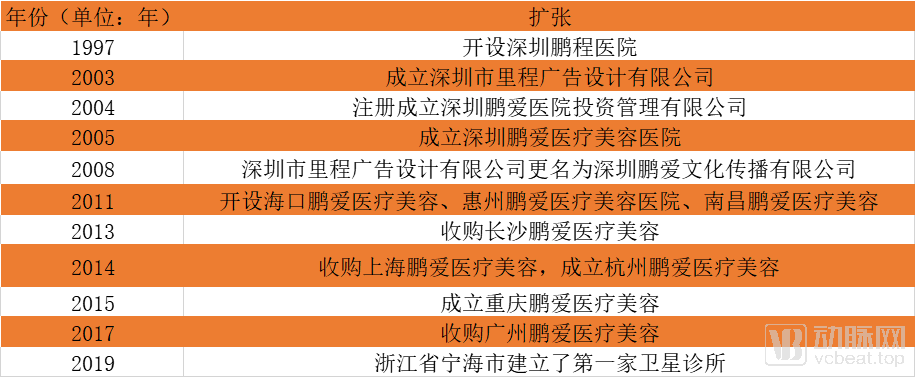
Currently, Peng'ai Medical operates three flagship medical institutions: Shenzhen Pengcheng Hospital, Shenzhen Peng'ai Medical Aesthetic Hospital, and Chongqing Peng'ai Medical Aesthetic Hospital.
Peng'ai Medical's Layout in Mainland China
Tracing the development trajectory of Peng Ai Medical, Shenzhen Pengcheng Clinic began operations in 1997 and was upgraded to Pengcheng Hospital in 2003. Since then, the chain has expanded through acquisitions and organic growth. The second flagship hospital, Shenzhen Peng Ai Hospital, was established in 2005. In October 2015, it acquired 100% equity interest in Newa Medical Aesthetics Limited to further expand its business presence in Hong Kong, China. In February 2019, Peng Ai Medical invested in LZP Holding, Inc., which owns and operates five plastic surgery centers and cosmetic laser centers in California, United States.
In terms of financing, from 2011 to 2018, Peng’ai Medical received equity investments from Andafu Capital, IDG, and Shanghai Chuangrui Investment (SCI). With capital support, Peng’ai achieved leapfrog development from 2016 to 2019.
The latest development is that, as part of Peng’ai Medical’s initiative to establish satellite clinics in China’s third- and fourth-tier cities, the first satellite clinic was opened in Ninghai City, Zhejiang Province, in April 2019 and began operations in July. In August, Peng’ai Medical entered into a strategic cooperation agreement with So-Young (NASDAQ: SY), under which So-Young will promote Peng’ai Medical Aesthetics on its platform, while Peng’ai Medical will offer certain discounts to customers referred from the So-Young platform.
Looking ahead, Peng'ai Medical will continuously expand its customer base and repeat purchase rate, enhance brand awareness, acquire more hospitals and clinics through mergers and acquisitions, continue to develop and introduce innovative medical aesthetic technologies, and strategically position itself in the global market.