Generate Biomedicines Submits IPO Filing as First AI-Designed Antibody GB-0895 Enters Phase III Trials

Generate Biomedicines
New Drug Developer

AI-Designed Antibody Enters Phase 3 Clinical Trial
2025Year12Month, the world's first product entirely created by artificial intelligence (AI) Designed antibody drugsGB-0895LaunchⅢPhase clinical trial,Marks that AI-synthesized antibodies are no longer a theoretical concept, but a tangible clinical reality.
GB-0895It is a thymic stromal lymphopoietin (TSLP)-targeted drug designed by Generate Biomedicines.TSLP) Long-acting monoclonal antibody.
TSLP Is located at the top of the airway inflammatory response cascade “Main Switch” Cytokines, by blockingTSLPThe drug can be used to treat severe asthma and chronic obstructive pulmonary disease, especially in patients receiving medium to high doses of inhaled corticosteroids (ICS) After treatment, the condition still cannot be effectively controlled.Adult and adolescent patients with severe refractory asthma。
GB-0895 :The advent of became a historic milestone in this field
Best-in-class Potential: Existing anti- TSLP Therapies (such as tezepelumab) typically require once-monthly injections, while GB-0895 Designed with ultra-high affinity and ultra-long half-life (approximately89Days, are standard biologics3-4 times), patients only need to take the medication once every six months, significantly reducing the treatment burden.
Unprecedented R&D Speed:GB-0895 From Preliminary Design to Entry Ⅲ The Phase clinical trial took only four years, nearly halving the time typically required in traditional drug development processes.
2025 At the end of the year, the company launched two global Ⅲ Phase Clinical Trial (SOLAIRIA-1 And SOLAIRIA-2), A total of 1600 patients. The two clinical trials aim to confirm the efficacy of this AI-generated molecule in a large-scale, diverse patient population.This is the first time that an antibody designed by artificial intelligence has entered the late-stage clinical validation phase.
The Rise of AI + Biology
In recent years, the pharmaceutical industry has been undergoing a major transformation: from“Drug Discovery”To“Drug Generation”Transformation. For decades, antibody design has relied on trial-and-error methods. —— Screening massive natural molecular libraries or immunizing animals to identify effective candidate drugs.
However, with the rise of generative artificial intelligence, pharmaceutical companies are now pursuing precision and purpose akin to software development,“Programming”Drug creation.

In the field of AI-driven antibody design, it has moved from mere structure prediction (such as AlphaFold) to a new stage of de novo molecular generation. Early AI models could only predict how proteins fold.Generate BiomedicinesTheGenerative BiologyPlatform capable of creating entirely new protein sequences that have never existed in nature.
The platform was trained on hundreds of millions of known protein data,Mastered the “Statistical Language”, thereby translating the desired therapeutic function into a precise molecular blueprint.
Where is the innovation in AI-designed antibodies?
Generative BiologyThe platform is a closed-loop system that integrates computing power with high-throughput laboratory validation, consisting of four iterative stages:
Generate:AI algorithms generate thousands of novel protein sequences designed to target specific goals or achieve specific characteristics (such as ultra-high affinity).
Construction:In the lab, these computer-designed sequences are synthesized into physical proteins.
Testing:Leverage high-throughput automation technology to test various properties of proteins. —— Including binding ability, stability, and interactions with the immune system.
Learning:The experimental data is fed back into the artificial intelligence model, forming “Virtuous cycle”, the platform's intelligence and precision will further improve with each new molecule it creates.
Traditional methods can usually only optimize one characteristic of a protein at a time, often at the expense of other characteristics, whereas this platform can simultaneously perform collaborative optimization of multiple characteristics, such as efficacy, stability, and manufacturability.Generative BiologyThe platform is based on2022Programmable protein generation model developed in [Year]ChromaEstablished, the model is hailed as“In the field of protein engineering DALL-E(OpenAI Cross-modal Generation Development AI milestone product). It includes four core technology modules: aDiffusion Process Consistent with Polymer Conformation Statistics; A highly efficient neural network architecture applicable to molecular systems, capable ofQuadratic complexityAchieve long-range structural reasoning; a series of network layers that can efficiently synthesize 3D protein structures based on predicted geometric relationships between residues; and a general low-temperature sampling algorithm suitable for diffusion models.The model can transform protein design intoBayesian Inference Process under External Constraints, these constraints can cover symmetry, substructures, molecular shapes, semantic features, and can even be compatible with natural language instructions.
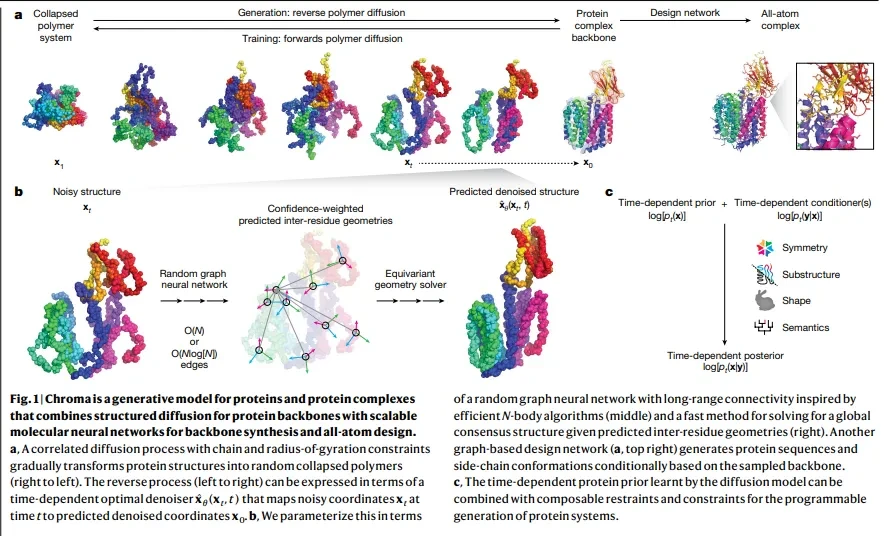
ChromaSchematic Diagram of the Model
In通过对 310 The experimental validation results of the protein show that: based on Chroma The proteins generated by the model possess high expression levels, can fold correctly, and exhibit excellent biophysical properties. Among them, the crystal structures of two designed proteins are... Chroma The generated model structure has achieved atomic-level accuracy.
Currently,Generate BiomedicinesHas partnered with Amgen (Amgen), Novartis (Novartis) Reached a multi-billion dollar cooperation, and with NVIDIA (NVIDIA) to jointly enhance their computational capabilities. These collaborations focus on overcoming“Undruggable”Targets, as well as develop multi-specific antibodies that were previously impossible to design manually. Generate Biomedicines has rapidly built one of the industry's most comprehensive AI-driven R&D pipelines, covering three major fields: immunology, oncology, and infectious diseases.
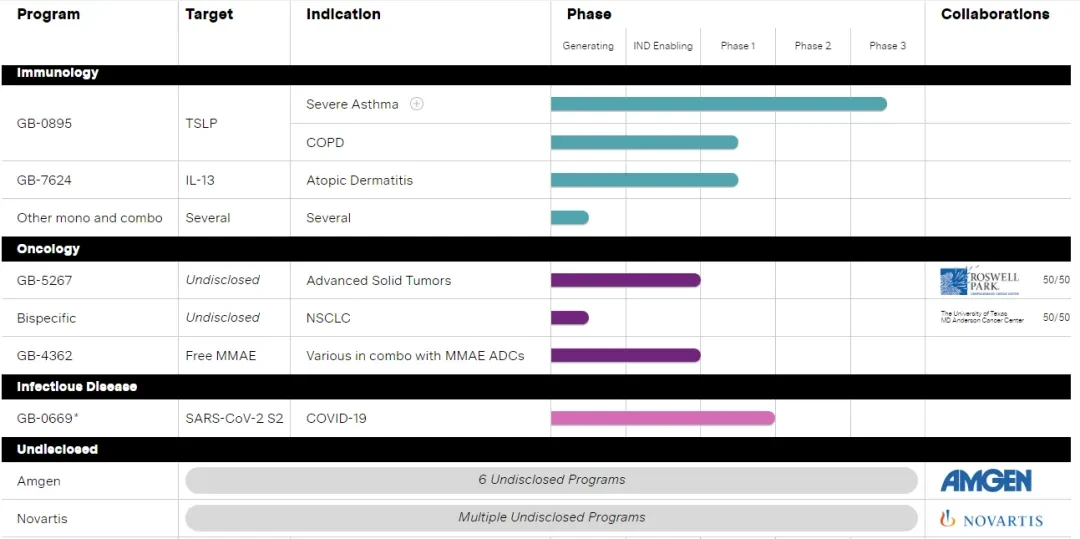
GeneratePipeline under research
Immunology and inflammation are the most mature research and development areas of the company, in whichGB-7624(Anti-IL-13Antibody)This molecule is engineered to possess ultra-high affinity and an ultra-long half-life,IL-13As the target,IL-13Are key mediators of skin inflammatory responses. In the field of oncology, Generate Biomedicines, Inc. is collaborating with MD Anderson Cancer Center to develop the next generation of antibody-drug conjugates.With Novartis (Novartis)A multi-billion-dollar development of protein therapies targeting multiple undisclosed tumor targets is equally eye-catching. In addition, the company is also focusing onBest-in-Class Chimeric Antigen ReceptorTCell Therapy (CAR-T)。
Generate BiomedicinesThe success proves that biology can be “Programming” It not only accelerates the pace of innovation but also creates drugs with stronger efficacy, greater convenience, and higher accessibility. With GB-0895 Advance Ⅲ Phase clinical trial, it has become a beacon for the future of medicine:In this future, the next life-saving drug may play a crucial role with just a few keystrokes.
Reference Links
https://firstwordpharma.com/story/6718323
https://generatebiomedicines.com/
Scan the WeChat QR code, add the editor of the Biologics Circle, and those who meet the requirements can join.
Biological Products WeChat Group!
Please indicate: Name + Research Direction!


Edition Authority Sound Bright All articles reprinted by this official account are intended to convey more information, with the source and author clearly stated. Media or individuals who do not wish to be reprinted can contact us (cbplib@163.com), and we will immediately delete the content. All articles represent the views of the author and not this site.