

Decoding BeiGene: From Local Roots to Global Reach — PD-1 and BTK Inhibitors Are Just the Tip of the Iceberg
BeOne
Developer of Molecular Targeted and Immune Anti-Tumor Drugs
My first encounter with BeOne Medicines was at a biopharmaceutical investment forum in 2016, when the wave of innovative drug investment was just beginning to rise. Although there were already many domestic innovative pharmaceutical companies in China, most were still in their early to mid-stages. As a Chinese pharmaceutical company listed on NASDAQ, it stood out prominently in the market. “A local innovative pharmaceutical company going global”—this was the reporter’s first impression of BeOne Medicines at the time.
The first true face-to-face engagement with BeOne Medicines occurred in the aftermath of the company’s short-selling incident, at a small-scale media briefing held during the 2019 CSCO conference. Senior executives, including President Xiaobin Wu, Senior Vice President Lai Wang, Vice President of Commercialization Yan Liu, and Chief Business Officer for Greater China Qingyi Wu, jointly participated in the interview. VCBeat posed questions regarding BeOne Medicines’ future pipeline strategy, as well as the commercialization strategies for zanubrutinib and tislelizumab.
Most of BeOne Medicines’ executives boast more than a decade of experience in the pharmaceutical industry, and their backgrounds at multinational pharmaceutical companies have given them a thorough understanding of the rules governing international markets. Yet, unlike the stereotypical formality and reserve often associated with executives at foreign enterprises, they were approachable and down-to-earth throughout the interview. When asked about the high-profile short-selling incident that once shook the industry, Wu Xiaobin appeared largely unfazed by the rumors. He joked that the short seller had previously targeted leading companies across various sectors, including Alibaba and JD.com, suggesting that BeOne Medicines’ inclusion on their radar was, in itself, a testament to the company’s strength and market standing.
It is no exaggeration to describe BeOne Medicines as a representative enterprise in China’s innovative pharmaceutical industry. Following its dual listings on the NASDAQ and the Hong Kong Stock Exchange, BeOne Medicines has not only earned a strong reputation in the domestic market but also gained recognition for its R&D capabilities overseas. Oncology is BeOne Medicines’ core therapeutic area, with a focus on innovative molecularly targeted therapies and immunotherapies for cancer treatment. Its pipeline includes three self-developed candidate drugs in late-stage clinical development, as well as commercialization rights in China for three marketed oncology drugs.
Tislelizumab, a PD-1 antibody, is one of BeOne Medicines’ flagship in-house developed products. Competition in this sector is fiercely intense, often described in the industry as “thousands of troops crossing a single-log bridge.” Among domestically developed drugs, toripalimab (Junshi Biosciences), sintilimab (Innovent Biologics), and camrelizumab (Hengrui Medicine) have already been launched. From a timeline perspective, BeOne Medicines has been slightly slower to market. However, according to Wang Lai, Senior Vice President of BeOne Medicines, competitiveness in the pharmaceutical market depends not only on speed but also on quality, breadth of indications, and inclusion in national medical insurance reimbursement lists, all of which are key indicators of core competitiveness.
In terms of indication strategy, BeOne Medicines is the first pharmaceutical company to submit a PD-1 monoclonal antibody for urothelial carcinoma, a field that has seen no breakthrough therapeutic options for many years. Furthermore, the company has completed enrollment for three Phase III clinical trials in lung cancer and one Phase III trial in squamous non-small cell lung cancer, maintaining a leading position in China. Regarding liver cancer, a cancer type with high prevalence in China, the Phase III study for first-line hepatocellular carcinoma treatment is underway, while patient enrollment for the single-arm clinical trials evaluating second- and third-line treatments has been completed.
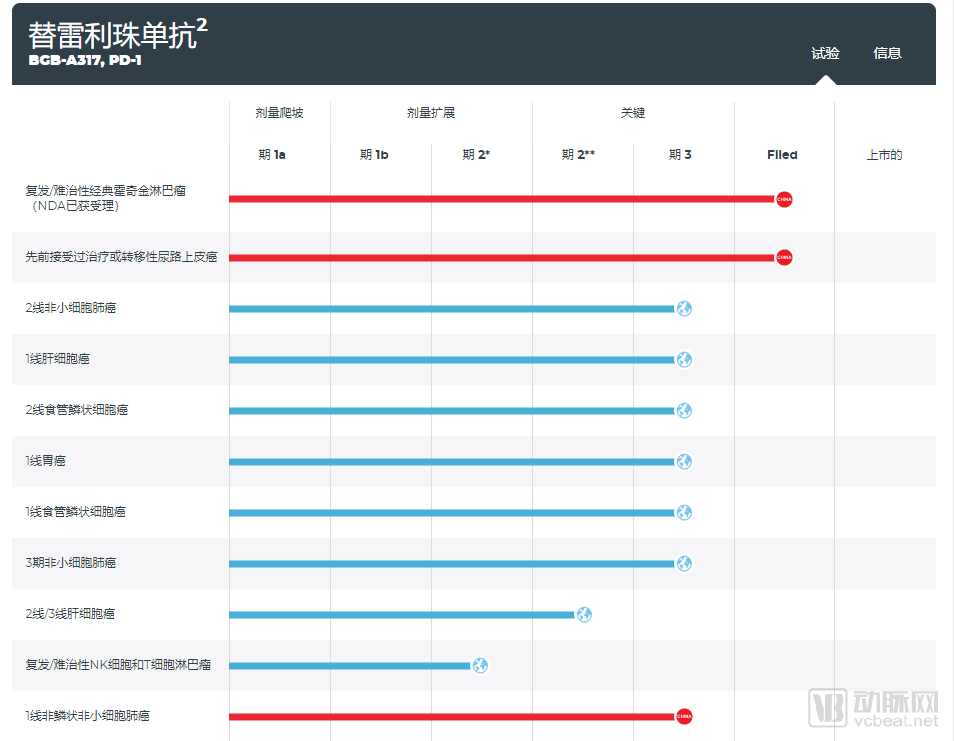
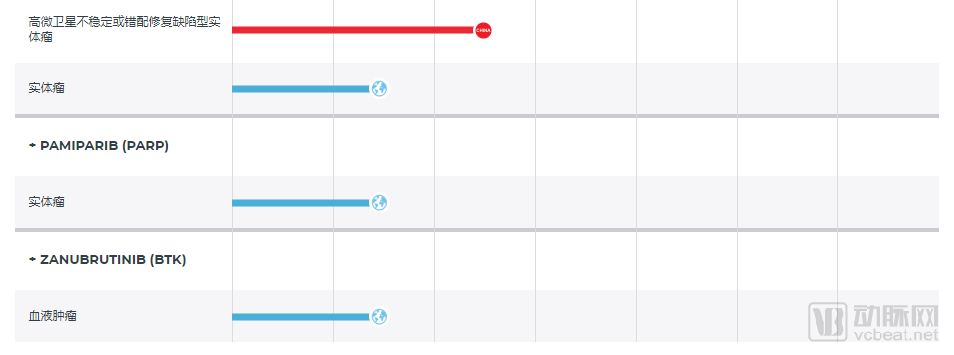
Tislelizumab Clinical Trial Progress, Image from BeOne Medicines Official Website
Wang Lai stated that BeOne Medicines will focus its PD-1 strategy on China, emphasizing broad market coverage to align with the characteristics of the Chinese market. For its PD-1 monoclonal antibody, BeOne Medicines is currently conducting 11 Phase III clinical trials and four registrational Phase II clinical trials.
“We have extensive deployments across major cancer types and maintain a leading position in several indications, so we are highly confident about future market competition,” summarized Wang Lai. Based on the broad layout across indications, he believes BeOne Medicines will have more opportunities to include its drugs in the National Reimbursement Drug List, which will be a key factor in future competition.
“In addition, we have many combination therapy studies underway,” said Wang Lai. He indicated that BeOne Medicines may bring more “PD-1 + X” combination treatment regimens to the international market in the future. “This ‘X’ could be an inhibitor or chemotherapy. Countless pharmaceutical companies have been searching for this ‘X’ in the past, and we also have our own ideas and strategic layout,” he continued.
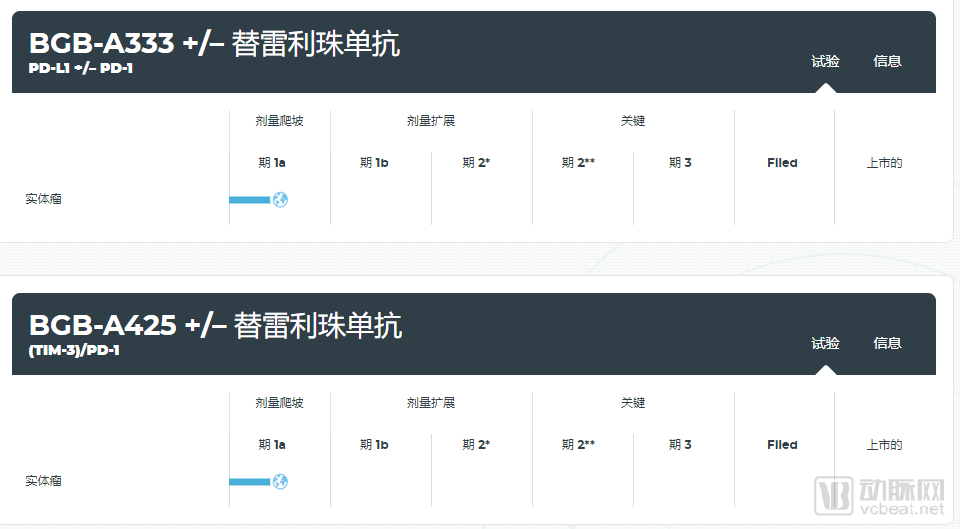
Progress of Tislelizumab Combination Therapy Trials, Image from BeOne Medicines Official Website
In May 2018, BeOne Medicines announced that Dr. Wu Xiaobin had joined the company as General Manager of its China region and President of the company. His previous role was as the head of Pfizer China. As its products entered the commercialization phase, the market demanded not only R&D capabilities but also strong operational competence from the company. Over the past two years, BeOne Medicines has progressively assembled its commercial management team.
Qingyi Wu, Chief Commercial Officer for Greater China, joined the company in June 2019. Prior to this, she held positions at renowned multinational pharmaceutical companies including Pfizer, Genzyme, Eli Lilly, AstraZeneca, and Sanofi. At Sanofi, she successfully launched Aubagio for multiple sclerosis, setting a record for the exceptional market introduction of new products within the company. Joining her at the same time was Yan Liu, Vice President and Head of Marketing for Greater China. During her tenure at Takeda Pharmaceutical, Ms. Liu facilitated the inclusion of Ninlaro in the National Reimbursement Drug List just five months after its new drug application was approved, and revitalized the Enantone business line. While at Pfizer, she drove Xalkori to become the top-selling product in Pfizer’s oncology portfolio.
On the eve of the product launch, BeOne Medicines’ commercialization team has entered a state of full readiness. Although newly formed, the team is largely composed of industry veterans, with over 85% of its sales staff hailing from multinational corporations and bringing proven track records and successful experience in launching multiple new products. “I have full confidence in our team’s combat effectiveness,” stated Wu Qingyi.
Moreover, as BeOne Medicines holds the commercialization rights in China for three products—Abraxane, Revlimid, and Vidaza—its commercial team has had the opportunity to hone its capabilities through practical experience. After more than a year of hands-on practice, the team is now poised and eager to embrace the upcoming commercial launch of its independently developed products.
Regarding the medical insurance sector, which has drawn significant industry attention, although the current trend is toward greater centralization, BeOne Medicines may still find opportunities in areas such as local market access, critical illness insurance, and commercial health insurance. “Whoever secures market access wins the game,” Wu Qingyi remarked. She explained that, in terms of organizational structure, BeOne Medicines has established dedicated central and regional market access teams. Through clear division of labor and specialized expertise, these teams help accelerate the inclusion of its products into the national medical insurance scheme.
“This year, the country has completely updated the National Reimbursement Drug List (NRDL), with many domestically developed innovative drugs being included,” added Wu Xiaobin. He believes that the fundamental solution to improving national health lies in the rise of domestically developed innovative drugs, and he is confident that the proportion of such drugs in the NRDL will continue to increase.
Furthermore, Phase I of BeOne Medicines’ Guangzhou biologics manufacturing facility was officially completed on September 27, 2019. Covering an area of 100,000 square meters, the facility is dedicated to process development and production of large-molecule biologics, with an annual production capacity of 8,000 liters. Following the approval of tislelizumab, future production will be carried out at this site.
In contrast, BeOne Medicines holds a more pronounced advantage in the BTK inhibitor market. Currently, there are two such products marketed globally, and zanubrutinib demonstrates superior ORR (overall response rate) and CR (complete response rate) data compared to the two BTK inhibitors already on the global market (from Johnson & Johnson and AstraZeneca, respectively), positioning it as a potential best-in-class product.
On August 21, 2019, the U.S. Food and Drug Administration (FDA) announced that it had accepted the New Drug Application for zanubrutinib, a Bruton’s tyrosine kinase (BTK) inhibitor developed by BeOne Medicines, and granted it Priority Review designation for the treatment of patients with mantle cell lymphoma (MCL) who had received at least one prior therapy. This indicates that zanubrutinib is expected to enter the U.S. market in the first quarter of 2020. Upon approval, it would become the first independently developed Chinese anticancer novel drug to be approved by the FDA and marketed in the United States, marking a historic milestone in China’s pharmaceutical industry. Consequently, the overseas launch of zanubrutinib may serve as a significant milestone for Chinese innovative drugs going global.
In China, the National Medical Products Administration (NMPA) has accepted the marketing applications for zanubrutinib for two indications: relapsed/refractory mantle cell lymphoma and relapsed/refractory chronic lymphocytic leukemia/small lymphocytic lymphoma, and has granted them priority review. Wang Lai stated that zanubrutinib is currently undergoing head-to-head global Phase III trials directly comparing it with ibrutinib for the indications of Waldenström’s macroglobulinemia and chronic lymphocytic leukemia.
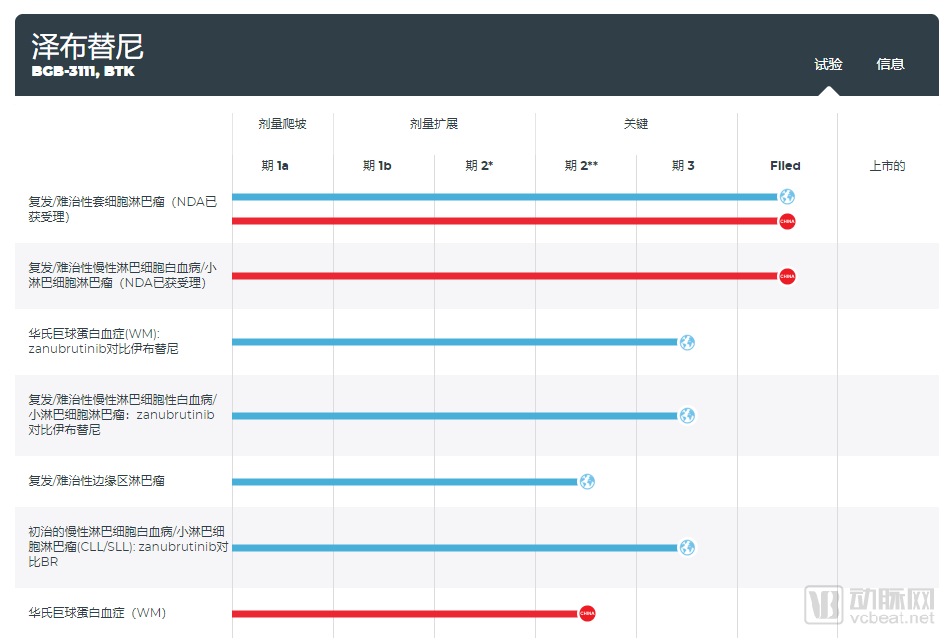
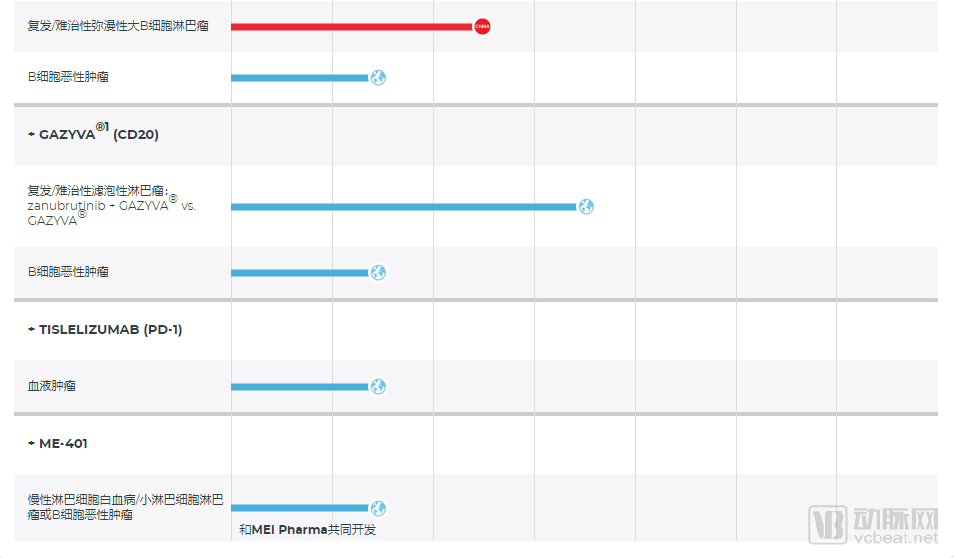
Progress of Zanubrutinib Clinical Trials, Image from BeOne Medicines Official Website
Tislelizumab’s market is primarily in China, whereas the most critical battleground for BTK inhibitors may be overseas markets such as the United States.
Approximately one year ago, BeOne Medicines began preparing for the U.S. market launch of zanubrutinib, with plans to commercialize the product independently. This marks the first overseas sale of an innovative Chinese oncology drug. Wu Xiaobin candidly acknowledged that, given China’s historical reliance on generic drugs, domestic teams have indeed lacked experience in overseas commercialization. He revealed that, for the U.S. commercialization of zanubrutinib, the company prefers to assemble a team in the United States with established industry experience and reputation.
“The commercial team for zanubrutinib in the U.S. market is now largely in place. These individuals are well-versed in the U.S. market and sales operations, with some having joined specifically for this product,” introduced Wu Xiaobin. Josh Neiman, Head of U.S. Commercial Operations, joined in July 2018. Prior to this, Neiman held commercial leadership roles at Flatiron Health, Onyx Pharmaceuticals, and Genentech, where he was responsible for Kyprolis.®(carfilzomib)、Rituxan®(rituximab)、Gazyva®(obinutuzumab)Herceptin®multifaceted efforts related to the commercialization of (trastuzumab).
In terms of product and commercialization strategy, BeOne Medicines has consistently taken the lead in paving the way for Chinese innovation to go global. While expanding from the domestic market to the international stage is a shared aspiration among many Chinese innovative pharmaceutical companies, BeOne Medicines stands apart by having this ambition embedded in its DNA since its inception, endowed with such a mission from the very day it was founded.
In 2003, Wang Xiaodong returned to China and founded the National Institute of Biological Sciences (NIBS) in Beijing, which was located in the same park as Bio-Duro, the biotechnology company established by John Oyler. The following year, at the age of 41, Wang Xiaodong was elected a member of the U.S. National Academy of Sciences. In 2009, Bio-Duro was acquired by Pharmaceutical Product Development Inc. (PPD) for $80 million. Attracted by the San Francisco Bay Area, Wang Xiaodong considered inviting John Oyler to join him there. However, after careful analysis, Oyler believed that China, with its vast market and substantial demand, would provide fertile ground for business growth. Ultimately, Oyler persuaded Wang Xiaodong.
In 2010, a group of scientists and R&D professionals dedicated to discovering novel cancer therapies and improving patient accessibility founded BeOne Medicines in Changping, Beijing. The company was given the English name BeiGene, a homophone for “Beijing” in Chinese. Among its founders were a world-renowned Chinese scientist and an entrepreneur well-versed in China—a blend of East and West, science and business—that determined BeOne Medicines would set its sights on the global market from the outset.
In 2016, the Nasdaq market witnessed a wave of delistings among Chinese companies listed in the U.S., with WuXi AppTec also going private that year. In the same year, BeOne Medicines bucked the trend by listing on the Nasdaq, achieving a total market capitalization of $720 million on its first day of trading. At the time, the company had been established for six years, becoming the first Chinese innovative biopharmaceutical enterprise to list in the United States and marking the first IPO by a Chinese company on the U.S. stock market that year.
A closer look at BeOne Medicines’ R&D reveals that nearly all of its product portfolios are global in scope, with most studies conducted simultaneously in Australia, the United States, and China. Several of the company’s self-developed products initially launched their clinical trials overseas.
BeOne Medicines has rapidly gained recognition in the international market, leveraging its robust R&D capabilities. In 2013, BeOne Medicines initiated a collaboration with Merck Serono on lifirafenib and pamiparib, launching clinical trials in Australia and globally. In 2017, BeOne Medicines entered into a co-development agreement with Celgene Corporation for the PD-1 antibody BGB-A317. As part of this partnership, BeOne Medicines assumed Celgene’s operations in China, securing exclusive rights to commercialize Celgene’s approved products in the Chinese market. It also acquired Celgene’s commercial team in China, bringing ABRAXANE®, Revlimid®, and Vidaza® under its portfolio (for the China region only). However, following the announcement earlier this year that Bristol Myers Squibb (BMS) would acquire Celgene, BeOne Medicines subsequently reclaimed the overseas licensing rights for its PD-1 monoclonal antibody.
According to the latest annual report, BeOne Medicines’ R&D expenses are significantly higher than those of other domestic innovative pharmaceutical companies. Dr. Wang Lai, Senior Vice President of BeOne Medicines, explained, “Our clinical studies are conducted globally in parallel, which results in higher development costs compared to domestic clinical trials. Regarding R&D investment, BeOne Medicines maintains a rigorous review process. Furthermore, the CROs we engage are all major international firms with their own extensive compliance procedures, ensuring the reasonableness of our R&D expenditures.”
BeOne Medicines currently has more than 60 ongoing clinical trials, including 26 registrational trials, 17 of which are being conducted globally. Wang Lai stated that BeOne Medicines will continue to advance new drug candidates into clinical development in the future, encompassing not only best-in-class but also potentially first-in-class products.
“In the coming years, BeOne Medicines will deliver a satisfactory performance,” he stated. BeOne Medicines currently has 10 drug candidates in clinical development. With continued innovation in R&D, this number is expected to grow further in the future. The upcoming launches of its PD-1 monoclonal antibody and BTK inhibitor may only be the tip of the iceberg.