

Innovative Payment Emerges as a New Frontier: When Will Drug Installment Break Through?
Life is money.
At the 19-minute mark of the film “Dying to Survive,” the moment Xu Zheng, portraying the character “Cheng Yong,” gestures with his hands while delivering this line, art successfully captures the paradox and reality of an industry.
On one hand, there is the fundamental human need for life and health, which is listed as the most basic and foundational level in American psychologist Abraham Maslow’s Hierarchy of Needs; on the other hand, due to substantial costs such as those involved in new drug development, companies must price drugs or medical devices at high levels during their business operations to recoup costs and achieve profitability.
This long-standing pain point, deeply entrenched in the healthcare sector for years, has come under siege from “innovative payment” models in recent years. From crowdfunding for critical illnesses and million-yuan medical insurance to online mutual aid and drug installment plans, various new models have emerged one after another. Innovation across the industry chain has expanded beyond “medical care” to encompass multiple segments, including “medical care, pharmaceuticals, insurance, and health management.”
This article provides a detailed overview of pharmaceutical installment payment plans. As an innovative payment model emerging at the intersection of “healthcare + finance,” what specific challenges can pharmaceutical installments address? What impact does this business model have on stakeholders such as financial institutions, pharmaceutical companies, and patients? Furthermore, what are the current market status and future prospects for pharmaceutical installment payments?
VCBeat interviewed multiple industry insiders in an effort to provide answers to these questions.
In the past year or two, discussions about “installment payment for medications” have emerged in some online communities where patients congregate.
On Baidu Tieba’s “Rare Diseases” forum, there is a post discussing the market launch of nusinersen injection for the treatment of spinal muscular atrophy. A user commented, “At RMB 700,000 per vial, nusinersen injection has set a new record for drug pricing in China… Are patients’ families really expected to carry nearly one million yuan in cash to pharmacies to purchase the medication? For such expensive rare-disease drugs, innovative payment models (such as installment plans for medications) should be available… Have you implemented any such measures?”
This user’s comment highlights a pressing issue: there is indeed a demand for installment payment plans for many high-cost medications, particularly those used to treat critical and rare diseases, where such needs are even more pronounced. The film “Dying to Survive” exposed the phenomenon of Gleevec, a drug for treating chronic myeloid leukemia, costing nearly RMB 40,000 per bottle, which is merely the tip of the iceberg when it comes to high-priced drugs for certain critical and rare diseases.
In China’s healthcare environment, one of the most significant pain points is the excessively high proportion of out-of-pocket expenses for patients, coupled with a scarcity of supplementary payment methods, which leaves patients without adequate financial protection and support during treatment. Although the healthcare landscape has been gradually improving against the backdrop of rapid growth in China’s medical market, patients face increasing payment pressures, with the out-of-pocket expense ratio remaining stubbornly high at 40%.
Previously, patients had no options beyond out-of-pocket payments, basic medical insurance, and commercial insurance. The vast majority of hospitals were unable to provide direct reimbursement for patients enrolled in the New Rural Cooperative Medical Scheme (NRCMS), and there was a time lag in the cross-regional settlement of basic medical insurance claims. Although this delay might appear short, it effectively became a race against time. Due to the burden of upfront payments and the subsequent wait for fund reimbursement, many families were forced to forgo optimal treatment plans or struggled to maintain consistent medication adherence, thereby failing to achieve desired therapeutic outcomes.
Cong Guojun, co-founder of Zhongnuo Puhui, used data to explain this phenomenon. He stated, “We have conducted some basic statistical analyses. For instance, while an appropriate treatment regimen may be theoretically applicable to 100% of the target population, at the physician level, doctors comprehensively evaluate patients’ economic status and physical condition. When deciding between conservative therapy and novel therapeutic approaches, approximately 20% to 30% of patients may not have access to the optimal treatment plan. Furthermore, even when physicians recommend superior treatment options, a portion of patients still decline them, largely due to the high costs associated with these regimens and the resulting financial burden.”
Although the National Reimbursement Drug List (NRDL) is continuously being adjusted, with pediatric drugs, emergency medications, and drugs for critical illnesses (such as anti-tumor agents) as well as innovative drugs being progressively included, it is undeniable that the majority of innovative drugs remain excluded from NRDL coverage.
According to the "2017 China Pharmaceutical Market" report, sales of innovative drugs are primarily concentrated in the 162 largest hospitals located in first- and second-tier cities. For innovative drugs to penetrate grassroots markets, medical insurance cannot cover them entirely; out-of-pocket expenses still constitute a significant proportion. Since patients using innovative drugs typically require long-term medication, pharmaceutical companies must directly address the issue of healthcare payment for these products.
Supported by substantial capital, domestic new drug R&D enterprises are well-prepared to embrace the boom in innovative drugs. However, the payment capacity of patients in China has failed to keep pace. Just as innovative drugs are about to benefit patients, many are forced to forgo treatment due to unaffordability.
Alleviating patients' financial burden may become one of the top priorities in the healthcare sector. At the policy level, the Chinese government has introduced measures to encourage the development of supplementary payment mechanisms, thereby creating more room for medical innovation.
Against this backdrop, installment payment plans for medications have emerged, serving as a “godsend” for patients unable to afford exorbitant drug prices.

The image shows a promotional page for installment payment plans for pharmaceuticals, as displayed on a company’s official website.
Following installment plans for shopping, rent, and medical aesthetics, the reach of internet finance has now extended to the pharmaceutical sector, which addresses people’s fundamental needs for life and health.
From the perspective of its development history, pharmaceutical installment payment plans first emerged in 2016 amid the wave of internet finance innovation.
According to data reported by Entrepreneur Elite, in 2016, a consumer finance company named Qian Daifu partnered with Yunnan International Trust to launch a pharmaceutical installment payment service. Qian Daifu established strategic collaborations with multinational pharmaceutical companies such as Xi’an Janssen, AstraZeneca, and Roche, providing patients with interest-free installment plans for purchasing medications.
Under the medical installment service provided by Dr. Qian, patients themselves are not eligible to apply; however, their parents, children, spouses, and other relatives may apply.
Applications for installment plans or loans require the patient’s diagnostic or examination reports, hospital payment notices or medication prescriptions, the borrower’s basic information, and authorizations such as Zhima Credit. The maximum credit limit is RMB 200,000, with a maximum term of 24 installments and a minimum daily interest rate of 0.03%. In case of overdue repayment, a late fee shall be charged at a daily rate of 1% of the total outstanding amount. If the principal is repaid early before the end of the installment term, a handling fee equal to 2% of the prepaid amount shall be payable.
In 2017, Dianrong.com partnered with China Resources Pharmaceutical to launch a financial installment program for infliximab. The program primarily targets autoimmune diseases such as rheumatoid arthritis, ankylosing spondylitis, psoriasis, and Crohn's disease.
Patients can apply for a loan via the Dianrong mobile app when purchasing infliximab at pharmacies with a doctor’s prescription. Upon passing risk control assessment, they can pay for the medication in monthly installments. According to Dianrong’s official website, this pharmaceutical consumer installment service is offered at a zero-fee rate, requiring users to repay only the principal over a 12-month term, and supports multiple purchases.
According to Wang Dong (a pseudonym), a senior insider in the financial industry, a batch of consumer finance companies launched medical installment services at that time, such as installments for medical aesthetics and pharmaceuticals. “Companies like Maidanxia and Mimeo were very prominent in this sector back then.”
Pharmaceutical installment payment plans occupy the intersection of “healthcare + finance.” If, in the previous two years, the players visible in this space were predominantly from the financial side, then in 2018 and 2019, participants from the healthcare side began to emerge, such as Zhongnuo Puhui, Medbanks Health, and Nuohui Medical. Compared with their counterparts on the financial side, these healthcare-oriented players appear to demonstrate greater determination.
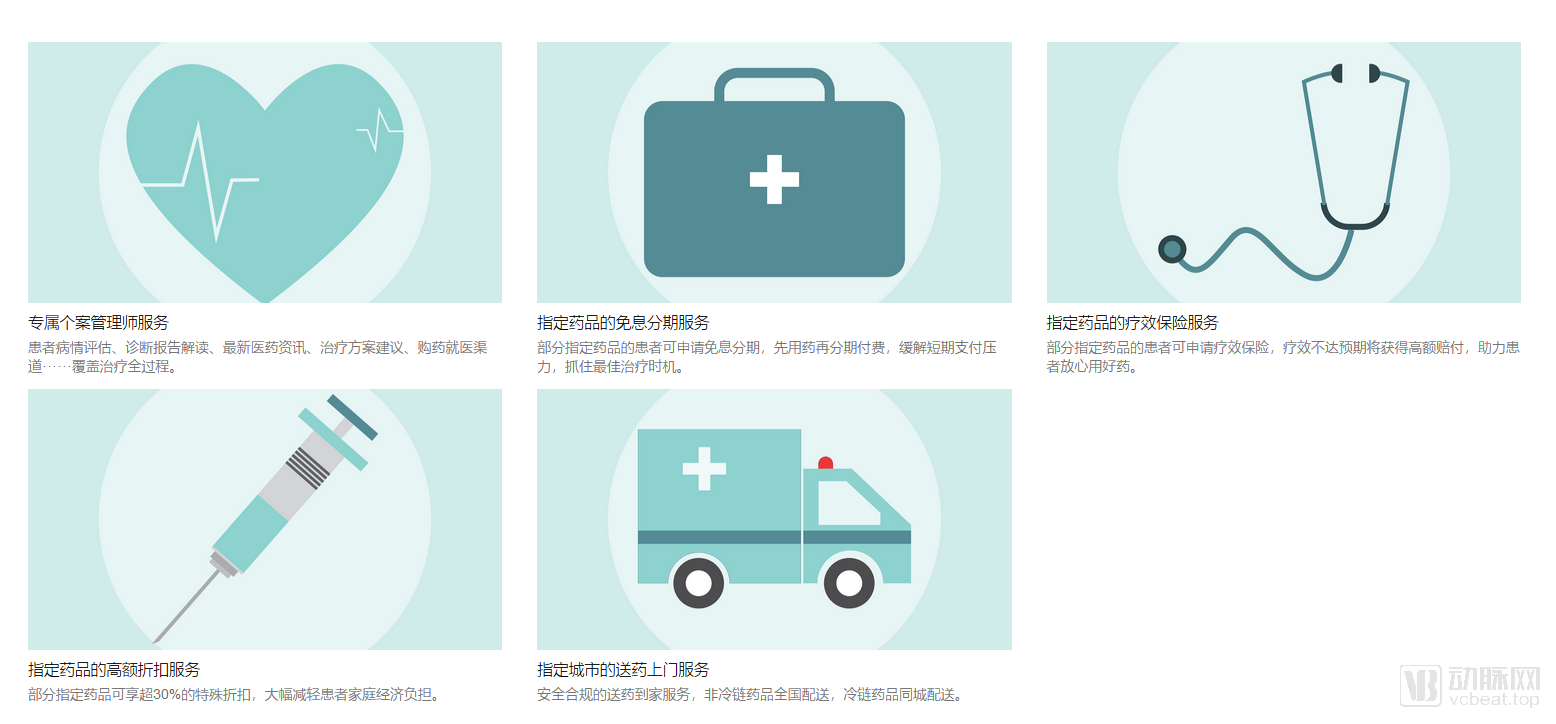
The image shows a service promotional page displayed on a company's official website.
To enhance the accessibility of pharmaceuticals and high-quality medical services, Magnesium Health has launched two business lines: “New Payment” and “New Retail.” The “New Payment” line encompasses pharmaceutical installment plans, pharmaceutical benefits, and efficacy insurance. Regarding pharmaceutical installment plans, take the collaboration between Magnesium Health and AstraZeneca on Tagrisso, a targeted therapy for lung cancer, as an example. Tagrisso is a third-generation EGFR-targeted drug for treating lung cancer; it was approved in the United States in November 2015 and received approval in China in March 2017. Due to its significant efficacy, the annual treatment cost exceeds RMB 200,000, and it is not included in the National Reimbursement Drug List. The pharmaceutical installment plan introduced by Magnesium Health for this drug can substantially alleviate the short-term cash payment burden on patients’ families.
Founded in 2018, Nuohui Medical provides industry solutions aimed at enabling more people to access worry-free medical services within their financial means, transforming the short-term financial burden of optimal treatment plans into long-term, more affordable healthcare consumption needs.
According to founder Liu Xiaojie, Nuohui Medical was established with the initial aim of “providing insurance plans and innovative payment solutions to patients with critical illnesses.”
Among the diverse participants, there are roughly three types of players involved in the drug installment payment business:
A. Funders—Banks, Trusts. Traditional banks have launched order-based installment payment plans on top of their existing credit card installment services. However, due to the lengthy application process, slow approval times, and extensive documentation requirements for credit cards, these services are largely limited to offline consumption scenarios. Given these significant limitations, involvement in pharmaceutical installment businesses has been minimal. Trust institutions lack direct lending scenarios; therefore, within the ecosystem of pharmaceutical installment services, they generally assume the role of “funders,” similar to banks.
B. E-commerce Giants and Internet Finance Companies. With the development of pharmaceutical e-commerce in recent years, major traffic platforms such as JD.com and Tmall have implemented installment payment options for the sale of pharmaceuticals and medical devices by leveraging JD Baitiao and Ant Huabei. Leveraging their large user bases, these platform-based payment services have become common payment tools; most installment plans do not require credit review, allowing users to select repayment periods based on their individual circumstances. Normally, Alipay is open to all third-party e-commerce platforms. As long as Alipay is included among the payment methods, Huabei payments are generally supported. Large e-commerce platforms can also integrate Huabei directly, enabling users to choose installment payment options.
The same principle applies to internet finance companies, particularly consumer finance firms. Currently, there is a wide variety of consumer finance companies, and the number of entities holding consumer finance payment licenses or other valid qualifications continues to grow. Financial institutions or insurance companies are collaborating with pharmaceutical manufacturers or retailers to support medical finance, focusing primarily on chronic conditions that require long-term medication, such as diabetes, liver disease, and pulmonary disease.
According to Wang Dong, from a financial perspective, “as long as one holds a financial license, it is possible, to some extent, to offer installment plans for any type of business.” Chun Xiao, a partner at Jianyibao, also stated, “The market entry barrier for offering pharmaceutical installment plans is actually quite low.”
C. Innovative payment players in the healthcare sector, such as Magnesium Health and Nuohui Medical. Although some of these players are only partially involved in pharmaceutical installment payment services, they generally approach such services from the perspective of the entire industry chain. Their integration capabilities tend to be stronger, and the products they launch are better aligned with patients’ substantive needs.
Zhang Shengming, founder and CEO of Jianyibao, revealed, “Our goal is to connect pharmaceutical companies, patients, and financial services to improve the current state of pharmaceutical sales. In this process, we will serve as the core hub.”
Thanks to the pioneering efforts of multiple stakeholders, pharmaceutical installment payment plans have opened up new avenues for breakthroughs among other nodes in the industry chain.
For pharmaceutical companies, offering installment payment plans for medications helps rapidly lower the financial barrier for patients, thereby attracting additional patients—a core benefit with the most significant impact on these enterprises. Liu Xiaojie, founder of Nuohui Medical, stated, “The reason why pharmaceutical companies are currently willing to offer installment plans is that the high upfront cost of certain expensive drugs creates a prohibitive barrier, preventing patients with limited payment capacity from accessing these treatments.”
For pharmacies, installment payment plans for medications will become a key value-added service for DTP (Direct-to-Patient) pharmacies. Amid the broader trend of prescription outflow from hospitals, DTP pharmacies have been among the first to benefit from favorable policies. In their early development stage, DTP pharmacies primarily focused on innovative and specialty drugs for major diseases such as cancer. These medications tend to be high-priced, imposing a significant financial burden on patients. Commercial solutions such as medication installment plans can help alleviate this burden. For instance, Cardinal Health China has collaborated with Novartis, Merck, AstraZeneca, Bayer, and several domestic pharmaceutical companies to jointly provide patient assistance programs.
The impact on hospitals is also expected to be significant. Cong Guojun stated, “We anticipate that in the coming years, a large number of highly advanced therapies will be integrated into the current healthcare system. While these treatments demonstrate strong efficacy, they come with correspondingly high prices, and medical insurance will not be able to cover these novel therapies and the associated patient populations within a short timeframe.” If financial mechanisms such as installment payment plans for pharmaceuticals are introduced to improve accessibility, physicians will be more proactive in recommending these drugs or therapies to patients.
For financial institutions, drug installment plans are merely a routine financial service. At their core, all operations of financial institutions constitute a “business of selling money.” According to Wang Dong, licensed internet finance companies are fundamentally engaged in the business of money. “For instance, they borrow funds from banks or P2P lending platforms and lend them to patients. If the annual interest rate on funds obtained from banks is 8%, while the annual interest rate charged to patients is 28%, they can earn a 20-percentage-point spread. After deducting costs such as operations, personnel, risk control, and customer acquisition, the remainder constitutes their profit margin.”
Wang Dong stated that within this space, there can be a wide variety of concepts and business models: some rely on user payments, others on B-side payments with interest-free access for users, and many even involve corporate subsidies and cash-burning strategies.
However, the primary concern in financial operations is to prevent the occurrence of bad debts.
Under the medical installment service provided by Dr. Qian, patients themselves are ineligible to apply; instead, their children assume the debt. This approach is adopted because many cancer patients have limited survival times, even after taking expensive targeted therapies. By having children apply for the loans, the risk of bad debts can be mitigated to some extent.
There are also some diseases that, while not fatal in the short term, incur extremely high treatment costs.
Taking rare diseases as an example, although these conditions are individually rare, the patient population is not insignificant given China’s large demographic base. In the face of realities such as the absence of commercial insurance coverage, high thresholds for basic medical insurance reimbursement, and a high proportion of out-of-pocket expenses, individuals with rare diseases are often overlooked.
In the cutting-edge field of gene therapy, the five drugs or treatment regimens approved for marketing in Western countries to date include Yescarta, the least expensive option, priced at $373,000 (equivalent to RMB 2.5 million). Such prohibitive costs place these therapies far beyond the reach of conventional medications and deter patients in need from accessing them.
There is also hepatitis C. Epclusa (Gilead’s third-generation treatment for hepatitis C) is priced at RMB 23,200 per bottle in Chinese hospitals, with a 12-week course of treatment costing RMB 70,000. This poses a significant financial burden for low- and middle-income families. As the first therapy to achieve a cure for hepatitis C, offering installment payment options for patients with limited financial resources would undoubtedly be a win-win solution for both pharmaceutical companies and patients.
It is undeniable that tiered drug pricing can effectively reduce medication accessibility, and the prospects for implementing such a model for drugs used in potentially curable conditions are promising.
Although installment payment plans for pharmaceuticals can exert a significant impact on all parties across the industry chain, when discussing the current market landscape, numerous industry insiders have offered assessments such as “this is still a very nascent market,” “healthcare does not constitute a consumer finance scenario in the conventional sense,” and “the actual market size for pharmaceutical installment payments is estimated to be only in the tens of millions.”
What Exactly Has Happened to Drug Phased Development During Its Evolution?
On Baidu Tieba, VCBeat came across an interesting post featuring a promotional poster for a pharmaceutical installment payment program designed by a consumer finance company. The poster included the phrase “Usage Instructions: For Emergencies, Not for Poverty Alleviation.”
Amidst the witty and humorous design, there seems to be a tinge of bitterness. From a risk control perspective, individuals with genuine and urgent financial needs are more likely to be excluded from financial products than ordinary users, in order to minimize the incidence of non-performing and bad debts.
“Installment payments for mobile phones are fundamentally different from installment plans for medical treatments and medications. From an industry perspective, healthcare is not a typical consumer finance scenario. If the treatment fails, who should the patient seek reimbursement from? When critical illnesses occur, they often devastate entire families; can borrowers still meet their repayment obligations after loans have been disbursed?” said Wang Dong. He noted that medication installment plans operate on a completely different risk control level compared to other types of consumer spending. Many companies that ventured into medical and medication installment services two years ago have since failed and pivoted to cash loan businesses.
For these reasons, although the market for installment payment plans for pharmaceuticals has developed over several years, it remains in a very early stage. Liu Xiaojie believes that for a market starting from scratch, it is meaningless to talk about maintaining annual growth rates of even 300% or 500%, as market acceptance is still quite low.
According to Liu Xiaojie’s estimate, the current actual market size for pharmaceutical installment plans is around tens of millions of yuan, and it may grow to approximately RMB 1 billion in the future.
Some industry insiders have even questioned whether drug installment plans constitute a substantive solution. Chun Xiao, a partner at Jianyibao, believes that drug installment plans do not lead to a substantial reduction in overall medical expenses. Compared with drug installment plans, measures such as drug discounts and charitable medication donations can provide patients with more tangible cost reductions.
For the emerging innovative payment sector of installment-based drug purchases, the challenges facing future development are quite apparent, with issues such as customer acquisition, risk control, and operations looming over this nascent field.
Although the market for installment payments on pharmaceuticals is still in its early stages, it is undeniable that innovation within the industry is taking place.
Good things are happening.