

Gengmei APP Releases '2019 Gengmei AI National Beauty Report': Chengdu Women Rank Highest in Appearance Satisfaction, First Batch of Post-90s Generation Faces Hair Loss Surge
VCBeat (WeChat ID: vcbeat) has learned that on October 24, 2019, Gengmei APP, a leading professional medical aesthetics platform in China, released the “2019 Gengmei AI National Facial Attractiveness Atlas.” Since its launch in July, the Gengmei AI feature has reached users in over 300 cities across China, with clicks exceeding 100 million; female users outnumber male users by a ratio of 3 to 1. Compiled using extensive big data from the Gengmei AI feature, the atlas aims to provide an analysis of facial attractiveness characteristics among the Chinese population and forecast trends in medical aesthetics consumption.
The report highlights the following key findings regarding the physical appearance of Chinese consumers and their consumption trends:
I. The first wave of post-90s generation is experiencing a “balding surge,” predominantly characterized by “refined balding”;
2. Chengdu women have the highest satisfaction with their appearance, and there are the most beauties with oval faces;
3. Significant potential in male medical aesthetics, with strong demand for rhinoplasty, hyaluronic acid fillers, and hair transplantation; men in Shanghai are the most inclined to undergo cosmetic procedures.
IV. Trend Toward a More Youthful Appearance Among Chinese People: The Average Skin Age of Those Born in the 1990s Is Five Years Younger Than Their Chronological Age, While for Those Born After 1985, It Is Two Years Older;
5. “Liposuction for breast reduction” emerges as a new aesthetic medicine demand among women in the new era, while abdominal slimming remains an essential need.
I. The First Wave of Post-90s Individuals Faces a “Baldness Surge,” Predominantly Characterized by “Refined Balding”
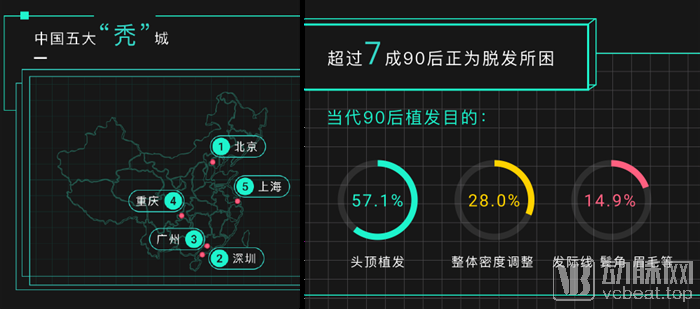
“Exquisite Baldness”—Hair loss among modern young people caused by excessive mental stress. In 2019, the first cohort of those born in the 1990s turned 30. According to the “2019 Gengmei AI National Appearance Atlas,” more than 70% of individuals born in the 1990s were struggling with hair loss. Beijing, Shenzhen, Guangzhou, Chongqing, and Shanghai had the highest number of users clicking on hair transplant services, becoming China’s top five “bald” cities. This may be related to the relatively large population of IT and internet professionals in these cities, as well as their more developed internet and scientific and technological sectors.
An analysis of hair transplant motivations among individuals born in the 1990s reveals that procedures for vertex baldness account for over half of cases, overall density adjustments comprise nearly 30%, and detailed contouring of areas such as the hairline, sideburns, and eyebrows makes up more than 10%, with this latter category showing a trend of continuous growth. According to forecasts by Gengmei, the demand for hair transplants aimed at enhancing local aesthetic appeal is poised for explosive growth in the near future.
II. Chengdu Women Report Highest Satisfaction with Physical Appearance, and Oval-Faced Beauties Are Most Prevalent
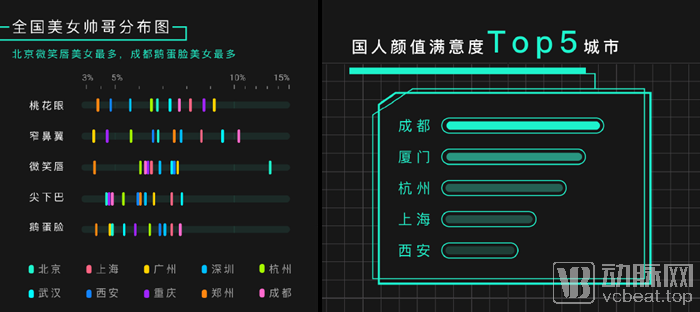
Peach-blossom eyes, narrow alae nasi, smiling lips, a pointed chin, an oval face, and wild eyebrows have long become hallmark features of handsome men and beautiful women. The data shows that post-95s and post-00s favor wild eyebrows the most; the number of women with double eyelids is 2.5 times that of men, while over 70% of men have single eyelids.
The top five cities in China for appearance satisfaction are Chengdu, Xiamen, Hangzhou, Shanghai, and Xi’an. Among them, women in Chengdu report the highest level of satisfaction with their own looks, and the city has the largest number of beauties with oval faces and narrow nasal alae. In contrast, Xiamen, Hangzhou, Shanghai, and Xi’an show relatively balanced distributions. Wuhan, which did not make the top five, ranks first in the number of beauties with pointed chins; Guangzhou has the highest number of handsome men with “peach blossom” eyes; and Beijing boasts the largest number of beauties with smiling lips.
If the "smiling lip" is synonymous with a sense of happiness, then women in Beijing exhibit the highest level of happiness. It is worth noting that the "diamond face," also known as the rhomboid face, is not considered an ideal facial shape; rather, it refers to a face with prominent cheekbones and a three-dimensional contour.
3. Shanghai men are the most avid seekers of cosmetic procedures, with medical aesthetics services searched 239,188 times on Gengmei AI
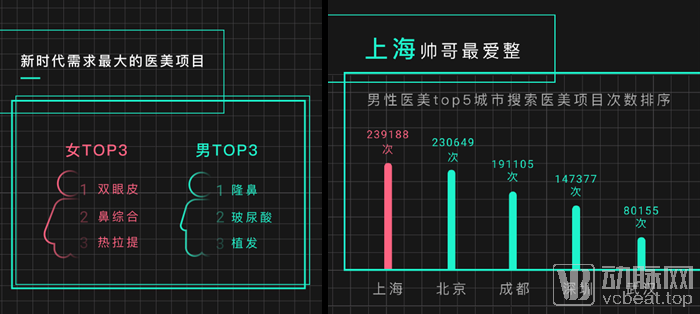
Do Men Also Love Medical Aesthetics? Meigeng AI defines "trendy men" as a new generation of male medical aesthetic users who are willing to invest time and money to become more fashionable and handsome. The report points out that the top three procedures with the highest demand among women are double eyelid surgery, comprehensive rhinoplasty, and Thermage FLX (ReTheraLift), while the top three favorite medical aesthetic procedures among men are rhinoplasty, hyaluronic acid fillers, and hair transplantation. The high demand for nasal procedures among both men and women is largely because Asians generally have low nasal bridges and wide alae, whereas modern aesthetics consider a high nasal bridge and standard-sized alae as hallmarks of beauty for both men and women.
Among the search data from numerous cities, men in Shanghai ranked first for male aesthetic medicine, with 239,188 clicks on recommended aesthetic procedures via the Gengmei AI. Beijing ranked second with 230,649 clicks, while Chengdu came in third with 191,105 clicks. Shenzhen and Wuhan ranked fourth and fifth, respectively, with 147,377 and 80,155 clicks on recommended aesthetic procedures via the Gengmei AI. It appears that the development of male aesthetic medicine is positively correlated with urban culture and the degree of openness to new trends.
IV. The average skin age of individuals born in the 1990s is five years younger than their chronological age, while that of those born after 1985 is two years older.
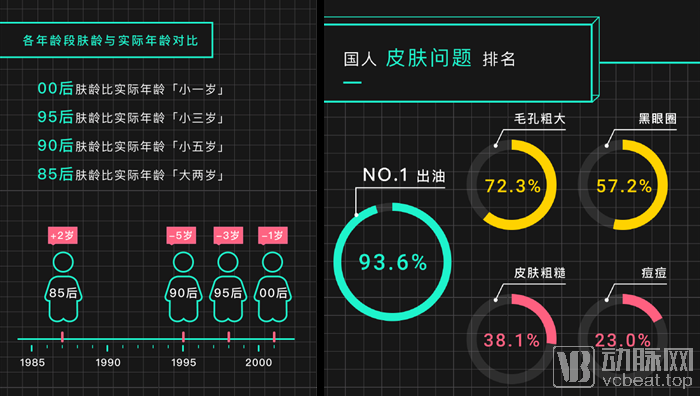
In the comparison between skin age and chronological age, individuals born in the 1990s have a skin age five years younger than their actual age, reflecting better skincare maintenance. Those born in the late 1990s follow with a skin age three years younger, while the post-2000 generation, in the prime of youth, have a skin age one year younger. In contrast, individuals born in the late 1980s have a skin age two years older than their chronological age, demonstrating the highest demand for anti-aging medical aesthetic treatments such as Ultherapy.
Among the myriad of skin concerns, over 90% of Chinese individuals struggle with excessive sebum production, more than 70% suffer from enlarged pores, over half have dark circles under their eyes, and more than 20% experience acne. In light of this, minimally invasive aesthetic procedures addressing basic skincare needs—such as hydration, acne treatment, and hyaluronic acid therapies—will remain essential demands in the coming years.
5. “Liposuction for Breast Reduction” Emerges as a New Aesthetic Medicine Demand Among Women in the New Era, While Abdominal Slimming Remains a Core Need
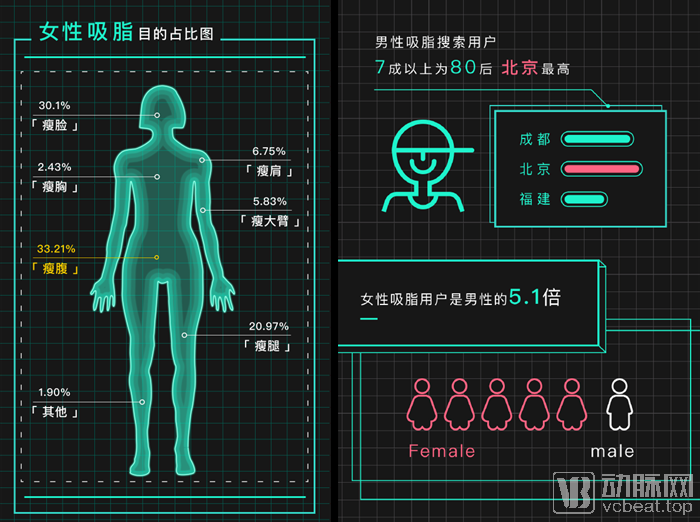
Liposuction is currently a widely popular medical aesthetic procedure that can quickly help beauty enthusiasts achieve their ideal body shape. Data shows that female liposuction users are 5.1 times more numerous than male users, indicating that in the prevailing aesthetic environment where slimness is prized, women’s demand for becoming thinner still far exceeds that of men.
For women, liposuction primarily targets abdominal and facial slimming, followed by leg and shoulder contouring; however, we have observed that the demand for breast-reduction liposuction has entered the public spotlight for the first time. Among male users searching for liposuction services, over 70% are post-1980s individuals experiencing steady weight gain, with Beijing, Fujian, and Chengdu ranking as the top three cities in terms of demand.
Today, the post-80s generation is collectively crossing the threshold into their 40s. Accompanying this “micro-middle-age” phase is a significant increase in body fat, and as their purchasing power stabilizes, this demographic presents substantial growth potential for medical aesthetic consumption.
About Gengmei AI:
“Gengmei AI” leverages Gengmei’s vast datasets of facial imagery and aesthetic procedure images, along with specialized aesthetic knowledge and expertise accumulated through deep engagement in the medical aesthetics field. Powered by Gengmei’s advanced core AI technologies, it establishes the “Gengmei AI Brain.” This represents an upgraded, full-scenario AI tool for facial attractiveness perception and aesthetic analysis, following Gengmei’s industry-first launch of a plastic surgery simulator in 2017.
Currently launched features include: Gengmei AI Intelligent Facial Diagnostic Analysis, Gengmei AI Intelligent Facial Deformation Simulation, and Gengmei AI Intelligent Skin Diagnostic Detection. Through scientific and professional analysis, Gengmei AI enables users to accurately understand their own needs, reduces communication costs with merchants, and significantly enhances industry efficiency.
About Gengmei
Gengmei App, established in 2013, is a leading consumer healthcare platform in China, offering services in plastic surgery, minimally invasive procedures, dentistry, ophthalmology, and anti-aging treatments. Gengmei serves 36 million users, with nearly 20,000 professional doctors and over 8,000 institutions registered on the platform, and features 4 million authentic cosmetic surgery diaries.
In 2018, the Gengmei app completed a Series D financing round worth tens of millions of U.S. dollars. Over six years, Gengmei secured five rounds of funding. Its investors across these rounds have included numerous listed companies and renowned investment firms such as Tencent, Sequoia China, CHJ Jewellery, Matrix Partners China, Vivo Capital, Meitu, Fosun Pharma, Legend Capital, and China Securities Co., Ltd.