

Born Fuke Medical Files for IPO: Pioneering Non-Invasive Brain Edema Monitor Delivers Intracranial Lesion Assessment in 40 Seconds
Prior to the establishment of Chongqing BORN-FUKE MEDICAL Equipment Co., Ltd. (hereinafter referred to as “BORN-FUKE”), the BORN Group, co-founded by Chairman Wu Qi, had already gained significant renown in Chongqing’s software industry. As early as 1999, BORN Group became the largest IT enterprise in Chongqing Municipality. In 2001, it commenced the research and development of automated office software, emerging as China’s largest OA (Office Automation) developer.
Why Did Wu Qi, Who Had Already Achieved Fame and Fortune in the Software Industry, Choose to Establish BORN-FUKE in 2005 to Enter the Medical Device Sector?
Wu Qi stated that the establishment of BORN-FUKE embodies the Born Group’s philosophy of “making software tangible,” with its primary mission being to develop an embedded development platform with independent intellectual property rights, thereby enabling the application of software technology in modern medical devices.
When discussing the original intention behind founding Chongqing BORN-FUKE MEDICAL Equipment Co., Ltd., Wu Qi stated that it was due to a fortuitous coincidence.

Wu Qi, Chairman of BORN-FUKE
Lack of continuous bedside monitoring equipment for the brain
There is a significant unmet need for cerebral edema monitoring
The founding of BORN-FUKE is inseparable from two individuals: Professor Dong Weiwei from Chongqing Medical University and Professor Yang Hao from the Department of Electrical Engineering at Chongqing University. Professor Dong, a nationally renowned neurologist, and Professor Yang are both natives of Shanghai and have been friends for many years.
On one occasion, Professor Dong mentioned to Professor Yang, “There is a significant shortage of devices capable of effectively monitoring cerebral edema in neurology.” Upon hearing this, Professor Yang collaborated with Professor He Wei from Chongqing University to develop a simplified electronic device. To further refine the device, Professors Yang and He Wei approached Wu Qi, a Chongqing University graduate and entrepreneur, with the hope of jointly developing a non-invasive intracranial edema monitor.
Wu Qi had never ventured into the medical field and was completely unfamiliar with craniocerebral diseases. Wu Qi stated, “Before developing a new product, the most critical step is to conduct needs assessment. Through this process, the significant unmet needs in the field of cerebral edema monitoring became increasingly clear, prompting me to commit to the development of a non-invasive intracranial edema monitor.”
Cerebral edema can be caused by stroke, as well as other cerebral conditions such as traumatic brain injury, brain tumors, and cerebral hypoxia. Cerebral edema leads to increased intracranial pressure; if not promptly diagnosed and managed, it can cause severe brain damage and even result in death due to brain herniation.
CT and MRI are common modalities for diagnosing cerebral edema. However, due to radiation concerns, these imaging systems cannot be used for continuous bedside monitoring; they are limited to preoperative or postoperative imaging examinations, thereby failing to enable the immediate detection of changes in edema, rebleeding, diffuse cerebral edema, subarachnoid hemorrhage, and other intracranial pathologies.
Invasive intracranial pressure (ICP) monitors represent one approach to ICP monitoring; however, their use requires invasive surgical procedures involving burr holes in the skull to insert pressure sensors into the brain parenchyma or ventricles, thereby carrying risks of complications such as infection and hemorrhage. Furthermore, these devices monitor only intracranial pressure, overlooking cerebral edema, the primary cause of elevated ICP.
Therefore, a device capable of continuously monitoring intracranial pressure and cerebral edema in patients with craniocerebral diseases can fill many gaps in the bedside continuous monitoring of such conditions.
During the development of the dynamic monitor for cerebral edema, Wu Qi was responsible for software and funding, Professor Dong handled clinical requirements, and Chongqing University led hardware R&D. In 2005, the first-generation non-invasive dynamic monitor for cerebral edema, BORN-BE, was successfully launched.
40-second output of monitoring results
Simultaneous monitoring of cerebral electrical impedance, edema volume, and intracranial pressure
After years of technological accumulation, the non-invasive dynamic cerebral edema monitor BORN-BE, developed by the company, offers multiple advantages, including being non-invasive, continuous, dynamic, and intelligent. It can generate cerebral edema monitoring results in just 40 seconds, partially replacing invasive intracranial pressure (ICP) monitoring, lumbar puncture for pressure measurement, and imaging examinations, thereby providing more evidence for physicians to formulate precise diagnosis and treatment plans for patients with craniocerebral diseases. Additionally, its ease of operation and high portability enable wide application in settings such as ICUs, general wards, and ambulances.
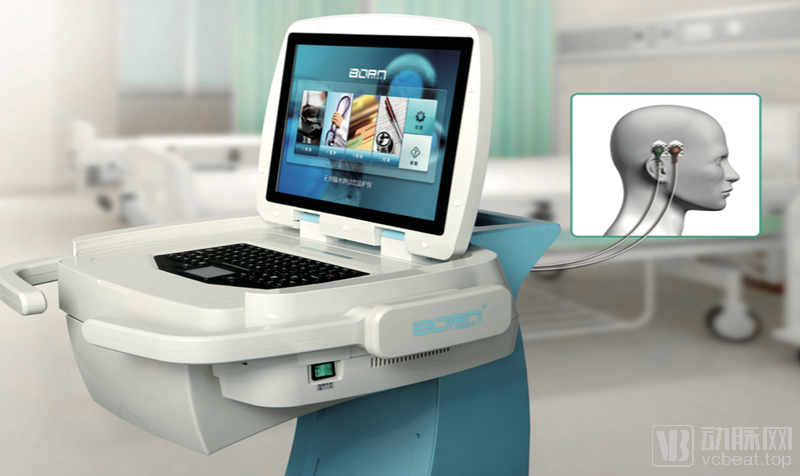
BORN-BE Non-invasive Dynamic Monitor for Cerebral Edema
BORN-BE employs Electrical Impedance Tomography (EIT) technology, which is fundamentally based on the principle of electromagnetic perturbation.
The R&D team at BORN-FUKE has discovered that establishing an external electromagnetic field within the cranium results in variations in the propagation and attenuation speeds of the field, due to differences in electrical conductivity and dielectric constants across various lesions. Consequently, by detecting different pathological conditions through electromagnetic perturbation and bioelectrical impedance differences, and leveraging precise algorithms powered by big data analytics, it is possible to monitor the progression of diseases.
Regarding the R&D process of BORN-BE, Wu Qi stated that it was not smooth, and he even considered giving up at one point. “Since the cranium is a relatively closed space, electromagnetic waves do not easily penetrate it, making it difficult to monitor changes in edema.” Fortunately, Wu Qi encountered his former classmate in the United States, Professor Zheng Yi. With Professor Zheng’s in-depth expertise in electromagnetic waves and his guidance, Chongqing BORN-FUKE MEDICAL Equipment Co., Ltd. successfully overcame this technical challenge.
After multiple upgrades and iterations, BORN-BE can simultaneously monitor cerebral electrical impedance, edema volume, and intracranial pressure. This is equivalent to completing both imaging examinations and intracranial pressure monitoring in a single session, which not only reduces costs but also minimizes the risks of misdiagnosis and missed diagnosis caused by relying on a single data source through comprehensive assessment of these three parameters.
To ensure the stability and accuracy of monitoring, BORN-BE employs a differential method to suppress common-mode interference in small signals and selects the thinnest point of the skull for detection, facilitating the penetration of electrical signals through the cranial bone. Meanwhile, the device features patented specialized brain electrodes that guarantee measurement consistency and stability. Additionally, during monitoring, four electrodes are used to perform rotational measurements at various locations and angles, achieving 360° coverage of the entire brain. Furthermore, several other key technologies have been adopted to significantly enhance detection precision.
Authoritative third-party statistical analysis reports indicate that the cerebral edema coefficient monitored by BORN-BE is highly positively correlated with edema conditions extracted from CT and MRI imaging data. The trends of change are basically consistent, with a concordance rate of up to 93.55%.
Wu Qi stated that screening for craniocerebral diseases, such as cerebral hemorrhage, cerebral infarction, brain tumors, traumatic brain injury, brain atrophy, and brain infections, should be included as part of the health checkup packages offered by medical examination centers. To this end, BORN-FUKE has developed a bioelectrical impedance analyzer for craniocerebral assessment specifically for these centers. The product development has been completed, and it is currently undergoing regulatory approval for market launch.
Academic and Research-Driven Sales
Clinically applied in over 700 medical institutions
Between 2017 and 2018, Chongqing BORN-FUKE MEDICAL Equipment Co., Ltd. collaborated with domestic and international universities, including St. Cloud State University in the United States, Chongqing University, and Soochow University, as well as dozens of authoritative domestic hospitals and laboratory platforms such as Xiangya Hospital of Central South University and Nanfang Hospital of Southern Medical University, to jointly apply for a series of major national and provincial projects. In response to the national call to advance the construction of medical consortiums, the company jointly carried out projects such as the “Demonstration Project on the Application of Innovative Medical Devices in Cranial Cerebral Disease Monitoring and Its Promotion and Application at the Primary Care Level,” covering multiple provinces across China.
In terms of business model, BORN-FUKE drives sales through academic and scientific research initiatives. The company has collaborated with tertiary Grade A hospitals and primary care hospitals across six regions—Southwest, East China, Central China, South Central China, South China, and Northwest China—to jointly establish the “Demonstration Project for the Application of Innovative Medical Devices in Cranial Disease Monitoring,” thereby achieving bulk sales.
To date, BORN-BE has been clinically applied in more than 700 medical institutions across China.
It is understood that Chongqing BORN-FUKE MEDICAL Equipment Co., Ltd. plans to raise funds for the research and development of new products, market expansion, and production line enlargement.