

Twelve Ministries Jointly Issue 'Opinions on Further Promoting Integrated Medical and Elderly Care Development' Outlining Five Key Areas and Fifteen Policies
VCBeat (WeChat ID: vcbeat) reported that on October 25, the National Health Commission, the Ministry of Civil Affairs, and ten other ministries and commissions jointly issued the “Several Opinions on Further Promoting the Development of Integrated Medical and Elderly Care Services” (hereinafter referred to as the “Opinions”). Addressing some of the bottlenecks and difficulties that have been widely reported by various parties in recent years, and in accordance with the deployment outlined in this year’s Government Work Report to “reform and improve policies for integrated medical and elderly care services,” the “Opinions” are grounded in the actual development of such integration and adhere to a problem-oriented approach. They focus on advancing five key areas and introduce a total of 15 specific policy measures.
First, strengthen the integration between medical and health services and elderly care services.
Second, advance the “decentralization, regulation, and service” reform.
Third, increase government support.
Fourth, optimize support policies.
Fifth, strengthen team building.
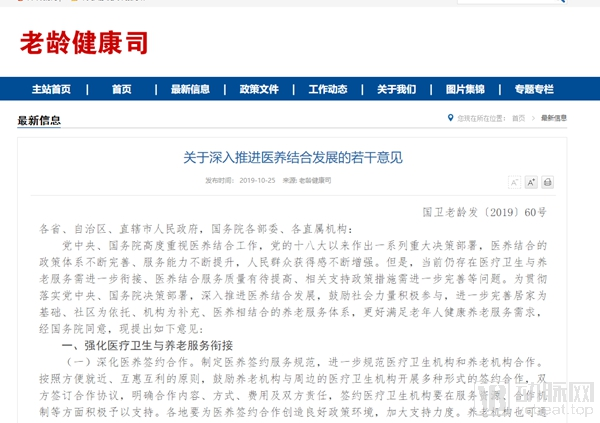
The full text of the policy is as follows:
To the People’s Governments of all provinces, autonomous regions, and municipalities directly under the Central Government, and to all ministries and commissions of the State Council and all institutions directly under the State Council:
The CPC Central Committee and the State Council attach great importance to the integration of medical care and elderly care. Since the 18th National Congress of the Communist Party of China, a series of major decisions and deployments have been made, leading to continuous improvement in the policy framework for integrating medical and elderly care services, enhanced service capacity, and a growing sense of gain among the people. However, challenges remain, including the need for better coordination between healthcare and elderly care services, improvements in the quality of integrated medical and elderly care services, and further refinement of relevant supportive policies and measures. To implement the decisions and deployments of the CPC Central Committee and the State Council, promote the in-depth development of integrated medical and elderly care, encourage active participation by social forces, further improve the elderly care service system that is home-based, community-supported, institution-supplemented, and integrates medical care with elderly care, and better meet the health and elderly care needs of older adults, the following opinions are hereby proposed with the approval of the State Council:
I. Strengthening the Integration of Medical and Health Services with Elderly Care Services
(1) Deepen the signing of cooperation agreements between medical and elderly care institutions.Develop standards for contracted medical and elderly care services to further regulate cooperation between medical and health institutions and elderly care institutions. In accordance with the principles of convenience, proximity, mutual benefit, and reciprocity, encourage elderly care institutions to engage in various forms of contracted cooperation with nearby medical and health institutions. Both parties shall sign cooperation agreements that clearly define the content, methods, fees, and responsibilities of each party. Contracted medical and health institutions shall provide active support in terms of service resources and cooperation mechanisms. Local governments shall create a favorable policy environment and increase support for such contracted cooperation. Elderly care institutions may also engage medical and health institutions to provide medical and health services to resident elderly persons through service outsourcing or entrusted operation models. Encourage elderly care institutions to establish close linkages and collaborative mechanisms with continuing care institutions in their vicinity, such as rehabilitation hospitals (rehabilitation medical centers), nursing hospitals (nursing centers), and hospice care centers. Medical institutions within elderly care facilities that meet the necessary conditions may establish two-way referral mechanisms with contracted medical and health institutions. Strictly adhering to admission and discharge criteria and two-way referral indications of medical and health institutions, they shall provide continuous, full-process medical and health services for the elderly. (The National Health Commission, the Ministry of Civil Affairs, and the National Administration of Traditional Chinese Medicine shall be responsible according to their respective duties; local people's governments at all levels shall be responsible.)
(2) Reasonably plan and establish relevant institutions.Implement projects to enhance the capacity of integrated medical and elderly care services in communities. Community health service institutions, township health centers, community-based elderly care facilities, and nursing homes shall utilize existing resources to renovate and expand a batch of community (township) facilities for integrated medical and elderly care services, focusing on providing centralized or home-based integrated medical and elderly care services for disabled (including those with dementia, hereinafter referred to as such) elderly individuals in communities (townships). Newly built community health service institutions in urban areas may establish internal facilities for integrated medical and elderly care services. Primary healthcare institutions with appropriate conditions may set up beds for rehabilitation, nursing, palliative care, and elderly care, and develop home hospital bed services tailored to local conditions. Leverage the unique role of Traditional Chinese Medicine (TCM) in preventive treatment, chronic disease management, disease treatment, and rehabilitation; promote TCM-appropriate technologies, products, and services; and strengthen the capacity of communities to provide integrated medical and elderly care services incorporating TCM.
In areas with the necessary conditions, efforts may be made to explore the integration of medical and healthcare resources with elderly care services, improve service coordination, enhance hardware facilities, and strengthen staffing, with a focus on providing integrated medical and elderly care services to impoverished elderly individuals who are disabled. In rural areas, integrated planning and co-located construction of township health centers with nursing homes for the elderly, and village clinics with rural happiness homes, may be explored. (The National Health Commission, the Ministry of Civil Affairs, the National Development and Reform Commission, the Ministry of Finance, the Ministry of Natural Resources, the Ministry of Housing and Urban-Rural Development, the Ministry of Agriculture and Rural Affairs, and the National Administration of Traditional Chinese Medicine shall be responsible according to their respective duties; local people’s governments at all levels shall be responsible.)
(3) Strengthening Information Technology Support for the Integration of Medical and Elderly Care Services.Leverage existing information platforms for health and elderly care to build a smart health and elderly care service network covering households, communities, and institutions, thereby promoting the sharing, in-depth development, and rational utilization of health and elderly care data for older adults. Implement an action plan for the development of the smart health and elderly care industry, supporting the research and development of intelligent service robots for medical assistance, home caregiving, security monitoring, disability assistance, and emotional companionship. Vigorously develop smart health and elderly care products and services, such as health management, health screening and monitoring, health services, and intelligent rehabilitation aids. Advance the construction of telemedicine systems for integrated medical and elderly care institutions (referring to medical or elderly care institutions that possess both medical qualifications and elderly care service capabilities).
Improve and strengthen the management of electronic health records (EHRs) for residents. Within one month after the completion of free health examinations for the elderly, inform them of their examination results and provide health guidance recommendations. Based on historical examination data, establish continuous electronic health records for the elderly and deliver targeted health management services, including traditional Chinese medicine (TCM) health management services. (The National Health Commission, the Ministry of Industry and Information Technology, the Ministry of Civil Affairs, and the National Administration of Traditional Chinese Medicine shall be responsible according to their respective duties; local people’s governments at all levels shall be responsible.)
II. Advancing the “Streamline Administration, Delegate Power, and Improve Services” Reform for Integrated Medical and Elderly Care Institutions
(4) Streamlining the Approval and Registration of Integrated Medical and Elderly Care InstitutionsAll localities shall earnestly implement the requirements set forth in the “Notice on Doing a Good Job in the Approval and Registration of Medical-Nursing Combined Institutions” (Guo Wei Ban Lao Ling Fa [2019] No. 17) issued by the National Health Commission and other relevant departments, so as to optimize the approval processes and administrative environment for medical-nursing combined institutions. For elderly care institutions establishing medical institutions at Level II or below (excluding emergency centers, emergency stations, clinical laboratory centers, Sino-foreign joint venture or cooperative medical institutions, and wholly owned medical institutions from Hong Kong, Macao, and Taiwan), the approval for establishment and the registration for practice license shall be integrated into a single certification process (“two certificates merged into one”). Where medical and health institutions utilize existing resources to provide elderly care services, they may directly proceed with registration and filing based on their existing qualifications related to construction, fire safety, food safety, and hygiene and epidemic prevention, thereby simplifying procedures. (The National Health Commission, the Ministry of Civil Affairs, the National Development and Reform Commission, the Ministry of Housing and Urban-Rural Development, the State Administration for Market Regulation, and the National Administration of Traditional Chinese Medicine shall be responsible according to their respective duties; local people’s governments at all levels shall be responsible for implementation.)
(5) Encourage social forces to establish medical-nursing combined institutions.The government imposes no planning restrictions on the total regional number of privately operated medical-nursing combined institutions. In accordance with the principle of “market entry unless explicitly prohibited,” no pre-approval requirements lacking legal or regulatory basis or deemed unreasonable shall be imposed, and all such existing requirements shall be comprehensively reviewed and abolished. The operational nature of privately operated medical-nursing combined institutions shall not be restricted without legal or regulatory basis. For matters involving relevant administrative departments at the same level, local government service agencies shall implement a “single-window” processing system, providing one-time notification of approval items and procedures, acceptance conditions, document checklists, processing timeframes, and other relevant information. Social forces are supported in establishing medical-nursing combined institutions through market-oriented operations, and they shall enjoy preferential policies related to taxes and fees, financing and investment, land use, and other areas in accordance with regulations. Localities may adopt models such as publicly built but privately operated, or privately run with public assistance, to support social forces in providing multi-level and diversified medical-nursing combined services for the elderly. Local governments are encouraged to formulate various preferential support policies tailored to local conditions. Support is provided for large-scale privately operated medical-nursing combined institutions to pursue group-based and chain-based development. Financial institutions such as insurance companies and trust investment companies are encouraged to act as investors in establishing medical-nursing combined institutions. (The National Health Commission, the National Development and Reform Commission, the Ministry of Civil Affairs, the Ministry of Finance, the Ministry of Natural Resources, the Ministry of Housing and Urban-Rural Development, the People’s Bank of China, the State Taxation Administration, the State Administration for Market Regulation, the China Banking and Insurance Regulatory Commission, the China Securities Regulatory Commission, and the National Administration of Traditional Chinese Medicine shall be responsible according to their respective duties; local people’s governments at all levels shall be responsible.)
(6) Strengthen the supervision of integrated medical and elderly care services.Supervision of integrated medical and elderly care services shall be led by the health administrative departments (including traditional Chinese medicine authorities, hereinafter the same) with coordination from civil affairs departments. Medical and health institutions and elderly care institutions within integrated medical and elderly care facilities shall be subject to industry-specific supervision by the health administrative departments and civil affairs departments, respectively. The National Health Commission, in conjunction with the Ministry of Civil Affairs and other relevant departments, shall formulate regulatory and assessment measures, strengthen the assessment and inspection of service quality in integrated medical and elderly care, and include factors such as increases in medical beds and home hospital beds in the assessment criteria. Guidelines for services and management of integrated medical and elderly care institutions shall be studied and formulated. All integrated medical and elderly care institutions shall strictly comply with relevant laws, regulations, rules, standards, and norms governing medical and health services as well as elderly care services; establish and improve relevant institutional rules and regulations and personnel post responsibility systems; and strictly implement fire safety responsibilities and various safety systems. (The National Health Commission, the Ministry of Civil Affairs, the Ministry of Emergency Management, and the National Administration of Traditional Chinese Medicine shall be responsible according to their respective duties, with local people's governments at all levels bearing overall responsibility.)
III. Increase Government Support
(7) Reducing Tax and Fee BurdensImplement various tax and fee preferential policies. For privately operated medical-nursing combined institutions recognized as non-profit organizations, corporate income tax shall be exempted on their eligible non-profit income, and preferential policies for real estate tax and urban land use tax shall be applied to their self-used properties and land in accordance with regulations. Eligible medical-nursing combined institutions shall enjoy fiscal and tax preferential policies applicable to small and micro enterprises. Institutions providing day care, rehabilitation, nursing, and other services within communities shall receive support such as tax and fee reductions or exemptions, financial assistance, and preferential pricing for water, electricity, gas, and heating, provided they meet the relevant conditions. Preferential policies for administrative and institutional fees shall be implemented for medical-nursing combined institutions in accordance with regulations. (The Ministry of Finance, the State Taxation Administration, the National Development and Reform Commission, and the State Administration for Market Regulation shall be responsible according to their respective duties; local people's governments at all levels shall be responsible.)
(8) Strengthen investment support.Localities shall intensify government procurement of services to support qualified private medical-nursing combined institutions in undertaking local public health, basic medical care, and basic elderly care services. Lottery public welfare funds allocated for social welfare undertakings shall provide appropriate support for the development of medical-nursing combined services. (The Ministry of Finance, the National Development and Reform Commission, the National Health Commission, and the Ministry of Civil Affairs shall be responsible according to their respective duties; local people’s governments at all levels shall be responsible.)
(9) Strengthen the guarantee of land supply.In the preparation of territorial space plans, all localities shall take into comprehensive consideration the development of integrated medical and elderly care services, ensure proper land-use planning and layout, and effectively guarantee the land required for the construction and development of institutions providing such integrated services. Non-profit institutions offering integrated medical and elderly care may use state-owned allocated land in accordance with the law, while for-profit institutions shall obtain land use rights through compensated means. Local governments are encouraged to improve long-term mechanisms for the operation and maintenance of community comprehensive service facilities, and to allow the free or low-cost use of such facilities for the provision of integrated medical and elderly care services. The use of rural collective construction land that conforms to planned purposes for the construction of institutions providing integrated medical and elderly care is encouraged in accordance with the law.
Without altering planning conditions, existing vacant commercial properties, factories, school buildings, office buildings, training facilities, and other facilities in urban areas are permitted to be revitalized and utilized to provide integrated medical and elderly care services, and the transitional period policy shall apply. Land may continue to be used for its original purpose and under the original type of land use rights for five years. Upon expiration of the five-year period, or where transfer involves the need to complete relevant land use procedures, such procedures may be handled through agreement based on the new purpose, new type of land use rights, and market price. For land used by non-profit institutions, originally allocated land may continue to be used under allocation. (The Ministry of Natural Resources, the Ministry of Housing and Urban-Rural Development, the Ministry of Finance, the Ministry of Agriculture and Rural Affairs, the National Health Commission, and the Ministry of Civil Affairs shall be responsible according to their respective duties; local people's governments at all levels shall be responsible.)
(10) Broaden investment and financing channels.Encourage elderly care institutions within privately operated medical-nursing combined facilities to raise start-up and development funds through equity financing, project financing, and other methods. Encourage financial institutions to innovate financial products and services based on the characteristics of medical-nursing integration, expand diversified investment and financing channels, leverage the synergistic effects of “investment, lending, bonds, leasing, and securitization,” and increase financial support for the medical-nursing integration sector. Encourage local governments to explore and improve mortgage loan policies and broaden the scope of collateral for credit guarantees. (The People’s Bank of China, the China Banking and Insurance Regulatory Commission, the China Securities Regulatory Commission, the National Development and Reform Commission, the Ministry of Natural Resources, the National Health Commission, and the Ministry of Civil Affairs shall be responsible according to their respective duties; local people’s governments at all levels shall be responsible.)
IV. Optimizing Support Policies
(11) Improve the price policies for public medical institutions providing elderly care services.Pricing standards shall, in principle, be determined based on actual service costs, taking into account factors such as market supply and demand conditions and the public’s ability to pay. The leverage role of pricing should be fully utilized to enhance the enthusiasm of public medical institutions in providing elderly care services; where bidding conditions are met, it is encouraged to determine pricing standards through a bidding process. (The National Development and Reform Commission and the State Administration for Market Regulation shall be responsible according to their respective duties, and local people’s governments at all levels shall be responsible.)
(12) Support the provision of home-based services.Develop and issue policies defining the content, standards, and specifications for in-home medical and health services, and improve pricing policies for such services. Establish and strengthen support mechanisms to appropriately enhance compensation and benefits for personnel providing in-home services. Institutions delivering in-home services must purchase liability insurance, medical malpractice insurance, personal accident insurance, and other relevant coverage to mitigate and respond to professional practice risks and personal safety hazards. Implement a long-term prescription system for medications used in the management of chronic diseases among the elderly. Family doctor contract service teams shall provide enrolled elderly individuals with basic contracted services, including primary medical care and public health services, as well as personalized services. (The National Health Commission, the Ministry of Finance, the National Healthcare Security Administration, the Ministry of Human Resources and Social Security, and the National Administration of Traditional Chinese Medicine shall be responsible according to their respective duties; local people’s governments at all levels shall also bear responsibility.)
(13) Strengthen insurance support and regulatory oversight.Medical institutions within qualified integrated medical and elderly care facilities shall be included in the designated network for urban and rural resident basic medical insurance in accordance with regulations. These institutions may apply for designated status after three months of formal operation, and the evaluation process for designated status must be completed within no more than three months. For patients referred and hospitalized in compliance with regulations, the deductible amount for medical insurance shall be calculated consecutively. We will actively promote diversified composite payment methods, including diagnosis-related groups (DRG), per-diem payments, and other models. Localities with the necessary conditions are encouraged to gradually expand the range of medical rehabilitation services covered by basic medical insurance, in accordance with relevant regulations.
Clarify the payment boundaries between medical and health services and elderly care services. The basic medical insurance fund shall only be used to cover expenses for medical and health services, such as diagnosis and treatment of diseases, medical nursing, and medical rehabilitation that fall within the scope of basic medical security; it shall not be used to pay for elderly care service costs, such as daily living assistance. In regions implementing the long-term care insurance system, the long-term care expenses for disabled elderly individuals shall be paid by the long-term care insurance in accordance with relevant regulations. Accelerate the pilot programs for long-term care insurance.
Support commercial insurance institutions in vigorously developing medical and elderly care insurance. Develop exclusive products tailored to the risk profiles and needs of the elderly, increase the variety of commercial insurance options available to them, and submit these products for approval and filing in accordance with regulations. Prioritize the development of disease insurance, medical insurance, and accidental injury insurance for the elderly. Encourage the provision of end-to-end services to facilitate the purchase of commercial insurance by the elderly through deep community engagement. Study the introduction of a conversion mechanism between life insurance payout liabilities and long-term care payment liabilities, supporting insured individuals in receiving insurance benefits in advance upon becoming disabled during their lifetime, to cover nursing care expenses. Accelerate the development of various elderly care insurance products, including commercial long-term care insurance, to meet the nursing care protection needs of the elderly. (The National Healthcare Security Administration, the National Development and Reform Commission, and the China Banking and Insurance Regulatory Commission shall be responsible according to their respective duties; local people's governments at all levels shall be responsible.)
V. Strengthening Team Building
(14) Expand the workforce for integrated medical and elderly care services.Integrate the development of personnel for integrated medical and elderly care into the development plans for health services and elderly care services, respectively. Encourage and guide ordinary universities and vocational colleges (including technical schools) to add relevant majors and courses, strengthen the training of professionals in geriatrics, rehabilitation, nursing, health management, social work, and elderly care service and management, and expand enrollment in these related fields. Coordinate existing resources to establish a number of training bases for integrated medical and elderly care, and explore collaborative training models involving ordinary universities, vocational colleges, research institutions, industry societies and associations, and integrated medical and elderly care institutions. Localities should formulate training plans to provide professional skills training and safety awareness training to relevant professional technical personnel and service staff at different levels and categories. Integrated medical and elderly care institutions should give priority to hiring medically trained caregivers and elderly care assistants who have completed approved training programs.
Fully leverage the role of public welfare organizations, increase efforts to cultivate and support volunteer service projects and organizations that assist the elderly, and encourage volunteer service organizations to partner with medical-nursing combined institutions to provide services, thereby offering greater care and support to older adults through volunteer activities. Encourage medical institutions, elderly care facilities, and other professional organizations to provide caregiving and emergency first aid training to family members of older adults and practitioners in domestic services, among others. (The Ministry of Education, the Ministry of Human Resources and Social Security, the National Development and Reform Commission, the National Health Commission, the Ministry of Civil Affairs, the Central Committee of the Communist Youth League, the All-China Women's Federation, and the Red Cross Society of China shall be responsible according to their respective duties; local people's governments at all levels shall be responsible.)
(15) Support medical personnel in providing integrated medical and elderly care services.Implement a regional registration system for physician practice locations to support medical personnel in practicing at integrated medical and elderly care institutions. Establish mechanisms for advanced studies and rotational training for medical staff at these institutions to enhance their service capabilities and standards. Encourage retired medical professionals to practice at integrated medical and elderly care institutions. Local governments should introduce supportive policies to guide graduates from vocational colleges in nursing and related fields to practice at such institutions. Medical personnel at integrated medical and elderly care institutions shall enjoy equal treatment with those at other healthcare institutions regarding professional title evaluation and continuing education for professional and technical personnel. Where integrated medical and elderly care institutions lack the capacity to provide continuing education and training, local health administrative departments may coordinate qualified entities to organize centralized training. (The National Health Commission, the Ministry of Human Resources and Social Security, and the Ministry of Education shall be responsible according to their respective duties; local people’s governments at all levels shall be responsible.)
All localities and relevant departments must attach great importance to this matter, strengthen communication and coordination, and form a synergistic working force. Health administrative departments at all levels shall, in conjunction with civil affairs and other departments, enhance supervision, inspection, and performance evaluation. Building on the establishment of demonstration provinces for integrated medical and elderly care services, efforts will continue to create pilot demonstration counties (cities, districts) and institutions. Regions and institutions that proactively implement policies and achieve outstanding results will receive preferential support in the allocation of fiscal subsidies, thereby leveraging their demonstrative and leading roles to promote the in-depth and healthy development of integrated medical and elderly care services across China.
National Health Commission of the People's Republic of China Ministry of Civil Affairs
National Development and Reform Commission Ministry of Education
Ministry of Finance Ministry of Human Resources and Social Security
Ministry of Natural Resources Ministry of Housing and Urban-Rural Development
State Administration for Market Regulation National Healthcare Security Administration
National Administration of Traditional Chinese Medicine National Working Committee on Aging
October 23, 2019
Link to the original policy text:http://www.nhc.gov.cn/lljks/pqt/201910/8a2dcde905074e89bef088f9f1a5b397.shtml