

AI Bone Age Follow-up Research Unveiled at Chinese Pediatric Academic Congress, Significantly Enhancing Radiographic Assessment Efficiency
The 24th National Pediatric Academic Conference, hosted by the Chinese Medical Association and its Subspecialty of Pediatrics, was held at the Zhuhai International Convention Center from October 23 to 26. Over 10,000 renowned experts and scholars in the field of pediatrics from around the world attended this prestigious event to exchange insights on hot topics in pediatric medicine.
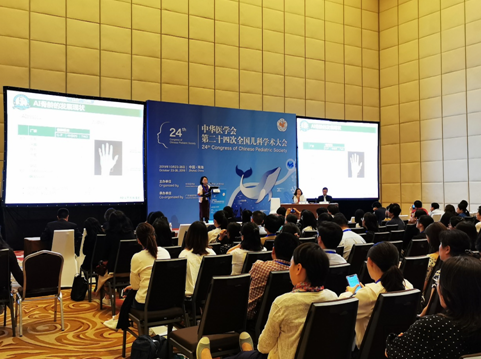
The National Academic Conference on Pediatrics is the highest academic benchmark in the field of pediatrics in China, with over 13,000 paper submissions received for the 2019 conference.
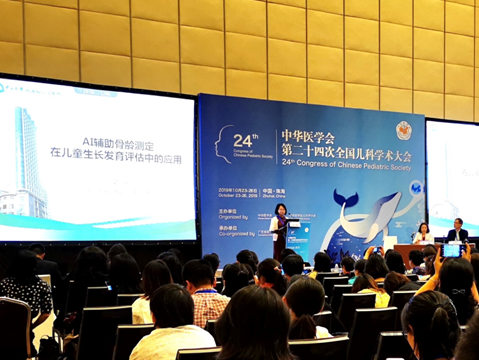
On October 25, Liang Liyang, a member of the Child Endocrinology, Genetics and Metabolism Group under the Pediatric Branch of the Chinese Medical Association, Deputy Leader of the Pediatric Endocrinology Group of the Guangdong Medical Association, and Director of the Department of Pediatric Endocrinology at Sun Yat-sen Memorial Hospital, Sun Yat-sen University, delivered a keynote address titled “Application of AI-Assisted Bone Age Assessment in the Evaluation of Children’s Growth and Development.” He elaborated in detail on the real-world clinical effectiveness of AI systems for assessing children’s growth and development in pediatric practice, as well as recent advances in related clinical research.
Sun Yat-sen Memorial Hospital of Sun Yat-sen University introduced the Yitu Healthcare care.ai® Intelligent Diagnostic System for Pediatric Growth and Development in December 2018. Currently, both campuses of the hospital have adopted a “physician + AI” model for interpreting all pediatric bone age radiographs in the Departments of Radiology and Pediatrics. To date, more than 1,000 images have been interpreted using this model, and the adoption rate of the AI-generated pediatric growth and development reports by the Department of Radiology has exceeded 99%, achieving deep integration of the AI system into clinical workflows.
“The widespread adoption of AI systems has brought welcome changes to clinical practice,” said Director Liang, reflecting on his experience with AI. “Under the new ‘physician + AI’ model for image interpretation, both the accuracy and consistency of pediatric bone age assessments have improved significantly, while reading time has been substantially reduced. Furthermore, features such as intelligent historical imaging follow-up and pediatric growth and development reports provide a more comprehensive and scientific basis for clinical diagnosis.”
To further explore the clinical effectiveness of AI systems for pediatric growth and development, Sun Yat-sen Memorial Hospital of Sun Yat-sen University, in collaboration with Yitu Healthcare, is conducting a research project on bone age follow-up. The preliminary results are promising, and detailed findings will be announced soon.
The Report on the Nutrition and Chronic Disease Status of Chinese Residents shows that there are currently 248 million children and adolescents aged 0-15 in China, with an urgent need for diagnosis and treatment of growth and development issues such as short stature, obesity, and precocious puberty. It is roughly estimated that over 100 million children and adolescents require regular growth and development assessments each year.
Director Liang revealed that prior to the introduction of Yitu Healthcare’s care.ai® Intelligent Diagnostic System for Pediatric Growth and Development, the various hospital campuses predominantly relied on the more convenient Greulich-Pyle (GP) atlas method. However, due to differences in image-reading habits and subjective interpretation, discrepancies existed among bone age assessments performed by different physicians. This posed certain challenges to the precise evaluation of pediatric growth and development, as well as to longitudinal bone age monitoring during patient treatment.
With the adoption of the “physician + AI” image interpretation model, pediatric endocrinologists have widely embraced more precise scoring methods. Supported by AI systems, the efficiency of bone age assessment has been significantly improved, while inter-observer variability among physicians has been markedly reduced. The interpretation results demonstrate high consistency, achieving a “dual improvement” in both interpretation efficiency and quality.
“Variations in usage habits and subjective differences among different regions, hospitals, and experts have long been significant factors hindering the improvement of clinical bone age interpretation quality. Therefore, the consistency achieved under the ‘physician + AI’ model is particularly valuable. It is crucial to establish industry standards for clinical quality control,” stated Director Liang. “Meanwhile, the AI system’s intelligent historical imaging follow-up function provides comprehensive technical support for pediatricians in monitoring growth trends and evaluating clinical efficacy. This facilitates scientific assessment of treatment progress by clinical experts, enabling the formulation of personalized, precision treatment plans and helping to avoid delayed treatment or excessive medication.”
To fully validate the value of AI systems in follow-up assessments of pediatric growth and development, this study, supported by Director Liang, enrolled 52 children with growth hormone deficiency. Nearly 300 historical bone age images and extensive valuable multidimensional clinical diagnosis and treatment data were collected. Two pediatric endocrinologists independently interpreted the enrolled images using the Chinese-05 method. Core metrics observed included interpretation time, accuracy of follow-up assessments, and inter-rater reliability among different physicians.
Preliminary analysis revealed that the “physician + AI” image interpretation model significantly improves reading efficiency. Prior to the adoption of AI assistance, the average time required for manual bone age assessment per image was 2.6 minutes. After implementing the “physician + AI” model, one group of experts doubled their reading speed, achieving a rate of 1.45 minutes per image; another group tripled their speed, reaching 0.84 minutes per image.
In terms of the more critical aspects of image interpretation accuracy and consistency, the accuracy of dynamic bone age assessment was significantly improved. Instances of negative growth in bone age interpretation by the same expert during follow-up assessments of the same patient were markedly reduced. Meanwhile, inter-expert variability in dynamic bone age assessment was significantly decreased, with no significant between-group differences observed in the image interpretation results between the two groups of experts.
Figure: During a follow-up assessment of a pediatric patient by Doctor 2, the bone age determined from the imaging on September 20, 2017, was younger than that from the previous imaging on March 29, 2017, indicating negative growth. After incorporating AI-assisted analysis, this phenomenon of negative growth was eliminated.
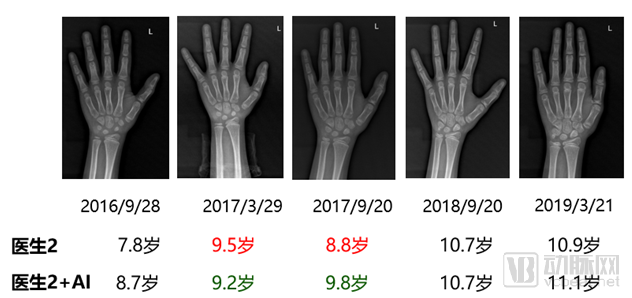
Figure: After AI assistance, the discrepancy in dynamic bone age assessment between two experts was significantly reduced
“Bone age assessment is a critical component in the diagnosis and treatment of pediatric endocrine disorders. It is particularly essential for children with growth and developmental abnormalities, such as short stature and precocious puberty, to undergo regular bone age monitoring to accurately track changes in their growth and development,” stated Director Liang. “Issues related to child growth and development cannot be delayed; missing the optimal intervention window may lead to lifelong regrets. We anticipate the widespread clinical adoption of AI systems for pediatric growth and development, and we hope that AI will deliver greater value in areas such as strengthening specialized care capabilities, enhancing primary healthcare services, and empowering tiered diagnosis and treatment within regional healthcare systems.”