

Beijing Medical-Engineering Convergence Innovation Top 10 Frontier Technology Directions Released at Inaugural Zhongguancun 'Med-Eng Valley' Forum
On October 26, 2019, the inaugural Zhongguancun “Med-Eng Valley” Innovation and Entrepreneurship Summit Forum was held at Beihang University, where the “Top Ten Hotspots in Frontier Technologies for Medical-Engineering Cross-Disciplinary Innovation in Beijing” were released. The report focuses on five major areas: AI-driven healthcare, precision minimally invasive surgical robots, intelligent elderly care and wellness, biomaterials and 3D printing, and hospital automation services.

(Figure caption: Conference venue)
“Top 10 Hotspots in Frontier Technologies for Medical-Engineering Interdisciplinary Innovation in Beijing” was jointly released by the Beijing Advanced Innovation Center for Biomedical Engineering, the Innovation and Translation Center of Peking University Third Hospital, and the Zhongguancun Zhiyou Angel Research Institute.The ten key directions were identified through extensive research into global frontier trends in medical-engineering interdisciplinary technologies, combined with China’s actual clinical needs, and informed by consultations with experts from academia, industry, and the investment sector. These directions were distilled across three dimensions: technology, clinical practice, and industry.
It aims to provide reference for research institutions, entrepreneurs, and investors engaged in frontier interdisciplinary basic research, development of technologies addressing critical clinical pain points, and innovation and entrepreneurship; it also seeks to contribute to establishing Beijing as a strategic high ground for medical-engineering interdisciplinary innovation across China and worldwide.
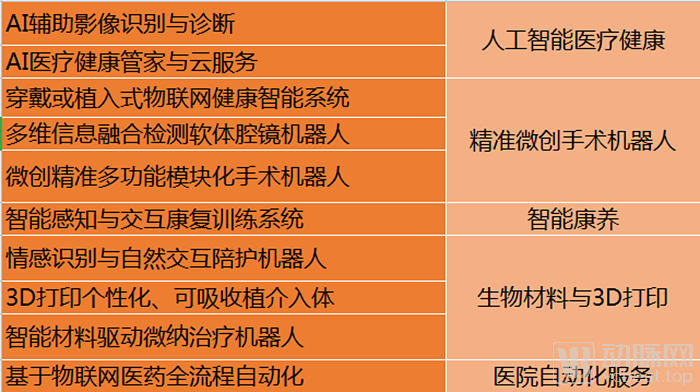
(Note: Top Ten Hotspots in Frontier Technologies for Medical-Engineering Interdisciplinary Innovation in Beijing)
1. AI-Assisted Image Recognition and Diagnosis
Built upon a database of medical imaging diagnostic experts, this system applies technologies such as reinforcement learning and deep learning to medical imaging to achieve rapid image processing and precise identification of lesion locations, thereby providing diagnostic recommendations to physicians. It is primarily used for the rapid diagnosis of pathological images, fundus images, radiography, and magnetic resonance imaging (MRI), reducing diagnostic time for physicians, lowering misdiagnosis rates, and alleviating doctor-patient conflicts. Meanwhile, it explores automatic image acquisition technologies, making intelligent recognition and diagnosis of real-time medical images, such as ultrasound and endoscopic images, possible.
2. AI Healthcare Manager and Cloud Services
Integrating artificial intelligence with health management devices, wearable technology is utilized to collect patient data and establish a physiological information database. Intelligent speech recognition technology enables user health management, while personalized health management plans are developed by analyzing personal health records in conjunction with big data. Cloud computing technology facilitates the monitoring and analysis of daily behaviors, achieving real-time health status monitoring and disease prediction. Furthermore, voice interaction provides patients with timely health management services at any time, thereby enabling chronic disease management and real-time health monitoring.
3. Wearable or Implantable IoT-Based Intelligent Health Systems
The integration of wearable sensor technology, big data intelligent analysis platforms, and human-computer interaction technologies has endowed wearable and implantable health systems with multiple capabilities, including biometric monitoring, health information feedback, and functional bionic organ support. Flexible, high-sensitivity wearable health systems, combined with highly stable signal communication technologies and intelligent data analysis platforms, achieve the integration of biometric monitoring and information feedback. The combination of biocompatible sensors and 3D printing technology enables wearable health systems to evolve from external vital sign monitoring to the realization of implantable bionic organ functions, thereby promoting the development of healthcare systems.
4. Soft Endoscopic Robot with Multidimensional Information Fusion Detection
By integrating flexible, variable soft robotics technology with laparoscopic surgical techniques, a master-slave operated soft laparoscopic robotic system is employed to perform complex laparoscopic procedures through minimal incisions, comprehensively advancing the minimally invasive nature of soft tissue surgery. Building on this foundation, technologies such as three-dimensional imaging and force/torque feedback are introduced to provide surgeons with more comprehensive intraoperative information, thereby ensuring surgical safety. Through independent technological innovation, this approach breaks the foreign monopoly on laparoscopic surgical robots and promotes the development of minimally invasive surgery.
5. Minimally Invasive, Precision, Multifunctional Modular Surgical Robot
Aiming for precise localization and accurate manipulation in surgical procedures, this system integrates technologies such as intelligent planning, 3D navigation, robotic automatic control, and AR/VR to drive the development of surgery towards minimally invasive, precise, and intelligent practices. It reduces the reliance of surgical robots on clinical experience through intelligent surgical planning, enhances the precision and safety of surgical procedures via real-time 3D navigation, performs delicate minimally invasive operations through robotic automatic control, improves the visualization of the surgical process using AR/VR technology, and achieves precise localization and manipulation in fields such as orthopedics, neurosurgery, and dentistry through a multifunctional modular design.
6. Intelligent Sensing and Interactive Rehabilitation Training System
Integrate wearable signal monitoring, assistive robotic structures and control, virtual reality, and neural interaction technologies to advance the intelligence of rehabilitation training systems and achieve superior human-machine interaction. Introduce rehabilitation robots designed according to human anatomical and physiological characteristics into assisted rehabilitation training, while incorporating interactive virtual scenes with multimodal perception. Utilize physiological signal monitoring and neural interaction to enable personalized rehabilitation feedback and tailored rehabilitation plans, thereby enhancing patients’ sensory stimulation and proactive responses, improving rehabilitation outcomes, and shortening recovery time.
7. Emotion Recognition and Natural Interaction Companion Robots
By integrating artificial intelligence with robotics and incorporating technologies such as intelligent speech recognition, information acquisition, and human-computer interaction, robots are enabled to interact with care recipients. Through the collection and extraction of data such as voice inputs, combined with AI-driven recognition, these robots can continuously monitor the physiological status of care recipients, identify their emotional states, and provide targeted feedback, thereby addressing both their physiological and psychological needs. Furthermore, through environmental perception and collaborative interaction, caregiving robots can perform nursing tasks in place of human caregivers, thereby enhancing the overall standard of medical and nursing care.
8. 3D-Printed Personalized, Bioabsorbable Implants and Interventional Devices
Leveraging 3D printing, integrated with three-dimensional personalized design and biomechanical analysis, to develop biocompatible, safe, and stable implantable prostheses; researching novel implantable materials to promote the application of absorbable and controllably degradable implants, thereby achieving short-term functional compensation for defective tissues and inducing long-term self-healing of the body. Accelerate the clinical adoption of novel implants in departments such as orthopedics, cardiovascular surgery, and general surgery, significantly reducing surgical complexity, enhancing surgical precision, improving postoperative outcomes and prosthesis survival rates, facilitating patients’ functional recovery, and ultimately enhancing the quality of life for patients following implant surgeries.
9. Smart Material-Driven Micro/Nano Therapeutic Robots
Guided by actual clinical needs, this initiative promotes the deep integration of new materials, novel configurations, and emerging actuation technologies with medical robotics. It aims to foster innovation in medical diagnostic and therapeutic methods and concepts, driving revolutionary advancements in medical technology. Research focuses on the application of new materials—such as low-temperature phase-change materials and active functional materials—and novel actuation techniques—including magnetic and electrochemical actuation—in micro- and nanoscale robots. These efforts enable novel therapeutic approaches at the microscopic level, such as cardiovascular intervention, targeted drug delivery, and directional ablation of local tissues, thereby catalyzing transformative changes in medical diagnosis and treatment paradigms.
10. IoT-Based Full-Process Automation in the Pharmaceutical Industry
Develop automated robotic swarm technologies, encompassing medication dispensing robots, pharmaceutical warehousing robots, and logistics robots. By leveraging Internet of Things (IoT) technology, network and digitize the entire pharmaceutical process, establishing a comprehensive information network for medication retrieval, dispensing, transportation, and storage. This approach aims to reduce the workload of healthcare professionals, improve operational efficiency, lower hospital costs, prevent occupational injuries, ensure the safety of medications throughout the entire supply chain, standardize pharmaceutical procedures, reduce the rate of nosocomial infections, promote automation of in-hospital medical services, and enhance the efficiency of healthcare delivery.