

Alibaba Secures Dominance in China's Health Checkup Market: A Strategic Move to Capture the Healthcare Traffic Gateway

Ikang Guobin
Health Management Service Platform
health 100
Medical Examination Service Provider

AliHealth
Medical and Health Services Network Service Provider
Alibaba’s most notable campaign previously was its fierce battle against giants such as Meituan and Tencent in the local life services market; however, key metrics for Alibaba’s platforms, including Ele.me and Koubei, have yet to surpass those of Meituan.
In the healthcare sector, Alibaba has seized the first-mover advantage.
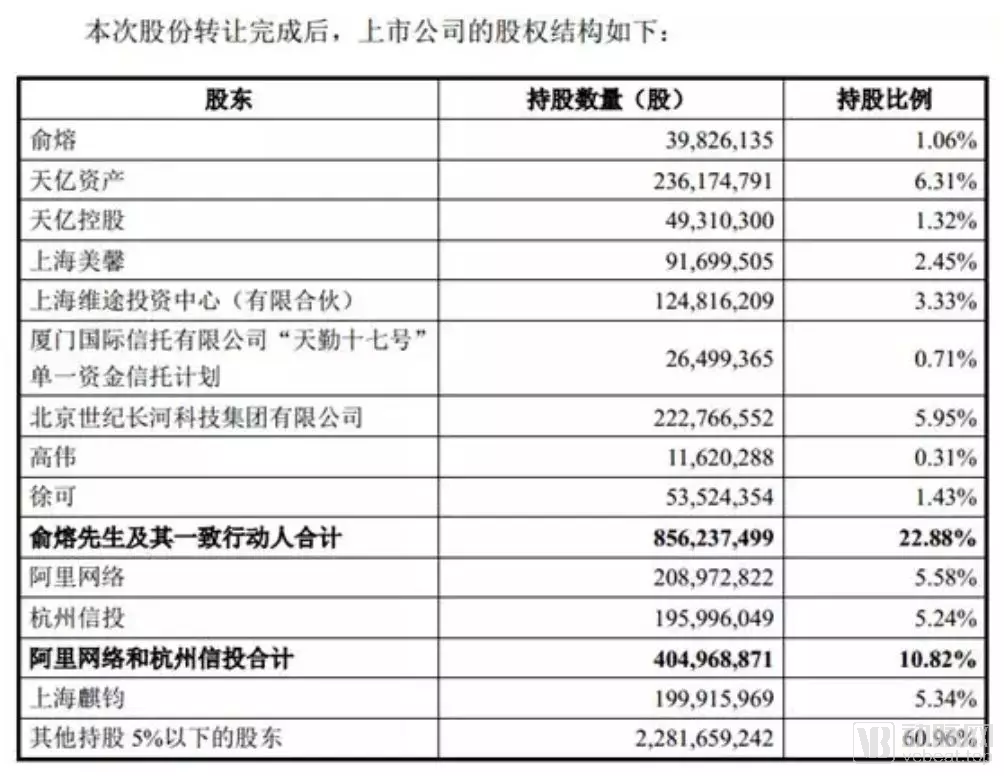
On the evening of October 27, Meinian Onehealth Healthcare Holdings Co.,Ltd. issued an announcement stating that Alibaba has become its second-largest shareholder. According to the disclosure, Alibaba Network and its party acting in concert, Hangzhou Xintou, collectively acquired a 10.82% stake in Meinian Onehealth, thereby becoming the company’s second-largest shareholder. Meanwhile, Shanghai Qijun acquired a 5.34% stake in Meinian Onehealth; this entity is managed by Yunfeng Capital and maintains close ties with Jack Ma.
The simultaneous moves by the three major companies associated with Jack Ma constitute a significant development, with Alibaba’s total investment reaching RMB 7.265 billion.
Health checkups were once regarded as the most critical traffic entry point in the healthcare sector. They not only break through the bottlenecks in online-to-offline (O2O) traffic channels but also deliver a range of strategic values, including data acquisition, health record management, and chronic disease management.
Earlier this year, Alibaba’s Taobao, along with Suning.com (in which Alibaba has invested) and other parties, jointly funded the privatization of all shares of Ikang Guobin, another major player in the health checkup industry, in a deal valued at $1.5 billion. Coupled with its recent investment in Meinian Onehealth, this move will firmly establish Alibaba’s dominance in the health checkup market.
According to data from iiMedia Research, the market size of China's health checkup industry was approximately RMB 150 billion in 2018.
The story of China’s health checkup industry dates back to 2014.
In 2014, the market size of China's health checkup industry was RMB 71.37 billion. Hospital-based checkup departments accounted for 91% of the market share, while specialized checkup institutions held only 9%.
In the specialized health checkup sector, industry concentration is extremely low. There are approximately 7,000–8,000 health checkup institutions across China, with the top nine specialized providers operating around 300 outlets in total, accounting for only a 4% market share.
The current state of the health checkup industry has laid the groundwork for future mergers and acquisitions within the sector.。
Around 2014, the top three players in China’s health checkup market were Meinian Onehealth (Health 100), Ikang Guobin, and Ciming Health Checkup. According to relevant data, the number of health checkups conducted by Meinian Onehealth, Ikang Guobin, and Ciming Health Checkup that year was 5.28 million, 3.55 million, and 2.00 million, respectively.
All three companies were established in 2004. Since its inception, Ikang Guobin has consistently attracted venture capital interest, securing nearly $100 million in investments in 2013 from Goldman Sachs and the Government of Singapore Investment Corporation (GIC), among others. Health 100, also founded in 2004, has received backing from domestic and international investment firms such as The Carlyle Group and Ping An Innovation Investment Fund. Similarly, Ciming Health Checkup is supported by multiple investors, including CDH Investments.
Prior to 2012, Ciming Health Checkup led both Meinian Onehealth and Ikang Guobin in terms of the number of offline examination centers, annual revenue, and profits. However, following Ciming’s two unsuccessful attempts at going public, and with Ikang Guobin and Meinian Onehealth achieving rapid growth backed by capital infusion, the domestic health checkup market shifted from a “tripartite balance” to a duopoly by 2014.
On April 9, 2014, Ikang Guobin listed on the NASDAQ, raising approximately USD 153 million in its initial public offering and becoming China’s first publicly traded health checkup company. In late November of the same year, Meinian Onehealth acquired 100% equity interest in Ciming Health Checkup for RMB 3.6 billion.
Unlike Ikang Guobin, which chose to list on the NASDAQ, Meinian Onehealth opted for China’s A-share market. In March 2015, Meinian Onehealth went public on the A-share market through a reverse merger with Jiangsu Sanyou.
Two Options, Two Development Paths.
Less than two years after its Nasdaq listing, Ikang Guobin announced plans to go private. In an internal email, Zhang Ligang, Chairman and CEO of Ikang Guobin, stated that the decision to privatize was driven entirely by strategic planning rather than being a passive choice. Zhang further noted that, in the long run, with improved corporate governance and management systems—particularly once the registration-based IPO system replaces the approval-based system—more high-quality companies will return to China.
After a three-year-long privatization marathon and a protracted battle for equity control, Ikang Guobin, once the leading listed company in China’s health checkup industry, officially announced the completion of its privatization on January 18, 2019, and will delist from the NASDAQ Stock Exchange.
Following the privatization of Ikang Guobin, Alibaba-affiliated entities collectively held 59.6% of the company’s equity through Yunfeng Capital and Taobao China, becoming the controlling shareholders; Boyu Capital, which maintains close ties with Alibaba, and Suning International held 13% and 3.4% equity stakes, respectively; Zhang Ligang, Chairman and CEO of Ikang, and He Boquan, Vice Chairman, held 11.73% and 12.27% of the privatized shares, respectively.
From the results,The Alibaba Group has undoubtedly become the largest shareholder, dominating decision-making power.
In this move, Alibaba spent another RMB 7.265 billion to acquire a 10.82% stake in Health 100, making it the dominant player in China’s health checkup market.
Building an Ecological Closed Loop: Alibaba’s Encounter with the “Two Giants” of Health Checkups
We believe that Alibaba’s significant moves in the health checkup market are underpinned by mature strategic considerations.
Not only is Alibaba eyeing the physical examination market, which is valued at over RMB 100 billion, but it also targets the entire medical and health ecosystem. Within Alibaba’s health ecosystem, physical examinations will serve as a critical gateway for healthcare-related traffic.
2014 was known in China as the inaugural year of internet healthcare. That year, Alibaba revealed its ambition to lay out its strategy in the healthcare industry. In January, Alibaba Group announced a strategic investment totaling USD 170 million in CITIC 21st Century Limited, a subsidiary of the CITIC Group, in partnership with Yunfeng Capital. In October, the Hong Kong-listed company CITIC 21st Century (00241.HK) issued an announcement officially changing its name to “AliHealth.”
Since then, AliHealth has become the implementation and practice platform for Alibaba Group’s “Double H Strategy” (Happiness & Health) in the broader healthcare sector. Within the comprehensive business ecosystem built by Alibaba, AliHealth plays the role of providing “Internet + Healthcare” service solutions to 1.4 billion Chinese people.
It was from this point that Alibaba embarked on its journey to build a closed-loop “Internet + Healthcare” business ecosystem. As early as 2016, Alibaba began participating in the privatization of Ikang Guobin Health Physical Examination Management Group Co., Ltd.
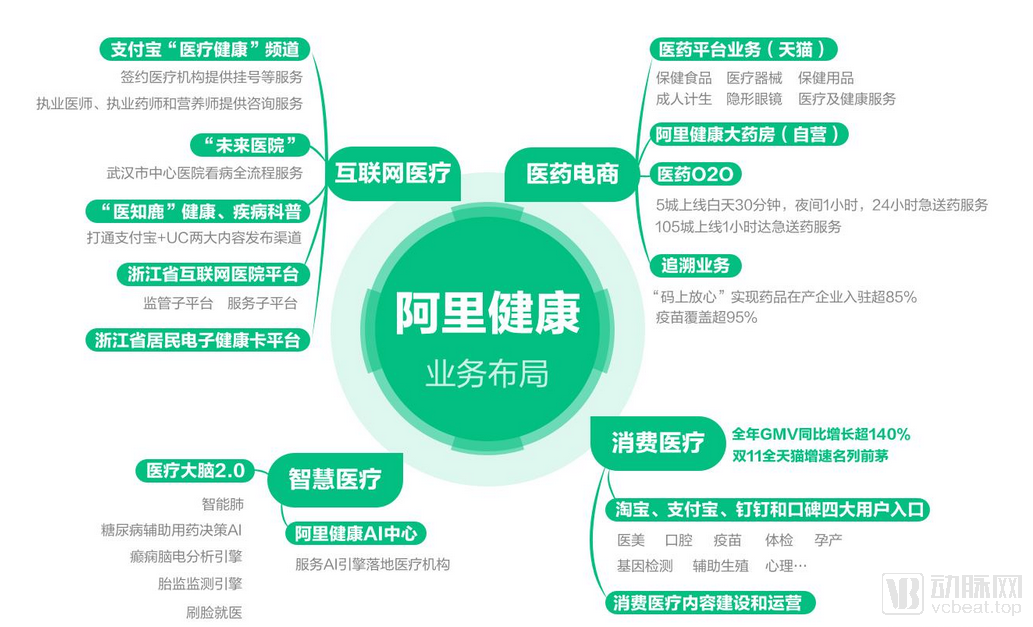
In the consumer healthcare sector, AliHealth leverages four major user entry points from its affiliated companies—Taobao, Alipay, DingTalk, and Koubei—to conduct content operations and development across various consumer healthcare fields, including medical aesthetics, dentistry, vaccination, health check-ups, maternity care, genetic testing, assisted reproduction, and mental health. In 2016, health check-up services were integrated into DingTalk. The large base of enterprise users on DingTalk represents the most important customer segment and implementation scenario for the health check-up industry.
In the pharmaceutical e-commerce sector, AliHealth has established businesses including the Tmall pharmaceutical platform, its self-operated AliHealth Pharmacy, pharmaceutical O2O services, and drug traceability systems.
In the realm of smart healthcare, AliHealth leverages its Medical Brain 2.0 and AliHealth AI Center to actively collaborate with external institutions such as government agencies, hospitals, and research institutes. It is exploring and expanding intelligent healthcare services based on informatization, artificial intelligence, and big data technologies, having already developed products such as intelligent lung cancer screening, an AI system for auxiliary medication decision-making in diabetes, and an EEG analysis engine for epilepsy.
In the realm of internet healthcare, AliHealth’s segment appears to encompass a broader range of services compared to other sectors, including the “Medical Health” channel on Alipay, “Lailai Hospital,” the “Yizhilu” platform for health and disease education, the Zhejiang Provincial Internet Hospital Platform, and the Zhejiang Provincial Resident Electronic Health Card Platform.
Alibaba’s healthcare initiatives are clearly disclosed in AliHealth’s annual financial report.
On May 16, 2019, AliHealth released its financial report for the fiscal year 2019. According to the report, AliHealth achieved an annual revenue of RMB 5.096 billion, a year-on-year increase of 108.6%; gross profit reached RMB 1.331 billion, up by 103.9% year on year. After deducting share-based compensation expenses, the net profit amounted to RMB 122 million.
Among its four major business segments—pharmaceutical e-commerce, consumer healthcare, internet healthcare, and smart healthcare—the pharmaceutical e-commerce platform has become the primary revenue driver, accounting for 96.4% of AliHealth’s total revenue. The GMV (Gross Merchandise Volume) of the Consumer Healthcare Division increased by more than 140% year-on-year compared to the previous year.
As of March 2019, the number of monthly active users of AliHealth’s internet healthcare services in hospital settings exceeded 12 million.
By becoming the largest buyer in the privatization of Ikang Guobin, acquiring a stake in Meinian Onehealth and emerging as its second-largest shareholder, Alibaba’s major moves this year in the health checkup market are aimed at capturing a larger gateway to medical and healthcare traffic.
As the number of internet users approaches its ceiling, the trend toward mobile traffic is rapidly emerging, leading to a swift restructuring of the original internet traffic ecosystem. According to the "China Internet Healthcare Development Report (2018)" released by VCBeat, medical traffic entry points can be categorized into the following four types based on the nature of the traffic: general traffic entry points represented by super apps, such as Alipay, WeChat, and Meituan; search-based entry points represented by search engines, such as Baidu and Sogou; content-driven entry points represented by vertical healthcare platforms, such as Chunyu Doctor; and scenario-based long-tail medical demand entry points represented by cross-industry collaborations, such as pharmacies and physical examination institutions.
The user journey for entry points in pharmacy and health checkup scenarios typically involves users having healthcare service needs within specific service contexts. By establishing seamless connections, the value of existing services can be extended, thereby achieving in-depth exploration and fulfillment of user needs.
Currently, competition for traffic entry points is concentrated on general traffic channels, search engines, and content platforms. These mature markets are fiercely competitive, with high costs per unit of traffic. In contrast, scenario-based entry points remain a blue ocean market, with only a small fraction of scenario-specific medical demands being tapped. The health checkup scenario features clear demand and naturally connects downstream to health management and specialized treatment sectors, offering unique advantages. Moreover, its traffic volume has already reached the tens of millions, demonstrating significant traffic effects.
From this perspective, Alibaba’s move to capture the health checkup scenario represents securing a critical new traffic gateway into healthcare and medical services.
Although some analyses suggest that the growth of China’s health checkup market will generally slow down in 2019, Alibaba has chosen to enter the sector at this juncture, valuing not only the role of health checkups as a gateway to preventive care management but also the hundreds of millions of health records and data accumulated by checkup providers.
With access to traffic entry points and vast health data, combined with Alibaba’s own advantageous resources, AliHealth can transition its health management model from a scale-and-traffic-driven approach to a data-driven, refined management model.
The entry into the health checkup scenario has also had a significant impact on the AliHealth ecosystem.
Following the completion of the acquisition of Ikang Guobin, it has become AliHealth’s primary vehicle for capturing offline traffic, while AliHealth’s online traffic has effectively compensated for Ikang Guobin’s weakness in insufficient offline store coverage.
Health examination institutions possess extensive user data, which can help AliHealth collect more health-related information. Through integration, this enables the connection of health examinations, medical services, pharmaceuticals, and wearable devices, creating a refined closed-loop health management system and establishing personal digital health records for users.
Last night, the “Ikang Guobin” WeChat official account published an article featuring Zhang Ligang, founder of Ikang Group, sharing his reflections on changes in the health checkup industry. In the article, he mentioned“For healthcare services, the core of professional substance lies in medicine and science, not in complex capital operations and structural design.”and“Investors with strong values entering the market is logically conducive to the healthy development of the industry. Whether this will lead to tangible improvements and foster healthy competition remains to be seen.”such viewpoints.
Since the influence is mutual, what benefits can Alibaba’s entry bring to health 100?
In its latest announcement, Health 100 stated that Alibaba can provide technological empowerment to the company, such as enhancing its digitalization and intelligent development. Leveraging Alibaba Cloud, physical examination institutions can train big data algorithms for health management, significantly improving the performance and accuracy of vital signs data analysis, thereby supporting the enhancement of the quality of physical examination services.
Yu Rong, Chairman of Health 100, once stated in an interview that the product competitiveness of medical service enterprises should be built upon the exploration of professional substance and service experience, customer perception, and brand value. It now appears that Alibaba’s expertise in big data, artificial intelligence, and other technologies can further empower physical examination institutions, enhancing their service quality.
With Ikang Guobin in one hand and Meinian Onehealth in the other, Alibaba has, to some extent, captured half of China’s health checkup market, securing absolute dominance over this new traffic gateway into healthcare services.
Amid the increasingly prominent boom in the broader health sector, Alibaba has begun to reap rewards, leveraging its robust capital strength.