

Dolphin Lele: Why Elite Graduates from Top Five Universities Chose the Autism Intervention Field?
One summer night in 2016, Chen Jie, a graduate of Peking University, received a phone call from his hometown in Guangxi. On the other end was his closest friend from middle school, who broke down in tears he had long suppressed, revealing that his child had been diagnosed with autism. This was Chen Jie’s first close encounter with autism. He scoured online resources, sought out renowned specialists across Beijing, and offered constant comfort...
In 2017, due to work-related commitments, Chen Jie assisted in planning and organizing a lecture on autism spectrum disorder (ASD) held in Beijing. “It was just a brief two- to three-hour session, yet the attendee list included dozens of participants from across China, including Hainan, Guizhou, Fujian, Jilin, and Liaoning,” he admitted. “Although the lecture itself did not offer substantial technical content, it drew my attention to the sheer size of this population.”
According to the “Report II on the Development Status of China’s Autism Education and Rehabilitation Industry” (hereinafter referred to as “Report II”) released in 2017, the prevalence of autism spectrum disorder in China is conservatively estimated at approximately 1%. There are about 2 million children under the age of 14 affected by the condition, with the total number of individuals potentially exceeding 10 million, and this figure is increasing by more than 100,000 each year.
As Chen Jie deepened his understanding of the autism industry, he gradually received private messages from friends seeking help. In May 2019, Chen Jie and Li Sen, a former board secretary of a company listed on the New Third Board and his classmate at Hejun Business School, decided to jointly explore the autism market.
Neither Chen nor Li came from a special education background. As novices, they spent six months conducting research, reviewing over 200 academic papers, visiting five cities, six universities, and more than thirty institutions. Leveraging alumni networks from their alma mater, Peking University, and Hejun Business School, they gained in-depth insights into special education programs at medical schools and universities both domestically and internationally. Additionally, they interviewed more than ten physicians, visited over twenty teachers, and engaged with more than thirty parents.
Core team members hail from Peking University, Tsinghua University, Beijing Normal University, The Ohio State University (USA), and the University of Hamburg (Germany).
Perhaps moved by the sincerity of the two individuals, some experts and scholars they visited gradually joined their team. The team currently includes two postdoctoral researchers, three PhD holders, and three master’s degree holders, with expertise spanning psychology, special education, biomedicine, and family quality-of-life research.
Li Tangchen, a core member of the teaching and research team, obtained the Board Certified Behavior Analyst (BCBA) credential while pursuing his Ph.D. at The Ohio State University in the United States. He has many years of frontline teaching and supervision experience and has frequently participated in major international academic conferences, engaging in technical exchanges with professionals in the fields of special education and autism intervention. Wang Lihong, a teaching and research assistant, majored in Special Education at Beijing Normal University. She studied and practiced early childhood education theory at Pingtung University in Taiwan and possesses many years of hands-on practical experience.
Dr. Ren, another core member, graduated from the University of Hamburg in Germany. He is a young scholar at the Center for Globalization and Governance Research and has been engaged in research on the quality of life of special populations in Europe.
It is reported that there are only a few dozen Board Certified Behavior Analysts (BCBAs) currently practicing on the front lines in China. This certification, issued by the Behavior Analyst Certification Board (BACB), is required for professionals to practice independently as ABA experts. To achieve certification, candidates must meet several stringent requirements: hold a master’s degree in education or psychology; complete an approved ABA graduate coursework sequence; undergo ethics training focused on working with vulnerable populations; accumulate at least 1,500–2,000 hours of supervised practical experience; and receive 75 hours of direct supervision. Widely regarded as the most professional and prestigious credential in the field of autism intervention, the BCBA certification garners international recognition only after candidates successfully pass its rigorous assessments.
Family-Centered Autism Education and Rehabilitation Center
Although the population of individuals with autism is substantial, China’s rehabilitation and therapy market—corresponding to this large patient base—remains in its early stages and has yet to gain widespread acceptance. According to the “Report on the Development Status of China’s Autism Education and Rehabilitation Industry,” the conservative estimate for the current market size for children aged 2–6 with autism in China is approximately RMB 36.6 billion. As post-1985 generations increasingly become parents, the rate at which families accept their child’s autism diagnosis is rising. These parents are more willing to pay for professional educational interventions, with average monthly expenditures reaching as high as RMB 15,000 among parents in first-tier cities.
Although the market is substantial, it faces critical pain points: a scarcity of professional institutions, industry disorder, and unmet market demand. Chen Jie stated, “The industry is grappling with a severe imbalance between supply and demand. There are 820,000 children aged 2 to 6 requiring care in the market, yet only a few thousand institutions exist, capable of accommodating fewer than 100,000 children with autism. Furthermore, 90% of these institutions not only lack professionalism but are also small, fragmented, and unsystematic, suffering from insufficient teaching staff and an inability to provide professional interventions.”
Therefore, in September 2019, Chen Jie formally established Haidun Lele (Beijing) Education Technology Co., Ltd. (hereinafter referred to as “Haidun Lele”), positioning it as a professional autism education and rehabilitation institution centered on the family. On October 28, the first offline Haidun Lele store opened in Beijing’s Yayuncun area.
“Traditional autism rehabilitation institutions often focus on the child, neglecting the family environment in which the child lives,” said Chen Jie. “Many students make good progress at the center but revert to their previous state once they return home.” During his research, Chen Jie found that parent-child, marital, and intergenerational relationships within families affected by autism are often strained, with parents experiencing significant anxiety, fatigue, and even confusion. Parents frequently worry about who will care for their child after they pass away, and whether their child will be able to marry or find employment in the future. Some parents are even forced to leave their jobs to provide full-time care for their children.
Therefore, the Dolphin Lele therapy program for children with autism is family-centered, utilizing educational interventions to fundamentally enhance behavioral capabilities in children with autism spectrum disorder (ASD), while simultaneously increasing family well-being. It is understood that this approach not only maximizes the effectiveness of educational interventions but also provides supportive services to families.
ABA Therapy: Respite Services and Parent Support Groups Available
For a child with autism spectrum disorder to benefit from Dolphin Lele, the process begins with a family assessment and guidance on family-based educational planning, ultimately establishing a family-centered educational approach that includes individualized training, psychological counseling, and remote education.
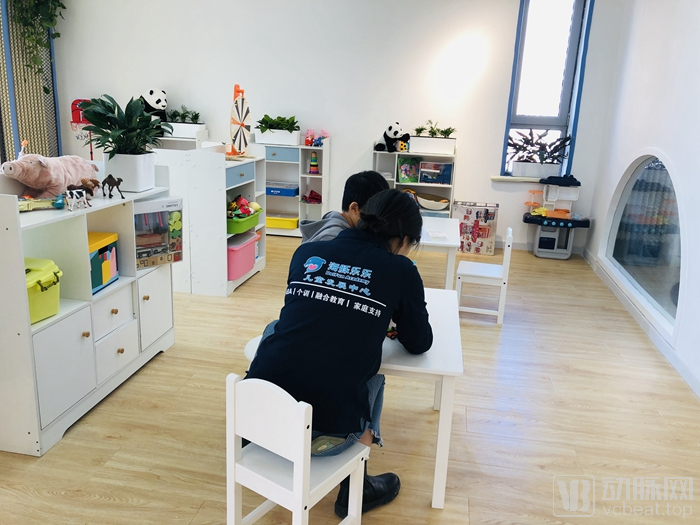
Image source: Provided by the company
At the Dolphin Lele physical store, families of children with autism can receive assistance through four types of courses:
One-on-One Early Foundational Skills Enhancement Course: Based on the Early Intensive Behavioral Intervention (EIBI) framework, one-on-one intervention sessions are provided using teaching methods that are evidence-based, positive, interest-driven, and flexible.
Integrated Skills Enhancement Course:Based on the methods and principles of Applied Behavior Analysis (ABA), this approach integrates Naturalistic Teaching Strategies to further enhance children’s various skills. Through 1:1 instruction, it increases social skills group sessions supported by shadow teachers, aiming to train and generalize children’s social, academic, and play skills within natural contexts.
Courses for Parents:Provide parents with easy-to-implement and effective behavioral intervention strategies, and train them to carry out home-based ABA intervention programs. This enables parents to help reduce their child’s problem behaviors, increase functional language, teach new skills, and support the maintenance and generalization of behavior changes achieved in clinical settings across natural environments such as the home, community, parks, and supermarkets.
Family Support Services:Human-centered services, including family assessment, educational intervention training, inclusive education, psychological support for parents, family quality of life, respite care, and parent mutual support groups.
Chen Jie introduced that Dolphin Lele adopts a “half-day care” model, enabling children to receive comprehensive learning support within the facility while alleviating the burden on parents. In terms of teaching, Dolphin Lele employs the internationally popular open-classroom approach, with intervention services delivered by professionals from diverse specialties in special education and psychology. Furthermore, to create an optimal intervention environment, the overall design and renovation were carried out by a team from Tsinghua University in the style of British elite private schools. The indoor environment is maintained at peak quality through features such as one potted plant per two square meters on average, complemented by diatomaceous earth wall coatings and fresh air ventilation systems.
In terms of future planning, Dolphin Lele will further refine its intervention, operations, and training systems. Once the single-store model reaches maturity, it will rapidly expand through a standardized framework.
Those interested in the company, please contact DongMai_Investent, the financing assistant.