

Bridging the Gap: How National Policy and Capital Are Addressing China's Elder Care Talent Shortage – Insights from a Survey of Nearly 300 Universities and Colleges
On October 9, the General Office of the Ministry of Education and six other departments issued the “Opinions on Educational Support for the Development of the Social Service Industry and Improving the Quality of Training for Personnel in Short Supply,” explicitly stating that, in principle, each province should have at least one undergraduate university offering majors related to domestic services and elderly care. Furthermore, vocational colleges with the necessary conditions are encouraged to actively establish new program offerings in fields related to the social service industry, such as nursing, elderly service and management, and smart elderly care services.
On October 16, the Ministry of Human Resources and Social Security and the Ministry of Civil Affairs promulgated and implemented the National Occupational Skill Standards for Elderly Care Workers (2019 Edition), relaxing entry requirements for elderly care workers while raising skill requirements.
Amidst the booming landscape of the elderly care industry, the “talent” issue has persistently plagued industry practitioners. Challenges in team building, recruitment and hiring, education and training, career development prospects, compensation and benefits, and social status have all become critical and decisive factors affecting the quality of elderly care services in China. The problems faced by enterprises in the elderly care sector, after their strategic, business, and organizational landscapes are defined, ultimately leave them “helpless” when it comes to the talent landscape.
Based on interviews with more than 30 entrepreneurs in the elderly care sector, it is evident that most elderly care enterprises are grappling with the dual challenges of “difficulty in recruitment” and “high staff turnover.” Admittedly, as the elderly care industry is still in the stage of exploring viable business models, suboptimal employee benefits and compensation—driven by the industry’s overall “thin-margin” nature—constitute a significant factor. However, an even more critical reason lies in the insufficiency on the supply side.
Recently, a steady stream of favorable policies for talent development has been released. From talent cultivation and skill requirements to policy orientations, the state is encouraging and regulating the “elderly care workforce” market. Policies mandate that each province must have at least one undergraduate university offering programs in elderly care, while also encouraging vocational colleges to launch similar majors. To gain insights into the current state of elderly care talent training in China, specific employment situations, and the challenges and issues faced, VCBeat (WeChat ID: vcbeat) conducted research and interviewed several representative undergraduate and vocational institutions as well as market-oriented training enterprises, aiming to hear their perspectives.
Amid the severe demographic challenges and growing demand for elderly care, the development of the eldercare service sector hinges on a professional workforce equipped with modern concepts, knowledge, methods, and skills in elderly care. Based on the structure of older adults’ needs, talent can be broadly categorized into five types:
Life Care TalentIt refers to professionals who ensure the basic livelihood of the elderly by covering their essential needs in clothing, food, housing, and transportation. Their service scope includes property management, domestic services, administrative agency, mobility assistance, and professional meal planning, constituting the main body of the workforce in the elderly care industry.
Medical Care ProfessionalsThis refers to professionals who provide services such as disease prevention, health and wellness care, psychological counseling, medical treatment, and rehabilitative nursing for the elderly. Based on service content, they can be further categorized into basic caregiving personnel with foundational nursing knowledge, professional medical and nursing staff with advanced medical expertise, rehabilitation and healthcare specialists with knowledge in rehabilitative care, and psychological counselors with professional training in psychology.
Life Services TalentRefers to professionals who provide elderly individuals with life assistance services, including financial and insurance planning, legal consultation, senior care product design, travel services, and continuing education.
Institutional Management (Operations) TalentIt refers to professionals who possess certain management knowledge and skills, such as organizational management personnel (human resources management professionals, accounting professionals, sales professionals, etc.), senior management personnel (managers), event organization personnel (social workers, etc.), external liaison personnel, and administrative management personnel (professionals working in government departments related to the elderly care industry).
Education and Training TalentIt refers to talents for whom training programs are designed and specialized education and training are provided, based on the diverse needs of the elderly care industry and different types of elderly care services, targeting specific categories of professionals.
Types vary, and so do the corresponding talent needs. According to an industry insider with nearly a decade of experience, current demand for personal care staff is primarily driven by large Continuing Care Retirement Communities (CCRCs) and integrated complexes. Ordinary facilities have no special requirements for such personnel, making recruitment relatively easier. Among medical and nursing professionals, entry-level elderly care workers are the most difficult to recruit and exhibit the highest turnover rate. Meanwhile, healthcare professionals with specialized expertise are relatively hard to hire in smaller cities. Recruitment for lifestyle service staff typically adopts a “plus elderly care” approach based on specific needs; for instance, legal consultants are hired directly as lawyers.
Currently, China lacks specialized institutional management talent in the healthcare sector. Most professionals in this field have transitioned from former hospital management companies, hotel and real estate sectors, or even investment backgrounds, and they are predominantly concentrated in developed regions. The pool of educational and training professionals is relatively fragmented; organizations typically seek out specific types of instructors based on particular needs, with a notable scarcity of professionals capable of delivering comprehensive, full-spectrum training programs.
“Entering the elderly care industry is actually quite flexible now; prior experience in real estate or project management is sufficient. This is because there is a severe shortage of specialized professionals, and most recruitment currently follows an ‘XXX + elderly care’ model.” He further told the reporter, “In fact, the majority of talent in the elderly care sector today is still cultivated by the market.”
When the foundational talent structure of an “emerging” industry has not yet matured, but top-level demand remains robust, the market often spontaneously cultivates a segment of talent. Subsequently, the government steps in to systematically develop specialized, knowledge-based professionals in alignment with China’s education system.
In China’s talent development system, master’s and doctoral students are oriented toward theoretical research and constitute academic research talent; undergraduate students are trained as applied professionals focused on industry planning, design, and management; while vocational college students are geared toward hands-on, practical skills.
Currently, specialized training in elderly care at the junior college, master’s, and doctoral levels is quite popular, yet there is a distinct shortage of undergraduate-level talent. So, does China truly lack undergraduate professionals in elderly care? When did the first undergraduate program in this field launch? According to VCBeat’s research, China’s first undergraduate elderly care program officially began enrolling students in 2010. To gain a deeper understanding of how Chinese universities train elderly care professionals, VCBeat interviewed three representative institutions:
Tianjin University of Traditional Chinese Medicine, Nursing (Geriatric Nursing Track)
This major officially began enrolling students in 2010, becoming the first undergraduate program in geriatric nursing in China. In addition to the core curriculum of traditional nursing, the program incorporates disciplines such as community and geriatric nursing, nursing care for geriatric diseases, and sociology of aging. Career pathways for graduates extend beyond traditional healthcare institutions to include employment opportunities in elderly care facilities.
Wang Tianqi, a student from the class of 2011 at this university, told VCBeat that in addition to adding corresponding courses to their curriculum, they have also introduced training in geriatric nursing procedures to enhance their skills and practical experience. During their internship, besides completing the standard one-year internship at a Grade A tertiary hospital required for ordinary nursing students, they must also complete an additional one-month internship focused on geriatric care. Upon graduation, students will receive dual certificates: a general nursing diploma and a geriatric nursing diploma.
Linyi University: Social Work (Operation and Management of the Silver Economy Industry)
This major officially began enrolling students in 2014, becoming the first undergraduate program in China (Sino-foreign cooperative education) to specialize in Silver Industry Management (referred to as the Aging Industry in China). In addition to covering the fundamentals of gerontological social work, the curriculum features specialized courses taught directly by professors from Kangnam University in South Korea. Kangnam University pioneered the Silver Industry major in South Korea in 2006; recognized as a key discipline construction program, it received approximately RMB 60 million in cumulative support from the Korean Ministry of Education over five consecutive years. The specialized courses include Introduction to Gerontology, Introduction to Silver Finance, Silver Financial Asset Management, Silver Industry Marketing, Silver Industry and Entrepreneurship, and Health Management for the Elderly. The program aims to cultivate professional management talents for the silver (health and wellness) industry chain, equipped with innovative spirit, research and development capabilities, and practical skills.
The university adopts a flexible model for cooperative education. In addition to completing their four-year undergraduate studies in China, students may apply for a 2+2 dual-degree program in South Korea in accordance with the inter-university agreement. During the first two years, all students follow the same curriculum in China. Those who meet the Korean language proficiency requirements and choose to study abroad will spend the final two years at Kangnam University’s Department of Silver Industry in South Korea, studying alongside Korean students. Students who do not opt for overseas study will remain in China to take corresponding courses on the silver (health and wellness) industry, taught by professors dispatched from the Korean partner institution.
Yu Mingjiang, the academic leader of the Senior (Aging) Industry Operations and Management program at the Law School of Linyi University, told reporters that students pursuing dual degrees in South Korea complete their professional internships during their study period there. To enable students remaining in China to experience the life of international students in South Korea and to conduct visits and internships at relevant institutions in the Korean senior (aging) industry, the university arranges for students to undertake short-term study and internship programs in South Korea around the summer vacation, led by faculty members. However, due to language barriers and other factors, these trips primarily focus on observational visits and professional study. Graduates of this program ultimately receive an undergraduate diploma in Social Work and a Bachelor of Laws degree from Linyi University. Students who study in South Korea receive, in addition to the two domestic certificates, an undergraduate diploma in Senior Industry Studies and a Bachelor of Management degree from Kangnam University in South Korea.
Tianjin Vocational Institute and Tianjin University of Technology Collaboration: Social Work (Elderly Welfare and Management)
This program officially began enrolling students in 2019, becoming the first undergraduate elder care program in China operated entirely by domestic institutions. In addition to covering the foundational knowledge of social work, the curriculum includes courses such as Mental Health and Management for Older Adults and Introduction to Gerontology. Jointly offered by Tianjin Vocational Institute and Tianjin University of Technology, the program builds upon the latter’s Social Work major by adding a specialization track in “Elderly Welfare and Management,” with the aim of cultivating mid- to senior-level management professionals for the elderly care sector.
According to a freshman in the program who requested anonymity, the major is offered through a joint educational partnership between two institutions. Tianjin University of Technology is responsible for student enrollment management, while Tianjin Vocational Institute handles daily teaching activities. Based on the curriculum for the first semester of the freshman year, courses offered include Social Psychology, Introduction to Sociology, Introduction to Social Work, and Advanced Mathematics, along with other mandatory university courses. Courses related to elderly care have not yet been introduced.
According to the Admissions Information Website of Tianjin University of Technology, the “Elderly Welfare and Management” major admits students from both science/engineering and humanities/social sciences backgrounds, with a four-year program duration. Upon completion, students are awarded a Bachelor of Laws degree. The major listed on the graduation certificate and bachelor’s degree certificate shall be stated as “Social Work,” in accordance with the Undergraduate Major Catalogue for Regular Higher Education Institutions, and shall not include the phrase “Specialization in Elderly Welfare and Management.”
VCBeat reviewed the “Catalogue of Undergraduate Majors in Regular Higher Education Institutions (2012)” (hereinafter referred to as the “Catalogue”) (Note: This is the latest version, with no revisions made since 2012) and found that there is currently no dedicated major in elderly care. Under the framework of this Catalogue, and in light of the current aging trends, relevant officials from the Ministry of Education have actively pursued innovation by establishing a “new” major under the sociology category related to elderly studies. However, as graduation certificates and degree certificates must be issued in accordance with the Catalogue’s specifications, students cannot obtain corresponding credentials for this new major.
In addition to the aforementioned universities, in order to actively respond to population aging, the Ministry of Education approved five universities for the first time in 2016 to enroll students in the Health Services and Management major, including: Zhejiang Chinese Medical University, Binzhou Medical University, Shandong Sport University, Guangdong Pharmaceutical University, and Chengdu Medical College. According to the official website of Zhejiang Chinese Medical University, career paths for graduates of the Health Services and Management major include elderly care medical facilities and health-and-wellness centers. Besides these five institutions, some other universities have also launched relevant professional courses after 2016:
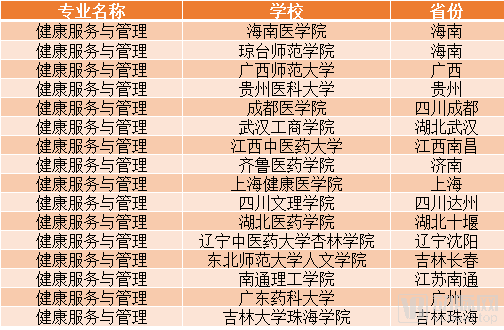
Source: Compiled by VCBeat from public information. Please feel free to add any missing details.
The cultivation of elderly care professionals follows a pyramid-like structure, with vocational colleges and specialized institutions primarily training service-oriented personnel for frontline roles in the elderly care sector, forming the base of the pyramid. In 2013, regarded as the inaugural year for the elderly care industry in China, demand for frontline service personnel gradually surged, leading to a steady increase in the number of higher vocational colleges offering such training programs—from only 50 institutions in 2013 to a total of 293 by 2019.
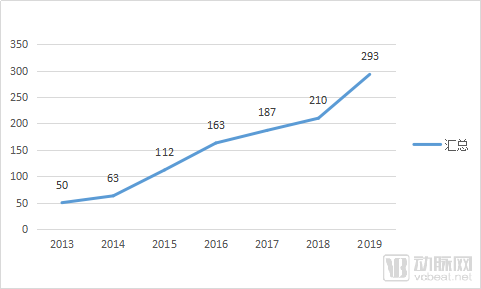
Data source: Record-filing results for major establishment in higher vocational education (graphic by VCBeat)
As shown in the table above, the number of elderly care professionals trained in higher vocational colleges has shown a year-on-year increasing trend since 2013. Notably, there were significant increases from 2014 to 2015 and from 2018 to 2019. These trends often reflect the direction of national policies. In September 2013, the State Council issued Document No. 35, which outlined 45 tasks related to elderly care. The year 2014 saw the highest level of implementation, with more than 30 of these 45 tasks being carried out. Starting in 2015, policy focus shifted towards supporting industry development and facilitating market transformation. From 2018 to the present, there has been another intensive period for the issuance of elderly care policies, with over 40 policies released during this time, many of which address issues concerning elderly care personnel.
As the type of higher education in China that is most closely aligned with the market, higher vocational education naturally exhibits the fastest response speed.
From a professional perspective, the major in Elderly Care Services and Management has long been mainstream in vocational education for elderly care. According to data from the WeChat official account “Focus on Vocational Education,” in 2019, this major was offered by 221 higher vocational colleges across China, ranking 66th among all majors in terms of the number of institutions offering it.
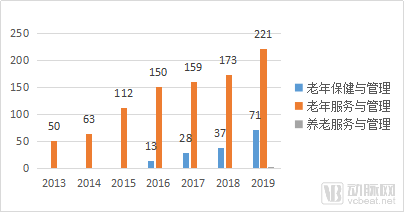
Number of Elderly Care Sub-specialties Established from 2013 to 2019
(Data source: Filing results for major setup in higher vocational education; graphic by VCBeat)
As shown in the table above, the major in Elderly Health Care and Management was added in 2016. Compared with the major in Elderly Service and Management, the curriculum of Elderly Health Care and Management places greater emphasis on practical skills such as caregiving, rehabilitation, and assessment, while also covering foundational medical content. This aligns with the background of 2016, when the National Health and Family Planning Commission, jointly with the Ministry of Civil Affairs, formally proposed the concept of integrating medical care with elderly care and vigorously promoted its implementation.
From a regional perspective, it is well known that the most developed areas for China’s elderly care industry are predominantly major cities such as Beijing and Shanghai. According to national rankings by the proportion of the aging population, the top three regions are Liaoning, Shanghai, and Zhejiang. However, the top three regions for the development of elderly care education are Shandong, Sichuan, and Anhui.
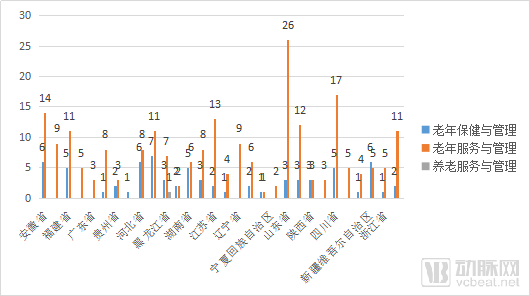
2019 Statistical Table of Elderly Care Specialties by Province and Municipality
(Data source: Filing results for major establishment in higher vocational education; graphic by VCBeat)
As shown in the table above, Shandong Province leads with 29 elderly care-related academic programs, a distinction closely tied to its status as a major province in both population and education. Sichuan Province ranks second with 22 higher education institutions offering such programs, followed by Anhui Province in third place with 20.
In terms of the duration of higher vocational programs, there are currently three types: two-year, three-year, and five-year programs. The five-year programs correspond to the “3+2” junior college-to-bachelor’s degree articulation tracks, which are offered by 11 institutions. Six institutions offer two-year programs, while the rest offer three-year programs.
As can be seen from the above, the country is currently intensifying efforts to cultivate professionals specializing in elderly care. However, among the college and university graduates who have entered the job market, how many are actually working in the elderly care sector? What challenges do they face?
Undergraduate: Is it difficult to find a job that matches your major?
“In our cohort at Tianjin University of Traditional Chinese Medicine, specializing in geriatric nursing within the nursing program, there were 48 students, while the previous cohort (the inaugural class) had approximately 45. Among them, 90% secured positions in tertiary-grade A hospitals, and seven joined subordinate units of the Civil Affairs Bureau.” Recalling his classmates’ experiences, Wang Tianqi, who currently works at the Tianjin No. 1 Nursing Home Apartment, said, “Initially, more than ten of us joined a private elderly care institution. However, due to issues such as compensation, working hours, and workplace atmosphere, only one person remains in the private sector to date.”
“For care workers who have undergone specialized training, the level of specialization required for elderly care is not high (compared to medical care).” Wang Tianqi further explained that undergraduate nursing students basically do not engage in basic nursing work in institutions (he himself mainly engaged in sales work in private elderly care institutions back then), and those who actually engage in nursing work are mostly middle-aged women in their forties and fifties.
In addition to nursing, there is widespread anticipation and curiosity regarding other undergraduate majors related to aging, which naturally sometimes leads to one-sided perceptions. “I have found that many people hold misconceptions about the silver (aging) industry. Working in this field does not necessarily mean being employed in elderly care institutions; it should encompass any industry involved in the health and wellness of middle-aged and older adults,” said Professor Yu Mingjiang, who has supervised two cohorts of graduates specializing in the silver (aging) industry. “Our two graduating classes comprised a total of 79 students. Among these graduates, excluding the 27 who pursued further graduate studies domestically or abroad, approximately half are engaged in careers related to the health and wellness sector or industry. However, only five or six of them are working specifically in elderly care institutions.”
An anonymous graduate from the Class of 2014 in the silver economy sector told reporters, “In fact, many of us wanted to work for large elderly care institutions, but our families discouraged us from leaving home, considering ‘elderly caregiving’ undignified. With no suitable job opportunities available locally, we had no choice but to give up.”
Professor Yu Mingjiang stated that high-quality elderly care projects are currently concentrated mostly in major cities such as Beijing, Shanghai, and Guangzhou. This trend offers greater advantages to graduates specializing in the health and wellness industry in these metropolitan areas, while students from second- and third-tier cities face certain challenges in securing internships and employment.
Specialty: Is the proportion of professionals engaged in elderly care-related work as high as 50.55%?
A considerable number of vocational colleges offer specialized programs in elderly care. VCBeat has selected Beijing College of Social Administration, one of the most representative institutions in this field, as its case study. In 2007, Beijing College of Social Administration first established a specialization in Elderly Welfare Services under its Social Welfare major, marking the beginning of its training of professional personnel for elderly care services. In 2009, the college enrolled its first cohort of students specifically into the Elderly Service and Management major.
The university conducted a survey of 451 valid graduates from this major across the classes of 2013 to 2018. The results showed that a total of 228 graduates remained in the elderly care industry, with an employment rate in elder-related roles reaching 50.55% (including 64 from the class of 2018, 58 from 2017, 39 from 2016, 44 from 2015, and 4 from 2014). Their positions spanned frontline elderly care workers, geriatric social workers, community station managers, sales personnel, administrative staff, financial officers, consultants and trainers, health managers, and other roles.
Survey results indicate that 223 students have left the elderly care industry. These individuals cited limited career development opportunities, low benefits, and an inability to achieve their professional aspirations as the primary reasons for their departure.
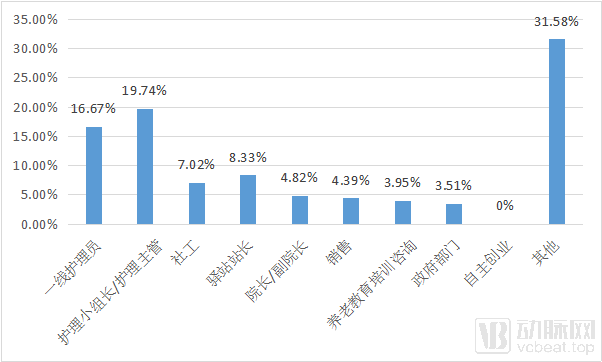
Analysis and Statistics on Attrition from the Elderly Care Industry (Source: Beijing College of Social Administration)
However, when the survey asked, “The government has issued a series of favorable policies to promote the elderly care service industry. As a graduate specializing in elderly care, are you willing to re-engage in this field?” most students expressed their willingness to return to the elderly care sector.
As indicated by the above results, the number of graduates with undergraduate or associate degrees in elderly care is relatively small, and the number of such graduates who actually enter institutions to engage in grassroots work is far from sufficient to meet market demand.
Regarding the most critically shortage of elderly care workers in the industry, data shows that for 249 million elderly people and 40 million semi-disabled or disabled seniors, there are only 300,000 elderly care workers. In this situation, the market can better leverage its advantages of "quick response" and "closer alignment with demand," rapidly training a batch of urgently needed talents in the short term.
It is understood that most elderly care enterprises currently provide short-term training for elderly care practitioners after recruitment. Some of these enterprises have separated this function into a distinct business unit, recruiting externally and offering paid training through online, offline, or blended formats.
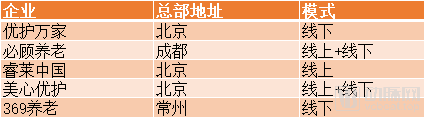
List of Prominent Elderly Care Training Enterprises
(Source: Compiled by VCBeat from public information. Contributions are welcome.)
The head of the Education and Talent Department at Youhu Wanjia told VCBeat that current training programs offered by market institutions generally include skills training for frontline caregivers, training for management personnel in elderly care institutions, and customized training for elderly care enterprises. These initiatives have played a significant role in enhancing the overall professional competence of industry practitioners, as exemplified by Youhu Wanjia’s specialized training program for professionals in integrated medical and elderly care.
Currently, market-oriented education for the elderly is still in its early exploratory stage, and there is a lack of unified standards and norms for training elderly care practitioners in the market. It is understood that training for elderly care practitioners in the market is currently divided into two channels: part of the training is purchased by the government and conducted at designated institutions, while the other part requires elderly care practitioners to pay for themselves and receive training from training institutions in the market. However, there are many institutions providing training for elderly care practitioners in the market, and the quality of training varies. Some institutions choose to cooperate with certain societies and associations to issue qualification certificates to elderly care practitioners.
“The turnover rate among market-trained elderly care workers is extremely high,” Wang Tianqi told reporters. “Currently, migrant female workers from other regions account for more than 80% of the elderly care workforce. Some resign and return home due to family matters or after having saved a certain amount of money. With their work experience and skills, they can simply seek new employment once their family obligations are fulfilled.”
“Compared to the ‘arbitrariness’ of elderly care workers cultivated by the market, the turnover of those trained through higher education is often due to factors such as compensation and social status.”
Private institutions (non-educational) are market-oriented, enabling them to respond rapidly to demand and align their specialized programs more effectively with market needs. In contrast, public institutions hold advantages in faculty strength, systematic knowledge acquisition, and the provision of diverse resources. Moreover, the cultivation of multifaceted talent cannot be achieved through brief training alone; it requires prolonged, systematic education.
However, as it stands, there is still a disconnect between higher education and social demands. To address this issue, the Ministry of Education launched a pilot program for the “1+X” certificate system earlier this year, covering six specialties, including elderly care services and management. Wang Wei, Vice President of Beijing College of Social Administration—one of the first batch of institutions responsible for developing the “1+X” certificates in elderly care and among the pilot schools—told VCBeat that while the framework for vocational education in elderly care has been basically established, the integration of education and training systems remains relatively weak. The depth of industry-education integration is insufficient, and the cultivation of technical and professional skills lacks specialization, failing to fully meet societal demands for multi-skilled talents.
In the “1+X” certificate system for elderly care, “1” refers to the academic diploma, and “X” denotes several vocational skill level certificates in elderly care. The academic diploma comprehensively reflects the quality of talent cultivation provided by educational institutions and plays an indispensable foundational role in national human resource development. Vocational skill level certificates serve as credentials attesting to the vocational competency levels of graduates and members of society, reflecting the comprehensive capabilities required for professional activities and personal career development.
In addition to vocational skills, professional knowledge is equally important. Professor Yu Mingjiang from Linyi University told reporters that since 2018, the major in Operation and Management of the Silver (Aging) Industry has undergone certain curriculum adjustments. Courses in social work with low relevance to the silver (aging) industry have been reduced, while the remaining core specialized courses have been realigned toward the silver (aging) industry, with an increased emphasis on practical, management-oriented courses in this field.
We are witnessing public higher education gradually moving toward marketization. In fact, this is also forcing private education to become more standardized, systematic, and diversified from another perspective.
Based on our interviews and research, we propose the following recommendations regarding the training and education of professionals in elderly care:
1. Call for deepening educational reform, establishing undergraduate majors related to aging, and providing corresponding subsidy support
Currently, very few undergraduate institutions offer majors or courses related to elderly care. The shortage of mid-tier undergraduate talent hinders the development of gerontology-related disciplines and further impedes the reserve of professionals in this field. In addition to establishing more relevant programs, it is equally important to provide greater subsidies and support for these elderly-care-related majors.
2. Gradually expand the pilot program nationwide and fully implement the “1+X” certificate system
The “1+X” certificate program enables students in aging-related majors to acquire professional skills alongside their graduation diplomas, thereby better meeting societal demands for multi-skilled talent. The comprehensive promotion of the “1+X” certificate also raises the bar for the skill requirements of elderly care practitioners from another perspective.
3. Establish guidelines to progressively standardize education for professionals in the elderly care sector
Standardize the teaching, training, and examination systems for elderly care practitioners to reduce training irregularities and further regulate market-oriented training institutions.
4. Strengthen university-enterprise connectivity; universities should actively promote themselves externally, while enterprises should direct their recruitment efforts toward second- and third-tier cities.
Schools should seek multi-faceted collaborations to provide students with a diverse range of internship opportunities. Meanwhile, enterprises should also turn their attention to second- and third-tier cities to tap into a larger pool of talent specializing in elderly care.
5. Strengthen Public Education and Awareness on Aging-Related Issues
Strengthen public education and awareness regarding aging, proactively address population aging, and reduce prejudice against professionals in the elderly care sector. Currently, specialized personnel in elderly care are often stereotyped as mere “caregivers,” resulting in low social status and a lack of societal recognition for their work. This phenomenon undermines the stability of the workforce in this field. The state should intensify publicity efforts promoting active aging, enhance public awareness, and mitigate such biases.