

Miao Health Accelerates on the Right Path with Innovative Model, Data Accumulation, and Closed-loop Ecosystem
The wheel of time rolls ever forward, sweeping those eager for change along in its relentless advance amid soaring calls for transformation.
The Rapid Advancement of Science and Technology in the 20th Century, and the Collaboration Between Medicine and Public Health: Humans Are Healthier and Living Longer Than Ever Before. Persistently High Public Health Expenditures Have Led Authorities to Recognize That the High-Tech Returns in the Health Sector Appear to Be Declining. The Cost of Developing New Technologies Centered on Disease Treatment Is Rising, While Their Contribution to Human Health and Longevity Is Diminishing.
This means that we should no longer incur such high costs to restore health, but rather invest in maintaining health and preventing disease. Consequently, in the late 1950s in the United States, a large number of experts and scholars began researching how to enable individuals to manage their own health.
After more than 60 years of development, the United States has established mature models such as Health Maintenance Organizations (HMOs), giving rise to healthcare giants like UnitedHealth Group. In contrast, China’s health management industry remains in its infancy, awaiting recognition and awakening.
Where there is demand, there is a market. As public health awareness continues to awaken, astute entrepreneurs have keenly sensed the opportunity. Among them, VCBeat has been closely following the “game-changer” in the health management sector—Miao Health—since 2015. After completing its Series C financing, September became a period of concentrated announcements for Miao Health’s core initiatives, including the launch of an insurtech platform and the deployment of offline stores. Strategically, Miao Health is gradually entering the latter half of building a closed-loop ecosystem in the health management industry.
Looking back on the five-year journey since its establishment, Miao Health has evolved from focusing on national health management to building a closed-loop ecosystem encompassing “wellness, healthcare, pharmaceuticals, and insurance.” From the very inception of the health management industry, Miao Health had already laid the groundwork for its current achievements.
During the peak of the medical entrepreneurship wave in 2015 and 2016, the big health industry was undoubtedly the hottest investment sector. With a continuous stream of investment deals, it not only attracted a steady influx of various startups but also saw the full participation of internet giants such as Tencent and Alibaba.
Coupled with the rise of internet healthcare, the wave of the platform era has led many entrepreneurs to take their first steps by leveraging the internet as a technological carrier and adopting platform-based product models to enter the healthcare sector—a rigid-demand industry that was still dominated by traditional service methods at the time.
In the traditional healthcare sector, covering the entire process from appointment registration and consultation to physician networking and pharmaceutical e-commerce, platform-based companies such as WeDoctor Group, Chunyu Doctors, DXY, and Tmall Pharmacy have already entered the market. The competitive landscape of internet healthcare platforms has taken initial shape, leaving little room for startups. However, in the internet-driven “big health” sector, the platform-level market remains an “untapped frontier.”
While most entrepreneurs are still striving to decode the AARRR model, focusing on various incentives to acquire customers and retain more users within their apps, Kong Fei, CEO of Miao Health, has already leveraged the B2B2C model to maximize platform advantages and open up access to “users” to the greatest extent.
In this model, “users” encompass not only individual consumers and households but also corporate clients—such as insurance providers, health examination centers, and banks—as well as their end users. Miao Health can tailor its health management products and services to meet the needs of corporate clients, thereby lowering the entry barrier for industry players into the mobile health market while enhancing user stickiness by satisfying the demands of enterprise end users.
Adopting a B2B2C business model to focus on health management, Miao Jiankang accumulated its first batch of early users and consolidated health data for future development. Since then, its user base has grown steadily. By 2019, Miao Jiankang had amassed over 78 million users in five years, becoming the undisputed leader in the internet health management sector.
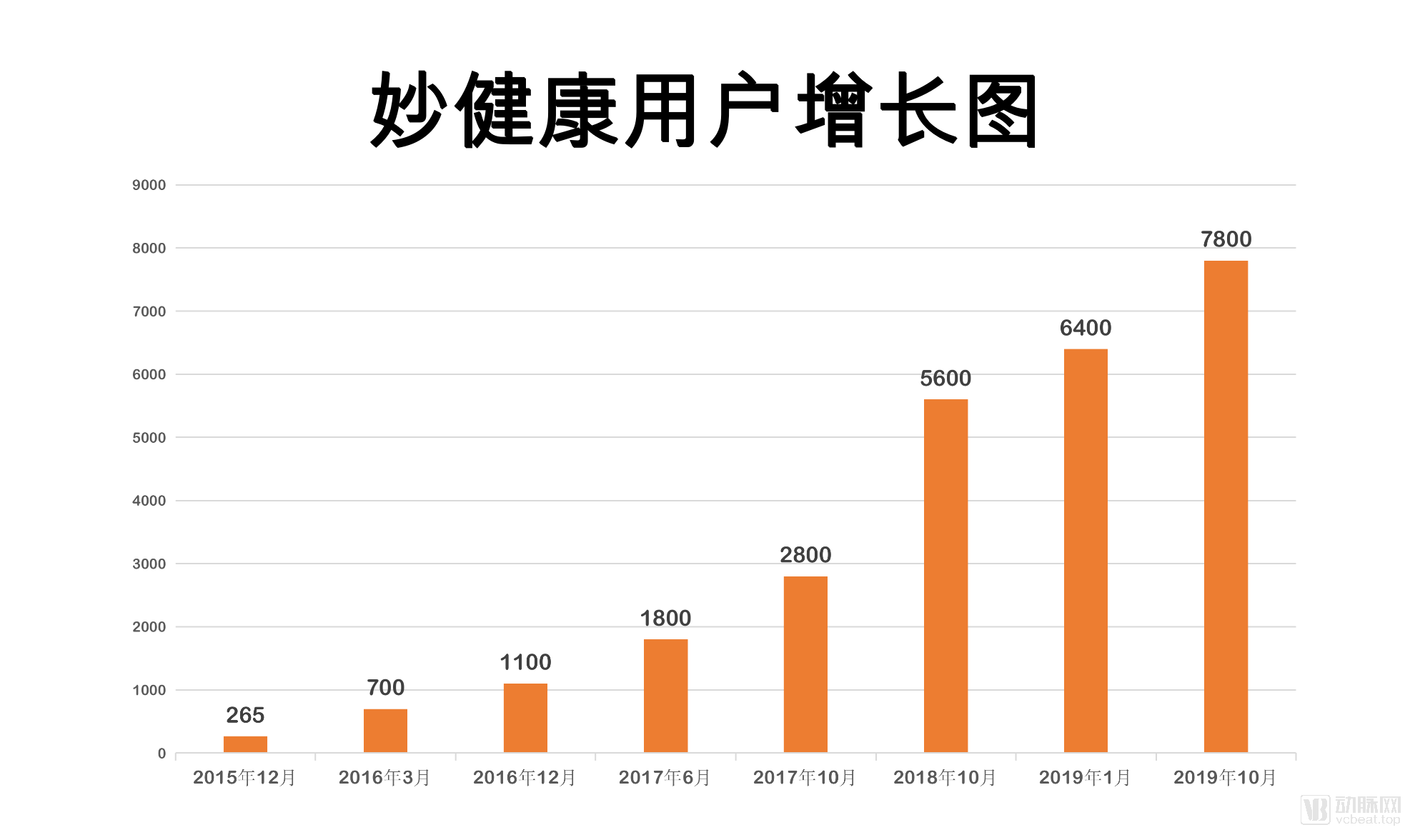
Figure: Changes in the Number of Miao Health Users from 2015 to 2019 (Unit: 10,000)
“Making mistakes while growing, but the pace must not slow.” Perhaps due to the leadership qualities honed in the gaming industry, Miao Health was destined to focus deeply on user acquisition from the outset. In Kong Fei’s view, “the comprehensive health management platform represents a strategic opportunity akin to what the online gaming industry experienced ten years ago.”
The subsequent development of Miao Health further corroborates Kong Fei’s statement.
Capital has always been quicker to sense opportunities than the market. As early as the beginning of 2016, Miao Jiankang, then a startup, secured RMB 100 million in Series A financing led by Ronghui Capital, an affiliate of Sunshine Insurance Group. At that time, Miao Jiankang had been established for only a few months, yet its platform already boasted a user base of 7 million.
At that time, many well-known wearable device manufacturers both domestically and internationally had already opened their data interfaces to Miao Health. Building on this foundation, Miao Health established the “Miao+” data integration platform, developed the “Miao Cloud” big data analytics platform for healthcare, and began implementing AI-driven interventions targeting users’ health behaviors. Meanwhile, Miao Health gradually forged in-depth collaborations with numerous insurance providers, medical institutions, and physical examination centers. By 2017, in addition to the Miao Health app, the concurrent development of the Miao+ and Miao Cloud platforms enabled Miao Health to acquire a broader range of external health data.
During this period, national policies also began to gradually shift their focus from “disease-centered care” to “with“Prevention-centered,” the term “health management” has gradually become familiar to the public.
Professor Zeng Qiang, Chairman of the Health Management Branch of the Chinese Medical Association and Dean of the Institute of Health Management at the Chinese PLA General Hospital, once pointed out: By definition, health management is a medical practice and process guided by the modern concept of health, new medical models, and the Traditional Chinese Medicine principle of “preventive treatment of disease.” It employs the theories, technologies, methods, and approaches of modern medicine and modern management to conduct comprehensive monitoring, assessment, effective intervention, and continuous follow-up services for the overall health status of individuals or populations, as well as the risk factors affecting their health. Its aim is to achieve maximal health benefits with minimal input.
Detection, assessment, effective intervention, and continuous tracking—this series of key actions relies heavily on the support of human health data. With the advent of the AIoT era, the Internet of Everything has established intricate connections among devices via network infrastructure, enabling data to flow along traceable pathways and generate greater value. At that time, Miao Health’s role in the market was more akin to a data acquirer, or simply put, an “entry point” for health data.
Following the launch of Miao Health’s “M-Value” health behavior index, which uses gamification to cultivate healthy user habits, and the emergence of a series of other data-driven innovations, the company’s strategic focus has shifted from emphasizing “data entry points” to prioritizing “data algorithms.” Continuous monitoring and tracking capabilities, coupled with an extensive health database and robust algorithms, have become Miao Health’s core competitive advantages.
Specifically, on various occasions, Kong Fei has consistently emphasized that the three core capabilities of More Health are:
1. Data tracking capability: After proposing health management solutions, monitor user adherence and outcomes through data tracking to establish a closed-loop system, thereby continuously improving the health management solutions;
2. The capability of AI-driven health interventions, which enhances efficiency by translating physicians’ expertise into machine-based outputs to provide a broader range of intervention solutions, thereby enabling more efficient health management;
3. Gamified Operations: Applying gamification strategies to health management can encourage users to proactivelyConductHealth Management.
At this juncture, the value of data, services, and ecosystem chains constitutes the core competitiveness of More Health, as well as the key driver behind its continued success in securing substantial financing rounds.
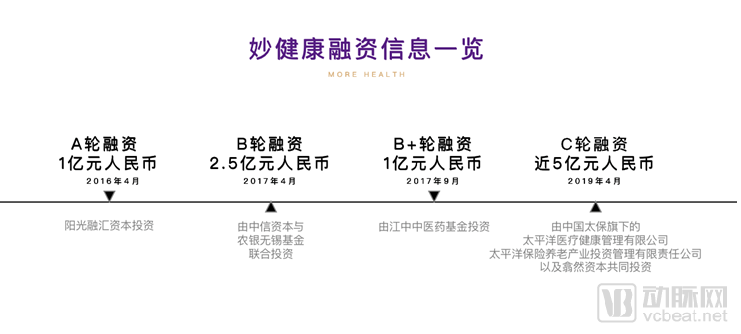
Figure: Overview of Major Financing Rounds for Miao Health
Miao Health’s user base primarily consists of individuals aged 20–45, a demographic with relatively weak health management awareness. In contrast, those over 45 exhibit strong willingness to engage in health management but lack the willingness to pay. Health management has long been perceived as counterintuitive or “against human nature,” meaning that even gamified operations aimed at boosting user stickiness struggle to generate revenue from individual consumers (C-end). This is a lesson Kong Fei learned through trial and error. Consequently, Miao Health has positioned its clients in the B-end sector, specifically targeting insurance companies and enterprises.
A review of the history of health management development in the United States reveals that, against the backdrop of government-funded healthcare for its citizens, the original intent of health management was none other than to intervene early in diagnostic and treatment processes, thereby achieving cost containment in medical care.
“Oranges grown north of the Huai River become trifoliate oranges.” The differing soil conditions have destined the path of health management in China to be far from smooth, with the public-hospital-dominated diagnosis and treatment environment casting a shadow over insurance-backed health management. However, Miao Health’s partners are not public hospitals; it has chosen to completely bypass the “diagnosis and treatment” track. As early as 2016, Miao Health had already begun expanding its reach among users of major insurance companies.
Kong Fei stated in an interview with the media: “At the current stage, the demand for health management is not particularly evident at the individual level. Instead, due to increasing pressure on government medical insurance funds, the inability of commercial insurers to accurately control the incidence rates of health insurance claims, and employers’ growing preference for a robust workforce, health management has become a critical necessity for enterprises.” Serving end-users through business-to-business (B2B) models is a common practice driving the growth of the health management industry in China and represents a globally adopted model.
However, in September 2018, while the debate over whether health insurance should incorporate health management services was still ongoing, U.S. life insurance giant John Hancock issued an open letter that prematurely announced the advent of an era in which health management had become a standard feature of health insurance.
For insurance companies, the profit model primarily stems from premium income plus the difference between actual investment returns and future actual cost expenditures. Therefore, by leveraging Miao Health’s big data mining and analytics, they can gain deeper insights into the future health development trends and conditions of the national population, thereby designing insurance products that better meet users’ future needs and ultimately benefiting their business.
When change arrives, those who are better prepared will find it easier to pull ahead in a crowded field. Looking back at Miao Health’s previous moves, the company established an Insurance Business Department within its organizational structure to specifically serve insurance company clients. Meanwhile, Tongren Insurance Brokerage, a subsidiary of Miao Health, has been committed to providing customized products for insurance companies.
Insurance companies have long been important partners of Miao Health. Sunshine Insurance was the first insurer to collaborate with Miao Health, followed by partnerships with Taikang Insurance, Founder Meiji Life Insurance, and Aeon Life Insurance.
On April 23, Pacific Health Management Co., Ltd., a subsidiary of China Pacific Insurance (CPIC), jointly launched the new mobile health management service brand “CPIC Miao Jiankang” with Miao Jiankang in Shanghai. Meanwhile, the first “Health Interaction Insurance Plan” in China, developed by Miao Jiankang in collaboration with Taiyi Company, was officially rolled out. The interactive insurance policy, which had been promoted extensively for some time, was formally released.
In response to the technological transformation of the insurance industry, Miao Health has long been prepared to become a driving force behind insurance innovation.
As Kong Fei stated, “As long as we avoid mistakes today, we will be in a state of rapid acceleration.”
At a time when everyone was proclaiming a “capital winter,” Miao Health bucked the trend by securing nearly RMB 500 million in Series C financing in April 2019, jointly invested by CPIC Pension Industry Investment, CPIC Medical Health, and Xiran Capital. Thereafter, its development seemed to accelerate.
Miao Health, Miao+, and Miao Cloud’s triangular business structure has evolved into seven major business units: “Miao+,” “Miao Cloud,” “Miao Health APP,” “Miao Bao,” “Miao Yi,” “Miao Yao,” and “Canada Health Management Center (China).” These units jointly focus on smart hardware connectivity, out-of-hospital health big data tracking, health behavior intervention, insurance services, internet-based medical and healthcare services, smart pharmaceutical e-commerce, and offline health management.
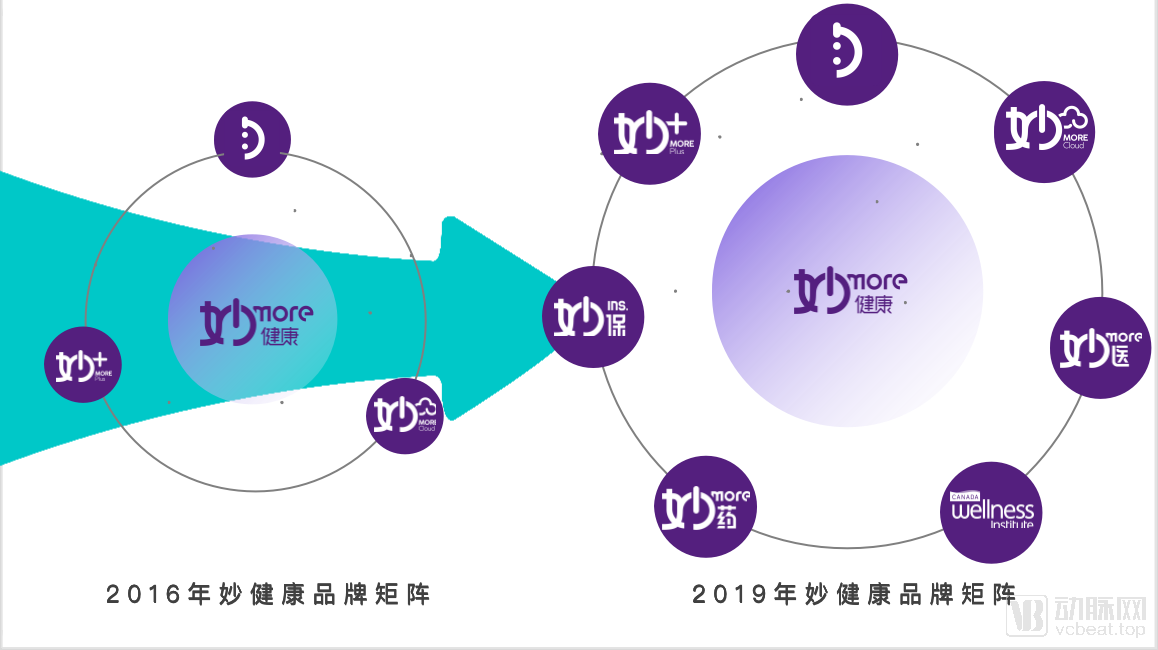
Figure: Evolution of the Miao Health Brand Matrix
In 2019, particularly in the offline implementation of insurance and AIoT-based health management, Miao Health confirmed Kong Fei’s earlier statement through a series of intensive announcements: “There are currently no major players in China’s health management industry. When we first entered the market, our initial thought was that, in the absence of dominant companies, Miao Health has the opportunity to become the largest.”
On August 28, Miao Health unveiled its self-launched “Miao Bao” brand and technology-driven insurance platform. The Miao Bao brand officially introduced two platform initiatives: the Insurance User Health Management Platform and the Intelligent Underwriting System.
The Insurance User Health Management Platform is a one-stop health risk solution that assists users with chronic disease management, risk protection, and medical services. It truly realizes “health promotion,” “medical services,” and “insurance coverage,” returning to the essence of “insurance safeguarding health.” Meanwhile, by establishing closed loops across three dimensions—“management service,” “health data,” and “business model”—the platform better adapts to users’ upgraded health needs and the payment environment in the current AIoT era.
Also in September, in terms of technological capabilities, Miao Health’s first “AI Health Manager,” built upon the upgraded “Miaoyun” platform, passed the review by a panel of experts from institutions including the Disease and Health Management Professional Committee of the Chinese Hospital Association. This signifies that its “AI Health Manager” has acquired the competence to participate in and pass the Health Manager certification examination.
There is a scarcity of professional health management specialists. After scientific and technological development reaches a certain stage, the next challenge lies in how to implement these advancements effectively. Currently, Miao Health’s offline AIoT Health Management Centers have pioneered the integration of AI-powered health manager capabilities. On the consumer side, Miao Health’s AI health managers prioritize disease prevention—including dynamic out-of-hospital monitoring, continuous tracking, and feedback—rather than focusing on disease treatment. As users bear primary responsibility for their own health management, the AI health manager provides proactive and personalized services.
Regarding the offline “new health species” that had long remained “veiled,” on September 4, the CWI Yishengyuan Center in China, jointly established by the Canadian Wellness Institute (CWI) and Miao Health, officially opened.
In October 2019, Miao Health’s Canada Health Management Center (China) successively entered into collaborations with Shiyan Taihe Hospital and Ningbo Hangzhou Bay New Area Greenland Health Industry Development Co., Ltd.
With this, Miao Health has successfully integrated the value chains across the real estate and hospital sectors, further advancing the development and application of its AIoT ecosystem in the field of health management. This achievement holds significant importance for establishing an online-offline innovative service model that integrates medical care, elderly care, and health services—encompassing health management, rehabilitation medicine, chronic disease prevention, and elder care—all driven by health data.
With the Miaobao platform online and offline health management centers established on the ground, Miao Health’s envisioned closed loop of “wellness, healthcare, pharmaceuticals, and insurance” has gradually taken shape. Miao Health has also evolved from a single mobile health management platform into a diversified, comprehensive health ecosystem.
Weak willingness to pay, singular business models, poor service capabilities, and uneven industry quality have characterized the health management sector. After undergoing trials in market education, business model innovation, and industrial integration, the industry has entered a second half focused on mutual benefit. This developmental trajectory appears increasingly aligned with the U.S. market, which has been ahead by several decades.
In contrast, looking at the market landscape, a “death list” of mobile health startups circulated online in early 2019. The author’s preliminary analysis revealed that more than 33% of these companies operated in the broader health sector, typically offering services such as mental health support, weight management, chronic disease management, and general health management. These companies largely “died” due to unsustainable customer acquisition costs and a lack of breakthrough business models.
Compared with diagnosis and treatment, health management is inherently a high-frequency activity; however, its very “high-frequency” nature also poses significant challenges. Scientific health management, which encompasses psychology, nutrition, sleep, and behavioral patterns, is often oversimplified by the public as single-dimensional services such as “medical check-ups,” “fitness,” or “wellness regimens.” Industry standards urgently need standardization, and market education requires guidance from national policies. The health management industry is still in its early stages, yet it is brimming with opportunities driven by the demands of the times.
The voices of startups that still brand themselves as health management companies and have achieved a certain scale are gradually fading in the current market, while More Health is steadily emerging, realizing its “big company dream.”
At VCBeat’s annual Top 100 Future Healthcare Companies Forum, Miao Health has been a constant presence. In the beginning, Kong Fei would jokingly remark, “People always like to ask me, ‘What exactly is health management?’” Later on, he noted, “No one asks me what ‘health management’ is anymore!”
“Dig deep tunnels, store grain abundantly, and delay claiming kingship.” Miao Health has delivered an outstanding performance report in its first five-year plan. How will it develop in the next five years?