

Beckman Coulter: Pioneering IVD Device Innovation and Localized Strategy to Sustain Leadership in China

Beckman Coulter
Diagnostic Product Developer
In Vitro Diagnostics (IVD) refers to the process of extracting samples such as blood, body fluids, and tissues from the human body, and using in vitro testing reagents, kits, calibrators, and quality control materials to test and validate these samples, thereby facilitating disease prevention, diagnosis, therapeutic monitoring, follow-up observation, health assessment, and genetic disease prediction.
Currently, over 80% of clinical diseases rely on in vitro diagnostics. Clinical diagnosis plays a crucial role in disease prevention, diagnosis, monitoring, and treatment.
Beckman Coulter (hereinafter referred to as “Beckman”) is currently one of the most powerful companies globally in the IVD sector, with leading capabilities in the development and manufacturing of instruments, reagents, and application software.
Over the past 80 years, Beckman Coulter’s diverse range of IVD instruments has gained widespread acceptance and recognition among healthcare professionals and researchers worldwide. Approximately 270,000 units are currently in use in laboratories across the globe, making outstanding contributions to human health and technological advancement.
The founder is a renowned scholar and scientist, who initially built the business through the research and development of scientific instruments.
Beckman Coulter was formed through the merger of Beckman Instruments and Coulter Corporation. Its founders were Arnold O. Beckman and the brothers Wallace H. and Joseph R. Coulter, all of whom were renowned scholars and scientists.
During his tenure at the California Institute of Technology, Arnold O. Beckman first invented an ink containing natural pigments to resolve the clogging issue in meter postage machines, and subsequently developed a pH meter for measuring citric acid in lemons. The pH meter is hailed as one of the top 10 inventions of the 20th century.
In 1935, Arnold O. Beckman entered the scientific instrument manufacturing industry by founding Beckman Instruments. The success of the pH meter positioned Beckman Instruments at the center of the instrument manufacturing sector. Meanwhile, the spectrophotometer developed by the company brought about a revolutionary transformation in the field of chemical analysis, becoming a standard instrument in research laboratories.
In 1943, Arnold O. Beckman developed the oxygen analyzer to test oxygen levels in the air. The device could monitor ambient oxygen concentrations for newborns and proactively issue alerts when levels approached 40%, thereby preventing total blindness in neonates. This invention propelled Beckman Instruments to global prominence.
By the 1980s, Beckman Coulter began providing equipment for the biotechnology and biomedical sectors, with its developed instruments used to measure blood, body fluids, and other substances, thereby facilitating drug development.
Beckman Coulter’s other two founders, Wallace and Joseph Coulter, were renowned inventors. In 1953, they jointly proposed the Coulter Principle. This principle provides a method for measuring the size (volume) of microscopic particles, ushering in the era of automated blood cell analysis and becoming the industry’s gold standard for cell counting.
In 1958, Wallace and Joseph Coulter founded Coulter Corporation, focusing on the manufacture of automated hematology analyzers.
In October 1997, Beckman Instruments acquired Coulter Corporation and was renamed Beckman Coulter, enabling its technologies to cover all aspects of biomedicine, including life sciences, clinical diagnostics, and molecular analysis.
In 2011, Beckman Coulter was acquired by Danaher for $6.8 billion, marking Danaher’s largest acquisition to date.
Following the acquisition, Beckman Coulter became one of the subsidiaries under Danaher’s medical diagnostics platform. News reports indicated that Beckman Coulter’s integration positioned Danaher as one of the largest in vitro diagnostic (IVD) companies globally, equipping it with the competitive strength to rival Siemens, Abbott, and Roche.
Danaher is a renowned serial acquirer. To accelerate the integration of acquired companies into the Danaher Group, it implements the Danaher Business System (DBS) within these entities to create added value and foster mutual growth.
Following the acquisition, Beckman Coulter’s organizational structure and culture underwent changes under the influence of the Danaher Business System (DBS), driving its business to new heights. Tom Joyce, CEO of Danaher, stated that with the support of DBS, the operating profit margin of Beckman Coulter’s Life Sciences segment increased by 500 basis points between 2015 and 2018.
Notably, like Danaher, Beckman Coulter has also leveraged mergers and acquisitions as a key strategy to expand its product portfolio. VCBeat has compiled a selection of M&A transactions from Beckman Coulter’s development history.
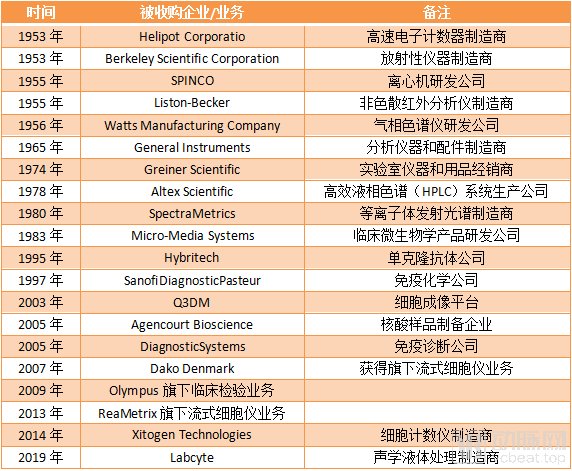
Source: Beckman Coulter official website; graphic by VCBeat
With a comprehensive product portfolio, its core business is the R&D and sales of IVD equipment.
As one of the leaders in the IVD field, Beckman Coulter is committed to providing advanced equipment, consumables, reagents, software, technical support, and services to researchers and commercial laboratories, with a comprehensive product portfolio. Notably, the R&D and sales of IVD equipment constitute Beckman Coulter’s largest business segment, with approximately 270,000 instrument systems installed in laboratories worldwide.
On Beckman Coulter’s official Chinese website, it is stated that the company divides its business into three major divisions: Clinical Diagnostics, Life Sciences, and Particle Characterization.
Clinical Diagnostic Products
Beckman Coulter Diagnostics’ product portfolio primarily includes laboratory automation systems, clinical chemistry analyzers, immunoassay systems, integrated clinical chemistry and immunoassay systems, hematology analyzers, specific protein analyzers, urinalysis systems, microbiology testing solutions, and blood bank blood typing analyzers.
The AU5800 Fully Automated Chemistry Analyzer is one of Beckman Coulter’s flagship products, specifically designed for large or ultra-large clinical and commercial laboratories, with configurable capacity to accommodate varying testing volumes. In addition to upholding the company’s hallmark traits of precision, cost-effectiveness, and ease of use, the AU5800 incorporates enhanced flexibility and intelligence.
The Access 2 Chemiluminescence Immunoassay Analyzer is also one of Beckman Coulter’s key products. It employs microparticle enzyme chemiluminescence technology, achieving a detection sensitivity as high as 10⁻²¹. The system is suitable for testing tumor markers, anemia, thyroid function, and prenatal screening panels. Additionally, it utilizes magnetic microparticle technology to enhance accuracy.
In addition, Beckman Coulter’s DxI series of fully automated chemiluminescent immunoassay analyzers are primarily used in high-end hospitals and can detect items across 12 major categories, including hormones, tumor markers, anemia, cardiac markers, prenatal screening, infectious diseases, and thyroid function.
Beckman Coulter has also been committed to providing personalized, comprehensive laboratory automation solutions. Power Express, the flagship product of Beckman Coulter’s laboratory automation systems, connects laboratory automation track systems and information networks to create a fully automated workflow environment. It covers the entire testing process, enabling large-scale automation of the total testing process and achieving integration of one or several testing systems (such as clinical chemistry, immunology, and hematology) within the clinical laboratory.
Life Science Products
Beckman Coulter Life Sciences’ product portfolio includes centrifuges, flow cytometers, automated workstations, nucleic acid extraction and purification reagents, and protein interaction systems. Among these, centrifuges and flow cytometers are the flagship products of the Beckman Coulter Life Sciences division.
Beckman Coulter has been a global leader in centrifugation technology for over 60 years, integrating the research and development, design, manufacturing, sales, and service of centrifuges. Recently, Beckman Coulter launched the intelligent Optima X series of ultracentrifuges. With a maximum speed of up to 150,000 rpm and a vacuum-sealed drive system that significantly reduces shaft wear and extends service life, this product enables the separation of various nucleic acids, proteins, and cells, thereby facilitating research in proteomics, genomics, and cellomics.
Additionally, Beckman Coulter proudly introduces the MoFlo Astrios EQ ultra-high-speed cell sorting system, an air-excited six-way sorter that utilizes patented enhanced dual forward-angle light scatter (eFSC) detection technology to simultaneously perform detection and sorting of particles ranging from 200 nm to 30 μm in diameter. With its capability to conduct high-speed cell sorting and microparticle detection within a single instrument, this device establishes a new core standard for flow cytometers.
It should be noted that the MoFlo Astrios EQ is intended for research use only and is not to be used for clinical diagnosis.
Granular Characteristics Products
Beckman Coulter’s particle characterization portfolio includes MET ONE airborne particle counters, HIAC liquid particle counters, particle size analyzers, cell culture biochemistry analyzers, and Anatel TOC analyzers, with applications in life sciences, oil analysis, electronics, aerospace, and defense industries.
As the first foreign IVD company to enter the Chinese market, it adheres to a localization strategy.
Beckman Coulter was the first foreign IVD company to enter China and the first IVD company to establish a manufacturing plant in the country. Since its entry into the Chinese market in the 1980s, Beckman Coulter has become a model for international IVD companies successfully pioneering the Chinese market.
Beckman has always placed great emphasis on the vast Chinese market. As early as 1978, Arnold O. Beckman led a team of top scientists to visit China, engaging in academic exchanges with Chinese scientists at Fudan University and the Chinese Academy of Sciences in Beijing, and donated a batch of equipment to both Fudan University and the Chinese Academy of Sciences.
In 1983, Beckman Coulter began establishing representative offices and service centers across China, with representative offices located in Beijing, Shanghai, Fuzhou, Guangzhou, and other cities, while service centers were set up in Beijing, Shanghai, Guangzhou, and elsewhere. Currently, Beckman Coulter’s China headquarters is based in Shanghai, with more than 20 subsidiaries established throughout the country.
In 1997, Beckman Coulter established a reagent manufacturing facility in Suzhou—Beckman Coulter Experimental Systems (Suzhou) Co., Ltd.—with an initial investment exceeding USD 5 million. Currently, the reagents produced at this plant supply markets across China, Southeast Asia, and Japan. Subsequently, in 2015, Beckman Coulter established a research and development center in Suzhou and expanded the original manufacturing facility.
In addition, in 1997, Beckman Coulter was selected by the National Center for Clinical Laboratory Testing of the Ministry of Health as a member unit of the Professional Committee on Standardization of Clinical Laboratory Testing, becoming the only company in the laboratory industry to receive this honor.
In June 2014, Beckman Coulter acquired CytoVale, a Chinese R&D company specializing in flow cytometers. Over the following two years, global sales of the China-made CytoFLEX flow cytometer exceeded 1,000 units, providing effective solutions for diverse needs in life sciences research and clinical testing.
As its business in China continues to expand, Beckman Coulter has begun to conduct product research and development and manufacturing tailored to the characteristics of the Chinese market. For instance, the testing needs of Chinese clinical laboratory physicians for certain indicators differ significantly from those in Europe and the United States. Total bile acid, for example, is rarely tested abroad but is in high demand domestically. In response to these specific needs, reagent production at Beckman Coulter’s Suzhou factory has gradually evolved from offering only biochemical reagents to including hematology reagents, and further to the manufacturing of complex instruments.
Mr. Chen Chunzhi, Marketing Director of Beckman Coulter’s Clinical Diagnostics Division, has stated that Beckman’s success in the Chinese market is inseparable from its localization strategy. Through its Suzhou factory, Beckman has developed more AU clinical chemistry reagents tailored to the Chinese market. Beckman is also seeking collaborations with Chinese companies in product R&D and business model development to achieve win-win outcomes. Additionally, to better serve Chinese customers, Beckman provides direct customer service to enhance service efficiency and quality.
Having cultivated the Chinese market with meticulous dedication for over 30 years, Beckman Coulter has now become a localized enterprise in China. Its localization strategy permeates every aspect of its operations, from product research and development to customer service. Faced with the vast market potential of China, Beckman Coulter is poised to continue its deep engagement in the Chinese market in the future.