Major Chinese Hospital's Illumina Sequencing Tender Fails Due to 'No Imported Products' Clause
Illumina
Diagnostic Product Developer
'%20fill='%23FFFFFF'%3E%3Crect%20x='249'%20y='126'%20width='1'%20height='1'%3E%3C/rect%3E%3C/g%3E%3C/g%3E%3C/svg%3E)
Source: China Government Procurement Network, Compiled by: In Vitro Diagnostics Network
A large tertiary hospital in China purchases Illumina whole genome sequencing services, but explicitly requires in the bidding qualifications"Bidders are not allowed to use imported products for bidding."— This seemingly contradictory clause appeared in its latest bidding announcement.
The project, with a budget of 2 million yuan, was already in its fourth bidding process but was eventually aborted due to an insufficient number of bidders (less than three).
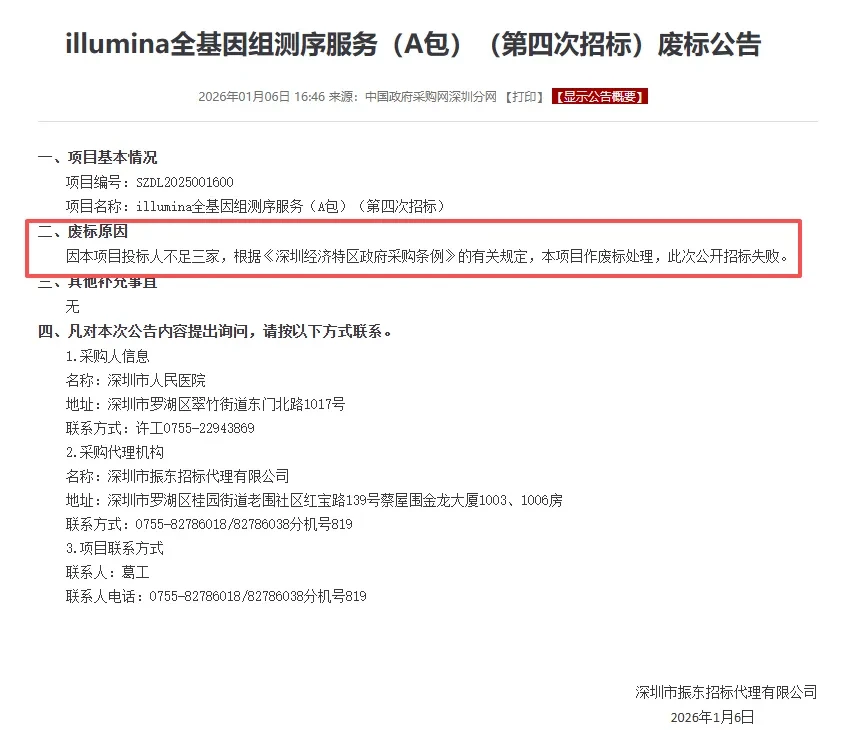
On January 6, the China Government Procurement Network released the "Nullification Announcement for Illumina Whole Genome Sequencing Service (Package A) (Fourth Bidding)," which stated: Due to fewer than three bidders participating in this project, according to relevant regulations of the Shenzhen Special Economic Zone Government Procurement Ordinance, this project has been nullified, resulting in the failure of this public bidding.
According to the editor's understanding, on December 11, the China Government Procurement Network released the tender announcement for this project. In the announcement, one of the requirements for applicant qualifications is:This project does not accept consortium bids, does not allow bidders to use imported products for bidding, and does not permit subcontracting.
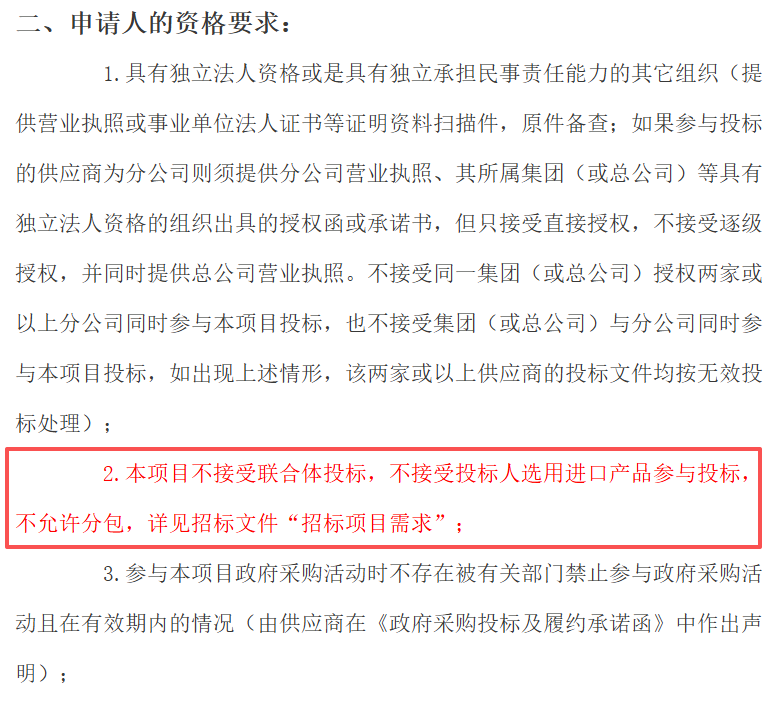
This RMB 2 million budget tender for Illumina whole-genome sequencing services has reached a deadlock due to a key clause, and the fourth tender was ultimately declared void. The tender document explicitly stated the procurement target as "Illumina whole-genome sequencing services" but stipulated in the supplier qualification requirements that "bidders using imported products are not accepted." This creates an obvious policy paradox: Illumina, as the mainstream sequencing platform, has its equipment and core consumables fall under the category of imports. This clause effectively excluded the vast majority of qualified service providers in the market, directly resulting in fewer than three bidders each time and causing the tender to fail repeatedly. This contradiction highlights the possible disconnect between specific technical needs and overarching procurement policies in high-end scientific research services procurement, affecting procurement efficiency and practical implementation.

Shenzhen People's Hospital was founded in 1946 and is the municipal hospital with the longest history, largest scale, and strongest comprehensive treatment capabilities in the city. In June 2018, it was selected as one of the first batch of high-level hospitals in Guangdong Province under the Peak Construction Plan. Currently, it has formed a "one hospital, five districts, six sites" development pattern, namely: the main campus (Inpatient Department), Longhua Branch, Bantian Campus, Dongmen Outpatient Clinic, Dapeng Translational Medicine Innovation Center, and Bao'an Hospital (planned for construction).
The hospital has been awarded an A+ rating in the performance assessment of tertiary public hospitals nationwide for five consecutive years, and its comprehensive strength has entered the top 100 in China.The hospital currently has 4 national key clinical specialties (Respiratory and Critical Care Medicine, General Surgery, Critical Care Medicine, Geriatrics), 1 national integrated traditional Chinese and Western medicine "flagship" department construction project, and has been approved for lung organ transplantation qualifications. It has established an air rescue base and completed its maiden flight. The hospital is a registered institution for national stem cell clinical research, national drug clinical trials, and national medical device clinical trials. It hosts 6 sub-centers of national clinical medical research centers, 1 Guangdong Provincial Clinical Medical Research Center (Geriatrics), 17 Guangdong Provincial Key Clinical Disciplines, and 17 Shenzhen Key Medical Specialties. The hospital also has 4 provincial major scientific and technological innovation platforms, 19 municipal key laboratories/innovation platforms, and 18 clinical quality control centers at the municipal level or above. Additionally, it includes 2 Shenzhen Clinical Medical Research Centers (Respiratory Diseases, Geriatrics) and serves as the Shenzhen Major Disease Prevention and Treatment Center for Alzheimer's disease and chronic obstructive pulmonary disease (COPD). The hospital has successively introduced 44 well-known discipline teams, including academician teams led by Zhong Nanshan and Dong Jiahong, signing "Three Prestigious Projects" agreements. There are 75 high-level medical talents in Shenzhen. In the latest performance monitoring of 43 diseases across the city, our hospital ranked first in the number of discharged patients for 20 diseases among the 16 municipal hospitals.
Disclaimer: This article is for sharing only and does not represent the platform's position. If there is any infringement or copyright issue, please contact us as soon as possible, and we will correct it immediately. Thank you!
In order to facilitate communication and exchange among the readers and fans of the In Vitro Diagnostics Network, we have specially established the 198th In Vitro Diagnostics Network group in China.Group! Everyone is welcome to scan the QR code below to join the group and speak up enthusiastically!