

Zunyi Medical University Second Affiliated Hospital: A $430 Million Smart Hospital Unveiled
On March 1 this year, the Second Affiliated Hospital of Zunyi Medical University (hereinafter referred to as “Zunyi Med U Second Affiliated Hospital”), located at the intersection of Xinlong Avenue and Xinpu Avenue in the Xinpu New District of Zunyi City, commenced its trial operations. It is a public hospital directly under the Guizhou Provincial Health Commission and also an affiliated hospital directly under Zunyi Medical University, serving a surrounding population of approximately 400,000 residents.
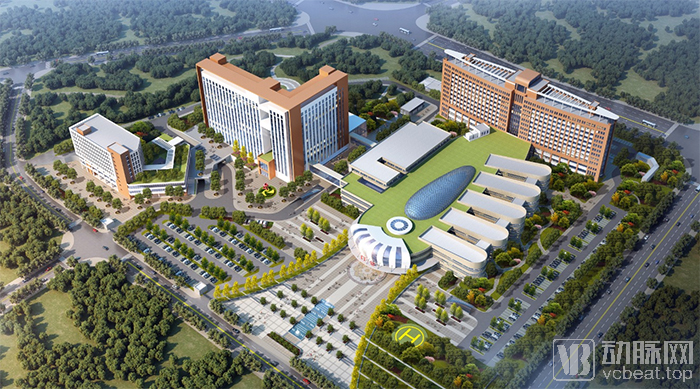
It is reported that the Second Affiliated Hospital of Zunyi Medical University has a planned total investment of nearly RMB 3 billion, covering a land area of 297 mu and a total floor area of approximately 300,000 square meters, with a green space ratio of nearly 40%. The hospital is designed to provide 1,800 beds and more than 3,000 parking spaces. Adhering to the principle of unified planning and phased construction, the project is scheduled to be completed in four phases, with the aim of establishing it as a benchmark “Smart Hospital.”
Upon its initial opening, the Second Affiliated Hospital of Zunyi Medical University had completed only Phase I and Phase II construction projects, with a built-up area of nearly 160,000 square meters put into use. This included an outpatient building of approximately 80,000 square meters (housing 408 consultation rooms) and an inpatient building of approximately 40,000 square meters (with 818 beds). The hospital launched 26 clinical departments, 13 medical technology departments, and 5 oncology departments. “We did not engage in external publicity, yet all available beds were fully occupied,” Shu Tao, Party Secretary of the Second Affiliated Hospital of Zunyi Medical University, told reporters.
The Phase III inpatient building is planned to cover a floor area of 86,800 square meters, featuring 24 standard wards and a medical examination center. The Phase IV project will be constructed on the site east of Xinlong Avenue, primarily comprising research and teaching facilities, a medical rehabilitation center, and expert dormitories, which are essential supporting components for a teaching hospital directly affiliated with a higher medical institution.
Six months have passed since its opening, and the hospital now handles 1,000 outpatient and emergency visits per day, with 760 inpatients. What has attracted so many patients? Where does its “smart” capability manifest? How can enterprises collaborate with hospitals to build smart hospitals? To answer these questions, we conducted exclusive interviews with Shu Tao, Party Secretary of the Second Affiliated Hospital of Zunyi Medical University, and Huang Deqiang, Vice President of Shenzhen Das Intellitech Co., Ltd., who shared their insights and experiences in building a smart hospital.
Secretary Shu recalled that in 2009, the People’s Government of Xinpu New Area in Zunyi City proposed the construction of a smart hospital to meet the needs of the new area. After extensive discussions, it was ultimately decided that the First Affiliated Hospital of Zunyi Medical University (hereinafter referred to as “the First Affiliated Hospital of Zunyi Medical University”) would undertake the project. Located in the city center, the First Affiliated Hospital of Zunyi Medical University faced significant pressure on medical services due to its large patient volume and congested traffic. Under these circumstances, the government aimed to establish the new hospital in the new area and operate it under a “one hospital, two campuses” model. This approach sought to alleviate traffic congestion and patient overload in the urban center while addressing healthcare access for residents in the new area.
“It took several years from proposal to feasibility study. Construction finally commenced in 2014, with the new campus configured and planned in accordance with the standards for a Grade III general hospital,” said Secretary Shu.
However, it took five years for the Second Affiliated Hospital of Zunyi Medical University to complete Phase I and Phase II of its construction project. What were the reasons for the slow progress? Secretary Shu summarized that there were three main reasons: First, the positioning of the Second Affiliated Hospital of Zunyi Medical University was unclear—it had never been definitively established whether it would operate independently or as part of a “one hospital, two campuses” model. Second, as the hospital was fully funded by the government, it was difficult to secure the entire amount of funding at once, which prolonged the construction period. Third, the government’s planning for the hospital underwent changes, with targets raised from the original 10,000 outpatient visits and 2,000 beds, resulting in the expansion of the project from an initial two phases to four phases.
In accordance with the arrangements deployed by the Zunyi Municipal Committee of the Communist Party of China and the Zunyi Municipal People’s Government, as well as Zunyi Medical University, the Second Affiliated Hospital of Zunyi Medical University was placed under the trusteeship of the Affiliated Hospital of Zunyi Medical University for the first three years of its operation, adopting a “one hospital, two campuses” model to coordinate and allocate resources between the two institutions. “We have reached a consensus with the First Affiliated Hospital of Zunyi Medical University to carry out in-depth cooperation in four areas: sharing of human resources, ward resources, and outpatient resources, as well as the expanded development of the oncology discipline. This effectively creates synergistic momentum and competitive drive for parallel advancement across both campuses, thereby better serving the healthcare needs of the public,” stated Secretary Shu.
Regarding the development direction of the Second Affiliated Hospital of Zunyi Medical University, Secretary Shu stated that the hospital adheres to the principle of prioritizing disciplinary development and positioning emergency care as a strategic focus. This strategy is driven not only by the hospital’s close proximity to high-speed rail stations, airports, and expressways, but also by its expansive campus. The combination of these geographical advantages and institutional strengths makes the hospital exceptionally well-suited for delivering emergency medical services.
In addition to its advantages in hospital development, the Second Affiliated Hospital of Zunyi Medical University is also the first public “Smart Hospital” in Zunyi City.
According to the National Health Commission’s new definition of smart hospitals this year, it primarily encompasses three aspects.
First, "Smart Healthcare" for medical personnel, focusing on the construction of information systems centered around electronic medical records.
Second, “smart services” for patients aim to make the patient experience more convenient and efficient. Examples include the deployment of numerous all-in-one kiosks and self-service terminals in hospital outpatient lobbies, mobile payment, online appointment registration and scheduling, informational alerts, and derived services such as push notifications and reminders for parking information.
Third is "Smart Management" oriented toward hospital administration, primarily applied to refined hospital management. The earliest system for hospital management was the Hospital Information System (HIS). Currently, there are numerous systems dedicated to hospital administration, including those for financial and materials management. These cover a wide range of items such as pharmaceuticals, consumables, laboratory reagents, medical waste, patient clothing, staff uniforms, and utilities (water, electricity, and gas). Operational status across the entire hospital, including Office Automation (OA) systems, can be monitored via mobile devices or computers. This constitutes refined, information-based management for hospitals.
“In addition to incorporating the aforementioned elements, the smart hospital we are building will also meet the human-centric infrastructure needs of patients and staff, such as clinical environments, work environments, and service workflows,” stated Secretary Shu. “The optimization of service workflows primarily leverages ‘Internet Plus’ technology to ensure seamless information connectivity across the entire hospital and enable smooth coordination among medical personnel.”
To date, nearly RMB 2 billion has been invested in Phase I and Phase II of the Second Affiliated Hospital of Zunyi Medical University. So where has this funding been allocated?
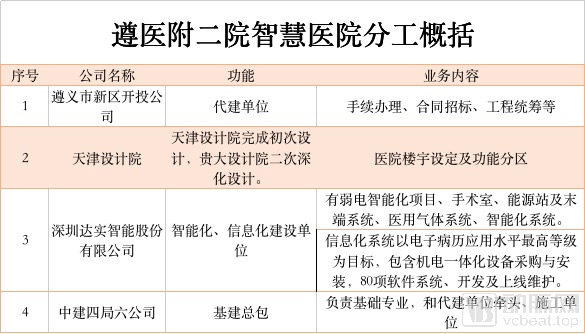
“The largest expenditure was on civil construction, followed by the development of smart hospital capabilities, such as procurement of medical equipment, healthcare information systems, digital operating rooms, internet-based healthcare services, and labor costs,” Secretary Shu told us. The companies undertaking these projects are summarized below:
Taking the procurement of hospital equipment as an example, with the full investment and policy support from the Zunyi Municipal Committee of the Communist Party of China and the Zunyi Municipal People’s Government for hospital construction, the hospital has procured large-scale imported equipment through the government centralized procurement model, including linear accelerators (2 units), magnetic resonance imaging (MRI) systems (2 units), computed tomography (CT) scanners (2 units), digital subtraction angiography (DSA) systems (2 units), fully automated biochemical analysis lines, and various surgical endoscopes. The total number of medical devices is 8,428 (including 117 units with a unit price exceeding RMB 1 million), with a total value of RMB 650 million.
With the hardware and software infrastructure of the smart hospital at the Second Affiliated Hospital of Zunyi Medical University now initially in place, how do patients and hospital administrators perceive the hospital’s “smart” capabilities?
From the perspective of the patient care journey, the process may involve scenarios such as outpatient clinics, pharmacies, medical technology departments, inpatient wards, and operating rooms, each of which has been imbued with "smart" capabilities.
Taking the outpatient hall as an example, Das Intellitech has implemented numerous smart healthcare scenarios, including integrated IT infrastructure construction, standardized integration platforms, self-service kiosks and patient mobile app services, omni-channel and scenario-based shared payment systems, integrated queue management and number calling, automatic in-clinic number calling, integrated medical technology department management, and integrated HRP & OA mobile office solutions.
Patients can register, make payments, and check the status of examinations and tests via a mobile app or WeChat official account on self-service devices. The hospital can send various notifications throughout the patient’s visit through these channels, with all push messages delivered via both the app and WeChat. In addition to traditional functions such as registration, payment, and viewing examination/test results, the Second Affiliated Hospital’s app also integrates features including care pathway guidance, physical examination results, hospital satisfaction surveys, and follow-up services.
Meanwhile, to enhance the patient experience by improving convenience and reducing wait times, our information technology infrastructure enables comprehensive, omnichannel payment solutions. Both service counters and self-service kiosks accept payments via medical insurance cards, bank cards, WeChat, and Alipay. Furthermore, to optimize outpatient workflows, the system provides an integrated queue management and calling function. This outpatient queuing system features secondary triage capabilities, automatically managing queues for standard appointments, priority cases, late arrivals, follow-up visits, and missed numbers. This ensures that patients receive assistance throughout their entire healthcare journey—from admission to discharge—via mobile devices and patient guidance systems.
“For hospital administrators, the smart hospital is a valuable tool for enhancing management,” stated Secretary Shu in his assessment of the smart hospital initiative. Currently, the Second Affiliated Hospital of Zunyi Medical University employs 742 staff members, including 288 physicians, 74 medical technologists, 321 nurses, 35 specialized technical personnel, and 24 administrative staff. In terms of professional titles, there are 65 senior-level, 95 intermediate-level, and 344 junior-level title holders. Regarding educational qualifications, the hospital has 15 doctoral degree holders and 149 master’s degree holders. This team was established with the support of the Affiliated Hospital of Zunyi Medical University and through recruitment efforts since 2014. The objective is to implement institutional mechanisms for integrated development with the Affiliated Hospital of Zunyi Medical University. The latter has committed to regularly dispatching experts to the Second Affiliated Hospital to provide on-site assistance, outpatient services, and surgical guidance, thereby ensuring basic homogenization of medical services across both campuses.
With the completion of Phase III and Phase IV projects at the Second Affiliated Hospital of Zunyi Medical University, the hospital will need to manage a significantly larger population, including hundreds to thousands of medical professionals and tens of thousands of patients. How should this be managed?
“This calls for testing the wisdom of managers. Only through the cultivation of philosophy and culture, aided by data support, can hospital management be effectively carried out. The core of a smart hospital lies in the interconnectivity of data across the entire institution; via a mobile phone or computer terminal, one can gain insight into the overall operations of the hospital, thereby enabling targeted management,” Secretary Shu candidly stated.
Smart hospitals generate vast amounts of data daily; however, not all data is suitable for management purposes, necessitating the identification of valuable data. Additionally, these systems enable the tracking of each employee’s daily tasks, helping administrators understand workload distribution across various roles. This facilitates the development of more effective and human-centric performance evaluation schemes, thereby enhancing hospital efficiency.
The reason why the Second Affiliated Hospital of Zunyi Medical University can deliver such an exceptional smart experience to both patients and hospital administrators is largely attributable to the innovative IoT technologies and products provided by Das Intellitech. These include the Intelligent Control Platform for Hospital Mechanical and Electrical Equipment, the Smart Operating Room Management Platform, the Clinical Decision Support System, and the Intra-hospital Information Platform. Their core value lies in enabling hospitals to achieve highly integrated intelligence and energy efficiency, digitalization of operating rooms and clinical workflows, and advancement of hospital management information systems, thereby building a digital smart hospital.
Huang Deqiang further added, “The ‘smart hospital’ is by no means merely a conceptual idea; it is entirely feasible for practical implementation. Based on its independently developed core technologies, Das Intellitech has provided hospitals with intelligent and energy-saving systems, specialized operating room and medical systems, as well as informatization and big data systems. By leveraging an IoT-based intelligent control platform, the company integrates monitoring and applications across various specialized systems. Furthermore, through a smart hospital management platform, it connects diverse application systems via interfaces adhering to unified data standards, enabling continuous iterative improvements of system applications as data accumulates. This approach realizes a smart hospital that is perceptible, thoughtful, and capable of growth. Ultimately, it can achieve the goals of increasing efficiency by more than 10% and reducing energy consumption by over 20%. The entire journey of the Second Affiliated Hospital of Zunyi Medical University, from conception to implementation, benefited from a favorable convergence of timing, location, and human collaboration. We are honored to have witnessed its birth.”
Furthermore, when addressing the common pain points in the development of smart hospitals, Huang Deqiang stated, “Specialized systems for smart hospitals are by no means a simple aggregation of individual systems; rather, they require top-level design capabilities, platform integration capabilities, and robust support from each subsystem. During hospital construction, improving operational efficiency while reducing energy consumption—under the premise of providing higher-quality services—has become a new challenge, characterized by this ‘one increase, one decrease.’ The traditional approach, which relies on general contractors for overall coordination and separate subcontractors for specialized systems, often lacks top-level design due to general contractors’ insufficient understanding of medical needs and the fragmented management of individual specialized systems. Consequently, progress and outcomes cannot be guaranteed, leading to frequent project delays and post-completion modifications.”
How has Das Intellitech addressed these pain points? Huang Deqiang further explained, “Leveraging its National-Level Postdoctoral Workstation, Das Intellitech applies its years of accumulated IoT and AI technologies to the healthcare sector. To address challenges in hospital construction, the company has innovatively adopted a specialized medical turnkey contracting model, providing top-level smart hospital design, engineering construction, and long-term operational maintenance. This approach centrally resolves the prominent pain points and difficult issues encountered in hospital construction.”
“To date, Das Intellitech has cumulatively served over 600 large hospitals and more than 6,000 operating rooms and ICUs across China, providing medical solutions to numerous renowned domestic healthcare institutions. The most comprehensive implementation is at the Second Affiliated Hospital of Zunyi Medical University, which has truly achieved interconnectivity among various in-hospital systems, enabling the medical data generated to be further applied for the benefit of both patients and the hospital,” said Huang Deqiang, Vice President of Das Intellitech and Chairman of Das Jiuxin.
“In the future, as cloud technology matures and 5G technology achieves breakthroughs—particularly leveraging 5G’s high bandwidth and ultra-low latency of 10 nanoseconds—platform connectivity will become more efficient and cost-effective. The era of the Internet of Everything is imminent, ushering in greater opportunities for the development of smart hospitals. We aim to break down the ‘walls’ of hospitals, extend services beyond hospital premises, provide more medical services, and achieve an innovative transition from healthcare to comprehensive health management,” said Huang Deqiang.
The advent of 5G technology and its application in the healthcare sector will bring new opportunities for enhancing smart healthcare and advancing the Healthy China initiative. This is not a simple extension of 4G, but rather marks the convergence of networks. Coupled with emerging technologies such as the Internet of Things (IoT) and artificial intelligence (AI), future smart hospitals hold infinite possibilities.
Finally, Secretary Shu shared three key insights on smart hospitals and hospital management:
First, adopt a cognitive approach that combines visionary aspirations with pragmatic execution: while benchmarking against world-class frontier standards, it is essential to ground strategies in the hospital’s actual conditions and act within its capabilities.
Second, respect for professionalism and mutual trust. We must uphold the professionalism of medical care while also incorporating the scientific rigor and rationality of architectural design.
Third, coordination that combines clear delineation of responsibilities with a willingness to assume accountability. The hospital administration must not only adhere to the defined roles and responsibilities of all parties but also actively lead coordination efforts and take proactive initiatives.
Over the next one to two years, the Second Affiliated Hospital of Zunyi Medical University will establish itself as a comprehensive hospital featuring oncology prevention and treatment, trauma care, and emergency critical care as its core specialties, supported by other essential disciplines. With an initial capacity of approximately 900 inpatient beds, the hospital will facilitate access to medical services for residents in the region, effectively alleviate the operational burden on the Affiliated Hospital of Zunyi Medical University, and significantly enhance the urban supporting service capabilities and overall urban quality of Xinpu New District.