

Eight Ministries Jointly Issue Guidelines on Building a Comprehensive Elderly Health Service System Centered on Six Key Areas
VCBeat (WeChat: vcbeat) reported that on November 1, the National Health Commission, the National Development and Reform Commission, and six other ministries and commissions jointly issued the “Guiding Opinions on Establishing and Improving the Elderly Health Service System” (hereinafter referred to as the “Opinions”). The “Opinions” propose building a comprehensive, continuous, and urban-rural coverage elderly health service system encompassing health education, preventive care, disease diagnosis and treatment, rehabilitation and nursing, long-term care, and palliative care. Work tasks and objectives are outlined around these six components.
The “Opinions” stipulate that by 2022, 50% of general hospitals at secondary level and above shall establish geriatric medicine departments. By 2022, more than 80% of general hospitals, rehabilitation hospitals, nursing care institutions, and primary healthcare facilities shall become age-friendly healthcare institutions. By 2022, the proportion of nursing care beds in primary healthcare facilities shall reach 30%.
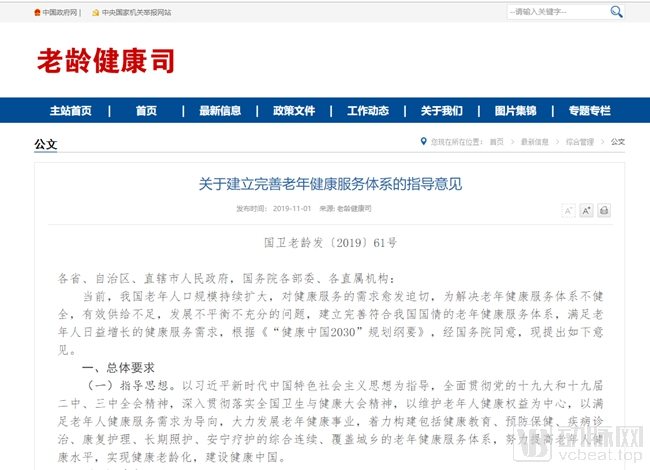
The full text of the policy is as follows:
To the People's Governments of all provinces, autonomous regions, and municipalities directly under the Central Government, and to all ministries and commissions of the State Council and all institutions directly under the State Council:
Currently, the elderly population in China continues to expand, leading to increasingly urgent demands for health services. To address issues such as an unsound elderly health service system, insufficient effective supply, and unbalanced and inadequate development, and to establish and improve an elderly health service system that aligns with China’s national conditions so as to meet the growing health service needs of the elderly, the following opinions are hereby proposed in accordance with the Outline of the “Healthy China 2030” Planning Program and with the approval of the State Council.
I. General Requirements
(I) Guiding Principles. Guided by Xi Jinping Thought on Socialism with Chinese Characteristics for a New Era, we shall fully implement the spirit of the 19th National Congress of the Communist Party of China and its Second and Third Plenary Sessions, thoroughly carry out the directives of the National Conference on Health and Wellness, center our efforts on safeguarding the health rights and interests of the elderly, orient our work toward meeting their health service needs, vigorously develop geriatric health services, and strive to build a comprehensive, continuous, and urban-rural covering health service system for the elderly that encompasses health education, preventive care, disease diagnosis and treatment, rehabilitation and nursing, long-term care, and palliative care. We shall make every effort to improve the health status of the elderly, achieve healthy aging, and contribute to the building of a Healthy China.
(II) Basic Principles. Health-led, full-course services. Guided by the concept of comprehensive hygiene and holistic health, we will advance the development of the elderly health service system, integrate health into all policies, focus on the entire life course, intervene in factors affecting health, and provide integrated, continuous, and full-course services.
Safety-net protection, equitable and accessible. With a focus on primary care, improve service efficiency to guarantee basic health services for elderly individuals with disabilities (including dementia) and those from special family planning households who face financial hardship. Promote the optimized allocation of resources, gradually narrow urban-rural and regional disparities, and ensure equitable access to elderly health services.
Policy Support to Stimulate Vitality. The government shall fulfill its responsibilities in formulating plans and policies and guiding investments, while allowing the market to play a decisive role in resource allocation. This approach aims to stimulate market vitality, encourage social participation, and meet the multi-level and diverse needs for elderly health services.
Coordinating Resources for Joint Development and Shared Benefits. Coordinate resources across government departments and various sectors of society, mobilize and guide broad public participation, jointly promote the development of elderly health services, and achieve joint development and shared benefits.
(3) Main objectives. By 2022, systems, standards, and norms related to elderly health will be basically established; the number of elderly health service institutions will increase significantly; service content will be enriched; service quality will be markedly improved; the workforce will be expanded; resource allocation will be more rational; a comprehensive, continuous, and urban-rural integrated elderly health service system will be basically established; and the basic health service needs of the elderly will be met.
II. Key Tasks
(1) Strengthen health education.Conduct health education activities for older adults and their caregivers through various methods and media channels, covering topics such as nutritional diet, physical exercise, mental health, injury prevention, disease prevention, rational medication use, rehabilitation nursing, life education, and traditional Chinese medicine (TCM) wellness. These efforts aim to promote healthy lifestyles among older adults and enhance their health literacy. Actively carry out science popularization activities on TCM medicated diets and therapies, promote traditional TCM exercises, and strengthen publicity of TCM health, wellness, and elderly care culture. Organize events such as the National Elderly Health Awareness Week to disseminate scientific knowledge on elderly health and relevant policies, fostering a social atmosphere that cares for and supports the health of older adults. Universities for the elderly and other elderly educational institutions shall integrate health education into their curriculum systems and teaching content. Relying on community service centers, grassroots aging associations, universities for the elderly, and other platforms, encourage older adults to actively participate in social activities and consciously take initiative in maintaining their physical and mental well-being. (The National Health Commission, the Ministry of Education, the Ministry of Industry and Information Technology, the Ministry of Civil Affairs, the Ministry of Agriculture and Rural Affairs, the National Radio and Television Administration, the General Administration of Sport, the National Administration of Traditional Chinese Medicine, and the China National Committee on Aging shall be responsible according to their respective duties.)
(2) Strengthen preventive healthcare.Establish and improve a three-tier prevention system for elderly health, encompassing intervention against health risk factors, early detection, diagnosis, and treatment of diseases, and disability prevention. Implement national basic public health service projects, strengthen health management for the elderly, and provide services including lifestyle and health status assessments, physical examinations, auxiliary tests, and health guidance. Incorporate elderly health management as a key component in the performance evaluation of basic public health service projects, using elderly satisfaction as an important evaluation indicator. County-level (city, district) health administrative departments shall assume primary responsibility for performance evaluations and organize one such evaluation annually. Prioritize the elderly in solidifying family doctor contract services. Launch initiatives to improve elderly nutrition, monitoring, evaluating, and enhancing their nutritional status. Strengthen early screening, early intervention, and classified management of key chronic diseases among the elderly, and actively promote early screening and health guidance for neurodegenerative diseases such as Alzheimer’s disease and Parkinson’s disease. Implement disability prevention projects, disseminate core information on disability prevention, and reduce the incidence of disability among the elderly. Enhance the construction and renovation of age-friendly environments to minimize accidental injuries among the elderly. Attach importance to the mental health of the elderly, improve early prevention and intervention mechanisms for mental disorders, conduct mental health assessments and follow-up management for common mental disorders and psychological behavioral issues such as depression and anxiety, and provide psychological care services—including psychological counseling, emotional relief, and grief consolation—for the elderly, particularly those facing special difficulties. (The National Health Commission, the Ministry of Industry and Information Technology, the Ministry of Civil Affairs, the Ministry of Finance, the Ministry of Housing and Urban-Rural Development, and the National Administration of Traditional Chinese Medicine shall be responsible according to their respective duties.)
(3) Strengthen disease diagnosis and treatment.Optimize the layout of healthcare resources for the elderly, and establish a sound geriatric healthcare service network based on primary healthcare institutions, centered on geriatric hospitals and geriatrics departments in general hospitals, and supported by relevant teaching and research institutions. General hospitals at Level II and above with appropriate conditions shall establish geriatrics departments; by 2022, the proportion of such hospitals with geriatrics departments shall reach 50%. Localities may increase efforts to build geriatric hospitals according to actual conditions. Attach importance to comprehensive geriatric assessment and the diagnosis and treatment of geriatric syndromes, and promote the transformation of geriatric healthcare services from a disease-centered, single-disease model to a patient-centered, multimorbidity co-management model. Strengthen medication security for the elderly, conduct monitoring of medication use among the elderly, enhance medication guidance, and establish a long-term prescription system for chronic diseases in the elderly. Provide traditional Chinese medicine (TCM) health services in communities and homes, and facilitate the extension of high-quality TCM resources to communities and households.
Fully implement preferential policies for medical services for the elderly. Medical institutions shall generally establish green channels for registration and medical treatment for the elderly, optimize healthcare processes for older adults, and provide convenient services to facilitate their access to medical care. Launch initiatives to create age-friendly medical and health institutions, promote age-appropriate renovations in these facilities, and deliver age-friendly services. By 2022, more than 80% of general hospitals, rehabilitation hospitals, nursing institutions, and primary healthcare institutions shall become age-friendly medical and health institutions. Encourage medical and health institutions to provide home-based medical services, such as home hospital beds and house calls, for elderly individuals with disabilities living at home. (The National Health Commission, the National Development and Reform Commission, the Ministry of Finance, and the National Administration of Traditional Chinese Medicine shall be responsible according to their respective duties.)
(4) Strengthen rehabilitation and nursing services.Fully leverage the role of rehabilitation medicine in healthcare services for the elderly, providing early, systematic, professional, and continuous rehabilitation medical services to elderly patients. Vigorously develop elderly care services and establish a sound elderly care service network supported by institutions, based in communities, and grounded in home care. Provide rehabilitation and nursing services for the elderly with distinctive features of Traditional Chinese Medicine (TCM). Strengthen the development of nursing and rehabilitation medical institutions; encourage regions with abundant medical resources to transform some public medical institutions into nursing and rehabilitation medical institutions; encourage comprehensive hospitals at Level II and above to establish departments of rehabilitation medicine; and increase the proportion of rehabilitation and nursing beds in primary healthcare institutions. Support rural healthcare institutions in utilizing existing surplus staffing quotas and beds to open rehabilitation and nursing beds. By 2022, the proportion of nursing beds in primary healthcare institutions shall reach 30%. (The National Health Commission, the National Development and Reform Commission, the Ministry of Civil Affairs, the Ministry of Finance, and the National Administration of Traditional Chinese Medicine shall be responsible according to their respective duties.)
(5) Strengthen long-term care services.Explore the establishment of a long-term care service model for disabled older adults that spans home-based, community-based, and professional institutional settings. Implement basic public health service programs to provide in-home health assessments and health services for disabled older adults. Support the development of community-embedded elderly care institutions through measures such as government procurement of services. Rely on medical and health institutions—including nursing homes (stations), nursing centers, community health service centers, and township health centers—as well as elderly care institutions with the capacity to provide long-term care services, such as community day-care centers and township nursing homes, to deliver long-term care services to disabled older adults. Encourage localities to support various medical-nursing combined institutions in admitting economically disadvantaged, advanced-age, disabled older adults through models such as publicly built but privately operated facilities, government procurement of services, and operational subsidies.
Increase the number of nurses engaged in caring for disabled elderly individuals, and encourage retired nurses to participate in guidance, training, and service provision for the care of disabled elderly individuals. Further develop vocational skills training and employment guidance services to strengthen the long-term care workforce. Provide emergency first aid and caregiving skills training to caregivers of home-bound disabled elderly individuals, thereby enhancing the caregiving capabilities and proficiency of family caregivers. (The National Health Commission, the Ministry of Education, the Ministry of Civil Affairs, the Ministry of Finance, and the Ministry of Human Resources and Social Security shall be responsible according to their respective duties.)
(6) Strengthen hospice and palliative care services.In accordance with the functions and positioning of medical institutions, relevant healthcare facilities shall be promoted to provide palliative care services based on the principles of “full informed consent and voluntary choice” by patients. These facilities should establish palliative care wards or beds; where conditions permit, dedicated palliative care centers may be constructed to accelerate the standardization and normalization of palliative care institutions. Community-based and home-based palliative care services shall be actively developed. Efforts shall be made to explore and establish a coordinated working mechanism integrating institutional, community, and home-based palliative care, thereby forming an efficient and rational referral system. Guidelines for patient admission and medication management in palliative care shall be formulated. For-profit medical institutions may independently determine the scope and fee standards for their palliative care services. For non-profit medical institutions, palliative care services that fall under medical services such as treatment, nursing, examinations, and tests shall be charged according to existing itemized fee schedules; those classified as non-medical services, including emotional support and daily living assistance, shall not be subject to medical service price management, with fee standards determined autonomously by the medical institutions.
Establish and improve a multidisciplinary service model for palliative care, providing patients in the terminal stage of disease with services such as pain and other symptom control, and comfort care, while offering psychological support and humanistic care to patients and their families. Strengthen public education and awareness, integrate life education into health curricula in primary and secondary schools, and promote widespread social recognition and acceptance of the concept of palliative care. Carefully summarize the experience from pilot programs on palliative care and steadily expand the scope of these pilots. (The National Health Commission, the National Development and Reform Commission, the Ministry of Education, and the National Healthcare Security Administration shall be responsible according to their respective duties.)
III. Safeguard Measures
(1) Strengthening Standard Development. Formulate standards for health interventions and evaluations for the elderly. Establish and improve standards and management specifications for long-term care services, and develop professional skill standards for long-term care personnel. Formulate basic standards and service specifications for elderly health service institutions providing medical care, rehabilitation, nursing, and palliative care; develop guidelines for the construction and management of geriatrics departments in general hospitals; and establish standards for age-friendly healthcare institutions. Study and improve the content, standards, specifications, pricing, and payment policies for home-based medical nursing and home hospital bed services; establish and improve safeguard mechanisms; encourage relevant institutions to purchase liability insurance, medical accident insurance, personal accident insurance, and other coverage to prevent and address professional and personal safety risks; and appropriately improve the compensation levels for home visit service personnel. (The National Health Commission, the Ministry of Civil Affairs, the Ministry of Human Resources and Social Security, the State Administration for Market Regulation, the National Healthcare Security Administration, the China Banking and Insurance Regulatory Commission, and the China Disabled Persons’ Federation shall be responsible according to their respective duties.)
(II) Strengthen policy support. Localities shall actively formulate and implement supportive policies, providing support and preferential treatment for the development of elderly health services in areas such as land supply and government procurement of services. Social forces are encouraged to establish geriatric hospitals, rehabilitation hospitals, nursing homes, hospice care centers, and other facilities. Greater support shall be provided for the construction of elderly health service institutions in impoverished areas, promoting the equalization of elderly health services across urban and rural areas and among different regions. A comprehensive subsidy system shall be established for economically disadvantaged elderly individuals who are of advanced age or disabled, ensuring effective coordination with the long-term care insurance system. Research shall be conducted to establish a stable and sustainable financing mechanism, fostering the development of a long-term care insurance system framework tailored to national conditions. (The National Development and Reform Commission, the Ministry of Civil Affairs, the Ministry of Finance, the National Healthcare Security Administration, and the China Banking and Insurance Regulatory Commission shall be responsible according to their respective duties.)
(3) Strengthening disciplinary development. Advance the construction of innovation bases such as Geriatrics Research Centers and the National Clinical Research Center for Geriatric Diseases, establishing high-level hubs for technological innovation and the translation of scientific achievements. Enhance scientific research related to elderly health, supporting the research and development of technologies and products for prevention, diagnosis, treatment, and other aspects of elderly health through fiscal science and technology programs at all levels. Strengthen the research, development, and promotion of appropriate technologies for elderly health. Guide ordinary higher education institutions and vocational colleges to establish majors and courses in geriatrics, pharmacy, nursing, rehabilitation, psychology, and palliative care, and to conduct degree-based education. (The Ministry of Education, the Ministry of Science and Technology, the National Health Commission, and the National Administration of Traditional Chinese Medicine shall be responsible according to their respective duties.)
(4) Strengthen workforce development. Enhance the training of professionals in elderly health, support continuing education for personnel engaged in elderly health services, and expand the workforce in this field. Strengthen training for professionals in health promotion for the elderly, geriatrics, and related disciplines; establish training mechanisms and bases to improve the service capabilities and proficiency of relevant personnel. Expand the elderly nursing care workforce to address service gaps, with the goal of basically meeting the nursing care needs of the elderly by 2022. Improve the professional qualification certification system for elderly health-related occupations and develop a compensation and distribution system oriented toward incentivizing technical and skill-based value, thereby broadening career development prospects. (The National Health Commission, the Ministry of Education, the Ministry of Civil Affairs, the Ministry of Human Resources and Social Security, and the National Administration of Traditional Chinese Medicine shall be responsible according to their respective duties.)
(5) Strengthening information support. Fully leverage technologies such as artificial intelligence to research and develop wearable health support technologies and devices for the elderly, and explore the provision of services including remote real-time monitoring, real-time positioning, health surveillance, and emergency assistance calls. Enhance the development of information systems related to elderly health services, promote the aggregation and integration of various types of health data, consolidate information resources, and achieve information sharing. Actively explore the “Internet + Elderly Health” service model, promote the integration of online and offline services, and launch a number of demonstration projects for smart health services. (The National Health Commission, the Ministry of Industry and Information Technology, and the Ministry of Civil Affairs shall be responsible according to their respective duties.)
(6) Strengthen organizational safeguards. Establish a working mechanism led by the government, with inter-departmental collaboration and social participation. Localities and relevant departments shall attach great importance to the development of the elderly health service system, incorporate it into relevant plans for economic and social development, include it in the overall deployment of deepening healthcare system reform and promoting the development of elderly care and health service industries, and formulate specific plans and implementation measures for building the elderly health service system in light of local conditions.
National Health Commission National Development and Reform Commission
Ministry of Education Ministry of Civil Affairs
Ministry of Finance Ministry of Human Resources and Social Security
National Healthcare Security Administration National Administration of Traditional Chinese Medicine
October 28, 2019
Original link to the policy:http://www.nhc.gov.cn/lljks/s7785/201911/cf0ad12cb0ec4c96b87704fbbeb5bbde.shtml