

JD Health Unveils 'Health Management-Centric' Strategy: CEO Xin Lijun Outlines Five Key Initiatives in IPO Prospectus
Since May this year, JD Health, which has spun off from JD.com and secured over $1 billion in Series A financing, has been a high-frequency topic of industry attention.
Since his appointment as CEO of JD Health was announced in July, Xin Lijun has not rested for a moment; he has been visible at numerous conferences, marking what is likely his busiest period since joining JD.com in 2012.
On October 28, JD Health held a partner conference attended by thousands of participants. At the event, Xin Lijun unveiled a new strategy centered on “health management,” committing to connect and integrate the entire industry chain, merge diverse medical resources, and provide users with products and services that span the full life cycle and cover all health scenarios.
Meanwhile, JD Health also announced a significant milestone: JD Pharmacy’s revenue surpassed that of the four largest listed pharmaceutical retail chains in just three years, making JD Health’s retail business segment the largest pharmaceutical retail channel in China.
Reshaping the business landscape by shifting from pharmaceutical e-commerce to a “health management-centric” model, JD.com has been strategically positioning itself for three years since the launch of JD Pharmacy. By the end of 2017, JD Internet Hospital went online, marking two years of JD’s involvement in the medical services sector.
Before JD Health became an independent entity, it was part of the Lifestyle Business Group under JD Retail Group, and its pharmaceutical and healthcare supply chain business was also directly managed by Xin Lijun. Therefore, JD Health did not emerge out of nowhere but had long been planned.
On the second day after the conclusion of the Partners Conference, a reporter from VCBeat (WeChat ID: vcbeat) went directly to JD.com’s headquarters to conduct an exclusive interview with Xin Lijun, aiming to gain a more comprehensive understanding of JD Health and its subsequent overall strategic logic and planning.
“If we cannot provide health guidance and management throughout the entire user lifecycle, we cannot be considered a health company, nor can we operate independently under the name JD Health,” Xin Lijun offered as a brief summary of JD Health.
However, the underlying connections are far more complex than they appear. Following an exclusive interview with Xin Lijun, we analyzed JD Health’s overall strategy by integrating the strengths and strategic plans of its core business segments:
1. Pharmaceutical e-commerce connects with channels, directly reaching more users;
2. Build trust in internet hospitals by fostering user confidence through high-quality medical services;
3. For chronic disease management, establish connections with high-level hospitals and physicians before developing the product;
4. Jointly building “Healthy Cities” helps JD Health aggregate resources, providing strong support for its other business segments;
5. With the subsequent launch of the JD Health app, the new strategy will become clearer.
Pharmaceutical e-commerce was JD.com’s earliest entry point into the healthcare sector. In 2013, JD ventured into the retail of non-pharmaceutical products such as health supplements. In 2016, JD Pharmacy was launched. Currently, JD Pharmacy’s revenue has surpassed that of the four largest listed pharmaceutical retail chains, making JD Health’s retail business segment the largest pharmaceutical retail channel in China, accounting for over 15% of the national pharmaceutical retail market share. Forty-five percent of the stock-keeping units (SKUs) offered by JD Pharmacy were previously not sold in retail pharmacies or did not primarily use retail pharmacies as their sales channel; these SKUs contribute more than 60% of specialty medication sales. Over half of the medicines are shipped to cities below the third tier.
Additionally, JD Health’s “Yaojingcai,” launched nearly three years ago to enhance the efficiency of traditional distribution channels, has become one of the largest third-party pharmaceutical wholesale platforms in China. It now covers 21 provinces and more than 400 cities, with its distribution network extending down to the township level.
This time, JD Health has proposed the “New Medicine Poverty Alleviation Program,” which will provide a pharmaceutical subsidy of RMB 1,000 per person to impoverished populations. Although this initiative is charitable in nature, an analysis of retail and wholesale market data reveals that JD Health has indeed made substantial efforts in penetrating lower-tier markets.
JD Health’s pharmaceutical products are delivered through an integrated logistics system alongside other JD.com merchandise, handled by JD Logistics. Logistics capability is a key strength of JD.com. According to the JD Logistics official website, as of June 30, 2019, its network for large and small-to-medium-sized items had achieved 100% coverage across all administrative districts and counties in China. Its self-operated delivery services reached 99% of the national population, with over 90% of self-operated orders delivered within 24 hours.
Leveraging JD Logistics, JD Health can deliver 50% of its medication orders by the next day; furthermore, through its network of 110,000 offline partner pharmacies, it offers delivery within 30 minutes.
According to Xin Lijun, the layout and construction of pharmaceutical warehouses are currently underway. “By the end of this year, we will complete the deployment of pharmaceutical warehouses across China based on regional hubs, ensuring that at least 50% of orders achieve same-day or next-day delivery.”
Internet-based healthcare involves multiple stages. If drug safety issues arise during delivery, it is difficult to clearly assign liability among hospital physicians, pharmaceutical e-commerce platforms, and logistics providers. “For drugs sold and delivered by us, we are confident in assuming responsibility as long as the prescription is valid,” said Xin Lijun. JD Logistics’ end-to-end tracking system serves as a critical safeguard for medication safety, while its cold-chain logistics framework further enhances the security of delivering specialized medicines and formulations.
Market penetration into lower-tier cities, coupled with robust delivery capabilities and continuously improving delivery speeds supported by pharmaceutical warehouses, enables JD Health to reach users directly in greater numbers and at a faster pace on the supply chain end. This serves as the offline channel foundation for future full-process, all-scenario health management—an advantage that companies primarily focused on online businesses struggle to replicate.
As pharmaceutical e-commerce platforms expand and strengthen, it has become common practice for them to extend upstream into the healthcare sector, creating an integrated “medical care + pharmaceuticals” model. In December 2017, JD.com’s Internet Hospital launched its trial operations.
Unlike other platform-based internet hospitals that aggregate a large number of physicians, JD Internet Hospital, despite its advantages in pharmaceuticals, lacks a competitive edge in medical talent. To address this, JD Internet Hospital has primarily partnered with offline hospitals to migrate their entire operations online.
In January 2019, the “JD Internet Hospital Suqian Branch” was launched, marking the comprehensive migration of Suqian First People’s Hospital onto the JD Internet Hospital platform. This initiative represented the first online-offline integrated collaboration between a public hospital and a platform-based internet hospital in China.
Meanwhile, the Suqian medical insurance system has been integrated with JD.com, enabling local residents to purchase medications directly through medical insurance after online consultations, without the need to visit hospitals or designated pharmacies with their physical insurance cards. In Suqian, JD.com has achieved a closed-loop internet ecosystem encompassing “medical care, pharmaceuticals, and medical insurance.”
Currently, JD Internet Hospital has signed partnership agreements with 30 hospitals, connecting over 30,000 doctors from 327 cities across 32 provinces, municipalities, and autonomous regions in China. Among these physicians, 62% are affiliated with Grade A tertiary hospitals, and 80% hold the title of attending physician or above. These doctors practice online either through institutional partnerships with their respective hospitals or as independent practitioners.
“Co-building internet hospitals with public hospitals should be the optimal model for platforms,” said Xin Lijun. He believes that public hospitals are not adept at consumer-facing (C-end) operations and lack the ability to connect and leverage pre- and post-diagnosis resources; they may even lack the capacity to effectively utilize physician resources. JD Health prefers to initiate collaboration at the institutional level, thereby securing greater hospital support for physicians’ online practice. “JD Internet Hospital can transform regional patient bases into a national one, expand physicians’ practice scope from regional to nationwide, and integrate high-frequency, consumer-grade healthcare services.”
In Xin Lijun’s vision, the ultimate goal of the internet hospital is to become a hub for tiered diagnosis and treatment, capable of handling a full range of services including online consultations, at-home testing, real-time synchronization of test results, and prescription fulfillment with medication delivery. When an in-person consultation is necessary, physicians will recommend appropriate hospitals or specialists based on the patient’s specific condition. The internet hospital will also provide users with services such as appointment scheduling, access to medical reports, and medication delivery.
JD Internet Hospital will play a pivotal linking role in its “health management-centric” strategy, making medical quality increasingly critical. “Medical quality” and “trust” are two key terms that Xin Lijun has repeatedly emphasized.
Currently, JD Internet Hospital has also hired full-time physicians to conduct medical quality audits, with the team expected to reach nearly 100 members by year-end. Within JD Internet Hospital’s performance evaluation system, medical service quality is the most critical metric, followed by user satisfaction. Xin Lijun stated, “Only after users have developed full trust in the medical services provided by an internet hospital will they entrust their health management to it.”
After establishing its “medical care + pharmaceuticals” framework, JD Health plans to deeply integrate the two sectors. At the Partner Conference, it officially announced its entry into the field of chronic disease management, collaborating with leading specialty departments of major public hospitals across China to provide specialized disease management for chronic conditions such as cardiovascular and cerebrovascular diseases, diabetes, and mental disorders.
Xin Lijun introduced that JD Health has signed agreements with eight specialized psychiatric hospitals, including Tianjin Anding Hospital, to establish a specialist medical consortium for mental disorders. It will also collaborate with the Chinese Society of Endocrinology of the Chinese Medical Association to jointly build the JD Internet Hospital Diabetes Center.
Xin Lijun revealed that witnessing a friend’s family struggle to seek medical care for their child with autism exposed the scarcity of mental health resources. He also noted that among the internet hospitals previously established in partnership with JD Health, there were quite a few specialized psychiatric hospitals, which inspired him to pursue in-depth management of mental health conditions.
Common chronic diseases such as hypertension and diabetes are areas in which many healthcare companies have ventured. However, few have entered the specialty of psychiatry. Mental disorders encompass a broad spectrum, including schizophrenia, depression, bipolar disorder, anxiety disorders, and obsessive-compulsive disorder, and are often hidden within everyday life.
However, according to Li Jie, Dean of Tianjin Anding Hospital, there are currently only 500 child psychiatrists and 40,000 psychiatrists nationwide in China, with varying levels of expertise and scarce medical resources. As a partner hospital of JD Health, Tianjin Anding Hospital operates on a large scale, with an annual outpatient volume of 560,000 visits. These high-quality medical resources are expected to become more accessible through internet-based solutions.
How Does JD Health Implement Chronic Disease Management? Xin Lijun Did Not Disclose Specific Details, but He Revealed the Following Direction: First, Partner with High-Level Hospitals to Connect with Physicians and Provide High-Quality Medical Services, Thereby Building User Trust and Engagement, and Then Gradually Implement End-to-End Management.
JD Health also unveiled two major initiatives: the “Upgrade of JD Internet Medical Services” and the “Opening of the JD Internet Medical Platform.” These initiatives are designed to serve consumer-facing (C-end) and business-facing (B-end) markets, respectively. They aim to connect individual users with a wider range of higher-quality medical services, while providing enterprises with integrated online-to-offline solutions that address the diverse healthcare needs of their customers and employees.
These upgraded medical services reveal that smart glucose meters, smart blood pressure monitors, smart wristbands and watches, and post-consultation management have become fundamental components of chronic disease management and other health management initiatives.
Many companies are involved in chronic disease management. High-quality medical resources and hardware equipment are only part of the equation. How to unlock these resources and achieve integrated management that combines online and offline services, prevention and treatment, as well as efficiency and personalization, remains a challenge many enterprises continue to explore. How exactly will JD Health manage this? It is worth our attention.
JD Health has built certain advantages to support its core strategy of health management and has made corresponding strategic plans and layouts.
Another key business line worth highlighting is the provision of smart solutions to governments, healthcare institutions, pharmacies, and other stakeholders. In recent years, in an effort to advance the Healthy China initiative, cities across the country have vigorously promoted the development of “Healthy Cities.” As a social force, JD Health has actively participated in these efforts (with JD.com serving as the primary participant prior to the establishment of JD Health). Based on publicly available information, we have compiled a list of cities where JD Health has been involved in construction projects, along with the main areas of collaboration.
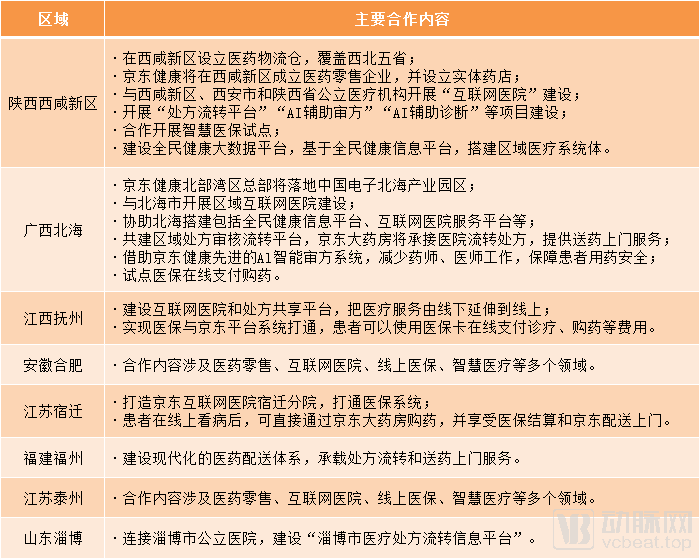
Source: “JD Bulletin” WeChat Official Account; graphic by VCBeat
In collaborations related to “Healthy Cities,” JD Health, together with its partners, offers a variety of smart solutions based on big data, artificial intelligence, cloud computing, the Internet of Things (IoT), and 5G. This has further extended into “interconnectivity,” enabling JD Health to aggregate substantial resources. Resource aggregation encompasses two aspects:
On the one hand, as shown in the figure above, healthy city solutions primarily include the development of internet hospitals and prescription circulation platforms. JD Internet Hospital and JD Pharmacy can participate in these projects to varying degrees, undertaking regional consumer-facing (C-end) businesses and strengthening their capabilities.
On the other hand, in Xin Lijun’s words, JD Health excels in serving consumer (C-end) markets, with strong capabilities in product design and user operations driven by consumer demand logic. In the government’s efforts to coordinate the integration of online and offline healthcare services, enterprises skilled in user engagement are needed to enhance citizens’ sense of gain. “At the same time, we have the credibility of JD.com as our endorsement.” However, Xin Lijun also admitted that JD Health is not as proficient in serving government (G-end) and hospital (H-end) clients, which necessitates resource integration and collaboration with more specialized partners to accomplish this task.
At the JD Health Partner Conference, multiple partner companies made their appearance, including: Peking University Medical Information, Yihuan Medical, Xinyijia, Zhuojian Technology, Kingdee Medical, iFlytek, Lianzhong Wisdom, Winning Health Technology Group, Heart Medical International, and CEC Technology. These partners’ areas of expertise cover in-hospital and out-of-hospital informatization and interoperability, chronic disease management, AI technology, payment technology, and more, thereby providing a strong complementary advantage to JD Health.
According to VCBeat, JD Health is currently in negotiations with more than 10 cities for collaboration, and the number of “Healthy Cities” it will help build is expected to continue growing. In addition, large public Grade A tertiary hospitals across various regions are also key partners for JD Health.
Leveraging smart solutions, JD Health can continuously channel resources to its other business segments while drawing in external resources through collaborative efforts, thereby fostering a healthy ecosystem for its core strategy of health management.
Currently, JD Health’s online entry point remains within the JD.com app, requiring a secondary click to redirect users to either JD Internet Hospital or JD Pharmacy. As a comprehensive e-commerce platform, this setup by JD is entirely appropriate.
However, JD Health’s footprint in the healthcare sector is expanding and will continue to grow, making its current front-end infrastructure increasingly inadequate. Much like a small family that has outgrown its original home, it is time to move into a larger one.
Meanwhile, the above-the-fold section of JD Health’s homepage continues to be dominated by categories such as pharmaceuticals, tonics, dietary supplements, and medical devices, underscoring its e-commerce orientation. This implies that, akin to changing residences, a substantial redesign of the layout is also warranted.
JD Health’s “home swap” plan is already on the agenda. Xin Lijun revealed that the JD Health app will enter its testing phase this December, with a full launch expected to follow shortly thereafter.
From pharmaceutical e-commerce to end-to-end health management, the target audience has expanded to include both patients and healthy individuals. JD Health has restructured its business landscape, and we anticipate that the front-end layout of its app will reflect the concept of end-to-end health management. The chronic disease management products that Xin Lijun temporarily held back during his exclusive interview may also be unveiled.
At that time, JD Health will no longer benefit from JD.com’s online traffic advantage. How to convert JD.com’s 300 million users into JD Health users, and truly address users’ needs for whole-process health management, will be a test for JD Health.