

Global First Elastic-Slicing-Based 5G SA Medical Private Network Launched at The First Affiliated Hospital of Zhengzhou University, Enabling a New Era of Smart Healthcare Applications
“5G” Wave Sweeps Through Hospitals in Just Over a Year. Looking back on this year, we can see that the world’s first 5G-enabled remote orthopedic surgery was successfully performed at Beijing Jishuitan Hospital; China’s first 5G-based remote implantation of a deep brain stimulator for Parkinson’s disease was successfully carried out at the Chinese PLA General Hospital... These achievements have undoubtedly laid a solid foundation for the large-scale application of “5G + Healthcare.”
However, while these pilot projects have demonstrated the viability of 5G technology in healthcare, transitioning from laboratory settings to real-world applications requires a comprehensive 5G infrastructure to support the practical implementation of “5G+Healthcare” in real-world scenarios.
The good news is that we have witnessed a breakthrough. On October 18, the National Engineering Laboratory for Internet Medical Systems and Applications of the First Affiliated Hospital of Zhengzhou University (hereinafter referred to as the National Engineering Laboratory), in collaboration with China Mobile Communications Group Henan Co., Ltd., China Mobile Chengdu Industrial Research Institute, and Huawei Technologies Co., Ltd., jointly developed the “Full-Scenario 5G SA Smart Healthcare Private Network Based on Elastic Slicing.” This marks the world’s first cross-regional 5G private network featuring full-scenario coverage based on elastic slicing.
The newly released 5G SA Smart Healthcare Private Network adheres to the 3GPP international telecommunications standards and is built upon a 5G Standalone (SA) core network. By employing end-to-end elastic slicing technology, it presents a 5G healthcare private network solution featuring network adaptability, network awareness, and intelligent network operations and maintenance (O&M) tailored for comprehensive medical scenarios across “intra-hospital, inter-hospital, and extra-hospital” settings. This solution achieves secure isolation between the healthcare private network and public user networks, effectively meeting the performance and security requirements of healthcare industry users for 5G medical private networks.
5G SA Medical Private Network no longer relies on 4G and is a complete, standalone 5G network. Compared to current 4G networks, the 5G SA network architecture represents a disruptive transformation. By leveraging MEC (Multi-access Edge Computing) and network slicing technologies, it enables true dynamic bandwidth awareness, mutual isolation of different services, and dynamic allocation of network performance, thereby meeting the customized requirements of various vertical industries for 5G private networks.
Based on comparative field tests of the 5G SA medical private network at the First Affiliated Hospital of Zhengzhou University, the results indicate that under both intra-hospital and cross-regional interconnection conditions, the 1G network slice achieved a download rate of over 900 Mb/s, an upload rate of over 180 Mb/s, and an average user latency of 8 ms. Under high network load conditions, the data rates for standard 5G services dropped by more than 60%, and maximum latency increased by more than sixfold. In contrast, all quality-of-service (QoS) indicators for services within the 5G medical private network remained normal, with uplink bandwidth assurance reaching 95%, downlink bandwidth assurance exceeding 90%, and latency assurance reaching 99%.
Furthermore, the 5G smart healthcare private network features high deployability and replicability; following this pilot, the deployment of 5G private networks in hospitals is expected to accelerate significantly.
To gain deeper insights into the disruptive changes brought to hospitals by SA and network slicing technologies, a reporter from VCBeat (WeChat ID: vcbeat) visited the National Engineering Laboratory for Internet Medical Systems and Applications at the First Affiliated Hospital of Zhengzhou University, engaging in discussions with the hospital’s technical team, Huawei, and China Mobile. The key points are summarized as follows.
How Does the SA Private Network Lay a Solid Foundation for 5G Development in Hospitals?
What Breakthroughs Has Elastic Slicing Technology Brought?
Which new applications will emerge with the support of SA and network slicing technologies?
5G technology features three major application scenarios: eMBB (enhanced Mobile Broadband, significantly increasing upload and download speeds), uRLLC (ultra-Reliable Low-Latency Communications, such as autonomous driving services), and mMTC (massive Machine-Type Communications, supporting multi-connectivity for urban IoT applications). There are two deployment strategies for 5G networks: Standalone (SA) and Non-Standalone (NSA). NSA 5G base stations rely on 4G infrastructure, using 4G base stations as anchors to deliver 5G services. In contrast, SA 5G base stations operate independently without relying on 4G base stations. A detailed comparison is provided below:

Functional Analysis of NSA and SA Networking Architectures
As can be seen from the figure above, NSA (Non-Standalone) networking focuses solely on eMBB high-bandwidth connections, which can meet the internet access needs of general users. However, new technologies such as low latency, massive connectivity, and network slicing require an SA (Standalone) networking architecture. In healthcare scenarios, remote surgery under low-latency conditions and mobile medical care with massive device connectivity place extremely high demands on mMTC and uRLLC.
The First Affiliated Hospital of Zhengzhou University has officially deployed an end-to-end medical private network based on the SA (Standalone) networking mode, leveraging elastic slicing technology. This setup completely isolates smart healthcare private network users from 4G public user services and standard 5G public user services, ensuring that private network users remain unaffected by public network traffic and thereby guaranteeing the high security of the medical private network.
Network isolation capabilities stem from the architectural characteristics of the medical private network itself. The medical private network deployed by the First Affiliated Hospital of Zhengzhou University comprises three channels: the dedicated channel, the priority channel, and the standard channel. Among these, the dedicated and priority channels offer Service Level Agreement (SLA) commitments to ensure the quality of medical services.
SLA denotes the service level that operators can provide to users, encompassing metrics such as bandwidth, latency, jitter, packet loss, security, and reliability. In the 5G era, vertical industries have imposed stringent requirements on networks, particularly on transport networks, including high bandwidth, low latency, and high reliability. The ability to deliver committed SLAs is key to driving the successful commercialization of 5G in vertical industries. The 5G Smart Healthcare Private Network achieves committed SLAs through manageable SLAs based on flexible slicing, controllable SLAs based on intelligent routing, and visible SLAs based on NCE+iFIT.
In layman's terms, a dedicated pipeline is akin to a hospital’s private vehicle—a VIP channel exclusively enjoyed by the hospital. This channel provides round-the-clock dedicated network services, is completely isolated from the public user network, and supports all business operations and applications within the hospital.
In practice, dedicated channels are generally used in intra-hospital and inter-hospital scenarios to isolate medical services from public internet access, and to isolate inter-hospital services from the public network. These channels ensure that medical data remains within the hospital premises; enable the download of a CT or MRI image (800 MB) within 3 seconds; and provide an audio-video interaction latency of <50 ms and a control-service latency (e.g., for remote ultrasound) of <20 ms.
In contrast, the Priority Access Channel is designed for emergency situations, such as mobile emergency care and critical patient transfers, functioning similarly to a taxi service. Within the overall system, this channel provides temporary, dedicated pathways for mobile ambulances, prioritizing emergency response at the forefront to buy patients more time for treatment.
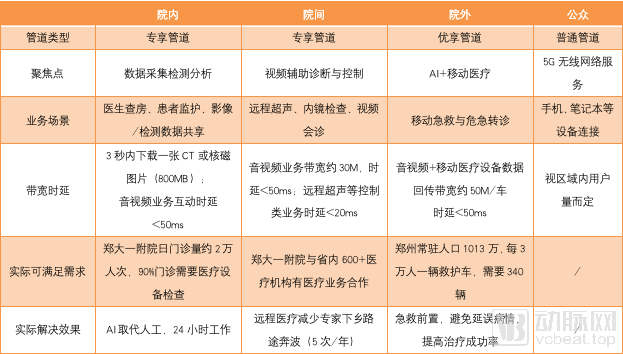
Four Major Business Scenarios of Smart Medical IoT
To ensure the secure transmission of various types of data, the inherent security of the medical private network is also critical. On one hand, 5G security standards are inherently superior to those of 4G; requirements such as 256-bit encryption algorithms, user-level security policies, and unified authentication provide 5G with stronger firewall capabilities. On the other hand, due to parallel multi-pipe transmission and packetized data delivery, even if the private network is compromised, attackers can only obtain fragmented, non-reconstructible data, thereby significantly safeguarding users’ information security.
Another major feature of the 5G medical private network at The First Affiliated Hospital of Zhengzhou University is its adoption of FlexE slicing technology developed by Huawei. This slicing solution offers the industry’s finest granularity of 1 Gbps, with a capacity three times that of competing solutions. Its elastic design enables the hospital to adjust network resources according to bandwidth demands, allowing for on-demand deployment and refined network management.
Huawei researchers stated, “In the past, entities such as hospitals were unable to accurately calculate bandwidth requirements before purchasing; they could only determine whether the bandwidth was sufficient after actual use.”
With elastic slicing, enterprises can calculate their bandwidth requirements in advance. During operation, bandwidth can be dynamically allocated through configuration. For example, if patient volume at the outpatient department is high between 8:00 and 10:00 a.m., idle bandwidth from other departments can be reallocated to the outpatient department during this period. Under such an architecture, limited bandwidth is precisely allocated to maximize resource utilization efficiency, allowing hospitals to deploy 5G networks at a reasonable cost by merely defining a peak bandwidth requirement.
Furthermore, under FlexE slicing, the uplink and downlink packet transmission process has shifted from the previous per-packet transmission mechanism to a strict TDM scheduling mechanism.
As shown in the figure below, FlexE determines the composition of each packet through slicing for every transmission. In practice, this composition should be determined by the bandwidth requirements of different hospital services. Under this mode, each packet is transmitted normally even if it is not fully filled. This mechanism ensures that different medical services can be transmitted in parallel, thereby avoiding high latency for urgent services.
When network congestion occurs, the independent packet transmission channels segmented by FlexE can hard-isolate specific medical services from other medical traffic, thereby prioritizing low latency and high efficiency for these critical services. Furthermore, even if other network services experience congestion or come under attack, the mutually isolated transmission channels ensure that services within the medical network slice remain unaffected.
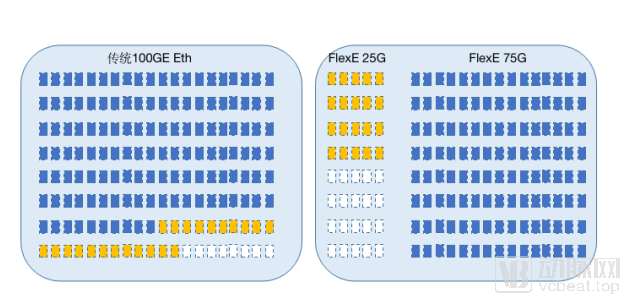
In this way, data for urgent services can avoid queuing delays.
Taking remote consultation as an example, the 5G medical private network combined with elastic slicing enables real-time collection and monitoring of network latency between the main hospital and branch hospitals. It selects a low-latency path within the network and makes timely adjustments when network conditions deteriorate and latency increases, thereby ensuring that service latency remains unaffected at all times.
In summary, the advantages of elastic slicing-based private networks can be summarized in the following six points:
1. The 5G medical private network replaces the in-hospital Wi-Fi network to meet the hospital's demand for high-quality wireless access;
2. Leverage 5G network slicing and edge computing technologies to integrate personal internet access with the hospital’s private data center network;
3. Leveraging advanced public cloud technologies can address the high costs and low operational efficiency associated with hospitals building their own Internet Data Centers (IDCs);
4. Data remains within the hospital premises, ensuring the security of hospital data during cloud migration;
5. High-speed, large-bandwidth connectivity to meet hospitals’ demand for integrated AI capabilities, accelerating transformation and enhancing diagnostic and treatment standards;
6. End-to-end network slicing ensures the reliability of medical service data, supporting intra-hospital, inter-hospital, and out-of-hospital medical services;
When discussing requirements, we must first understand the current state of 5G technology development.
Since the 5G standard R15 was finalized in late 2018, various enterprises have made significant strides in 5G applications. However, the R15 standard primarily focuses on eMBB (enhanced Mobile Broadband), placing the emphasis of network construction on high bandwidth. This will lead to substantial improvements in download speeds and data transmission security.
Massive machine-type communications and ultra-low latency will be the goals beyond 3GPP Release 16. In the longer term, 5G will drive changes in the operation of future hospitals and transform the entire evolution model. For instance, 5G may break down geographical barriers to diagnosis and treatment, gradually shifting the current healthcare structure toward a regional medical center model centered on health management.
So, which technologies are poised for early adoption given these characteristics? Staff members at the National Engineering Laboratory highlighted the following areas. (So, which applications can be realized and implemented first under these characteristics?)
Remote Emergency Care
Remote emergency care in out-of-hospital settings is one of the applications with the lowest barriers to entry and most rapid deployment potential under current conditions. Although existing ambulances are equipped with numerous diagnostic devices, bandwidth constraints force much of the data to be processed onboard these relatively rudimentary vehicles, preventing timely transmission to hospitals for real-time diagnosis. 5G technology undoubtedly offers a solution to this challenge.
Based on the deployment of the SA (Standalone) private network at the First Affiliated Hospital of Zhengzhou University, the uplink bandwidth for ambulances will reach 50 Mbps, sufficient to support remote consultations via 4K video. In this scenario, once a patient is onboard, their electronic medical records and real-time monitoring data will be transmitted to the hospital immediately. Physicians can also clearly observe the patient’s condition through high-definition video, enabling them to issue more accurate test orders. Furthermore, the 5G network within the smart city framework will plot the fastest route for the ambulance, thereby gaining precious time for patient rescue.
Internet Hospitals and Remote Consultations
5G’s application in internet hospitals primarily encompasses two aspects. On one hand, it enables richer remote consultation services for patients; on the other hand, it provides internet hospital service providers with a high-bandwidth, low-latency, and secure dedicated medical network line.
In wireless network scenarios, internet hospitals primarily provide patients with lightweight consultation services. With the widespread adoption of 5G, doctors can interact with patients in 4K or even higher resolution. For conditions such as dermatological and ophthalmic diseases, patients can complete a preliminary diagnosis to some extent simply by following the doctor’s instructions.
Therefore, the significance of 5G for internet hospitals lies in optimizing healthcare delivery processes and expanding service coverage by leveraging the ultra-high bandwidth capabilities of enhanced mobile broadband.
Teleconsultation also leverages the advantages of high bandwidth, enabling physicians to gain a clearer understanding of patients’ conditions and access more comprehensive patient information. As a result, individuals in primary care settings will benefit from specialist-level medical services.
Hospital Management in the 5G Era
Under the current technological paradigm, the advantages of 5G in hospital management lie in enabling unattended monitoring and robotic patient guidance. For a hospital of the scale of the First Affiliated Hospital of Zhengzhou University, real-time data monitoring of tens of thousands of inpatients would incur substantial costs under a 4G network architecture, while its rigid bandwidth allocation would lead to significant waste of network resources.
In contrast, SA private networks supported by network slicing can connect more devices while providing more stable network transmission services. Meanwhile, the hospital’s investment in network infrastructure will be more cost-effective. Furthermore, once 5G is deployed, hospitals and community health centers in the area can rapidly access the smart healthcare private network. The sliced bandwidth of the private network can be flexibly configured to meet the high-, medium-, and low-tier requirements of different healthcare services and various types of hospitals.
In the future, 5G-enabled hospitals may increasingly adopt localized cloud solutions to reduce their hardware cost requirements, a model that will also significantly lower operational costs.
In summary, although the 5G medical private network is merely an infrastructure, its integration with technologies such as artificial intelligence and cloud computing enables these latter technologies to deliver greater value in new scenarios. As 5G technology continues to mature, the realization of ultra-low latency and the Internet of Everything will transform the future healthcare ecosystem and models of care delivery.
Deep learning originated 40 years ago, but it was not until chips such as GPUs, FPGAs, and ASICs became computational hubs that the technology moved from theory to reality. Today, 5G is playing a role analogous to these “chips,” laying the foundation for the development of related applications.
Therefore, in the healthcare sector, even though a killer application has not yet emerged, 5G still holds immense potential to transform healthcare delivery models. As Jiang Wei, a researcher at the Zhejiang Digital Research Institute, stated, “Infrastructure determines the deployment speed of upper-layer applications.” As an infrastructure technology, 5G necessarily precedes applications and plays a guiding role in their development. By completing infrastructure construction, one gains a first-mover advantage in application development.
Just as few people today can foresee the transformative changes that 4G, widely adopted a decade ago, would bring to the future, the full potential of 5G remains largely unseen. Beyond current 5G healthcare applications such as dedicated hospital networks, internet hospitals, remote consultations, and remote emergency care, the integration of 5G with VR/AR, high-definition medical imaging, haptic feedback, wearable devices, and artificial intelligence holds the promise of truly breaking down the geographical and temporal barriers faced by physicians in delivering medical services. The future prospects are particularly encouraging.